
The biggest barrier to your next promotion isn't your work ethic; it's the belief that a career change has to cost a small fortune. It's frustrating to feel stuck in a role because the price of retraining feels completely out of reach. Most people feel overwhelmed by the rising costs of study and the complex maze of government rules. It's common to fear you'll choose a qualification that doesn't lead to a real-world job. By understanding how to access Smart & Skilled funded courses, you can bypass these hurdles and focus on your future.
You shouldn't have to choose between your financial security and your professional growth. This article will show you how to secure a nationally recognised qualification with minimal out-of-pocket expenses, fast-tracking your career without the heavy financial burden. We'll break down the 2026 eligibility rules and help you identify the right trade or community service pathway to secure your long-term success. Whether you are looking to enter the disability sector or start an apprenticeship, the right support makes all the difference.
Key Takeaways
- Understand how this NSW Government initiative helps you bridge the skills gap and enter high-demand sectors without the financial stress.
- Identify if you qualify for Smart & Skilled funded courses based on the 2026 residency, age, and schooling requirements.
- Discover specific career pathways in electronics, automotive, and individual support that lead to nationally recognised qualifications.
- Learn how the subsidy system works to keep your student fees low and manageable while you focus on your professional growth.
- See how partnering with a specialist training provider can help you fast-track your journey by recognising your existing trade expertise.
What are Smart & Skilled Funded Courses?
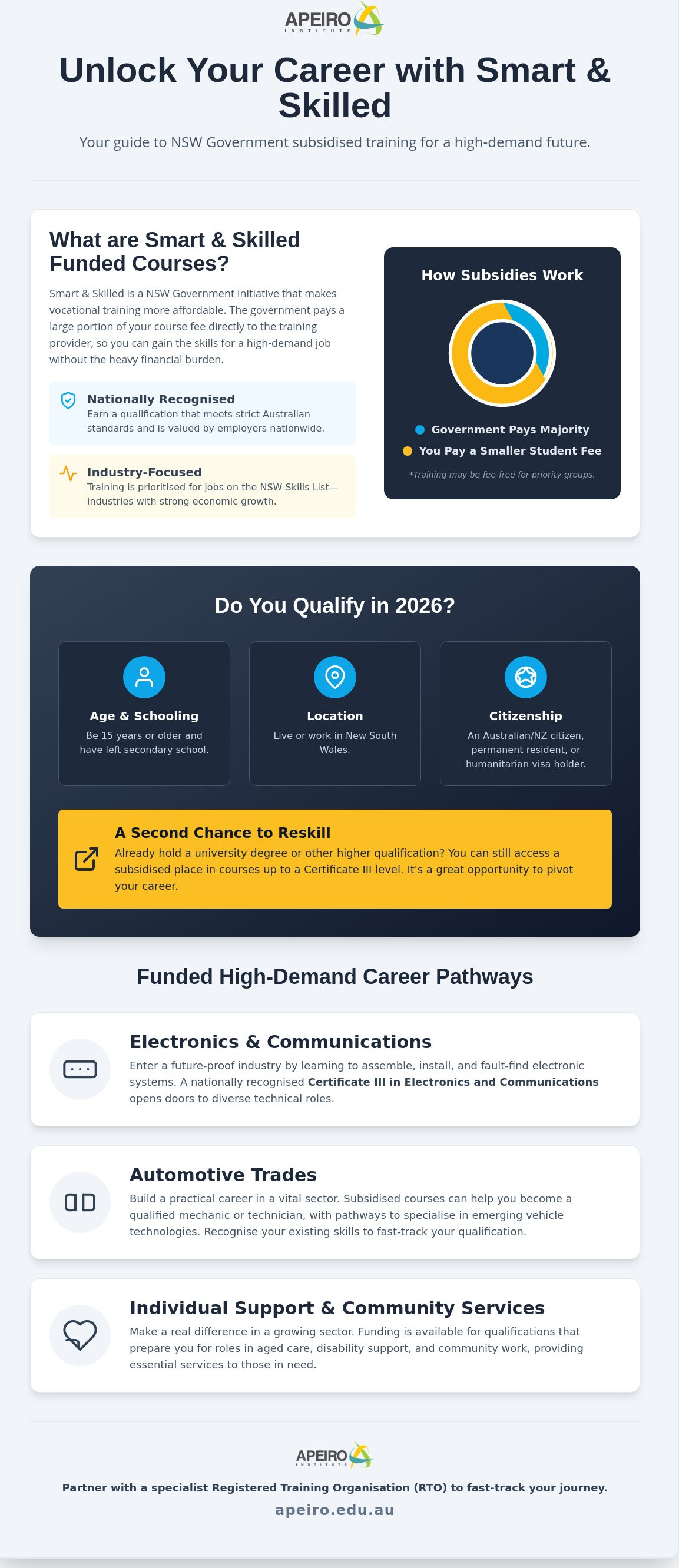
Smart & Skilled is a NSW Government initiative designed to give people the skills they need to find a job or advance their careers. It's a reform of the vocational education and training system that prioritises funding for qualifications in high-demand industries. Instead of paying full price for your education, the government subsidises the cost, making it much more affordable to gain a new trade or professional skill. This program is essentially a partnership between you, the government, and your training provider to bridge the skills gap in our local economy.
The program focuses on delivering nationally recognised qualifications. This means the certificate or diploma you earn meets the strict standards of the Australian Qualifications Framework. Whether you're looking at a UEE30920 Certificate III in Electronics and Communications or a leadership qualification, your skills will be recognised by employers across Australia. It's a powerful addition to your CV that proves you've been trained to an industry-approved level.
It's helpful to understand the difference between a subsidy and fee-free training. With Smart & Skilled funded courses, a subsidy means the government pays a large portion of the tuition fee directly to the provider, and you pay a smaller "student fee." In some cases, such as for apprentices or priority groups, the training may be completely fee-free, meaning the government covers the entire cost. This system ensures that financial status isn't a barrier to quality education within the Technical and Further Education (TAFE) and private RTO landscape.
The NSW Skills List Explained
The NSW Skills List is the backbone of the program. It's a curated directory of qualifications that the government has identified as vital for the state's economic growth. This list isn't static; it's updated annually to reflect the 2026 job market and current industry needs. It covers a broad range of levels, from Certificate II entry-level roles right through to Advanced Diplomas for those seeking management positions. If a course is on this list, it's because there's a genuine demand for those skills in the workforce.
Benefits of Subsidised Training
Choosing a subsidised pathway offers several clear advantages for your career journey:
- Lower Costs: You'll experience a significant reduction in out-of-pocket expenses compared to full-fee-paying students.
- Quality Assurance: You can only access this funding through approved registered training organisations Australia, ensuring you receive high-quality, regulated instruction.
- Career Readiness: These courses are specifically chosen because they lead to jobs in high-growth sectors like electronics, automotive, and community services.
By removing the heavy financial burden, these funded pathways allow you to focus on what really matters: mastering your new craft and securing your future. This dedication to professional skill-building is also reflected in creative sectors by providers like the Institute of Wedding Photographers, who offer specialised training for aspiring experts.
Smart and Skilled Eligibility: Do You Qualify in 2026?
Many people assume that government funding is only for school leavers or those without any prior education. That's a common myth. In 2026, the criteria for Smart & Skilled funded courses are more inclusive than ever, designed to support locals at various stages of their working lives. Whether you're looking to re-enter the workforce or change industries entirely, the first step is knowing where you stand.
To get started, you need to meet a few baseline requirements. You must live or work in New South Wales. You also need to be at least 15 years old and have finished your secondary schooling. These simple foundations ensure that the funding stays within the local community to support the state's economic growth. You'll also need to be an Australian citizen, a New Zealand citizen, an Australian permanent resident, or a humanitarian visa holder.
One of the most encouraging aspects of the current system is the "Second Chance" approach. If you already have a higher qualification, such as a university degree, you might worry you're ineligible for further support. However, for courses up to Certificate III level, your previous qualifications won't block your access to funding. While it might affect the specific student fee you pay, it doesn't shut the door on your training. It's a fantastic opportunity to pivot your career without being penalised for your past studies.
Special Eligibility Categories
The NSW Government is committed to making education accessible for everyone. There are specific provisions for Aboriginal and Torres Strait Islander students, who often qualify for fee-free training across various levels. Similarly, students with a disability, along with their dependents, can access additional support and fee concessions to make their learning journey smoother. For 2026, eligibility remains confirmed for asylum seekers and refugees, ensuring that those building a new life in Australia have a clear path to employment and community connection.
The Unique Student Identifier (USI)
Before you can enrol in any Smart & Skilled funded courses, you'll need a Unique Student Identifier, or USI. Think of this as your lifelong education number. It's a secure online record of all your Australian training and qualifications. It's free and easy to create; you just need a form of ID, like a driver's licence or Medicare card, to set it up on the official government website. Without this number, training providers can't issue your qualification or process your funding. It's a vital tool that keeps your training history in one place, no matter where you study in Australia.
If you're ready to see how these rules apply to your specific situation, exploring a pathway like the Certificate III in Individual Support (Ageing and Disability) is a great first step toward a rewarding new career.
High-Demand Funded Qualifications: Electronics, Automotive, and Care
The 2026 NSW Skills List isn't just a random collection of subjects. It's a strategic map of where our state needs workers most. By choosing Smart & Skilled funded courses in these high-priority areas, you're not just getting a discount; you're positioning yourself in a sector with long-term stability and growth. The government identifies these roles based on industry demand, ensuring that your training leads directly to a meaningful career.
The electronics industry is a prime example of this strategic focus. As technology becomes more integrated into every aspect of our lives, the demand for skilled technicians is skyrocketing. Completing a UEE30920 Certificate III in Electronics and Communications provides the technical foundation needed to work on complex systems, from telecommunications to advanced security networks. It's a field that offers both variety and a clear path to specialisation.
Similarly, the automotive trade remains a cornerstone of the NSW economy. With the shift toward more advanced vehicle systems and diagnostics, a Certificate III in Light Vehicle Mechanical Technology ensures you have the modern skills employers want. These qualifications are specifically targeted by the government because they represent the future of our workforce. You'll be entering an industry where your expertise is both valued and essential.
Apprenticeships and Traineeships
Smart & Skilled plays a massive role in supporting apprenticeships NSW Smart and Skilled. If you're a new entrant, you might even qualify for the "Fee-Free Apprenticeship" initiative. This program means your employer gets a skilled worker, and you get a nationally recognised qualification without the burden of debt. It's a practical "learn while you earn" model that combines real-world on-the-job training with formal study. This pathway is one of the most effective ways to build a career in the trades while maintaining financial security.
Community Services and Aged Care
The care sector is currently one of the fastest-growing industries in Australia. Funding for the Certificate III in Individual Support (Ageing and Disability) helps address the critical shortage of carers in our local communities. For those looking to take their career further into management or case work, there's a clear pathway to a Diploma of Community Services Australia. These roles offer some of the highest job security in the country because the need for compassionate, skilled support workers only continues to grow as our population ages. It's a career that offers both personal fulfilment and professional reliability.
Choosing one of these high-demand qualifications ensures that your time spent studying is an investment that will pay off. By aligning your education with the priorities of the 2026 job market, you're making a smart choice for your future career. To see how these technical skills are applied in a professional setting, you can learn more about Aspire Computing and their IT support services.
Understanding Fees, Concessions, and Fee-Free Training
Many people worry about hidden costs or "bill shock" when starting a new qualification. With Smart & Skilled funded courses, the financial side is transparent and highly regulated. The NSW Government sets fixed prices for every qualification on the Skills List. This means the total cost of the training is consistent across all approved providers. What changes is the balance between the government subsidy and your personal contribution.
The "student fee" is the portion you pay, often referred to as the "gap" payment. On average, the government subsidises a significant majority of the training cost, leaving you with a manageable amount to invest in your future. If you have years of experience in your trade but lack the paperwork, Recognition of Prior Learning (RPL) is a fantastic way to lower your costs. By proving you already possess certain skills, you can reduce the number of units you need to study, which often leads to a lower overall student fee.
Fee-free scholarships are also available for many young people and those in priority groups. These scholarships remove the student fee entirely, allowing you to focus 100% on your learning without any financial pressure. It's a direct investment by the state to ensure that the next generation of tradespeople and carers is ready for the 2026 workforce.
Concession Fees and Exemptions
Financial hardship shouldn't be a barrier to your career progression. If you receive a Commonwealth benefit, such as JobSeeker or a Disability Support Pension, you're likely eligible for a flat concession fee. This is a much smaller, fixed amount that replaces the standard student fee. Additionally, Aboriginal and Torres Strait Islander students and students with a disability are often exempt from paying any fees at all. To secure these rates, you'll just need to provide your current concession card or relevant documentation during the enrolment process.
Calculating Your Investment
To get a precise figure for your chosen course, you can use the official Smart & Skilled Fee Estimator tool online. It's a simple way to see exactly what your contribution will be based on your personal circumstances and previous education. While the tuition fee itself is fixed by the government, remember that there might be small incidental costs for things like specific safety gear, tools, or uniforms required for your trade. Most RTOs are happy to organise flexible payment plans to help you spread these costs out over the duration of your course.
If you're an experienced worker looking to turn your years of on-the-job knowledge into a formal qualification, see how Trade Pathways for Experienced Workers (TPEW) can work alongside government funding to save you time and money.
How to Enrol in a Smart & Skilled Course with Apeiro Institute
Choosing where you study is just as important as what you study. While large institutions offer a wide range of subjects, a specialist Registered Training Organisation (RTO) like Apeiro Institute provides a more focused, student-centred experience. We understand the specific nuances of the industries we teach, from automotive to electronics. This expertise means your training isn't just about ticking boxes; it's about preparing you for the realities of the 2026 Australian workforce.
A unique advantage of studying with us is how we integrate Trade Pathways for Experienced Workers (TPEW) with Smart & Skilled funded courses. If you've been working in your field for years but never got the formal certificate, we don't make you start from scratch. We combine the government subsidy with a streamlined assessment of your existing skills. This synergy ensures you get the qualification you deserve in the shortest possible time, without paying for training you don't actually need.
Our enrolment process is designed to be steady and reassuring. It begins with an initial enquiry where we discuss your career goals and previous experience. From there, we move to a mandatory Pre-Enrolment Consultation. This meeting is vital because it's where we confirm your funding eligibility and calculate your exact student fee. We'll guide you through every document and requirement, ensuring there are no surprises on your first day of class.
The Enrolment Checklist
To make your application as smooth as possible, please have the following items ready for our team:
- Valid Australian ID (like a driver's licence or passport).
- Your Unique Student Identifier (USI).
- Proof of residency or employment in NSW (such as a utility bill or payslip).
- A completed "Consent to Use and Disclosure of Personal Information" form.
- The "Living and Working in NSW" declaration.
Support Beyond the Classroom
Apeiro acts as more than just a training provider; we're an empowering mentor for your professional journey. We specialise in the trade pathways experienced workers Australia needs to stay competitive in a changing market. You'll join a vibrant, diverse community of learners from over 38 nationalities, all working toward the same goal of career success. Our team is committed to providing the person-to-person touch that helps you feel secure and confident from enrolment through to graduation.
Take the Next Step Toward Your New Career
Accessing government support doesn't have to be a complicated puzzle. We have explored how the 2026 eligibility rules open doors for many NSW residents, regardless of their previous study history. By choosing qualifications in high-demand sectors like electronics, automotive, or community services, you're aligning your professional growth with the areas where the state needs you most.
Smart & Skilled funded courses provide the essential financial relief needed to focus on your learning rather than your bank balance. At Apeiro Institute (RTO 45394), we offer nationally recognised training that respects your time and your existing expertise. Our dedicated Trade Pathways for Experienced Workers ensure that seasoned professionals can fast-track their certification. You'll be joining an inclusive community representing over 38 nationalities, all supported by expert mentors who are invested in your success.
Check your eligibility for Smart & Skilled funding with Apeiro Institute today and discover how attainable your career goals really are. Your next professional milestone is within reach, and we're ready to help you secure it.
Frequently Asked Questions
Can I do a Smart and Skilled course if I already have a degree?
Yes, you can. Previous qualifications, including university degrees, don't block your eligibility for Smart & Skilled funded courses up to Certificate III level. While having a higher degree might mean you pay a slightly different "second qualification" fee, you can still access the government subsidy to retrain or pivot your career into a new trade.
What is the difference between a subsidy and a fee-free course?
A subsidy covers a large portion of the training cost, while a fee-free course covers the entire amount. With a subsidised course, the government pays the majority of the cost to the provider, and you pay a smaller "student fee" to cover the gap. Fee-free training is reserved for specific groups, such as apprentices, Aboriginal students, and those with a disability, meaning they pay nothing out of pocket for tuition.
How many Smart and Skilled courses can I do at once?
You can generally only enrol in one Smart & Skilled qualification at a time. The program is designed to focus your energy on a single pathway to ensure you successfully complete your units and get job-ready. Once you finish your current qualification and receive your certificate, you may be eligible to apply for funding for a different course at a higher level or in another industry.
Are Smart and Skilled courses available for international students?
No, this specific funding is only for Australian citizens, New Zealand citizens, permanent residents, or humanitarian visa holders. While international students can certainly study vocational programs in Australia, they must pay the full international student fees. Our team is happy to help you explore suitable vocational pathways if you are currently on an international student visa.
What happens if I move out of NSW during my course?
You must notify your training provider immediately if your residency or work status changes. Because the funding is provided by the NSW Government, eligibility is strictly tied to living or working within the state. Moving interstate may affect your ongoing funding entitlement, so it is best to discuss your situation with us as soon as you know you're moving.
Is there an age limit for Smart and Skilled funding?
There is no upper age limit, but you must be at least 15 years old to apply. The program supports lifelong learning, whether you are a young person starting your first apprenticeship or a mature-aged worker looking to transition into a career in community services. As long as you're no longer at school and meet the residency rules, you are eligible to apply.
How much are the student fees for a Certificate III in Electronics?
Student fees are set by the NSW Government and remain the same regardless of which approved training provider you choose. Your specific fee depends on your prior qualifications and whether you qualify for a concession or exemption. We recommend using the official Fee Estimator or contacting our team for a personalised quote based on your 2026 eligibility status.
Can I get funding if I am currently unemployed?
Yes, being unemployed doesn't prevent you from accessing Smart & Skilled funded courses. In fact, the program is specifically designed to help job seekers gain the skills needed to enter high-demand industries. If you receive certain Commonwealth benefits, you may even be eligible for a concession fee, which significantly reduces the cost of your training and helps you get back into the workforce sooner.

Disclaimer
The information provided on this blog is for general informational and educational purposes only. While every effort is made to ensure the accuracy and reliability of the content, the author makes no representations or warranties of any kind, express or implied, about the completeness, accuracy, suitability, or availability of the information contained on this blog.
The views and opinions expressed in blog posts are those of the individual author and do not necessarily reflect the official policy or position of any organization, company, or employer.
This blog may contain links to external websites or third-party content. These links are provided for convenience only, and the author has no control over and assumes no responsibility for the content, privacy policies, or practices of any third-party sites.
Nothing on this blog constitutes professional advice (legal, financial, medical, or otherwise). Readers are encouraged to seek appropriate professional guidance before making any decisions based on the information provided here.
By using this blog, you acknowledge that any reliance on the information is at your own risk.


