

What if you could secure a fully qualified workforce or launch your own trade career without the stress of mounting tuition costs? It's a common concern for many across the state, as the demand for skilled tradespeople hits record levels while training budgets remain tight. Understanding how to access apprenticeships NSW Smart and Skilled funding is the key to overcoming these financial barriers. Whether you're an employer looking to upskill staff or an individual ready to earn while you learn, the 2026 program offers a clear, supportive pathway to success.
We understand that sorting through government eligibility rules can feel like a complex task. You want a straightforward way to gain a nationally recognised qualification while keeping your out-of-pocket expenses as low as possible. This guide promises to simplify the process, showing you how to secure fee-free training through the latest government initiatives. We'll explore the updated v17.0 Skills List commencing July 2026, explain the criteria for student fee waivers, and help you partner with a reliable Registered Training Organisation to support your professional growth.
Key Takeaways
- Learn how the NSW Government reduces financial barriers by covering student fees for eligible trade qualifications starting in 2026.
- Identify your eligibility for apprenticeships NSW Smart and Skilled funding based on residency, age, and current education status.
- Understand the key differences between apprenticeship and traineeship pathways to choose the career route that best fits your professional goals.
- Follow a clear, step-by-step guide to the enrolment process, from selecting a qualification on the NSW Skills List to completing your pre-enrolment profile.
- Discover how partnering with a specialist RTO like Apeiro Institute provides the flexible delivery and industry expertise needed to succeed in your chosen trade.
What is the NSW Smart and Skilled Program for Apprenticeships?
The NSW Government's commitment to vocational education and training (VET) is a cornerstone of the state's economic strategy. Through the Smart and Skilled program, the government ensures that the local workforce remains competitive, adaptable, and highly skilled. This initiative isn't just about providing classes; it's a strategic investment designed to meet the evolving needs of the 2026 economy. By subsidising training costs, the program effectively removes the heavy financial barriers that often prevent people from pursuing a trade. For employers, it's an opportunity to build a team of experts without the usual overheads associated with high-level training.
It's helpful to understand how the funding is actually distributed. The "entitlement" stream ensures that all eligible NSW citizens can access government-subsidised training up to and including Certificate III qualifications. This means if you're starting out, your path is protected. In contrast, "targeted priority" funding focuses on higher-level qualifications or specific industry niches where there are clear gaps in the workforce. Both streams rely on the NSW Skills List, which is updated regularly to reflect what the economy actually needs to thrive. This ensures that apprenticeships NSW Smart and Skilled pathways are always aligned with real jobs.
The Core Objectives of Smart and Skilled in 2026
In 2026, the program focuses on addressing critical skill shortages in sectors like electronics, automotive technology, and community services. These industries are the backbone of our modern society and require a constant influx of fresh talent. The program also prioritises a "fair go" for regional learners and those facing disadvantage, ensuring that location or background isn't a barrier to a great career. Every funded course is designed with real-world outcomes in mind, so you're learning skills that bosses actually want. It's about creating a sense of security for students as they transition into the workforce.
Nationally Recognised Qualifications vs. Short Courses
While short courses have their place for quick upskilling, full qualifications are the gold standard for apprenticeships NSW Smart and Skilled funding. Comprehensive programs, such as the UEE30920 Certificate III in Electronics and Communications, are prioritised because they offer deep, foundational knowledge. These programs are a vital part of the National Training System, which guarantees that your hard-earned skills are recognised by employers right across Australia. Selecting the right registered training organisation Australia is a critical step. They provide the structured learning required by the Australian Qualifications Framework (AQF), turning your raw potential into professional excellence through high-quality, regulated instruction.
Eligibility Criteria for Smart and Skilled Funding in 2026
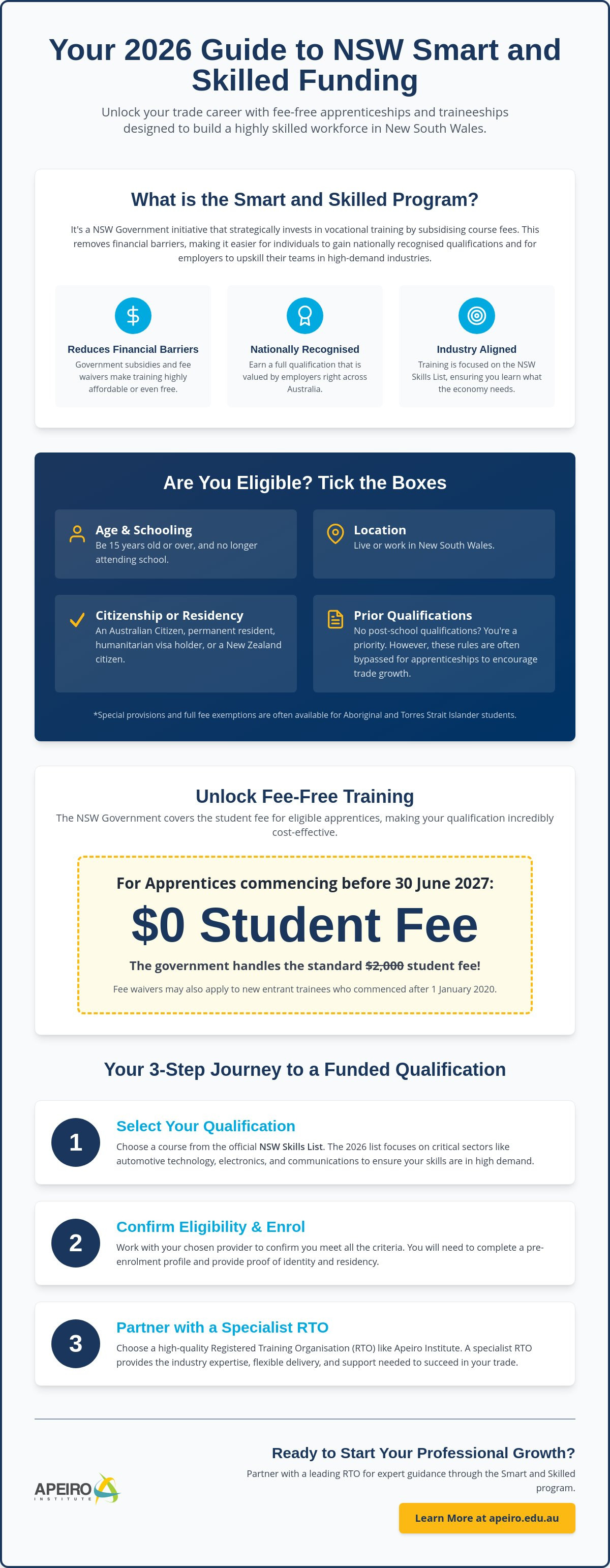
Finding out if you qualify for government support is the first step toward your new career. To access apprenticeships NSW Smart and Skilled funding in 2026, you generally need to meet four basic criteria. First, you must be at least 15 years old and no longer attending school. Second, you need to live or work in New South Wales. Third, you must be an Australian citizen, permanent resident, humanitarian visa holder, or a New Zealand citizen. Finally, while the program prioritises those seeking their first post-school qualification, apprenticeships and traineeships often bypass these 'prior qualification' rules to encourage trade growth.
Specific provisions exist for Aboriginal and Torres Strait Islander students to ensure equitable access to training. These learners are often eligible for full fee exemptions, removing the financial burden of tuition entirely. This is part of the state's broader effort to close the gap in vocational outcomes and support community-led career development. It's a supportive framework designed to ensure everyone has a fair go at professional success.
Am I Eligible for Fee-Free Training?
The NSW Government has extended the fee-free initiative for apprentices who commence their training before 30 June 2027. Under this scheme, the government handles the $2,000 student fee, making apprenticeships NSW Smart and Skilled pathways incredibly cost-effective. New entrant trainees may also have their fees waived to $0 if they started after 1 January 2020. If you receive Commonwealth benefits like JobSeeker or have a disability, you could be entitled to a concession fee of approximately $240 for Certificate III and IV qualifications. The best way to confirm your status is to Enrol in Smart and Skilled via the official portal and use the student estimator tool.
Employer Eligibility for Apprenticeship Subsidies
Businesses also have specific requirements to meet before they can claim subsidies. An employer must enter into a formal training contract with the apprentice, which is then registered with the state training authority. This process is typically managed through Australian Apprenticeship Support Network (AASN) providers. Employers must also commit to providing a safe workplace and allowing the apprentice time to complete their formal RTO studies. If you're already working in the industry and want to formalise your expertise, our Trade Pathways for Experienced Workers program can help you leverage these funding opportunities.
Apprenticeships vs. Traineeships: Choosing Your Funded Path
Deciding between an apprenticeship and a traineeship is a pivotal moment in your career journey. While both pathways combine work with structured study, they serve different professional goals. Apprenticeships are generally a long-term commitment, typically lasting three to four years, and are designed for traditional trades. These programs lead to a trade certificate and often require specific licensing to practice. Traineeships, on the other hand, offer more flexibility and are usually shorter, often completed within one to two years. They cover a broader range of non-trade vocations, from business administration to community services.
The way apprenticeships NSW Smart and Skilled funding applies can vary significantly based on your employment status. For "New Entrants", the government often provides the most substantial support, including the potential for $0 student fees to encourage fresh talent into the workforce. If you're an "Existing Worker", you can still access subsidised training, but the fee structures and eligibility might differ. Understanding these nuances helps you and your employer make an informed choice that minimises costs while maximising career progression from Certificate II right through to Advanced Diploma levels.
High-Demand Trade Apprenticeships in NSW
In 2026, certain sectors are seeing an unprecedented surge in demand for qualified professionals. The Certificate III in Electronics and Communications has become a top priority as our reliance on smart technology and advanced infrastructure grows. Similarly, the Certificate III in Light Vehicle Mechanical Technology remains a staple of the Smart and Skilled program. These qualifications don't just provide a piece of paper; they offer a direct route to stable, well-paid careers and the specific trade licences required to work independently across Australia.
Trade Pathways for Experienced Workers (TPEW)
If you've spent years on the tools but never finished your formal papers, you don't necessarily have to start from scratch. The trade pathways experienced workers Australia initiative is a game-changer within the Smart and Skilled framework. By utilising Trade Pathways for Experienced Workers (TPEW), you can use Recognition of Prior Learning (RPL) to account for your existing skills. This significantly accelerates your path to certification. When paired with government subsidies, it's an affordable and efficient way for seasoned professionals to finally gain the nationally recognised qualifications they deserve.
The Step-by-Step Enrolment Process for NSW Funding
Entering the world of vocational training shouldn't be a bureaucratic headache. Once you've chosen a qualification from the NSW Skills List, your first step is a formal enquiry with your chosen RTO. This initial conversation helps confirm that your career goals align with the apprenticeships NSW Smart and Skilled program. You'll then complete a Pre-Enrolment Profile. This includes a Language, Literacy, and Numeracy (LLN) assessment. Don't worry; it's not a pass-or-fail exam. It simply ensures we can provide the right support for your learning journey.
The technical side of things happens through the Training Services NSW portal. Your RTO will initiate a 'Notification of Enrolment' (NoE). This is a critical step that many people overlook. The NoE process generates a unique Commitment ID and calculates your specific student fee based on your circumstances. Once this is validated, you'll finalise the training contract alongside your employer. This legal agreement binds the student, the workplace, and the training provider in a shared mission for success.
Documentation You Will Need
Having your paperwork ready makes everything move faster. You'll definitely need a Unique Student Identifier (USI). It's a mandatory requirement for all nationally recognised training in Australia. You also need proof of NSW residency, like a current driver's licence or a recent utility bill. If you've studied before, bring your transcripts. These allow us to assess credit transfers, which might reduce your study load and get you qualified sooner. It's a practical way to recognise the expertise you already bring to the table.
Understanding the Commitment
Success in an apprenticeship requires a clear roadmap. This is known as the Training Plan. It outlines exactly what you'll learn and when. You'll need to balance on-the-job training with classroom sessions or self-paced online modules. It's a steady, methodical pace designed to keep you from feeling overwhelmed. Your progress is monitored through annual reviews and competency-based milestones. This ensures you're meeting industry standards every step of the way. If you're ready to start this journey, you can apply for our funded trade programs today and take the first step toward your new career.
Why Partner with Apeiro Institute for Smart and Skilled Training?
Choosing the right training partner is just as important as choosing the trade itself. At Apeiro Institute, we act as a bridge between your current skills and your future career goals. We specialise in high-demand fields like electronics, automotive technology, and community services, ensuring our students gain the practical expertise that modern employers actually value. By choosing apprenticeships NSW Smart and Skilled pathways with us, you're not just a number in a system; you're a valued member of a supportive learning community. We offer direct, hands-on assistance with the entire application process, helping you verify your eligibility and secure government funding without the usual stress.
Our approach is built on flexibility. We understand that many of our students are balancing their studies with full-time work or family commitments. Because of this, our delivery models are designed to be as adaptable as possible. Whether you're an apprentice starting your journey or an employer looking to upskill a team, we provide a steady, methodical path to success. We believe in providing a sense of security through expert guidance, making the prospect of starting a new educational journey feel attainable and exciting rather than intimidating.
Expertise in Technical Trades
Our teaching staff are more than just instructors; they're industry veterans who bring real-world insights into every lesson. For those pursuing the Certificate III in Individual Support, our trainers provide the most current industry standards in ageing and disability care. Our campuses are equipped with advanced facilities for our electrotechnology and automotive students, mirroring the environments you'll find in modern workshops. These strong industry connections mean our graduates don't just finish with a qualification; they finish with the networks needed to thrive in the NSW workforce.
Support Beyond the Classroom
We know that life doesn't stop when you start a course. Our dedicated student support services are always available to help you navigate Smart and Skilled funded courses NSW, ensuring you stay on track toward your milestones. If you're an experienced worker, we provide specialised assistance with Recognition of Prior Learning (RPL) and TPEW. This ensures your years of hard work are formally recognised, potentially shortening your study time significantly. We're committed to helping you achieve your professional certification with absolute confidence, knowing you have an expert partner by your side every step of the way.
Secure Your Professional Future with Funded Training
Securing a nationally recognised trade qualification in 2026 is more than just a career move; it's a strategic way to future-proof your professional life. We've explored how the NSW Government supports your growth by removing financial barriers and providing clear pathways through the latest Skills List. Whether you're just starting out or you're an experienced worker looking to formalise your skills, the opportunities for success are within your reach. The right training doesn't just build skills; it builds the confidence you need to excel in a competitive market.
As an approved provider, Apeiro Institute (RTO 45394) is here to help you navigate the complexities of apprenticeships NSW Smart and Skilled funding. We specialise in Nationally Recognised Training and offer specialist Trade Pathways for Experienced Workers to ensure your existing expertise is properly valued. Our team is dedicated to providing the expert guidance and warm support you need to move from enquiry to enrolment with absolute confidence. We act as your partner, ensuring you have every resource necessary to achieve your goals.
Don't let the paperwork hold you back from the career you deserve. Check your eligibility for NSW Smart and Skilled funding with Apeiro Institute today and take the first step toward a brighter, more secure professional future. We're excited to be part of your success story.
Frequently Asked Questions
Is the Smart and Skilled apprenticeship training really fee-free in NSW?
Yes, eligible apprenticeships NSW Smart and Skilled pathways are fee-free for students who commence their training before 30 June 2027. Under this government initiative, the state handles the $2,000 student fee directly with your training provider. This means you can focus on building your skills and starting your career without the burden of upfront tuition costs. It's a practical way to support the next generation of tradespeople in high-demand sectors.
Can I apply for Smart and Skilled if I already have a university degree?
Yes, you can still access government-subsidised training for an apprenticeship or traineeship even if you already hold a university degree. While some other Smart and Skilled courses have rules regarding previous qualifications, apprenticeships are generally exempt from these restrictions. This policy ensures that individuals can choose to pivot their careers into a trade at any stage of their professional life without being financially penalised for their prior academic achievements.
What happens to my funding if I change employers during my apprenticeship?
Your funding usually remains secure if you change employers, provided you continue the same qualification with an approved training provider. You will need to organise a new training contract with your new employer and ensure it's registered through an Australian Apprenticeship Support Network (AASN). It's a common situation, and we can help you manage the transition so your progress toward your nationally recognised trade certificate stays on track.
How long does the Smart and Skilled enrolment process typically take?
The enrolment process generally takes between two and four weeks from your initial enquiry to your official start date. This timeframe allows us to complete your Pre-Enrolment Profile, conduct the required LLN assessment, and finalise the technical 'Notification of Enrolment' on the Training Services NSW portal. Having your Unique Student Identifier (USI) and proof of residency ready at the start will help speed up this progression significantly.
Are there any hidden costs like textbooks or equipment fees?
The Smart and Skilled subsidy specifically covers your tuition fees, but there may be small costs for incidental items like specialised tools, protective equipment, or specific textbooks. These costs vary depending on the trade you've chosen, such as automotive or electronics. We believe in transparency and will provide you with a clear list of any required materials during your initial enquiry so you can plan your budget with confidence.
Can international students access Smart and Skilled funded apprenticeships?
No, Smart and Skilled funding is reserved for Australian citizens, permanent residents, New Zealand citizens, or humanitarian visa holders. International students are usually required to enrol in vocational programs under different fee structures. If you're currently on a student visa, we offer a range of international student vocational programs designed to meet your specific visa requirements while delivering the same high-quality Australian trade training.
What is the difference between a New Entrant and an Existing Worker trainee?
A New Entrant is a trainee who has been employed for less than three months full-time or twelve months part-time before starting their training. Existing Workers are those who have been with their employer for longer periods. This distinction is important because fee-free initiatives for apprenticeships NSW Smart and Skilled often prioritise New Entrants to encourage businesses to bring fresh talent into the industry and grow the local workforce.
How do I find out if my desired trade is on the NSW Skills List for 2026?
You can check the official Smart and Skilled NSW Skills List (v17.0), which commences on 1 July 2026, to see which trades are currently prioritised for funding. This list is updated regularly to reflect the specific skills the NSW economy needs most. If you're unsure how to read the list, you can contact our team directly, and we'll help you identify which funded pathways match your career interests and experience.

Disclaimer
The information provided on this blog is for general informational and educational purposes only. While every effort is made to ensure the accuracy and reliability of the content, the author makes no representations or warranties of any kind, express or implied, about the completeness, accuracy, suitability, or availability of the information contained on this blog.
The views and opinions expressed in blog posts are those of the individual author and do not necessarily reflect the official policy or position of any organization, company, or employer.
This blog may contain links to external websites or third-party content. These links are provided for convenience only, and the author has no control over and assumes no responsibility for the content, privacy policies, or practices of any third-party sites.
Nothing on this blog constitutes professional advice (legal, financial, medical, or otherwise). Readers are encouraged to seek appropriate professional guidance before making any decisions based on the information provided here.
By using this blog, you acknowledge that any reliance on the information is at your own risk.


