

Have you ever felt like your years of hard work on site are worth more than the piece of paper you're missing? It's a common frustration for many skilled workers who have the hands-on expertise but lack the formal credentials to move up. Finding the right registered training organisation Australia shouldn't feel like a gamble. You've likely felt confused by the differences between TAFE and private providers, or worried about spending your hard-earned money on a course that isn't industry-recognised.
We understand that your time is valuable and you want a clear path forward. This guide will help you identify and evaluate high-quality providers so you can secure your nationally recognised qualification with confidence. You'll learn how to navigate the 2025 RTO Standards, simplify the Recognition of Prior Learning (RPL) process, and access funding like Smart and Skilled to fast-track your career goals. We're here to help you turn your existing skills into a professional future.
Key Takeaways
- Learn how to verify that a registered training organisation Australia is properly accredited to deliver the specific trade or service qualification you need.
- Identify the red flags to avoid when selecting a provider. You'll learn exactly what to ask about their industry partnerships and employer links.
- Discover the specific deadlines and eligibility criteria for the Trade Pathways for Experienced Workers (TPEW) program to fast-track your trade certificate.
- Navigate the complexities of government funding and CRICOS registration to find the most cost-effective and compliant path to your new career.
- Explore the benefits of training in a diverse, community-focused environment that prioritises practical outcomes and student support.
What is a Registered Training Organisation in Australia?
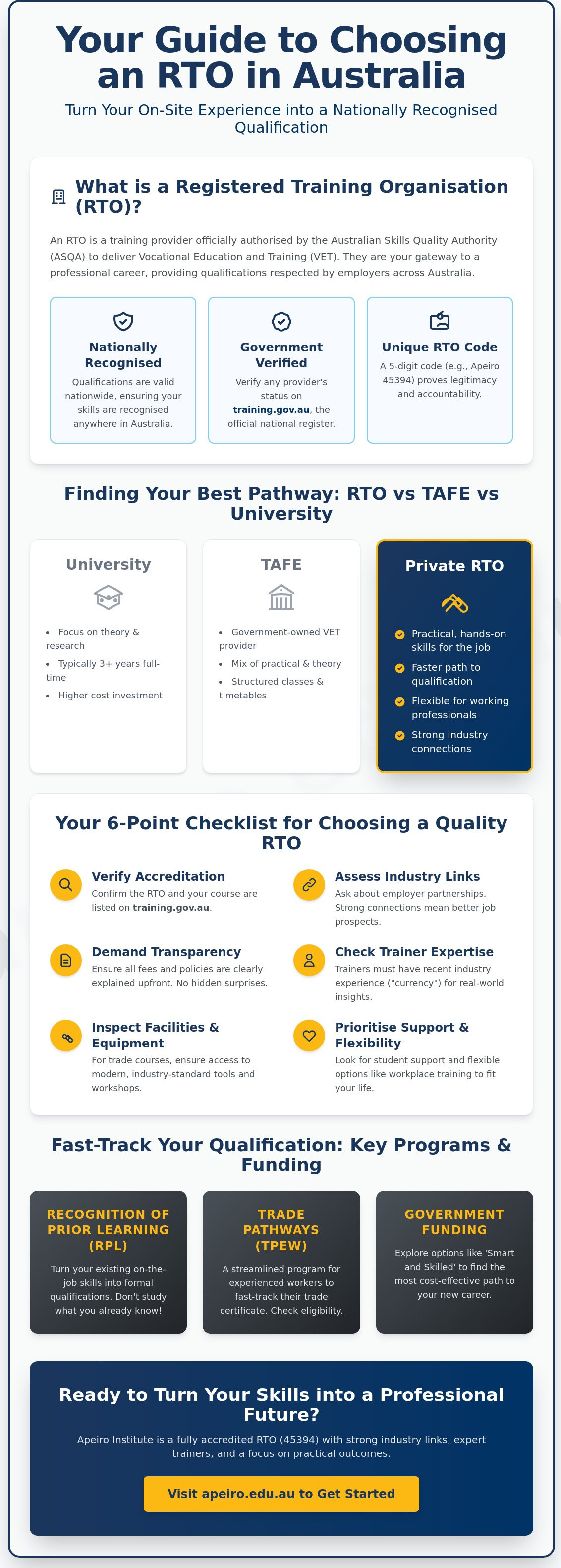
A Registered Training Organisation (RTO) is a training provider officially authorised by the Australian Skills Quality Authority (ASQA) to deliver Vocational Education and Training (VET) services. Think of an RTO as a gateway to your career. Because these organisations are strictly regulated, they're the only ones allowed to issue "Nationally Recognised Training" qualifications. This means whether you're in Perth, Sydney, or a regional town, your certificate or diploma will be respected by employers across the country. These qualifications sit within the Australian Qualifications Framework (AQF), ensuring a consistent standard of excellence nationwide.
If you're ever unsure about a provider's legitimacy, you should visit training.gov.au. This website is the national "source of truth" for the VET sector. It allows you to search for any registered training organisation Australia to confirm their current status. You can see exactly which courses they're allowed to teach and whether they've met the rigorous 2025 Standards for RTOs. Checking this database is a simple step that protects your investment and ensures your hard work leads to a valid, industry-recognised credential.
For example, Unico Education is an award-winning RTO that has been providing quality vocational training for over 16 years; you can visit their website to see how they maintain their scope of registration and community impact.
RTO vs. TAFE vs. University: Which is Right for You?
Choosing between different types of education can feel like a bit of a juggle. While TAFE is a government-owned RTO, private providers often offer more flexibility for working professionals. You might find that a private registered training organisation Australia provides smaller class sizes and more direct support from trainers who are still active in the industry. Compared to a three-year university degree, vocational training focuses on practical skills you can use on the tools immediately. It's a faster, more affordable way to get qualified. For many, programs like TPEW offer a streamlined path that university simply can't match.
The Importance of the RTO Code (e.g., Apeiro RTO 45394)
Every legitimate provider has a unique five-digit identifier, such as the Apeiro Institute code 45394. This isn't just a random number. It's a badge of legitimacy that proves the organisation has passed strict government audits. This code is linked to the provider's "Scope of Registration." An RTO isn't allowed to teach just any course they like. They must prove they have the right equipment, facilities, and expert staff for every specific qualification on their list. When you see an RTO code, you know the provider is accountable for the quality of the training they deliver.
How to Choose the Best RTO for Your Career Goals
Selecting a registered training organisation Australia is a decision that shapes your professional future. It's about finding a partner that understands the local job market and provides the specific support you need to succeed. While many people start by looking at the location or price, the most successful students look for an RTO with strong industry links. You want a provider that doesn't just teach from a textbook but maintains active relationships with Australian employers. This connection often leads to better networking opportunities and a smoother transition into the workforce once you've finished your studies.
Transparency is another vital factor. A high-quality RTO will be upfront about their fees, refund policies, and exactly what's included in your course costs. You shouldn't have to worry about hidden charges for materials or assessments later on. Before you commit, it's a good idea to search for RTOs and courses on official government platforms to see how different providers compare. Look for an organisation that offers flexible delivery options, such as workplace-based training or evening classes, which can be a lifesaver if you're balancing study with a job or family commitments.
Checking Trainer Expertise and Industry Currency
The quality of your education depends heavily on the people standing at the front of the room. In the Australian VET sector, trainers must maintain "industry currency." This means they're required to keep their skills and knowledge up to date with current workplace practices. Don't be afraid to ask about your trainers' backgrounds. Have they recently worked in the field? Do they have a deep understanding of modern Australian standards? Expert mentors provide more than just information. They offer real-world insights and can introduce you to professional networks that are invaluable for your career progression.
For those who are inspired by their instructors and wish to transition into a teaching role themselves, TAE Plus provides the nationally recognised qualifications required to become a professional trainer in the vocational sector.
Facilities and Equipment: Learning with Modern Tools
For trade-based qualifications, the environment where you learn is just as important as the curriculum. If you're studying a technical course like the Certificate III in Light Vehicle Mechanical Technology, you need access to modern, industry-standard workshops. Learning on outdated gear won't prepare you for a modern Australian worksite. When you visit a campus, look for high-spec tools and diagnostic equipment that mirror what you'll find in a professional setting. This hands-on experience with the right technology ensures you're job-ready from day one, giving you the confidence to tackle complex tasks in your new role.
Trade Pathways for Experienced Workers (TPEW) and RPL
Many workers across the country have spent years on the tools without ever getting their formal trade papers. This is where Recognition of Prior Learning (RPL) becomes a game-changer for your career. It's a practical process that allows a registered training organisation Australia to assess the skills you've already mastered on the job. Instead of sitting through long classes for things you can already do, you provide evidence of your expertise. The Trade Pathways for Experienced Workers (TPEW) program takes this a step further. It's designed specifically for long-term employees and business owners who need that official qualification to take the next step in their professional journey.
If you're looking at the TPEW model in NSW, timing is everything for your application. You must enrol in the program by 31 August 2026 to take advantage of this pathway. Training has to commence by 30 September 2026, and all components must be wrapped up by 31 May 2027. This fully funded initiative is a fantastic way to formalise your experience without the financial burden of a full tuition fee. It acknowledges that your time on site is just as valuable as time in a classroom, giving you the credit you've earned through years of hard work.
The RPL Assessment Process: What to Expect
The journey starts with a simple skill assessment where we look at your work history and identify any small gaps in your knowledge. Next, you'll gather evidence of your competence. This isn't just boring paperwork. It includes photos of your work, videos of you performing tasks on site, and references from your previous employers or clients. Finally, you'll have a practical observation and an interview with an industry expert. It's a straightforward conversation between two professionals, ensuring you meet the current national standards for your trade.
Formalising Experience in Automotive and Electronics
If you're a mechanic who has been working without a certificate, you can achieve your Certificate III in Light Vehicle Mechanical Technology through this streamlined pathway. Similarly, electronics professionals can secure their UEE30920 Certificate III in Electronics and Communications by proving their competence in the field. This isn't just about getting a piece of paper. It's a vital stepping stone. Once you have your Certificate III, the door opens to higher-level Diplomas and Advanced Diplomas, allowing you to move into management or specialised design roles with confidence.
Funding, CRICOS, and International Standards
Investing in your future is an exciting step, but we know the financial side can feel a bit daunting. The good news is that the Australian government provides significant support to help you get qualified without breaking the bank. In New South Wales, the Smart and Skilled program is a key initiative that offers subsidised or even fee-free training for eligible students. By selecting a registered training organisation Australia that is an approved Smart and Skilled provider, you can access high-quality education at a fraction of the usual cost. It's a fantastic way to gain the skills you need while keeping your finances on track.
Combining funded training with apprenticeships or traineeships is another smart move. This allows you to earn a wage while you learn, creating a better financial outcome from day one. These programs are designed to be inclusive and supportive, ensuring that everyone has a fair go at building a successful career. Whether you're just starting out or looking to upgrade your current skills, there's likely a funding pathway that fits your situation. It's all about making your educational journey as accessible as possible.
Accessing Smart and Skilled Funded Courses
Eligibility for Smart and Skilled usually depends on your residency and employment status. Generally, if you're a NSW resident and an Australian citizen or permanent resident, you're off to a great start. These funded spots cover a wide range of industries, from community services to technical trades. Applying for this funding doesn't have to be complicated. We walk you through the process to ensure you get the maximum support available. For more details on how to get started, take a look at our Smart and Skilled Funded Courses NSW Guide.
Vocational Training for International Students
Australia has a global reputation for excellence in vocational education. For international students, it's vital to choose a provider that is CRICOS registered. This registration means the registered training organisation Australia is authorised to teach overseas learners and complies with the Education Services for Overseas Students (ESOS) Act. This legislation is your safety net. It protects your rights, ensures tuition protection, and guarantees that the training you receive meets national quality standards. You can balance your studies with work, gaining valuable Australian experience while you study. Learn more about your options in our Vocational Courses for International Students Guide.
If you're ready to see how government support can lower your study costs, you can check your eligibility for funded trade pathways today.
Why Apeiro Institute is the Right RTO for Your Future
Choosing a registered training organisation Australia is a decision that extends far beyond the classroom. It's about finding a community that genuinely cares about your personal and professional growth. At Apeiro Institute, we've built a learning environment that celebrates diversity, with students from over 38 different nationalities currently studying with us. This multicultural atmosphere reflects the modern Australian workforce, helping you build the soft skills needed to thrive in a globalised economy. Whether you're looking to start a new trade or advance in your current field, we provide the expert guidance you need to succeed.
Our approach combines professional authority with a warm, student-centred style. We know that starting a new educational journey can feel a bit intimidating, especially if you've been out of the study game for a while. That's why our campuses are designed to be welcoming spaces focused on hands-on excellence. We don't just want you to pass an exam; we want you to leave us with the confidence to excel in your chosen industry. As a leading registered training organisation Australia, we maintain a national reach with facilities that mirror real-world worksites, ensuring your training is practical and relevant for the 2026 job market.
Specialised Qualifications for High-Demand Industries
We focus our expertise on the sectors where Australian employers need skilled workers the most. If you're passionate about making a difference in people's lives, we can help you enter the care sector with a Certificate III in Individual Support. For those already working in the field, you can take the next step into management or case work with a Diploma of Community Services. Our qualifications in Electronics and Civil Construction are also specifically designed to meet current industry standards, giving you a competitive edge in these rapidly evolving fields.
Your Journey Starts with a Friendly Conversation
At Apeiro Institute, you're never just a number on a spreadsheet. Our expert mentors are here to guide you through every step of the process, from your very first enquiry to the day you walk across the stage at your graduation ceremony. We're committed to providing an inclusive and encouraging environment where every student feels supported. We understand the challenges of balancing study with work and family, and we're here to help you find the right pathway. Ready to get trade qualified? Contact Apeiro Institute today to discuss your pathway.
Take the Next Step Toward Your Professional Goals
Choosing a registered training organisation Australia is about more than just picking a course. It's about finding a partner that respects your experience and provides the tools you need to succeed in a competitive job market. We've explored how to verify a provider's legitimacy and the way programs like TPEW can turn your years on the tools into a formal qualification. You now have the knowledge to navigate the 2025 RTO Standards and access vital funding through the Smart and Skilled program.
Apeiro Institute is proud to be a Registered Training Organisation (RTO 45394) and a CRICOS Provider (03703M). As an approved NSW Smart and Skilled provider, we're dedicated to making high-quality vocational education accessible to everyone. Whether you're an experienced worker looking for RPL or an international student starting a new chapter, your success is our priority. We're here to support you from your first enquiry right through to graduation day. It's time to stop waiting and start building the future you deserve.
Explore Nationally Recognised Courses at Apeiro Institute and discover how we can help you reach your career milestones. We can't wait to see what you achieve next.
Frequently Asked Questions
Is a qualification from a private RTO the same as TAFE?
Yes, a qualification from a private provider is legally equivalent to one from TAFE, provided it's nationally recognised. Both types of organisations must meet the same strict standards set by the Australian Skills Quality Authority (ASQA). This ensures that your certificate or diploma carries the same weight with employers across the country, regardless of whether you chose to study at a private institute or a government college.
How do I check if an RTO is actually registered in Australia?
You can verify the status of any registered training organisation Australia by visiting the national register at training.gov.au. This official database allows you to search by the provider's name or their unique five-digit RTO code. It provides a complete list of their approved qualifications and confirms whether their registration is currently active, giving you peace of mind before you enrol.
Can I get a trade certificate based on my work experience alone?
Yes, you can achieve a full trade certificate through the Recognition of Prior Learning (RPL) process. If you can demonstrate that your existing skills meet every requirement of the national qualification, you won't need to attend traditional classes. An assessor will review your evidence, such as work samples, photos, and references, to confirm you've already mastered the necessary competencies on the job.
What is the difference between an RTO and a CRICOS provider?
An RTO is authorised to deliver vocational training to local students, while a CRICOS provider is specifically registered to teach international students on student visas. Many organisations hold both registrations. If you're an overseas learner, it's essential to ensure your chosen registered training organisation Australia is also on the Commonwealth Register of Institutions and Courses for Overseas Students (CRICOS) to comply with visa regulations.
How much does it cost to get an RPL assessment at an RTO?
The cost of an RPL assessment varies depending on the specific qualification and the amount of evidence that needs to be reviewed. Generally, it's a more cost-effective option than paying for a full course of study because you aren't paying for classroom hours or textbooks. Most providers offer a free initial pre-assessment to help you understand the likely investment and potential time savings before you commit.
Are Smart and Skilled courses really free for eligible students?
Yes, many courses under the Smart and Skilled initiative are completely fee-free for eligible participants in NSW. Other programs are heavily subsidised, meaning the government pays a large portion of the tuition while you contribute a smaller student fee. Your eligibility depends on factors like your residency status and previous qualifications, so it's always best to have a quick chat with your provider to confirm your status.
Can international students apply for RPL in Australia?
International students are absolutely eligible to apply for RPL if they have relevant work experience or previous studies from their home country or Australia. This can often reduce the duration of your course and your overall tuition costs. However, you should discuss this with your provider before you enrol, as changes to your course duration must be reported and may affect your student visa requirements.
What happens if an RTO closes down while I am studying?
You're protected by the Australian Government's Tuition Protection Service (TPS) if your provider stops delivering a course. This service is designed to help you find an alternative course with another provider so you can finish your studies without starting from scratch. If a suitable replacement can't be found, you may be eligible for a refund of your unspent tuition fees, ensuring your educational investment is secure.

Disclaimer
The information provided on this blog is for general informational and educational purposes only. While every effort is made to ensure the accuracy and reliability of the content, the author makes no representations or warranties of any kind, express or implied, about the completeness, accuracy, suitability, or availability of the information contained on this blog.
The views and opinions expressed in blog posts are those of the individual author and do not necessarily reflect the official policy or position of any organization, company, or employer.
This blog may contain links to external websites or third-party content. These links are provided for convenience only, and the author has no control over and assumes no responsibility for the content, privacy policies, or practices of any third-party sites.
Nothing on this blog constitutes professional advice (legal, financial, medical, or otherwise). Readers are encouraged to seek appropriate professional guidance before making any decisions based on the information provided here.
By using this blog, you acknowledge that any reliance on the information is at your own risk.


