

The AUR30620 qualification and an apprenticeship are connected, but they are not the same thing. If you are exploring an AUR30620 apprenticeship NSW, it helps to know that an apprenticeship combines workplace learning with formal training towards the Certificate III in Light Vehicle Mechanical Technology.
It is common to have questions about who arranges each part and whether training could be fee-free. This guide explains how workplace experience and RTO training fit together, and how NSW Smart and Skilled funding applies to eligible apprentices and trainees. Funding is conditional, so include eligibility and training arrangements in your planning.
A training provider’s role is different from an apprentice employer’s. Apeiro Institute delivers training and assessment for AUR30620 as an ASQA-regulated RTO. Its role is to support your formal learning, while the employment arrangement and workplace learning sit separately. By the end, you will have a clearer picture of the pathway and the details to consider as you plan.
Apeiro Institute acknowledges Traditional Owners throughout Australia.
Key Takeaways
- An AUR30620 apprenticeship NSW pathway combines workplace learning with formal training towards the Certificate III in Light Vehicle Mechanical Technology.
- Practical workshop experience and formal assessment play different but complementary roles in developing skills for light vehicle mechanical work.
- An employer provides the employment arrangement and workplace learning, while an RTO delivers training and assessment for the qualification.
- NSW Smart and Skilled training is fee-free for eligible NSW apprentices and trainees. Eligibility is conditional, so include it in your training plans.
- Apeiro Institute is an ASQA-regulated RTO, code 45394, offering AUR30620 training. Apeiro Institute acknowledges Traditional Owners throughout Australia.
What is the AUR30620 apprenticeship in NSW?
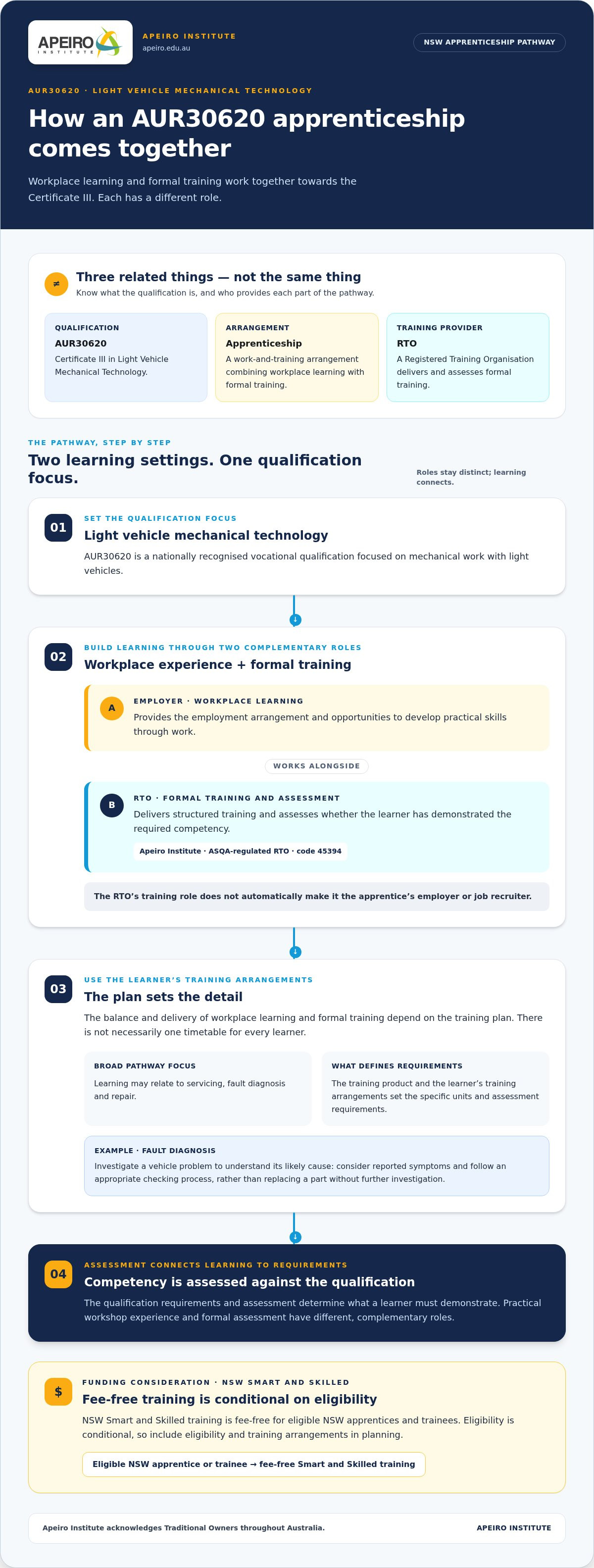
AUR30620 is the Certificate III in Light Vehicle Mechanical Technology, a nationally recognised vocational qualification focused on mechanical work with light vehicles. An apprenticeship combines workplace learning with formal training and assessment towards that qualification.
It helps to separate three terms: AUR30620 is the qualification, an apprenticeship is the work-and-training arrangement, and a Registered Training Organisation (RTO) delivers and assesses the formal training. These parts work together, but they are not interchangeable. An RTO’s training role does not automatically make it the apprentice’s employer or job recruiter.
When comparing options, look at the work arrangement and the training plan as well as the course name. The course identifies the qualification you are working towards. The employment arrangement provides workplace learning, while the RTO’s training and assessment support progress against the qualification requirements.
What does Certificate III in Light Vehicle Mechanical Technology cover?
The qualification focuses on light vehicle mechanical technology. Broadly, the pathway may involve learning related to servicing, fault diagnosis and repair, but the exact units and assessment requirements are set by the training product and the learner’s training arrangements. Do not assume that every example of mechanic work is a separate compulsory unit.
Fault diagnosis means investigating a vehicle problem to understand its likely cause. For example, rather than replacing a part without further investigation, a learner might consider the reported symptoms and follow an appropriate checking process. The qualification requirements and assessment determine what a learner must demonstrate.
How does training fit into an apprenticeship?
Workplace learning and formal vocational training complement each other. Workplace learning provides opportunities to develop practical skills through work. The RTO delivers structured training and assesses whether the learner has demonstrated the required competency. The balance and delivery arrangements depend on the training plan, so there is not necessarily one timetable that applies to every learner.
The employer and RTO have separate responsibilities. The employer provides the employment arrangement and workplace learning. The RTO provides formal training and assessment for the qualification. Knowing who is responsible for each part helps you direct questions about your work arrangement to the employer and questions about your course to the training provider. For a general overview of how apprenticeships combine work and learning, see What is an Apprenticeship?
Apeiro Institute is an ASQA-regulated RTO, code 45394, offering AUR30620 training. Delivery modes across Apeiro’s programs include classroom, workshop, face-to-face and e-learning, depending on the program. You can explore the Certificate III in Light Vehicle Mechanical Technology to understand the qualification and how formal study relates to workplace learning.
Apeiro Institute acknowledges Traditional Owners throughout Australia.
What skills and learning can the AUR30620 pathway build?
The AUR30620 pathway connects practical experience with the knowledge needed to understand light vehicle mechanical work. In an apprenticeship, workplace learning gives you opportunities to apply skills in a work setting. Formal training and assessment help develop and evaluate your understanding. The specific learning and assessment requirements are set by the qualification and your training arrangements.
The qualification’s focus is light vehicle mechanical technology. For specific tasks and unit choices, refer to the AUR30620 training requirements and the learner’s training plan, rather than relying on a generic list of mechanic duties. The qualification title describes its broad scope; the official requirements explain what must be demonstrated.
Do not assume that an advertised apprenticeship duration applies to every learner. The qualification code alone does not set the arrangements or timeframe for an individual pathway. When planning, focus on the training and workplace requirements that apply to you, and how competency will be assessed.
From vehicle servicing to fault diagnosis
Servicing, diagnosis and repair are useful examples for understanding how mechanical work can connect, but they are not a complete or guaranteed list of AUR30620 units. The training requirements define the scope. In general, servicing involves planned maintenance, while diagnosis means investigating a fault to understand its likely cause before deciding what action may be appropriate.
For example, if a vehicle is not performing as expected, a learner might gather information about the reported problem, consider possible causes and follow an appropriate checking process. That is diagnostic reasoning, rather than replacing a component without first investigating the issue. The specific activities depend on the learner’s training and workplace arrangements.
Practical workshop learning and technical knowledge
Workshop experience can help learners connect a task with the reasons behind it. Technical knowledge helps them interpret what they observe and explain why a check or repair approach may be suitable. The exact equipment, tasks and assessment requirements should be understood through the training plan and qualification requirements, rather than assumed from a general description of mechanic work.
This balance helps learners build understanding, not just repeat steps. Useful questions include: What evidence supports this diagnosis? How does a check relate to the reported fault? What does the assessment require me to demonstrate? These questions can make workplace experience more purposeful while keeping the qualification requirements in view.
For the precise scope, use the AUR30620 requirements as your reference and compare them with the training and workplace learning in your proposed arrangement. Apeiro Institute offers the Certificate III in Light Vehicle Mechanical Technology, a starting point for exploring the qualification alongside your apprenticeship plans.
How do apprenticeship arrangements and NSW Smart and Skilled funding compare?
Three connected parts shape an AUR30620 apprenticeship NSW pathway: the qualification, the employment arrangement that provides workplace learning, and the RTO that delivers formal training and assessment. Keeping these roles separate makes it easier to understand who is responsible for each part and where NSW Smart and Skilled funding may fit.
| Part | What it means | What it doesn’t mean |
|---|---|---|
| Qualification | AUR30620 is the Certificate III in Light Vehicle Mechanical Technology. It sets the vocational training requirements. | It isn’t, by itself, an employment arrangement. |
| Apprenticeship | A work-and-training arrangement that combines workplace learning with formal vocational training towards a qualification. | It isn’t simply course enrolment, and enrolling with an RTO does not automatically create an apprenticeship. |
| Training provider | An RTO delivers formal training and assesses competency against the qualification requirements. | An RTO doesn’t necessarily employ or place an apprentice. |
| NSW Smart and Skilled | Government-subsidised training that is fee-free for eligible NSW apprentices and trainees. | Eligibility is conditional and does not apply automatically to every learner or training arrangement. |
Apprenticeship, traineeship or course enrolment: what is different?
An apprenticeship is the work-based arrangement; course enrolment is participation in formal training with an RTO. They are related because training supports progress towards the qualification, but one does not replace the other. An RTO may deliver and assess AUR30620 without being the apprentice’s employer or arranging employment.
Before planning around a particular pathway, clarify how the employment arrangement and formal training connect in your circumstances. Identify who is responsible for workplace learning, who delivers training and assessment, and how progress towards the qualification is recorded. These details help you understand what course enrolment covers and what sits outside it.
When can NSW Smart and Skilled training be fee-free?
NSW Smart and Skilled funded training is fee-free for eligible NSW apprentices and trainees. Eligibility is conditional, so do not assume that living in NSW or choosing AUR30620 is enough to qualify. Current program requirements and course arrangements determine whether the funding applies to your circumstances. Review the relevant NSW Smart and Skilled information when planning.
Keep the funding question separate from the employment question. Funding relates to eligible training; it does not mean an RTO has employed or placed you in an apprenticeship. Apeiro Institute is an ASQA-regulated RTO, code 45394, offering the AUR30620 Certificate III in Light Vehicle Mechanical Technology. Understanding the training provider’s role can help you plan the next step clearly.
How to plan your AUR30620 apprenticeship pathway in NSW
A clear plan helps connect your career goal, workplace learning and formal training without assuming every apprenticeship follows the same arrangement. Work through these steps, then review the details that depend on your circumstances.
- Clarify your goal. Decide whether you are aiming to gain the AUR30620 Certificate III in Light Vehicle Mechanical Technology or want your existing automotive skills assessed for recognition.
- Understand the work arrangement. Find out how the apprenticeship supports workplace learning and who is responsible for each part. Course enrolment and an apprenticeship are related, but they are not the same thing.
- Review the training. Compare the workplace learning you expect with the AUR30620 requirements and the training plan for your circumstances. This helps you understand what formal learning and assessment need to cover.
- Consider funding eligibility. If you are planning around fee-free training, review the current NSW Smart and Skilled requirements and course arrangements. Funding is available to eligible NSW apprentices and trainees, not automatically to every learner.
Questions to resolve before starting
Start by getting a clear picture of the employment arrangement and the learning it can support. Who provides your workplace learning? Which RTO delivers formal training and assessment? How does your training plan relate to the qualification requirements? These questions separate employment responsibilities from course responsibilities and give you a practical basis for planning.
Use the qualification requirements as your reference when comparing learning needs. Do not rely on a general list of mechanic tasks or assume every apprentice will complete identical workplace activities. The requirements and your training plan provide a more useful guide to the skills and assessment involved. For further course context, explore this Certificate III light vehicle mechanical technology guide.
How to think about existing automotive experience
Experience may be relevant even if you have not completed a formal qualification. Recognition of Prior Learning (RPL) is a pathway for having existing skills and knowledge assessed against qualification requirements. The outcome depends on the evidence and assessment, so prior experience does not automatically provide credit or reduce study time.
If you are considering RPL, treat it as a separate assessment question alongside your employment and training plans. First identify the skills you have gained, then consider how they relate to the AUR30620 requirements. This can help you decide whether an assessment pathway may be relevant without assuming the result.
Planning an AUR30620 apprenticeship NSW pathway is easier when you treat the work arrangement, qualification requirements and funding eligibility as separate questions. Apeiro Institute delivers AUR30620 training as an ASQA-regulated RTO, code 45394, and acknowledges Traditional Owners throughout Australia.
Study AUR30620 with Apeiro Institute
Choosing a training provider is one part of planning an AUR30620 apprenticeship NSW pathway. Apeiro Institute is an ASQA-regulated Registered Training Organisation (RTO), code 45394, offering AUR30620 Certificate III in Light Vehicle Mechanical Technology training. Apeiro delivers the formal vocational training and assessment. The apprentice’s employment arrangement is separate, so training with Apeiro does not mean Apeiro employs or places the learner in an apprenticeship.
Eligible NSW apprentices and trainees can access NSW Smart and Skilled funded fee-free training. Eligibility is conditional, and current requirements and course arrangements apply. Consider funding alongside your training plans, while keeping it distinct from the question of who employs you and provides workplace learning.
What to expect from Apeiro as your training provider
Apeiro offers classroom, workshop, face-to-face and e-learning delivery modes across its programs, with the mode depending on the program. The training arrangements for AUR30620 should be understood through the course information. As the RTO, Apeiro supports formal learning and assesses competency against qualification requirements, complementing the practical experience gained through workplace learning.
This distinction can make planning clearer. The employer is responsible for the employment arrangement and workplace learning; the training provider is responsible for formal training and assessment. Your training plan connects these parts to the qualification requirements. Understanding that relationship can help you consider how the learning structure fits your needs.
Take your next step with confidence
Start by exploring the AUR30620 course information and considering how formal training relates to your workplace learning goals. The course page explains Apeiro’s training offering and provides relevant information as you plan. If you are an apprentice or trainee in NSW, keep Smart and Skilled eligibility in view and use current program information to understand whether fee-free training applies to your circumstances.
You do not need to resolve every detail at once. Begin with the qualification requirements, your employment arrangement and the training provider’s role. Then use those points to make a considered plan, rather than assuming course enrolment alone creates an apprenticeship or guarantees a particular outcome.
Explore the AUR30620 course information to learn more about Apeiro’s Certificate III training and consider how it could fit your pathway.
Take your next step towards a mechanical career
Your next step does not need to settle every detail at once. Start by deciding what you want from an AUR30620 apprenticeship NSW pathway, then use that goal to guide your planning around workplace learning, training and readiness to begin. A clear question can turn a broad career idea into a practical plan.
As you explore your options, focus on how the learning connects with the skills you want to develop. Give yourself time to understand the arrangements and make an informed choice. Progress starts with a considered first step.
Keep moving forward at a pace that works for you. With the right information, becoming a qualified mechanic can feel like a more achievable goal.
Frequently Asked Questions
How long does an AUR30620 apprenticeship take?
There is no single completion timeframe that applies to every apprentice. Training and employment arrangements can differ, and progress depends on the requirements that apply to the individual pathway. To plan realistically, look at the training plan and how competency will be assessed, rather than relying on a general duration quoted for a different arrangement.
Is AUR30620 training fee-free in NSW?
It can be fee-free for eligible NSW apprentices and trainees under NSW Smart and Skilled. This is conditional, not an automatic feature of every AUR30620 enrolment. Review current program requirements and course arrangements to understand whether fee-free training applies to your circumstances.
Who is eligible for NSW Smart and Skilled apprentice training?
NSW Smart and Skilled training is fee-free for eligible NSW apprentices and trainees. Eligibility is subject to current program requirements and course arrangements, so do not assume that every learner or training plan qualifies. Review the relevant requirements when considering funding for your AUR30620 training.
Can I complete AUR30620 without an apprenticeship?
The qualification and an apprenticeship are distinct, so AUR30620 training is not the same thing as taking up an apprenticeship employment arrangement. The course’s training and assessment arrangements determine how you can pursue the qualification. If your goal includes workplace learning as well as the certificate, consider how that experience will fit alongside formal training.
Does an RTO employ or place apprentices?
An RTO delivers vocational training and assesses whether learners meet the qualification requirements. An employer provides the employment arrangement and workplace learning. These roles can involve coordination, but they are not interchangeable. For example, enrolling with Apeiro Institute for AUR30620 training does not mean Apeiro has employed or placed you in an apprenticeship. Keep course questions and employment questions distinct as you plan your pathway.
Can my previous automotive work experience count towards AUR30620?
Existing skills and knowledge may be assessed through Recognition of Prior Learning (RPL) against qualification requirements. Relevant experience alone does not guarantee credit or a particular assessment result. If you have worked in automotive roles, consider which skills you have developed and how they might relate to AUR30620. An RPL assessment determines whether that experience meets the required competencies.
What does an AUR30620 light vehicle mechanic learn?
AUR30620 focuses on light vehicle mechanical technology, with learning and assessment shaped by the qualification requirements and the learner’s arrangements. Broad areas associated with the pathway include vehicle servicing, fault diagnosis and repair. Diagnosis means investigating a problem to understand its likely cause, rather than replacing a component without establishing why it may have failed. Refer to the qualification details and training plan for the specific requirements.
Disclaimer
The information provided on this blog is for general informational and educational purposes only. While every effort is made to ensure the accuracy and reliability of the content, the author makes no representations or warranties of any kind, express or implied, about the completeness, accuracy, suitability, or availability of the information contained on this blog.
The views and opinions expressed in blog posts are those of the individual author and do not necessarily reflect the official policy or position of any organization, company, or employer.
This blog may contain links to external websites or third-party content. These links are provided for convenience only, and the author has no control over and assumes no responsibility for the content, privacy policies, or practices of any third-party sites.
Nothing on this blog constitutes professional advice (legal, financial, medical, or otherwise). Readers are encouraged to seek appropriate professional guidance before making any decisions based on the information provided here.
By using this blog, you acknowledge that any reliance on the information is at your own risk.


