

What if you could build practical aged care skills while working towards a nationally recognised qualification? Start Your Career in Aged Care with a NSW Traineeship by combining workplace learning with formal training, so your study can connect with skills you’re developing on the job. The qualification associated with this pathway is CHC33021 Certificate III in Individual Support (Ageing and Disability).
It’s understandable to wonder how work and study fit together, what a traineeship involves and whether training fees apply. This guide explains how workplace learning and CHC33021 relate, what to consider when weighing up a traineeship, and how subsidised training arrangements can support eligible apprentices and trainees. You’ll also find practical ways to compare the workplace, study and qualification components before deciding on your next step. Apeiro Institute is regulated by the Australian Skills Quality Authority (ASQA) as a Registered Training Organisation, RTO Code 45394, and acknowledges Traditional Owners throughout Australia.
Key Takeaways
- Understand how workplace learning and formal study can fit together in an aged care traineeship.
- Learn how CHC33021 Certificate III in Individual Support (Ageing and Disability) relates to this pathway.
- See when NSW Smart & Skilled training is fee-free, and why eligibility matters.
- Use a practical checklist to consider the workplace, study and qualification components before pursuing a traineeship.
- Explore how Apeiro Institute’s nationally recognised training can support your next step as you Start Your Career in Aged Care with a NSW Traineeship.
What is an aged care traineeship in NSW, and how does it work?
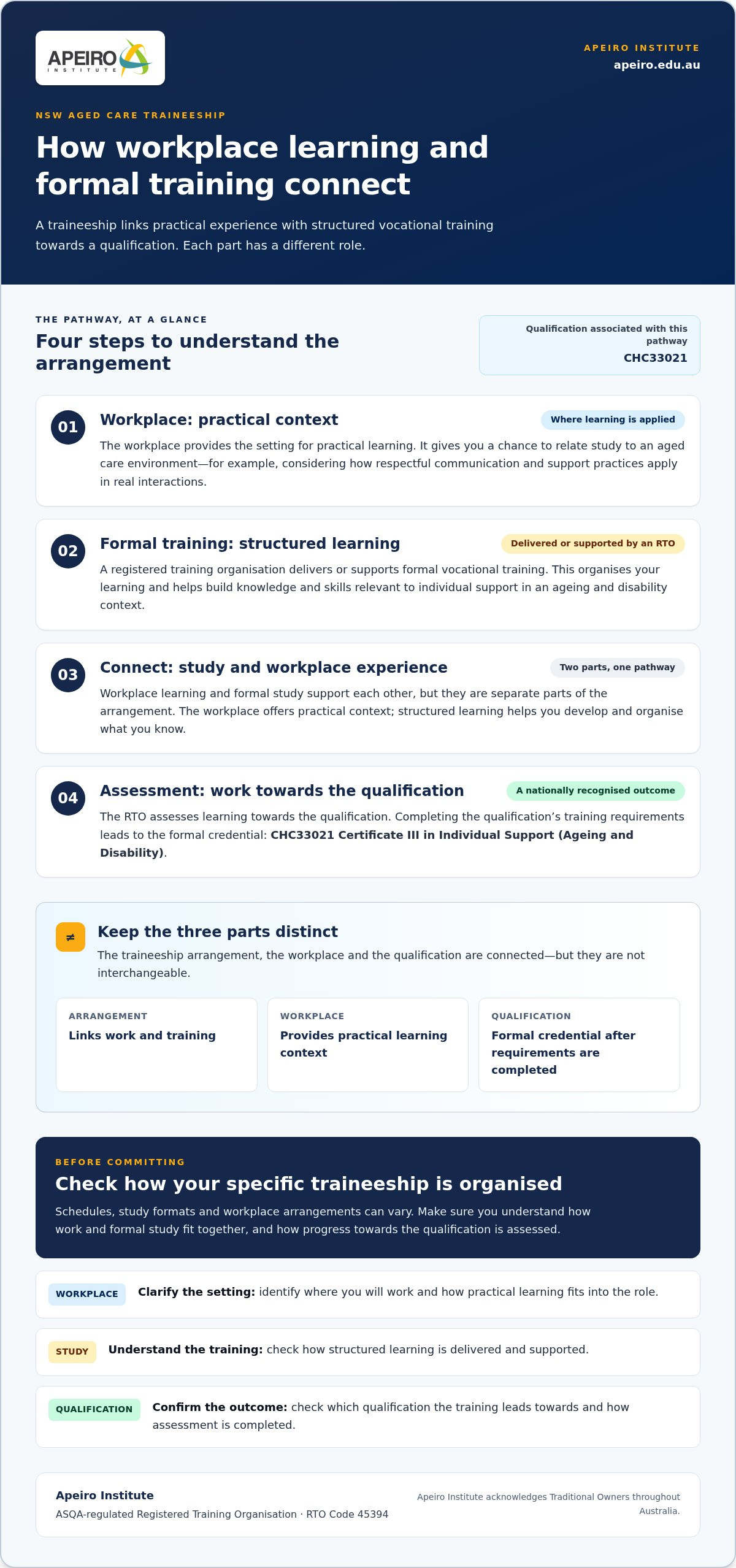
If you’re changing careers, it can be hard to picture how a job and formal study fit together. An aged care traineeship is a workplace-linked training pathway that combines practical experience in a work setting with structured vocational training towards a qualification. Workplace learning and formal study support each other, but they are separate parts of the arrangement.
It helps to distinguish three things: the traineeship arrangement, the qualification and the workplace. The workplace provides the setting for practical learning. A registered training organisation delivers or supports formal training and assesses learning towards the qualification. The qualification is the nationally recognised outcome of completing its training requirements. If you want to Start Your Career in Aged Care with a NSW Traineeship, understanding how these parts connect is a useful first step.
How workplace learning and formal training connect
Workplace learning gives you a chance to relate study to an aged care setting. For example, you could reflect on how respectful communication and support practices apply in real interactions, then build on those ideas through structured vocational learning. Formal training organises and assesses your learning, while the workplace provides practical context.
The schedule, study format and workplace arrangements depend on the specific traineeship. Don’t assume every learner follows the same timetable or delivery model. Before committing, make sure you understand how work and formal study are organised and how progress towards the qualification is assessed.
Who might explore an aged care traineeship?
A traineeship may suit someone leaving school, changing careers or considering a new vocational direction. You don’t need to have your whole career mapped out to explore the pathway. Consider whether the combination of workplace experience and structured study fits your goals, available time and other commitments.
Aged care includes different services and settings, so learning about the sector can help you choose a pathway. The overview of Aged care in Australia provides broader context about the types of services available. You can also think about what day-to-day work in your intended setting might involve and how you would organise time for study.
To compare a traineeship opportunity, clarify its main components:
- Workplace: Identify the work setting and how practical learning fits into the role.
- Study: Understand how structured training is delivered and supported.
- Qualification: Check which qualification the training leads towards and how assessment is completed.
Apeiro Institute offers CHC33021 Certificate III in Individual Support (Ageing and Disability), a relevant qualification for this pathway. The traineeship arrangement and qualification are connected, but not interchangeable: one links work and training, while the other is the formal credential. Apeiro Institute is an ASQA-regulated Registered Training Organisation, RTO Code 45394, and acknowledges Traditional Owners throughout Australia.
What does CHC33021 teach in an aged care traineeship?
The qualification associated with this pathway is CHC33021 Certificate III in Individual Support (Ageing and Disability). Apeiro Institute offers this qualification for people exploring individual support in an ageing and disability context. As nationally recognised vocational training, it provides a formal learning pathway. A traineeship arrangement connects that training with workplace learning.
The qualification and traineeship are related, but they are not the same thing. CHC33021 is the qualification a learner works towards. A traineeship links formal training with workplace learning. The workplace, training provider and learner each have a role, while the specific structure can vary. Understanding the distinction helps you see what the training leads towards without assuming every workplace or study plan is identical.
How the qualification fits an aged care pathway
The qualification name indicates its focus: individual support in an ageing and disability context. It offers a structured vocational route to develop knowledge and skills relevant to this area of work. The specific course content and assessment are set by the qualification and training arrangements, so don’t infer particular units or activities from the title alone.
A recognised qualification can form part of a broader aged care career pathway. It may support further exploration of individual support work, but it does not guarantee a particular role or employment outcome. Consider how the qualification fits your goals and how formal study would sit alongside the workplace component of a traineeship. You can explore Apeiro Institute’s CHC33021 Certificate III in Individual Support to learn more about the qualification.
Can existing skills count towards a qualification?
If you already have relevant experience or skills, Recognition of Prior Learning (RPL) provides a way to have existing skills assessed towards a qualification. It may be useful if you’ve developed knowledge through work or other experience and want that learning considered as part of your training pathway.
RPL involves an assessment, so it doesn’t guarantee that particular skills will receive credit or that every part of a qualification will be covered. It also isn’t a replacement for the full traineeship arrangement. The assessment determines what can be recognised, while any remaining training needs depend on the outcome and your pathway.
If you’re weighing up how to Start Your Career in Aged Care with a NSW Traineeship, separate the qualification you’ll study from the workplace arrangement around it. Then consider how your existing skills could be assessed through RPL. This gives you a clearer picture of the learning pathway and whether it aligns with your next step.
Is a NSW aged care traineeship fee-free, and does it guarantee a job?
Training is fee-free for eligible NSW Smart & Skilled apprentices and trainees. It is not automatic for every applicant or everyone considering an aged care traineeship. Funding eligibility, participating in a traineeship and getting a job are separate matters, so it’s important to understand what each involves before deciding on your next step.
What fee-free Smart & Skilled training means
If you’re eligible as a NSW Smart & Skilled apprentice or trainee, the training is fee-free. Being interested in aged care, enrolling in a qualification or exploring a workplace opportunity does not by itself mean you qualify. The funding applies to eligible training; it does not promise a particular job or employment outcome.
Funding arrangements can be easy to confuse with course or workplace details. The Smart and Skilled funded training guide provides more context. Keep the key condition in mind: fee-free training applies to eligible NSW Smart & Skilled apprentices and trainees.
Funding, training and employment are different things
Think of the pathway as three connected but distinct parts:
- Funding: NSW Smart & Skilled funding provides fee-free training for eligible apprentices and trainees.
- Training: Formal study works towards a qualification, such as CHC33021 Certificate III in Individual Support (Ageing and Disability).
- Employment: A job depends on the relevant workplace and employment arrangement. Funding or completing a qualification does not guarantee a job offer or a position afterwards.
This distinction is useful when comparing information online. An employer may describe a programme that combines a job with training, but its details apply to that employer’s programme. For example, information from Bupa about its own carer traineeship should not be treated as a general rule for every NSW traineeship. Consider each work arrangement and training pathway on its own terms.
Before proceeding, separate what you know about funding from what you know about the job and qualification. Is the training fee-free based on your eligibility? What workplace arrangement is involved? Which qualification does the training lead towards? Answering these questions helps you assess the opportunity without assuming one outcome guarantees another.
If you’re ready to Start Your Career in Aged Care with a NSW Traineeship, keep eligibility and employment expectations clear as you explore the pathway. Apeiro Institute offers CHC33021 training, and training is fee-free for eligible NSW Smart & Skilled apprentices and trainees. Apeiro Institute acknowledges Traditional Owners throughout Australia.
How to prepare for an aged care traineeship in NSW
Preparation can make it easier to assess an aged care traineeship. Start by understanding the particular arrangement rather than assuming every opportunity has the same workplace, study format or qualification. This helps you decide whether practical learning and formal training fit your goals and circumstances.
If you’re looking to Start Your Career in Aged Care with a NSW Traineeship, take it one step at a time. Identify the work arrangement and qualification, then consider how study will fit alongside workplace learning and whether NSW Smart & Skilled funding may apply. These are practical points to understand, not reasons to assume you’re eligible or that a job outcome is assured.
Questions to clarify before starting
Use the details of the specific arrangement to understand what you’d be committing to. The workplace, training provider and qualification each have a different role. Distinguish the work opportunity from formal study, then consider how you’ll plan your time around both.
- Workplace: What setting and work arrangement does the opportunity involve?
- Qualification: Is the training connected to CHC33021 Certificate III in Individual Support (Ageing and Disability)?
- Study: Which study modes are used, and how does formal learning fit with workplace learning?
- Funding: Is the training fee-free for you as an eligible NSW Smart & Skilled apprentice or trainee?
Delivery modes vary by programme, so focus on the arrangements that apply to the pathway you’re considering. Apeiro Institute’s CHC33021 Certificate III in Individual Support page is a useful starting point for information about the qualification.
A practical preparation checklist
You don’t need to treat previous experience as a formal entry requirement. Instead, take stock of what you already know and gather information that may help you plan your learning. Existing skills can also be considered through Recognition of Prior Learning (RPL), with any credit depending on assessment.
- Note relevant work, volunteering or transferable experience, including communication or support experience.
- Gather records that could help show what you’ve learned, such as training documents or evidence of relevant work.
- Review the NSW Smart & Skilled fee-free training condition and consider whether you may be eligible. Keep funding eligibility separate from taking part in training.
- Compare the study expectations with your current commitments so you can plan for formal learning and workplace participation.
You don’t need every answer before exploring the pathway. A clear understanding of the workplace, qualification, study arrangements and funding conditions gives you a sound basis for your next decision. Apeiro Institute acknowledges Traditional Owners throughout Australia.
Start your aged care training pathway with Apeiro Institute
Choosing a training pathway is a meaningful step, and you don’t need to have every detail of your future career settled before exploring your options. Start by understanding the qualification, the training format and how workplace learning connects with study. Apeiro Institute operates under the Australian Skills Quality Authority regulatory framework as a Registered Training Organisation, RTO Code 45394.
Apeiro’s relevant training and support
For aged care and individual support, Apeiro Institute offers CHC33021 Certificate III in Individual Support (Ageing and Disability). It is a nationally recognised qualification that can form part of a pathway towards work in individual support. The qualification is distinct from a traineeship, which links formal training with workplace learning. Study plans and other details depend on the programme.
Apeiro Institute offers classroom, workshop, face-to-face and e-learning delivery modes, with the format depending on the course. Consider how you learn best and how the available study format would fit your commitments. RPL may also be relevant if you have gained skills through previous work or experience. It allows existing skills to be assessed towards a qualification, with any recognition depending on the assessment outcome. It does not automatically replace all study or workplace learning.
NSW Smart & Skilled may also be relevant to your planning. Eligibility matters, so don’t assume every learner or aged care trainee receives fee-free training. Funding, the qualification and the workplace arrangement are connected parts of a pathway, but each has its own conditions and purpose.
Take the next step with confidence
If you’re considering how to Start Your Career in Aged Care with a NSW Traineeship, focus on the practical details. Identify the qualification you’re aiming towards, understand how formal study fits with workplace learning, and consider whether your existing skills could be relevant to an RPL assessment. Then review the training information and weigh the pathway against your goals and commitments.
Apeiro Institute’s information about CHC33021 Certificate III in Individual Support (Ageing and Disability) is a practical starting point for exploring the qualification. Take the time you need to understand the training pathway and choose an option that suits your plans.
Take your next step towards aged care training
A new vocational direction can start with one practical decision: learning more about the training pathway that fits your goals. You don’t need every stage mapped out. Consider what you want from workplace learning, how study might fit your circumstances and whether your existing skills could be assessed through Recognition of Prior Learning.
To Start Your Career in Aged Care with a NSW Traineeship, explore the CHC33021 qualification and the training arrangements that may support your next move. Apeiro Institute is an ASQA-regulated Registered Training Organisation, RTO Code 45394. Take time to understand the qualification and funding conditions as you consider your options.
Your next step doesn’t need to be a giant leap. Think about what matters most in your future work and move forward one decision at a time.
Frequently Asked Questions
What is an aged care traineeship in NSW?
An aged care traineeship in NSW connects workplace learning with structured vocational training. It brings together a workplace, a training provider and a learner, with the specific arrangement shaping how work and study fit together. If you’re considering this pathway, identify the qualification, workplace and study format involved. That overview can help you decide whether you’re ready to Start Your Career in Aged Care with a NSW Traineeship.
Is an aged care traineeship fee-free in NSW?
Eligibility is essential, so don’t assume that everyone interested in aged care or every trainee automatically receives fee-free training. Keep funding eligibility separate from the decision to pursue a course or workplace opportunity.
What qualification is used for an aged care traineeship?
Apeiro Institute offers CHC33021 Certificate III in Individual Support (Ageing and Disability) for this subject. It is a nationally recognised vocational qualification, while the traineeship is the broader workplace-linked arrangement. When reviewing a pathway, distinguish the credential you may work towards from the specific work and study setup.
Can I study an aged care course online?
Apeiro Institute offers e-learning, classroom, workshop and face-to-face delivery modes, depending on the programme. Don’t assume an aged care course is entirely online. If you’re balancing study with other commitments, consider how the available delivery mode fits your learning preferences and schedule.
Do I need aged care experience to start a traineeship?
Previous aged care experience isn’t stated as a universal prerequisite for exploring a traineeship. School leavers and career changers can consider the pathway without assuming they must already have worked in the sector. If you have relevant employment, volunteering or transferable experience, make a record of what you’ve learned. Recognition of Prior Learning (RPL) may assess existing skills towards a qualification, with any credit depending on assessment.
Does an aged care traineeship guarantee a job?
No. A traineeship or qualification does not guarantee a job or a position after training. Employment depends on the relevant work arrangement and outcome, so treat training and employment as separate parts of your plans. A traineeship can connect learning with workplace experience, but it isn’t a promise of ongoing work.
How long does an aged care traineeship take?
The duration depends on the specific traineeship and its training and workplace arrangements. There isn’t one timeframe that applies to every learner, so avoid relying on a duration quoted for a different programme. Consider how the study plan is organised and what progress towards the qualification involves. This gives you a more useful basis for planning around work and other commitments.

Disclaimer
The information provided on this blog is for general informational and educational purposes only. While every effort is made to ensure the accuracy and reliability of the content, the author makes no representations or warranties of any kind, express or implied, about the completeness, accuracy, suitability, or availability of the information contained on this blog.
The views and opinions expressed in blog posts are those of the individual author and do not necessarily reflect the official policy or position of any organization, company, or employer.
This blog may contain links to external websites or third-party content. These links are provided for convenience only, and the author has no control over and assumes no responsibility for the content, privacy policies, or practices of any third-party sites.
Nothing on this blog constitutes professional advice (legal, financial, medical, or otherwise). Readers are encouraged to seek appropriate professional guidance before making any decisions based on the information provided here.
By using this blog, you acknowledge that any reliance on the information is at your own risk.


