

What if your next career move was already paid for by the government, and all you had to do was choose the right path? It's completely normal to feel overwhelmed by the sheer volume of government-subsidised courses available across the country. You might worry about hidden costs or feel confused by the eligibility rules and the latest course offerings. At Apeiro Institute, we understand that choosing a training provider is a big decision; you want to be sure you're stepping into a supportive environment that values your individual journey and professional growth.
This guide is designed to clear the fog. You'll learn exactly how to access government-subsidised training to launch or advance your career with nationally recognised qualifications. We'll walk you through the current eligibility criteria, explain how the government sets student fees to ensure fairness, and show you how to find an RTO that acts as a true partner in your success. From understanding program updates to practical tips on starting your enrolment, we've provided everything you need to move forward with confidence.
Key Takeaways
- Learn how to access government-subsidised training to gain nationally recognised qualifications and advance your career in high-demand industries.
- Verify your eligibility for 2026, ensuring you meet the age, residency, and citizenship requirements to qualify for funding.
- Discover the priority qualifications on the latest NSW Skills List, including Smart and Skilled funded courses NSW in fields like electronics and individual support.
- Understand why choosing a supportive RTO can provide a more personalised, industry-aligned learning journey compared to larger institutional settings.
- Follow a clear, step-by-step path to enrol in your chosen course and begin your journey towards a brighter professional future.
What are Smart and Skilled Funded Courses in NSW?
Smart and Skilled is a NSW Government initiative designed to make high-quality education accessible to everyone. It represents a significant shift in the Vocational Education and Training (VET) system, focusing on giving people the practical skills needed for the modern workforce. By subsidising the cost of training, the government helps reduce the financial pressure on students looking for Smart and Skilled funded courses NSW. You don't have to worry about the full price of a qualification; instead, you pay a set student fee while the government pays the remainder directly to the training provider.
This programme isn't just about making courses cheaper. It's a strategic investment in the people of New South Wales. The goal is to ensure that residents have the right skills to thrive in high-demand industries. Whether you're looking to start your very first job or you're an experienced worker seeking career advancement, these subsidies provide a clear pathway. Because the government sets the student fees, you'll find that the cost remains consistent for a specific qualification, regardless of which approved provider you choose to study with.
The Role of the NSW Skills List
The NSW Skills List identifies exactly which qualifications the government will support at any given time. It's a dynamic document. For 2026, the list reflects a strong focus on sectors like healthcare, construction, and technology. The current version, v17.0, commenced on 1 July 2026. It includes qualifications ranging from entry-level Certificate II courses up to specialised Advanced Diplomas. Because the list is reviewed twice a year, it stays responsive to what NSW employers actually need. This means that when you enrol in Smart and Skilled funded courses NSW, you're training for a role that the industry is actively looking to fill. It ensures your time and effort are directed toward a career with real longevity.
Why Subsidised Training Matters for Your Career
Choosing subsidised training is about more than just saving money. It's about opening doors that might otherwise stay closed. For many, the prospect of a career change is daunting due to the costs involved. Subsidies allow you to pivot into growth sectors like electronics or community services without the weight of significant debt. This financial breathing room lets you focus on your studies and your future goals. Plus, since these qualifications are nationally recognised, they provide a sense of security. You'll finish the course with a qualification that is respected by employers across the country. It proves you have the expertise to excel in your chosen field and shows you're committed to professional excellence.
Eligibility Criteria for Smart and Skilled Funding in 2026
Understanding if you qualify for government support is the first step toward securing your future. The NSW Government has established clear guidelines to ensure that Smart and Skilled funded courses NSW are accessible to those who will benefit most. To be eligible, you must be at least 15 years old and have finished your secondary education. It's also essential that you either live or work in New South Wales. For Aboriginal or Torres Strait Islander people living in certain border areas adjacent to NSW, specific provisions apply to ensure you aren't disadvantaged by your location. These rules are designed to be inclusive, helping a wide range of people access the training they need to thrive.
Your residency status is another vital piece of the puzzle. You must be an Australian citizen, a permanent resident, a New Zealand citizen, or a holder of a humanitarian visa. If you're unsure about your specific visa category or how your current location affects your application, it's always best to check your status through official channels before you Enrol in a Smart and Skilled course. This ensures your application moves forward without any unexpected hurdles, giving you peace of mind as you begin your educational journey.
Previous Qualifications and Your Eligibility
A common concern involves previous studies and whether they might block you from receiving new funding. This isn't necessarily the case. The "Second Chance" policy is specifically designed for people who need to retrain in high-priority industries. For example, if you already hold a qualification but want to transition into a growth sector like aged care or community services, you may still be eligible for a subsidy. Additionally, if you completed a school-based apprenticeship, this generally doesn't count against your future eligibility for funded training as an adult. It's about giving you the flexibility to grow as the job market changes, ensuring your skills remain relevant and in demand.
The USI: Your Key to Funded Training
You cannot enrol in government-subsidised training without a Unique Student Identifier (USI). The USI is the essential digital record of all your Australian training. It acts as a lifelong account where all your nationally recognised qualifications are stored in one secure place. If you've studied in Australia since 2015, you likely already have one. You can easily check the national registry or create a new one using a form of identification like your birth certificate, Medicare card, or driver's licence. This identifier is critical because it allows the government to track your progress and apply the correct subsidies to your account. If you find the registry confusing, our team at Apeiro Institute is always happy to help you navigate the setup process and ensure your details are correct.
High-Demand Qualifications on the NSW Skills List
The NSW Skills List acts as a strategic guide for your career. It ensures that Smart and Skilled funded courses NSW align with the state's most critical labour needs. By prioritising industries facing significant skill shortages, the government directs funding where it will have the greatest impact on employment. This approach helps you avoid training for overcrowded fields and instead focuses your efforts on sectors where qualified workers are in high demand. It's a system designed to benefit both the individual student and the broader economy.
Electronics, Communications, and Automotive Pathways
The automotive industry is currently undergoing a massive transformation. As vehicles become more complex, the need for modern mechanical diagnosis has never been higher. For those looking to enter this field, the Certificate III in Light Vehicle Mechanical Technology provides the foundation needed to work with today’s advanced systems. It’s a perfect example of how the NSW Government's Smart and Skilled program supports practical, hands-on trades that offer long-term stability.
Similarly, the electronics sector is desperate for skilled technicians. From telecommunications to circuit design, the demand for expertise continues to outpace the supply of qualified workers. If you’re already working in a trade but lack formal papers, you don't have to start from scratch. Through Trade Pathways for Experienced Workers (TPEW), you can use government funding to formalise your existing skills. This recognition acknowledges your years of hard work on the tools, turning your experience into a nationally recognised qualification that can significantly boost your earning potential. It's about getting the credit you deserve for the work you already do.
Community Services and Individual Support
The care economy is one of Australia’s fastest-growing sectors. With an ageing population and a greater focus on disability support, the need for compassionate, qualified professionals is immense. This sector offers incredible job security and the chance to make a tangible difference in people's lives. Subsidised training makes entering this field more accessible than ever, especially for career changers who might be hesitant about the cost of retraining. It removes the financial barrier, allowing you to focus on developing your support skills.
For those aiming for leadership roles, the Diploma of Community Services is a vital pathway. It prepares you for case management and coordination roles, providing a step up from entry-level support work. By choosing Smart and Skilled funded courses NSW in the care sector, you aren't just getting a certificate; you're securing a place in an industry that values your contribution and offers a clear, stable career trajectory. It’s a smart move for anyone looking for a role that combines professional growth with community impact.
The Benefits of Choosing a Registered Training Organisation (RTO) for Funded Training
Selecting where to study is just as important as choosing the course itself. While large public institutions are a common choice, many students find that private Registered Training Organisations (RTOs) offer a more tailored experience for Smart and Skilled funded courses NSW. These organisations are often more agile, allowing them to adapt quickly to industry changes and provide a learning environment that feels personal and supportive. You aren't just another enrolment; you're a future professional with specific goals and challenges. This student-centered approach ensures that you receive the attention needed to truly master your craft.
RTOs often foster a diverse, multi-national student community. This provides you with a broader professional network that spans different cultures and industries, which is invaluable in Australia’s multicultural workforce. Additionally, flexibility is a core component of the RTO model. Many students balance their education with family commitments or existing jobs. RTOs understand this reality and offer study options that help you manage your time without sacrificing the quality of your education. It makes the prospect of starting a new educational journey feel attainable rather than intimidating.
Personalised Support and Mentorship
One of the biggest advantages of a private RTO is the smaller class size. This naturally leads to more direct interaction with your trainers. Instead of sitting in a crowded lecture hall, you're in a space where you can ask questions and get immediate, constructive feedback. Our trainers act as mentors, guiding you through the complexities of your chosen field and helping you map out a clear career path. This supportive approach is especially helpful for those returning to study after a long break or those from diverse backgrounds who value a welcoming, community-focused atmosphere. It builds the confidence you need to succeed in a new role.
Industry-Aligned Practical Outcomes
RTOs pride themselves on being industry-aligned. This means the training you receive is designed to mirror exactly what happens in a real-world workplace. Whether you're studying individual support or automotive technology, the focus remains on hands-on experience over purely academic theory. Employers value this practical approach. They know that a student with a nationally recognised qualification from a reputable RTO has spent time on the tools or in the clinic, not just behind a desk. This practical focus ensures you're job-ready from the moment you graduate, carrying significant weight with Australian employers who need workers with ready-to-use skills.
Ready to start your journey? Explore our trade pathways and funded options to see how we can help you reach your professional goals with confidence.
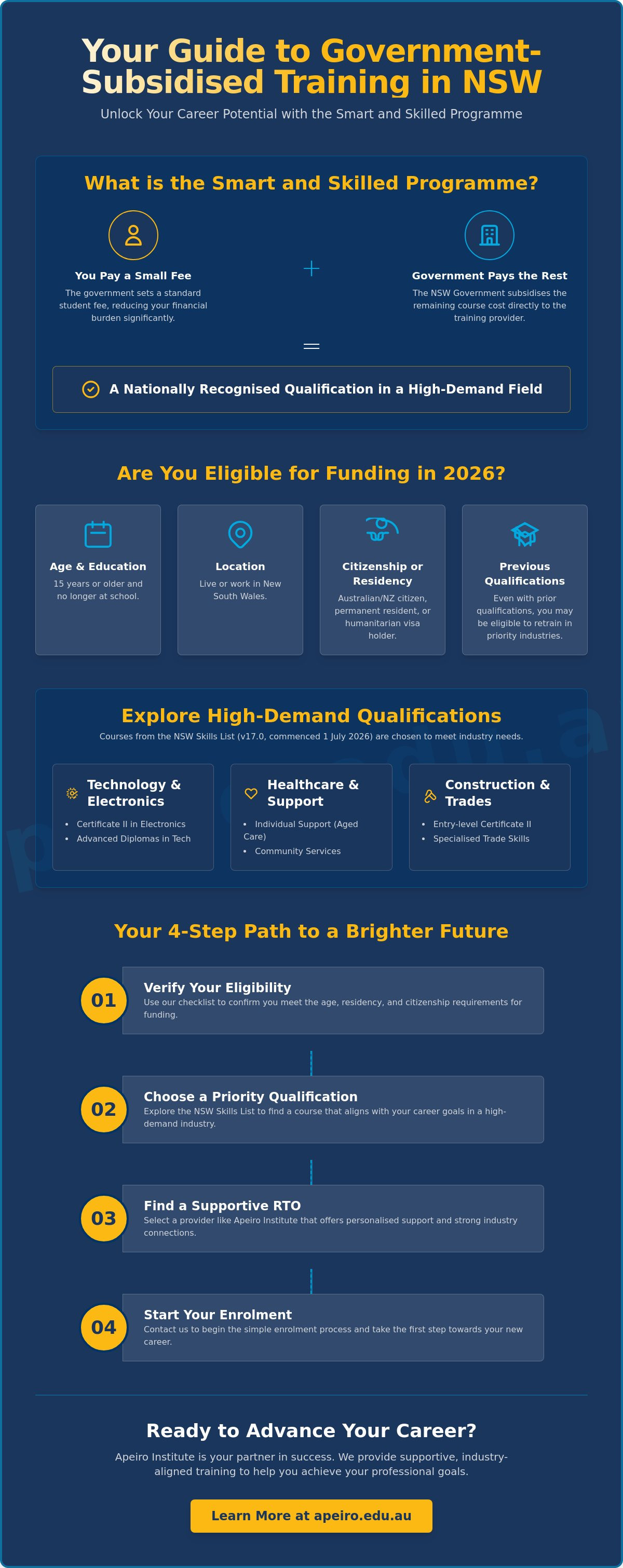
How to Enrol in a Smart and Skilled Course with Apeiro Institute
Enrolling in a funded course is a straightforward process when you have the right support. You shouldn't feel like you're stuck in a maze of government forms. Our goal is to make your transition into study as smooth as possible, ensuring you can focus on your future career rather than administrative hurdles. By following a few clear steps, you'll be well on your way to securing a place in one of the many Smart and Skilled funded courses NSW has available for the 2026 training period.
- Step 1: Research your qualification. Start by looking at the current NSW Skills List to see which courses align with your goals. Whether it's individual support or automotive technology, knowing what's available is the best place to begin.
- Step 2: Contact Apeiro Institute. Reach out to us for a preliminary eligibility assessment. We'll chat about your background, career goals, and residency status to confirm you meet the government requirements.
- Step 3: Provide your documentation. You'll need to submit your USI and proof of residency for verification. This step ensures the government subsidy is correctly applied to your enrolment.
- Step 4: Finalise and begin. Once your paperwork is verified, you'll complete the final enrolment forms. From there, you're ready to start your journey toward a nationally recognised qualification.
Preparing Your Documentation
Having your paperwork ready can significantly speed up your application. You'll generally need proof of your identity, such as a driver's licence or passport, and evidence of your residency status in NSW. Don't forget your Unique Student Identifier (USI). As we discussed earlier, this is your lifelong digital record for all Australian training. If you can't find your USI or need to create a new one, our team can guide you through the registry process. We recommend organising these documents into a single digital folder or a clear physical file. This simple bit of organisation prevents delays and ensures your application for Smart and Skilled funding is processed without a hitch. If you run into any paperwork hurdles, just let us know; we're here to help you solve them.
Your First Step Toward Success
The hardest part of any journey is often just taking the first step. It's natural to feel a bit of anxiety about starting something new, but you don't have to do it alone. We see ourselves as your partner in education, not just a training provider. Whether you're looking to enter the care sector through a Certificate III in Individual Support or you're formalising years of trade experience, we're here to support you. You've already done the hard work of researching your options; now it's time to turn that research into action. Enquire today to start your eligibility check and discover how Smart and Skilled funded courses NSW can transform your professional life. We look forward to welcoming you into our community and helping you achieve the success you deserve.
Take the Next Step Toward Your New Career
Accessing the right training shouldn't feel like an impossible task. By understanding the eligibility rules for Smart and Skilled funded courses NSW and identifying the high-demand sectors on the 2026 Skills List, you've already cleared the biggest hurdles. Whether you're moving into individual support, electronics, or automotive technology, the path to a nationally recognised qualification is now within your reach. You've seen how a supportive, industry-aligned RTO can make all the difference in your learning journey; it's about finding a mentor who values your personal growth.
At Apeiro Institute (RTO 45394), we pride ourselves on being more than just a training provider. Our industry-expert trainers bring real-world experience directly to the classroom, ensuring you're job-ready from day one. You'll join a vibrant, supportive community that represents over 38 nationalities, creating a truly inclusive environment for every student. We're ready to help you navigate the enrolment process and turn your career goals into reality.
Check your eligibility for Smart and Skilled funding with Apeiro Institute today and start your journey with a partner who cares about your success. It's time to invest in yourself and build the future you've always wanted.
Frequently Asked Questions
How much will I have to pay for a Smart and Skilled course?
The student fee you pay is set directly by the NSW Government and remains the same regardless of which approved provider you choose. This fee represents your contribution to the training, while the government pays the remaining subsidy directly to the training organisation. Some students, such as those with a disability or Aboriginal students, may be eligible for fee-free scholarships or concessions that further reduce these costs.
Am I eligible for Smart and Skilled if I already have a degree?
You can still be eligible for Smart and Skilled funded courses NSW even if you hold a university degree. The program prioritises retraining in high-growth industries, meaning your previous higher education doesn't automatically disqualify you from receiving a subsidy for a vocational qualification. This is particularly helpful if you're looking to pivot your career into a practical trade or a high-demand sector like community services.
What is the difference between a fee-free apprenticeship and a subsidised course?
Fee-free apprenticeships carry a A$0 student fee for those who started on or after 1 July 2018, whereas subsidised courses require you to pay a set contribution. While the government heavily supports both pathways, the fee-free initiative is a specific incentive for apprentices and selected traineeships. For other qualifications on the NSW Skills List, the subsidy reduces the total cost significantly but doesn't always eliminate the fee entirely.
Can I study a Smart and Skilled course online or part-time?
Flexible study options are widely available to help you balance your education with existing work or family commitments. Many training organisations offer part-time schedules or blended learning models that combine face-to-face practical sessions with online theory components. This approach ensures you can gain a nationally recognised qualification without having to step away from your current job, making career advancement much more attainable for busy adults.
What happens if I live in a border town near NSW?
Special rules apply to Aboriginal and Torres Strait Islander people living in specific interstate border areas, allowing them to access funding as if they lived in NSW. For other applicants, the standard requirement is that you must live or work within New South Wales to qualify. If you're unsure if your specific suburb qualifies under the border resident rules, it's best to verify your address against the official government guidelines.
How do I find out if a specific course is on the NSW Skills List?
You can verify if a qualification is eligible by checking the official NSW Skills List, which was updated to version 17.0 on 1 July 2026. This list is reviewed twice a year to stay aligned with current industry needs and labour shortages. You can also search by the specific qualification code, such as UEE30920 or CHC33021, on the Smart and Skilled website or ask our team to check for you.
Will I need to pay the student fee all at once?
Payment arrangements for the student fee depend on the specific policies of the training provider you choose to study with. While the fee amount itself is regulated by the government, individual providers have their own processes for how they collect those funds. It's a good idea to ask about payment schedules or potential installments during your preliminary eligibility assessment so you can plan your budget with confidence.
Can international students access Smart and Skilled funding?
Smart and Skilled funding is reserved for Australian citizens, permanent residents, New Zealand citizens, and humanitarian visa holders. International students don't have access to these specific government subsidies. However, international learners can still enrol in various vocational programs designed specifically for overseas students. These programs provide the same high-quality, nationally recognised training and follow the same rigorous Australian industry standards as funded courses.

Disclaimer
The information provided on this blog is for general informational and educational purposes only. While every effort is made to ensure the accuracy and reliability of the content, the author makes no representations or warranties of any kind, express or implied, about the completeness, accuracy, suitability, or availability of the information contained on this blog.
The views and opinions expressed in blog posts are those of the individual author and do not necessarily reflect the official policy or position of any organization, company, or employer.
This blog may contain links to external websites or third-party content. These links are provided for convenience only, and the author has no control over and assumes no responsibility for the content, privacy policies, or practices of any third-party sites.
Nothing on this blog constitutes professional advice (legal, financial, medical, or otherwise). Readers are encouraged to seek appropriate professional guidance before making any decisions based on the information provided here.
By using this blog, you acknowledge that any reliance on the information is at your own risk.


