

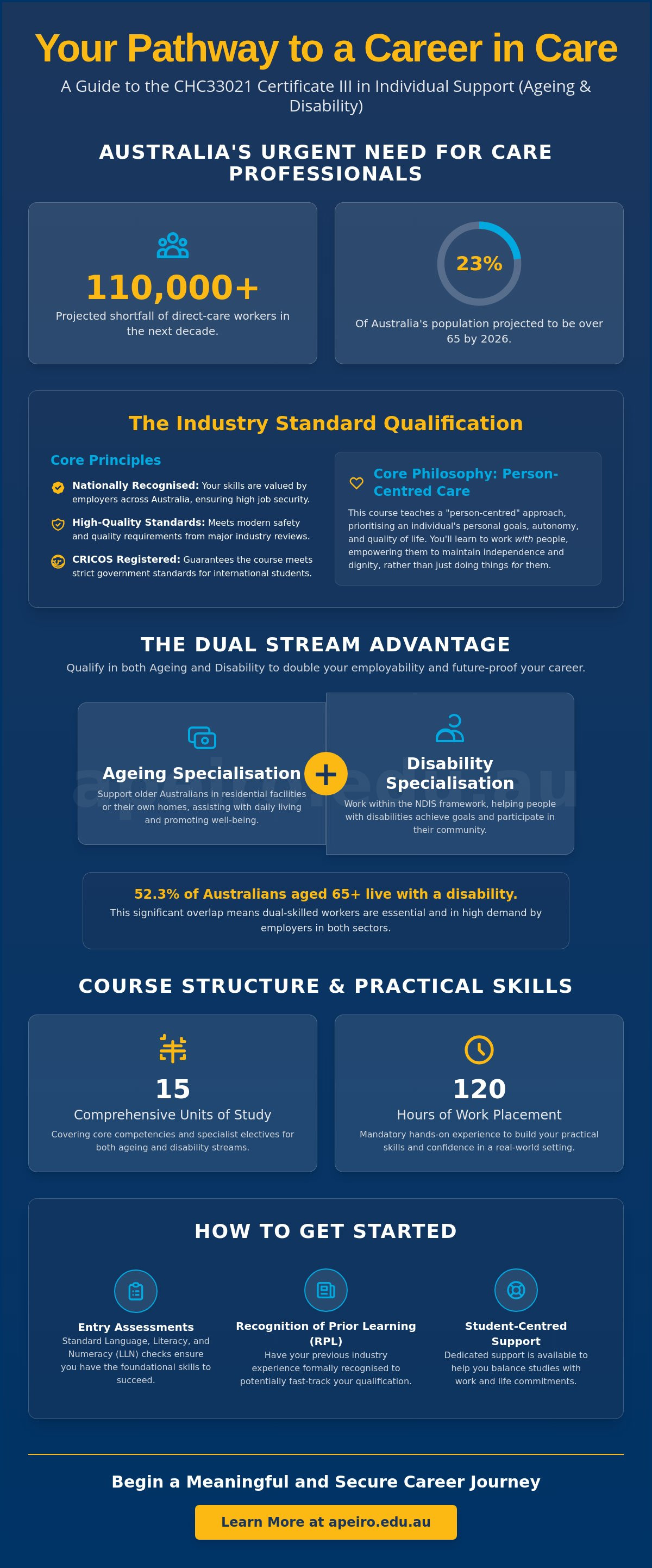
Did you know that Australia is facing a projected shortfall of over 110,000 direct-care workers within the next decade? With our ageing population set to reach 23% by 2026, the need for compassionate, skilled professionals has never been more urgent. You've likely felt the pull toward a more meaningful career, yet finding the right starting point can feel daunting. It's common to feel confused by complex course codes or worried about balancing your current commitments with new studies. The CHC33021 – Certificate III in Individual Support (Ageing and Disability) is the industry standard designed to bridge that gap, turning your natural empathy into a stable, professional future.
We understand that you want more than just a certificate; you want the confidence to step into a workplace and make a difference from day one. This comprehensive guide simplifies the process of getting qualified. We'll explore the entry requirements, the 120 hours of practical work placement, and how this nationally recognised qualification prepares you for immediate employment. Whether you're looking for job security or a way to give back to your community, we're here to help you navigate every step of your new journey.
Key Takeaways
- Learn why the CHC33021 – Certificate III in Individual Support (Ageing and Disability) is the essential qualification for anyone looking to enter Australia's high-demand care sector.
- Understand the "Dual Stream" advantage that makes you more employable by meeting the specific needs of both the NDIS and the aged care industry.
- Get a clear breakdown of the 15 units of study and the mandatory 120 hours of work placement required to build your practical, hands-on skills.
- Discover how your previous experience can be recognised through RPL and what to expect from standard entry assessments like Language, Literacy, and Numeracy.
- Explore the student-centred support available to help you balance your studies with work while navigating the specific requirements for international learners.
What is the CHC33021 – Certificate III in Individual Support?
The CHC33021 – Certificate III in Individual Support (Ageing and Disability) is the foundational qualification for anyone wanting to work in Australia's care sector. It is a nationally recognised training package. This means your skills will be valued by employers from Perth to Sydney, providing you with a high level of job security. This specific qualification was introduced to meet higher quality standards following major industry reviews. It ensures that every worker has a consistent, high-level skill set that meets modern safety requirements.
If you are joining us from overseas, studying with a CRICOS-registered provider is essential. It guarantees the course meets strict Australian Government standards for international education. This protection gives you peace of mind while you build your new career. It also ensures your qualification is respected by local healthcare providers when you begin your job search.
The Core Philosophy: Person-Centred Care
This course isn't just about clinical tasks; it's about a philosophy called person-centred care. Instead of a "one size fits all" approach, you learn to prioritise the individual's personal goals and autonomy. You'll learn how to balance clinical safety with genuine empathy. Understanding the history of Aged Care in Australia helps you see how far the industry has come in protecting the rights of those receiving support. It's about working with people, not just doing things for them.
In the 2026 healthcare environment, care workers are the backbone of the system. They provide the human connection that technology simply can't replace. You'll learn how to empower clients to maintain their independence for as long as possible. This approach improves the quality of life for the client and brings immense satisfaction to your daily work.
Ageing vs. Disability: Understanding the Streams
The ageing specialisation focuses on supporting older Australians. You might work in residential facilities or visit people in their own homes to assist with daily living. The disability specialisation is centred on the NDIS and community participation. In this stream, you help people with disabilities achieve their personal goals and engage with their local community. Both paths require a high level of patience and a commitment to human rights.
The industry is moving toward a multi-skilled workforce. Many older Australians also live with a disability, so the two sectors often overlap. Being qualified in both areas makes you twice as valuable to potential employers. It gives you the flexibility to move between different roles as your career grows. This "dual-stream" approach is the most effective way to future-proof your career in the care industry.
Why the Dual Ageing and Disability Specialisation is Vital in 2026
Choosing to qualify in both ageing and disability support isn't just a smart academic move; it's a strategic career decision. In the current job market, employers are looking for "dual-stream" professionals who can move seamlessly between different care environments. By completing the CHC33021 – Certificate III in Individual Support with both specialisations, you effectively double your employability. This versatility allows you to work in residential aged care facilities one week and provide community-based disability support the next. It provides a level of job security that single-stream qualifications simply cannot match.
This dual approach directly addresses the recommendations from the Royal Commission into Aged Care and the evolving requirements of the NDIS. The industry is shifting toward a more integrated model of care. Since 52.3% of Australians aged 65 or over live with a disability, according to 2022 data, having the skills to manage both sets of needs is essential. It future-proofs your career against economic shifts in either sector, ensuring you remain a high-priority candidate for healthcare providers across the country. If you're ready to take this step, enrolling in a dual-specialisation course is the most effective way to begin.
The Growing Demand for Skilled Support Workers
The demand for qualified staff is reaching critical levels. The Committee for Economic Development of Australia (CEDA) estimates a potential shortfall of 400,000 direct-care workers by 2050. This isn't a distant problem; the pressure is being felt right now in 2026. As the NDIS framework continues to prioritise community-based support, more workers are needed to help individuals live independently in their own homes. This shift creates a permanent, growing need for staff who hold the CHC33021 – Certificate III in Individual Support (Ageing and Disability).
Career Pathways and Beyond
Your journey usually begins in entry-level roles such as a Personal Care Assistant (PCA), Support Worker, or Community Care Worker. These positions offer a fantastic way to gain hands-on experience while making a real difference in people's lives. However, the CHC33021 is only the beginning. Many of our students eventually pathway into the Diploma of Community Services to move into management or case coordination roles. Others use their experience as a stepping stone toward specialised nursing or social work. The skills you learn today form the foundation for a lifelong career in health and human services.
Entry Requirements and Recognition of Prior Learning (RPL)
Stepping into a career in care is about more than just having a kind heart. You also need to meet specific regulatory and academic benchmarks to ensure you're ready for the demands of the job. Most students begin their journey with a Language, Literacy, and Numeracy (LLN) assessment. This isn't a high-pressure exam; it's a supportive tool we use to ensure you have the reading and writing skills needed to succeed in your studies. Beyond the classroom, you'll need to secure several mandatory clearances. These include a National Police Check, a Working with Children Check, and an NDIS Worker Screening Check. These are non-negotiable requirements for anyone working within the National Disability Insurance Scheme (NDIS) framework.
You should also be aware that most care facilities and placement providers require evidence of current vaccinations, including influenza and COVID-19. These checks and health requirements exist to protect both you and the vulnerable people you'll be supporting. If you're worried about the paperwork or the process, don't be. We're here to guide you through every step of these entry requirements, ensuring you're fully compliant and ready to start your practical training without delay.
Formalise Your Experience via RPL
Many people entering this field aren't actually "new" to care. You might have spent years looking after family members or working in uncertified support roles. If that's you, don't feel like you have to start from scratch. Recognition of Prior Learning (RPL) allows you to turn your "on-the-job" hours into a Certificate III. By providing evidence such as references from supervisors, detailed logs of your work hours, and workplace observations, you can bypass units you already master. This path offers significant cost savings and allows for a much faster certification process, giving you the professional validation you've already earned through your hard work.
The TPEW Advantage at Apeiro
At Apeiro, we specialise in helping skilled individuals through our Trade Pathways for Experienced Workers (TPEW) approach. We understand that experienced workers often find the formal assessment process more daunting than the actual care work. That's why we provide dedicated mentorship throughout the entire assessment. Our goal is to ensure you aren’t overwhelmed by the transition from practical skill to national certification. We act as a bridge, helping you translate your real-world expertise into the formal competencies required for the CHC33021 – Certificate III in Individual Support (Ageing and Disability). It's a respectful, student-centred way to get the qualification you need to advance your career.
What You Will Learn: Units, Skills, and Work Placement
The CHC33021 – Certificate III in Individual Support (Ageing and Disability) is structured into 15 units of competency. You'll complete 9 core units that provide the essential building blocks for any care role. These cover critical areas such as infection prevention, supporting independence, and understanding healthy body systems. For example, learning about body systems helps you recognise early signs of health decline in your clients, allowing for faster intervention. The remaining 6 elective units are where you specialise. This combination ensures you aren't just learning theory; you're gaining the specific knowledge that employers in both sectors desperately need right now.
The ageing units prioritise dignity and comfort. You'll learn the complexities of dementia support, including how to manage changed behaviours with patience and empathy. Palliative care units teach you how to provide respectful, compassionate support during one of life's most sensitive stages. For the disability stream, units focus on fostering empowerment and community participation. You'll learn how to help clients navigate their support plans and advocate for their own choices. This involves understanding how to facilitate social inclusion and support people with diverse needs in reaching their personal milestones.
The 120-Hour Mandatory Work Placement
A standout feature of this qualification is the 120-hour mandatory work placement. This isn't just a box-ticking exercise. It's your chance to apply what you've learned in a real-world aged care or disability setting. You'll work alongside experienced professionals, gaining hands-on confidence that a classroom alone can't provide. You might find yourself assisting with daily activities in a residential facility or supporting a client with community outings. Many of our students find that their placement host becomes their first employer. It's essentially a 120-hour job interview where you can demonstrate your work ethic and compassion. If you're ready to gain these practical skills, view our course units and placement details to see how we support you through this process.
Essential Technical and Soft Skills
Beyond the units, you'll develop a mix of technical and soft skills. Technical training includes manual handling to keep both you and your clients safe, as well as assistance with medication and accurate reporting. These skills ensure you meet the high safety standards expected in Australian healthcare. However, your soft skills are just as vital. You'll learn the importance of active listening, cultural safety, and building the emotional resilience needed for a long-term career. Person-Centred Support is the practice of tailoring care to an individual’s unique needs, choices, and life goals to ensure they remain the active lead in their own care journey. This human-first approach is what sets high-quality support workers apart in the 2026 healthcare landscape.
Start Your Care Journey with Apeiro Institute
At Apeiro, we don't just teach the CHC33021 – Certificate III in Individual Support (Ageing and Disability); we mentor you into a new way of living. We know that many of our students are career changers looking for more purpose. You might be leaving a retail job or returning to the workforce after a break. Our learning environment is designed to be supportive and flexible, fitting around your current work or family life. You'll have access to modern facilities and, more importantly, trainers who have spent years working on the front lines of the Australian care sector. They bring real stories and practical solutions into every lesson.
For those joining us from abroad, our CRICOS registration ensures your education meets the highest national standards. We provide specific guidance on Australian work rules and visa requirements to ensure you can study and gain experience legally and safely. It's about giving you a secure foundation to build your future in Australia. We believe that your success as a student is the first step toward your success as a professional, and we're here to support that transition at every turn.
A Community of Diverse Learners
Apeiro is proud to host a community representing over 38 nationalities. This diversity isn't just a number; it's a vital part of your training. In a sector where cultural safety is paramount, learning alongside peers from different backgrounds prepares you for the diverse range of clients you'll meet in the workforce. You'll gain a deeper understanding of various cultural perspectives on ageing and disability through daily interactions. Our trainers act as mentors, offering direct support based on their own professional journeys. They understand the challenges of the sector and are here to help you build the emotional resilience needed for a long-term career.
Enrolment and Next Steps
Taking the first step is often the hardest part. To apply for the CHC33021 Certificate III in Individual Support, simply reach out to our admissions team. We'll help you understand your funding options and walk you through the course fees to ensure your education is accessible. On your first day, you'll need a notebook, a willingness to learn, and a compassionate mindset. We provide the rest. Whether you're entering through a traditional study path or the Trade Pathways for Experienced Workers (TPEW) route, your success is our priority. Your journey toward a rewarding career in care starts with a single conversation.
Launch Your Career in Australia’s Care Sector
The Australian care industry is growing at a rapid pace, and there has never been a better time to join this rewarding field. By choosing the CHC33021 – Certificate III in Individual Support (Ageing and Disability), you are positioning yourself at the heart of a sector that values empathy and professional skill. You now understand how the dual-stream approach doubles your employability and how our specialised RPL pathways can recognise the experience you already have. With the guidance of our experienced industry trainers, you will gain the hands-on confidence needed to excel during your 120-hour work placement and beyond.
Apeiro Institute (RTO 45394 & CRICOS 03703M) is committed to your personal and professional growth. We provide the supportive environment you need to balance your studies with your life commitments. It is time to turn your compassion into a stable, long-term career. Enrol in the CHC33021 at Apeiro Institute Today and take the first step toward a future where your work truly matters. We look forward to welcoming you into our community of dedicated learners.
Frequently Asked Questions
What is the difference between aged care and individual support?
Individual support is the modern umbrella term for the sector, while aged care is a specific stream within it. Individual support focuses on a person-centred approach across various settings, including disability and community care. The CHC33021 – Certificate III in Individual Support (Ageing and Disability) combines these areas to give you a broader, more versatile skill set than a traditional aged care certificate.
How long does it take to complete the Certificate III in Individual Support?
Most students complete their qualification within six to twelve months depending on their study load. If you're studying full-time, you'll likely finish sooner than those balancing part-time study with work. For experienced workers, the timeframe can be even shorter if you're eligible for Recognition of Prior Learning, which fast-tracks units based on your existing expertise.
Can I work in disability support with just an aged care certificate?
It's possible, but many employers now prefer the dual-specialisation qualification to ensure you understand modern NDIS frameworks. Older aged care certificates often lack the specific units on empowerment and community participation required for disability roles. Holding a dual qualification makes you more adaptable and ensures you meet the current regulatory standards for both sectors.
Is the CHC33021 a nationally recognised qualification?
Yes, this is a formal qualification under the Australian Qualifications Framework (AQF). This means your certificate is respected and accepted by healthcare employers in every state and territory across Australia. Whether you're applying for a role in a major city or a regional community, your credentials will be recognised as meeting the national industry standard.
What are the job prospects for care workers in Australia in 2026?
Job prospects are exceptionally strong due to Australia's rapidly ageing population and the continued expansion of the NDIS. With 23% of the population projected to be over 65 by 2026, there is a permanent and urgent need for qualified staff. This high demand translates to excellent job security and a wide variety of roles in residential facilities and home-based care.
Do I need to do a work placement to get my Certificate III?
Yes, completing a minimum of 120 hours of practical work placement is a mandatory requirement. This ensures you can safely apply your classroom learning in a real-world healthcare environment. It's a vital part of the course that builds your confidence in manual handling, client communication, and clinical support under the guidance of experienced industry professionals.
Can international students study the CHC33021?
International students can definitely study this course provided they enrol with a CRICOS-registered provider. This registration ensures the program meets strict Australian government standards for international education. You'll need to meet specific English language requirements and follow the work-hour conditions of your visa while completing your CHC33021 – Certificate III in Individual Support (Ageing and Disability).
What is RPL and can I use it for this course?
Recognition of Prior Learning (RPL) is a process that turns your existing work experience and skills into formal course credits. If you've already worked in a care role or have relevant life experience, you can use RPL to bypass certain units of study. This reduces your time in the classroom and acknowledges the professional expertise you've already gained on the job.

Disclaimer
The information provided on this blog is for general informational and educational purposes only. While every effort is made to ensure the accuracy and reliability of the content, the author makes no representations or warranties of any kind, express or implied, about the completeness, accuracy, suitability, or availability of the information contained on this blog.
The views and opinions expressed in blog posts are those of the individual author and do not necessarily reflect the official policy or position of any organization, company, or employer.
This blog may contain links to external websites or third-party content. These links are provided for convenience only, and the author has no control over and assumes no responsibility for the content, privacy policies, or practices of any third-party sites.
Nothing on this blog constitutes professional advice (legal, financial, medical, or otherwise). Readers are encouraged to seek appropriate professional guidance before making any decisions based on the information provided here.
By using this blog, you acknowledge that any reliance on the information is at your own risk.


