

What if the years you've spent getting your hands greasy under the bonnet could be turned into a formal qualification without starting from zero? Many aspiring mechanics in Australia feel stuck, worried that they've missed the boat or that a traditional four year apprenticeship is the only way forward. It's common to feel overwhelmed by complex entry requirements or confused about how your international experience fits into the local system. The good news is that the AUR30620 – Certificate III in Light Vehicle Mechanical Technology is designed to be a flexible trade passport rather than a rigid hurdle.
We understand that you're looking for more than just a job; you want the higher earning potential and career security that comes with being a trade qualified professional. This guide will show you exactly how to achieve that status by mastering core units or fast tracking your certification through Recognition of Prior Learning (RPL). We'll clear up the confusion around international student eligibility and help you navigate the 2026 changes to apprenticeship incentives. You'll finish this article with a clear, practical roadmap to becoming a mechanic and eventually stepping into a workshop manager role.
Key Takeaways
- Understand why the AUR30620 – Certificate III in Light Vehicle Mechanical Technology is the essential credential for anyone looking to become a trade-qualified motor mechanic in Australia.
- Learn the specific workshop skills you'll master, from traditional engine repairs to diagnosing complex electrical and electronic faults in modern vehicles.
- Discover how experienced workers can use Trade Pathways (TPEW) and RPL to fast-track their certification instead of committing to a standard four-year apprenticeship.
- Get clear on the 2026 entry requirements and funding options, ensuring you have the right academic and physical foundations to start your journey.
- Explore your future career progression, from working in busy dealerships to advancing into specialised automotive mechanical diagnosis roles.
What is the AUR30620 Certificate III in Light Vehicle Mechanical Technology?
Starting a career in the automotive world requires more than just a knack for fixing things. You need a qualification that employers trust and recognise. The AUR30620 – Certificate III in Light Vehicle Mechanical Technology is the industry-standard credential that turns your interest into a professional trade. It's the essential framework for understanding what is an auto mechanic in the modern Australian context. This nationally recognised training ensures you're ready to handle the complexities of passenger cars, SUVs, and light commercials while meeting strict national standards.
Why This Qualification is Essential for Your Trade
Gaining your trade certificate is a major milestone for your career progression. In most Australian states, you cannot legally sign off on mechanical repairs or work as a lead technician without a recognised qualification. The AUR30620 – Certificate III in Light Vehicle Mechanical Technology meets the requirements for a motor vehicle repairer's licence, giving you the authority to stand behind your work. This certification also places you within the Australian Qualifications Framework (AQF), which means your skills are portable across the country. Whether you want to work for a high-end European dealership or a local independent workshop, this certificate proves you have the technical foundation to succeed.
Light Vehicle vs. Heavy Vehicle: Choosing Your Path
Choosing between light and heavy vehicle streams is one of the first big decisions you'll make. The AUR30620 focuses on vehicles up to 4.5 tonnes Gross Vehicle Mass (GVM), which covers almost everything from city hatchbacks to heavy-duty 4WDs and utes. This path is incredibly versatile because the sheer volume of light vehicles on the road ensures a constant demand for skilled technicians. Unlike the AUR31120, which specialises in heavy commercial trucks and machinery, the light vehicle qualification offers a broader range of daily tasks. It's an excellent starting point that opens doors to further specialisations in automotive diagnostics and high-performance technology. By mastering these smaller, more complex systems first, you build a versatile skill set that remains in high demand regardless of shifts in the economy.
Core Units and Skills: What You Will Master in the Workshop
The workshop is where your career truly begins. Through the AUR30620 – Certificate III in Light Vehicle Mechanical Technology, you'll transition from basic tinkering to precision engineering. You'll master the fundamentals of internal combustion engines, manual and automatic transmissions, and complex braking systems. These aren't just isolated tasks; they're the building blocks of vehicle safety and performance. You'll learn to diagnose wear, replace components with accuracy, and ensure every vehicle leaving your bay is roadworthy.
Modern vehicles are rolling computers. While the mechanical parts still move, they're controlled by intricate electronic networks. You'll spend significant time learning to diagnose faults in engine management systems, anti-lock braking (ABS), and stability control. As you research automotive industry careers, you'll find that the ability to use high-end scan tools is just as vital as knowing how to use a torque wrench. Your training ensures you can navigate these digital systems with confidence.
Safety and environmental standards are the backbone of any modern Australian workshop. You'll learn to manage hazardous materials, such as oils and coolants, ensuring they're disposed of according to local regulations. Mastering steering and suspension systems is another critical focus. These components are vital for vehicle stability, and your ability to calibrate them accurately will be a key part of your daily routine. Precision is everything when a driver's safety is in your hands.
The Balance of Theory and Practical Training
Success in the workshop requires a solid grasp of why systems fail, not just how to fix them. Your training combines classroom theory with hands-on application. You'll use industry-standard diagnostic software to interpret data before ever picking up a tool. You'll also develop essential soft skills. Learning how to communicate with customers and organise a workshop floor makes you a far more valuable employee in the eyes of a foreman.
Modern Technology: Beyond Simple Mechanics
The industry is shifting. With electric vehicles accounting for approximately ten per cent of new car sales in Australia as of 2026, your training must look ahead. You'll be introduced to EV safety protocols and high-voltage systems. Understanding how body control modules and vehicle communication networks interact is essential for the digital future. If you're ready to start building these skills, exploring a Certificate III path is the first step toward a future-proof career.
Recognition of Prior Learning (RPL) vs. Traditional Apprenticeships
You don't always need to spend four years as an apprentice to get your trade papers. While the traditional apprenticeship is a fantastic route for school leavers starting from scratch, it isn't always the best fit for someone who has already spent years on the workshop floor. If you've been turning wrenches and diagnosing faults for a long time, you likely already possess the skills required for the AUR30620 – Certificate III in Light Vehicle Mechanical Technology. Formalising those skills through Recognition of Prior Learning (RPL) can save you years of redundant study.
The main difference between these two paths is the timeline and the delivery of training. A traditional apprenticeship usually takes four years and involves a mix of on-the-job training and regular block release at a trade school. In contrast, an RPL assessment focuses on proving what you already know. For many experienced workers, the Trade Pathways for Experienced Workers (TPEW) program is a game-changer. It allows you to move from being an uncertified assistant to a trade-qualified technician in months rather than years. This isn't a shortcut; it's a rigorous process that acknowledges your existing expertise.
How RPL Works for Automotive Professionals
The RPL process starts with a deep dive into your current daily tasks. A qualified assessor looks at your skills and maps them directly against the unit requirements of the AUR30620 – Certificate III in Light Vehicle Mechanical Technology. If you can prove you're already competent in specific areas, like servicing cooling systems or repairing steering components, you get credit for those units. If the assessment identifies a "gap" in your knowledge, such as working with hybrid safety protocols, you only need to complete training for that specific unit. This targeted approach respects your time and your existing talent.
The TPEW Advantage for Skilled Workers
The TPEW pathway is specifically designed for workers who have significant industry experience but lack the formal piece of paper. To succeed, you'll need to build a solid portfolio of evidence. This isn't just about a resume; it's about showing your skills in action. You'll gather items such as:
- Photos and videos of you performing complex mechanical repairs.
- Detailed references from licensed supervisors or workshop owners.
- Logbooks or job cards that show the variety of vehicles you've worked on.
- Past employment records and training certificates from specific manufacturers.
Formalising your experience is a smart financial move. While there's an investment involved in the assessment process, the cost of remaining uncertified is often much higher. Qualified mechanics in Australia command significantly higher hourly rates and have access to more senior roles. By choosing the TPEW pathway, you're investing in a credential that reflects the true value of your hard-earned experience.
Entry Requirements and Funding: How to Get Started in 2026
Getting started in the automotive industry is more accessible than you might think. For the AUR30620 – Certificate III in Light Vehicle Mechanical Technology, the standard academic entry point is typically Year 10 or an equivalent level of schooling. While you don't need a university degree, you do need a sharp mind for problem solving. Modern mechanics spend as much time thinking through diagnostic logic as they do using physical strength. If you enjoy puzzles and have a high level of physical fitness, you're already halfway there.
Financial barriers shouldn't stop you from pursuing your trade. For residents in New South Wales, Smart and Skilled funded courses provide a way to access subsidised training. These government initiatives are designed to bridge the skills gap in priority industries like automotive repair. Eligibility usually depends on your residency status and previous qualifications. It's always worth checking if you qualify for fee-free or low-cost options before you begin.
The enrolment process is designed to be supportive and straightforward. It usually follows these steps:
- Initial inquiry to discuss your career goals and study options.
- A pre-training review to ensure the course matches your needs.
- A Language, Literacy, and Numeracy (LLN) assessment to identify any support you might need.
- Formal enrolment and a comprehensive orientation to the workshop environment.
CRICOS and International Student Requirements
Australia is a global leader in mechanical training, making it a top choice for international vocational students. If you're applying from overseas, you'll need to demonstrate English language proficiency through an IELTS test or equivalent. Once enrolled in the AUR30620 – Certificate III in Light Vehicle Mechanical Technology, your student visa generally allows for specific work rights. This lets you gain practical experience in a local workshop while you study. It's a great way to build a professional network while you learn.
Navigating Fees and Government Subsidies
We understand that managing costs is a priority. Many students find that employer-sponsored training is an excellent option if they're already working in a workshop. If you're paying independently, flexible payment plans can help spread the cost over the duration of your course. Always check the difference between upfront tuition and total course fees to plan your budget effectively. If you're ready to see which funding path fits your situation, enquire about our enrolment options today and let our team guide you through the process.
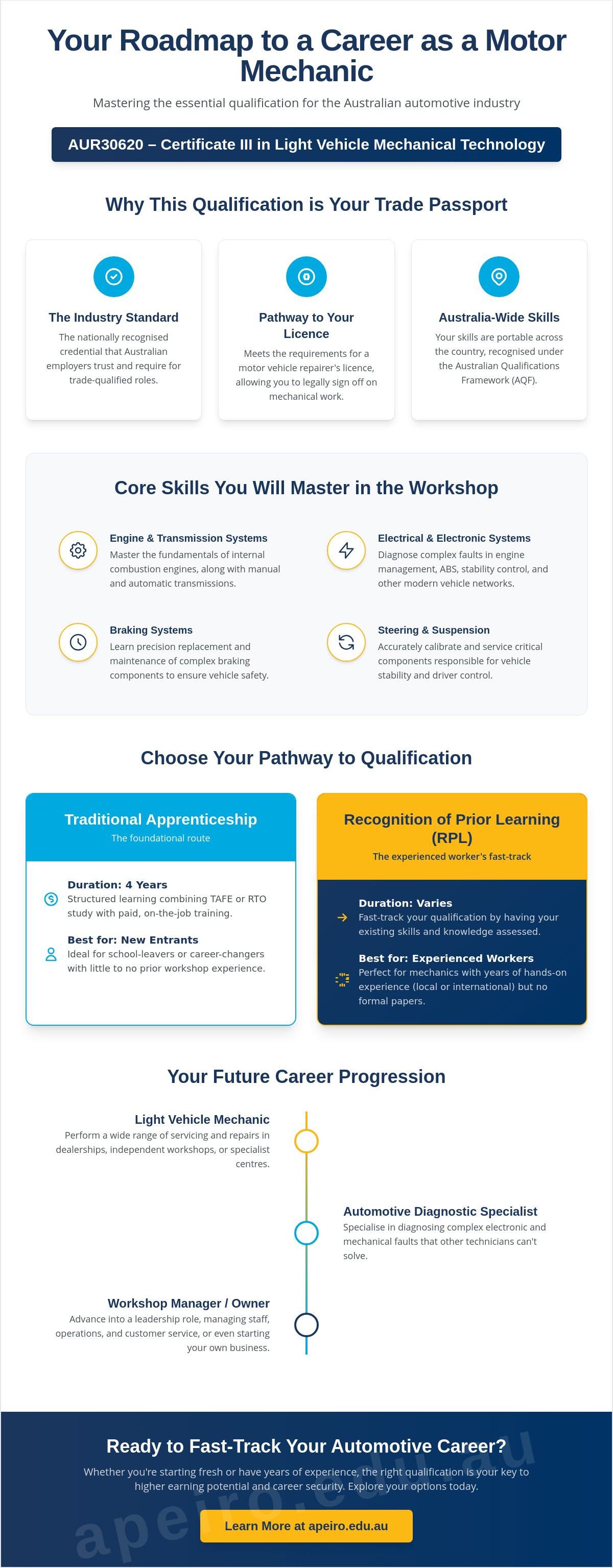
Career Pathways: Life After Your AUR30620 Qualification
Completing your trade qualification is a significant milestone that changes your professional status overnight. Once you've earned your AUR30620 – Certificate III in Light Vehicle Mechanical Technology, you're no longer just an assistant or a student. You're a trade-qualified technician. This opens doors to immediate roles in high-volume dealerships, specialised performance shops, or independent local workshops. The demand for skilled mechanics in Australia remains high, and your new credentials give you the leverage to negotiate better pay and more stable working conditions.
Your career doesn't have to stay under the bonnet forever. Many technicians use their workshop experience as a springboard into management or advisory roles. You might transition into a service advisor position, acting as the vital link between customers and the workshop floor. Alternatively, you could work toward becoming a workshop manager, overseeing daily operations, staff, and safety protocols. For those with an entrepreneurial spirit, this certificate is the foundational requirement for eventually opening your own mechanical repair business. You could also choose to specialise in niche areas like high-performance tuning, fleet maintenance for large corporations, or the rapidly evolving world of electric vehicle (EV) technology.
Advancing to Automotive Technology Diplomas
For those who enjoy the "detective work" of mechanical repairs, the next logical step is moving into advanced diagnostics. The Cert III provides the essential prerequisite skills for the AUR40216 Certificate IV in Automotive Mechanical Diagnosis. This shift moves you away from routine servicing and toward high-level system analysis. Diagnostic specialists are among the highest earners in the Australian automotive market because they can solve the complex electrical and software issues that stump general technicians. From there, you can even progress to a Diploma of Automotive Technology, further cementing your status as a leader in the trade.
Why Study with Apeiro Institute?
Choosing where to study is just as important as the qualification itself. At Apeiro Institute, we're committed to a student-centred approach that prioritises your personal growth and career success. Our trainers aren't just academics; they're industry experts who bring years of real-world workshop experience into the classroom. We understand that many of our students are balancing work and family life, which is why we offer flexible learning options designed to fit your schedule. We act as your partner in success, providing the support you need to move from your current circumstances to your dream career.
Ready to start your journey toward becoming a trade-qualified mechanic? View the AUR30620 course details here and take the first step toward a more secure and rewarding professional life.
Drive Your Automotive Career Forward
Achieving your trade papers is a milestone that changes everything about your professional life. We've looked at how the right training turns your mechanical interest into a career with genuine security and growth. Whether you're just starting out or an experienced worker looking to formalise your skills, the roadmap is now clear. You don't have to stay stuck in an uncertified role when the industry is crying out for qualified technicians.
The AUR30620 – Certificate III in Light Vehicle Mechanical Technology is your gateway to higher wages and the chance to lead your own workshop one day. Start your journey toward becoming a trade-qualified mechanic today with Apeiro Institute. We're specialists in Trade Pathways for Experienced Workers (TPEW) and offer Nationally Recognised Training (RTO Code 45394) that respects your time and your talent.
Your goals are within reach, and we're here to help you bridge the gap between where you are and where you want to be. It's time to get your hands on a future you've truly earned. We look forward to supporting you as you reach your full potential in the workshop and beyond.
Frequently Asked Questions
How long does it take to complete the AUR30620 Certificate III?
A traditional apprenticeship for the AUR30620 – Certificate III in Light Vehicle Mechanical Technology typically takes four years to finish. However, if you're an experienced worker using the RPL pathway, you could potentially qualify in just a few months. The timeline depends entirely on your current skill level and how quickly you can provide evidence of your competence to an assessor.
Can I get my mechanic qualification through RPL if I have overseas experience?
Yes, you can certainly use your overseas experience to gain your Australian trade papers through Recognition of Prior Learning (RPL). We specialise in Trade Pathways for Experienced Workers (TPEW) to help you bridge that gap. You'll need to provide solid evidence of your previous work, such as references, photos, and videos of you performing mechanical tasks in a workshop environment.
Is the AUR30620 qualification recognised in all Australian states?
The AUR30620 is a nationally recognised qualification under the Australian Qualifications Framework (AQF). This means it's accepted by licensing bodies and employers in every state and territory across Australia. Whether you're working in a busy Sydney dealership or a rural workshop in Western Australia, your certificate carries the same professional weight and authority.
What is the difference between a mechanic and an automotive technician?
While people often use the terms interchangeably, "technician" usually highlights the modern focus on computerised diagnostics and electronics. A mechanic traditionally focuses more on the physical repair of hardware and engines. The AUR30620 – Certificate III in Light Vehicle Mechanical Technology covers both aspects, ensuring you're comfortable with both heavy mechanical work and complex digital systems.
Do I need to have an apprenticeship to do the Certificate III in Light Vehicle Mechanical Technology?
You don't always need a formal apprenticeship contract to complete this course. While many students choose the four year apprenticeship route, experienced workers can opt for the TPEW pathway instead. This allows you to gain your qualification based on your existing industry knowledge without the need for a long term training contract if you already have the required workshop experience.
Are there government-funded options for the AUR30620 course in 2026?
Government funding is available in 2026 for eligible students through various state based initiatives. In New South Wales, for example, the Smart and Skilled program provides subsidised training for priority trades like automotive repair. Eligibility usually depends on your residency and your current level of schooling, so it's best to check your specific status with our enrolment team before you apply.
What tools do I need to start my Certificate III training?
You'll need basic personal protective equipment (PPE) like steel capped boots and high visibility overalls to start your practical training. While our workshop provides the heavy diagnostic equipment and specialised machinery, most apprentices and students begin building their own tool kit over time. This usually starts with a quality set of spanners, sockets, and screwdrivers that you'll use throughout your career.
Can international students apply for the AUR30620 course?
International students are welcome to apply for this course through our CRICOS registered programs. You'll need to meet specific English language requirements, such as a minimum IELTS score, and hold a valid student visa with work rights. Australia is a fantastic place to study automotive technology because our training facilities use some of the most advanced diagnostic tools available in the global market.

Disclaimer
The information provided on this blog is for general informational and educational purposes only. While every effort is made to ensure the accuracy and reliability of the content, the author makes no representations or warranties of any kind, express or implied, about the completeness, accuracy, suitability, or availability of the information contained on this blog.
The views and opinions expressed in blog posts are those of the individual author and do not necessarily reflect the official policy or position of any organization, company, or employer.
This blog may contain links to external websites or third-party content. These links are provided for convenience only, and the author has no control over and assumes no responsibility for the content, privacy policies, or practices of any third-party sites.
Nothing on this blog constitutes professional advice (legal, financial, medical, or otherwise). Readers are encouraged to seek appropriate professional guidance before making any decisions based on the information provided here.
By using this blog, you acknowledge that any reliance on the information is at your own risk.


