

What if you could swap the financial stress of full-time study for a steady pay packet while earning your qualification in one of Australia's most secure industries? It's a common dilemma; you want to make a difference, but you can't afford to stop working. Securing a paid traineeship aged care and disability solves this by letting you earn while you learn. Choosing between career pathways often feels confusing, especially when you're unsure which employers are reliable or how the transition affects your income.
We believe that starting a new career should feel attainable, not intimidating. This guide shows you how to launch a rewarding career in individual support through a paid traineeship that combines nationally recognised training with immediate employment. You'll discover how to gain your qualification while receiving a legal wage, giving you both financial security and professional growth.
We will explore the structure of the CHC33021 Certificate III in Individual Support, explain the 2026 award rates for aged care workers, and outline how NSW Smart and Skilled funding can support your journey. This is your clear roadmap to a stable and meaningful career in community services.
Key Takeaways
- Understand the formal structure of a traineeship and how it balances on-the-job work with structured vocational training.
- Explore the core units of the CHC33021 qualification that will prepare you for a versatile career in both ageing and disability support.
- Learn about your wage entitlements under the Modern Award and how to check your eligibility for a paid traineeship aged care and disability through NSW Smart and Skilled.
- Discover the specific soft skills that Australian employers value most and how to highlight them on your resume to land your first role.
- Find out how partnering with a student-centred RTO can bridge the gap between your current circumstances and your future professional goals.
What is a Paid Traineeship in Aged Care and Disability?
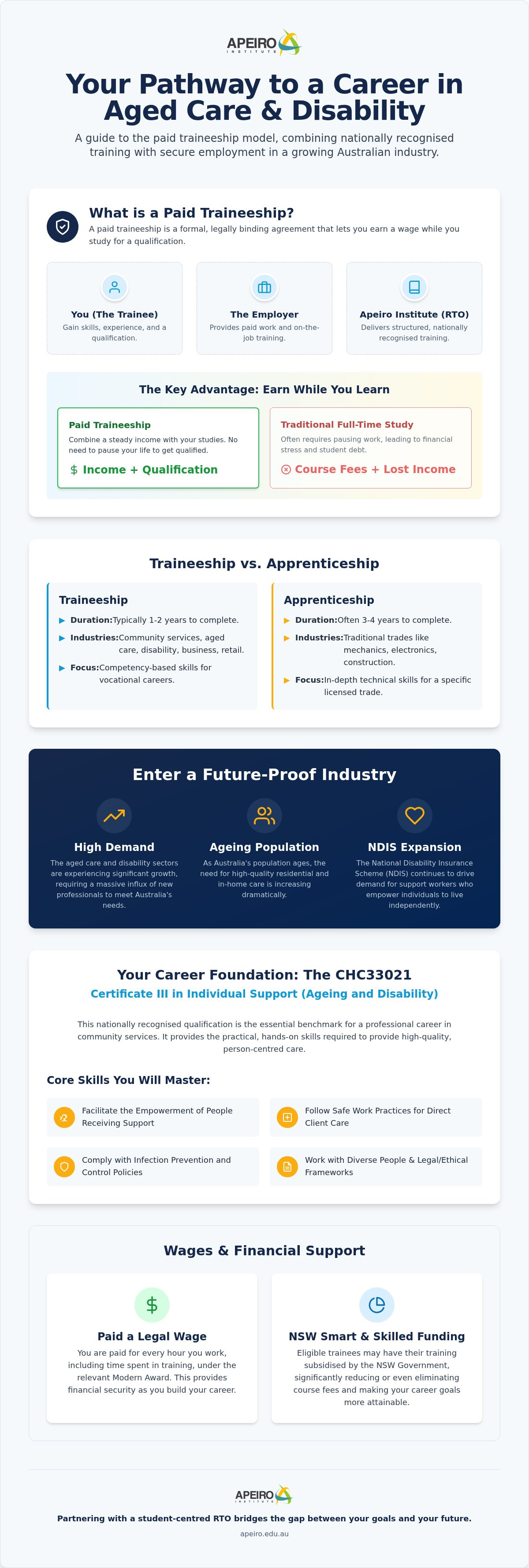
A paid traineeship aged care and disability is a legally binding agreement between three parties: you, your employer, and a Registered Training Organisation (RTO) like Apeiro Institute. This model bridges the gap between theory and practice. You spend part of your week working on-site, gaining real-world experience, and the rest of your time completing structured training. It's a practical way to enter the workforce without the financial burden of unpaid study. You're paid a legal wage for every hour you work, including the time you spend in class or finishing assessments.
This system sits within the wider framework of Vocational education. It focuses on competency-based learning, meaning you're assessed on your ability to perform specific tasks safely and effectively. For many, this hands-on approach is far more engaging than traditional classroom settings. It allows you to build confidence in a supportive environment while earning a steady income. We act as your guide throughout this process, ensuring your training aligns perfectly with the needs of your employer.
The Difference Between a Traineeship and an Apprenticeship
While people often use these terms interchangeably, they serve different career paths. Traineeships generally cover vocational areas such as community services, business, or retail. They usually take one to two years to complete. Apprenticeships are typically reserved for traditional trades like automotive mechanical diagnosis or electronics, often lasting three to four years. Despite these differences, both options provide a pathway to a nationally recognised qualification Australia. This ensures that the skills you learn today will be valued by employers across the nation for years to come.
Why the Individual Support Sector is Growing in 2026
The demand for skilled workers in Australia has never been higher. As our population ages, the need for high-quality residential and home care is increasing significantly. Current projections for 2026 show that the aged care sector requires a massive influx of new professionals to maintain standard levels of care. Simultaneously, the NDIS continues to drive demand for disability support workers who can help individuals live more independent lives.
Choosing a paid traineeship aged care and disability places you in a "future-proof" industry. It offers long-term job security and clear opportunities for career progression, moving from entry-level roles into specialised or management positions. Starting with the CHC33021 Certificate III in Individual Support (Ageing and Disability) gives you the flexibility to work across both sectors, effectively doubling your employment prospects in a competitive market.
The CHC33021 Qualification: Your Career Foundation
Entering the sector through a paid traineeship aged care and disability ensures you meet the rigorous standards set by the Australian Qualifications Framework. The CHC33021 Certificate III in Individual Support is the essential benchmark for anyone serious about a career in community services. It isn't just about obtaining a piece of paper; it's about mastering the practical skills required to provide high-quality, person-centred care. At Apeiro Institute, we've designed our delivery to be as hands-on as possible, bridging the gap between textbook theory and the real-world demands of a busy care environment.
Core Units and Skills You Will Acquire
During your studies, you'll dive deep into the core units that form the backbone of individual support. You'll learn how to facilitate the empowerment of people receiving support, moving beyond basic assistance to help clients maintain their dignity and independence. Safety is paramount, so we focus heavily on technical skills like safe manual handling and understanding healthy body systems to prevent injury to both yourself and your clients.
Infection control and hygiene practices are also critical components, especially in a post-pandemic landscape. You'll gain a firm grasp of the legal and ethical frameworks governing the Australian care sector, ensuring you practice with integrity and stay compliant with current regulations. These skills aren't just theoretical; you'll apply them daily during your work hours, receiving immediate feedback from industry professionals. This constant cycle of learning and doing is what makes the traineeship model so effective for new starters.
The Importance of a Dual Pathway
While some providers focus solely on one area, we believe in the power of a dual specialisation. By completing units in both Ageing and Disability, you significantly increase your employability. This flexibility allows you to move seamlessly between residential aged care facilities and community-based disability support settings depending on where the demand is highest. This is a major advantage when looking for a paid traineeship aged care and disability, as it makes you a more versatile asset to any employer.
If you're looking for a versatile career, you can learn more about the CHC33021 Certificate III in Individual Support and how it caters to both pathways. This dual approach means you're not just trained for one job, but for an entire sector. It's a strategic move that provides long-term security in an ever-changing job market. If you feel ready to take that first step, our team is here to help you navigate the enrolment process and find a pathway that suits your goals.
Wages, Benefits, and Smart and Skilled Funding
One of the most common concerns for students is how to balance their education with the cost of living. A paid traineeship aged care and disability addresses this directly by ensuring you are a formal employee from day one. You are legally covered by the relevant Modern Award, which for most in this sector is the Aged Care Award (MA000018) or the Social and Community Services Award. This means you aren't just a student; you're a professional with the same rights as your colleagues.
As of 1 July 2026, entry-level support roles (Level 1) start with a base rate of $27.77 per hour. Once you complete your training and become Certificate III qualified, this base rate increases to $34.42 per hour. These figures reflect a significant wage increase of 15 to 28.5 per cent mandated by the Fair Work Commission to better recognise the value of care work. Beyond your hourly rate, you also receive superannuation, sick leave, and annual leave entitlements. These protections provide a level of financial security that traditional full-time study simply cannot match.
The quality of your training is backed by national standards. The oversight provided by bodies like the Tertiary Education Quality and Standards Agency ensures that the qualification you earn carries weight across the entire country. Because the government recognises the critical shortage of skilled workers, they also provide incentives to employers to take on trainees, making it easier for you to find a placement.
Understanding Smart and Skilled Funded Courses in NSW
In New South Wales, the Smart and Skilled program is a game-changer for those looking to upskill. This initiative subsidises vocational training to make it more accessible. For 2026, many traineeships in individual support are available as fee-free options for eligible students. To qualify, you must be at least 15 years old, no longer at school, and living or working in NSW. You also need to be an Australian citizen, permanent resident, or hold a relevant humanitarian visa. You can check your eligibility for Smart and Skilled funded courses NSW to see how you can start your journey without the burden of upfront tuition costs.
Beyond the Paycheque: Employee Benefits
The financial side is only part of the story. Many employers in the disability and aged care sectors are not-for-profit organisations, which often allows them to offer salary packaging. This can increase your take-home pay by allowing you to pay for certain living expenses using your pre-tax income. You'll also likely have access to Employee Assistance Programs (EAP) and ongoing professional development opportunities. While the steady income is vital, most trainees find that the deepest reward is the genuine connection they build with their clients, knowing their work directly improves someone's quality of life every single day.
Steps to Securing Your Paid Traineeship in 2026
Starting your journey toward a paid traineeship aged care and disability requires more than just a keen interest. You need a strategic approach to stand out to potential employers. Begin by updating your resume to highlight "soft skills" like empathy, patience, and clear communication. While technical skills are taught during the course, these personal traits are what employers look for during the recruitment phase. They want to see that you have the right temperament for a role that involves deep personal connection and daily care.
You must also ensure your clearances are in order. Most employers require a National Police Check and an NDIS Worker Screening Check before you can step onto the floor. Getting these sorted early shows initiative and makes you "job-ready" from the moment you apply. It's also vital to research Registered Training Organisations (RTOs) that have strong industry ties. A partner like Apeiro Institute acts as a bridge, connecting you with quality employers who value structured training and student support. We help you transition from the classroom to the workplace with confidence.
Finding Traineeship Vacancies
Finding a paid traineeship aged care and disability role involves looking beyond standard job ads. Use Australian job boards and search for specific terms like "trainee support worker" or "entry-level individual support". You can also reach out to Group Training Organisations (GTOs) that specialise in community services. These organisations often manage the employment side of your traineeship, placing you with reliable providers. Don't be afraid to contact local aged care facilities or disability service providers directly to ask about their next intake. Many organisations prefer to hire people who show the initiative to reach out personally.
Meeting the Entry Requirements
Before you start, you'll need to complete a Language, Literacy, and Numeracy (LLN) assessment. This ensures you can handle the documentation and reporting required in a professional care setting. Physical fitness is also a factor; you'll need the stamina to stand for long periods and perform manual handling tasks safely. For community-based roles, having a valid driver's licence is often a non-negotiable requirement. Being able to travel to a client's home is a core part of providing flexible, person-centred support. When you reach the interview stage, focus on your passion for helping others. Employers aren't looking for experts yet; they're looking for trainees who are eager to learn and committed to the principles of person-centred care.
Apply for your Certificate III in Individual Support today
Why Partner with Apeiro Institute for Your Training?
Choosing where to study for your paid traineeship aged care and disability is a significant decision that shapes your professional future. At Apeiro Institute (RTO 45394), we act as more than just a training provider; we are your empowering mentor throughout the entire journey. Our learning environment is designed to be warm, inclusive, and student-centred, moving away from the cold feel of traditional institutional settings. We understand that starting a new educational path can feel intimidating, so we've built a culture of support that makes your goals feel attainable from day one.
Our trainers are the heart of our program. They are industry experts who bring years of real-world experience from the front lines of the Australian care sector directly into the classroom. This ensures that the skills you acquire are practical and perfectly aligned with what employers expect in 2026. Navigating government funding can often feel like a headache, but our team is here to help you simplify the process. We guide you through the eligibility criteria for NSW Smart and Skilled funding, ensuring you can access the subsidies or fee-free options you're entitled to without the stress of complex paperwork.
Our Commitment to Your Success
We believe that true competency comes from doing. That is why we take a proactive role in bridge-building between our students and the industry. We help organise practical placements that provide the hands-on experience necessary to build your confidence in a real-work setting. Our support is consistent, lasting from your initial enrolment through to your graduation and beyond. We don't just want you to finish a course; we want you to build a career. For those looking to progress even further, we offer clear pathways into higher-level qualifications, such as the Diploma of Community Services Australia, which can lead to roles in case management and leadership.
Ready to Start Your Journey?
Your transition into a stable and fulfilling career is just a conversation away. If you're already working in the sector and have existing skills that haven't been formally recognised, you might be interested in our TPEW pathways for experienced workers. This can help you fast-track your qualification through Recognition of Prior Learning (RPL). For everyone else, a paid traineeship aged care and disability offers the perfect blend of income and education. Reach out to our friendly, expert team today to discuss your career goals. We are ready to help you take that first step toward a rewarding future in the individual support sector.
Launch Your Future in Individual Support
Securing a paid traineeship aged care and disability is a strategic choice for anyone looking to enter the community services sector with confidence. You've seen how this model provides a steady income while you work toward a nationally recognised qualification under the guidance of expert trainers. By focusing on both ageing and disability support, you're positioning yourself for maximum flexibility and long-term job security in an industry that's only growing.
With Smart and Skilled funding available for eligible NSW residents, the path to becoming a qualified professional has never been more accessible. Apeiro Institute (RTO 45394) is here to act as your mentor, bridging the gap between your current goals and a rewarding career. Our industry-expert trainers bring real-world experience to every lesson, ensuring you feel prepared for the challenges of the workplace.
Enrol in the CHC33021 Certificate III in Individual Support today
It's time to take control of your professional growth and start making a genuine difference in your community. We are ready to support you every step of the way toward your new career.
Frequently Asked Questions
How much do I get paid during an aged care traineeship?
You are paid according to the Aged Care Award (MA000018). As of 1 July 2026, entry-level trainees start at a base rate of $27.77 per hour. Once you complete your qualification, this rate increases to $34.42 per hour for a Direct Care Level 2 employee. These rates don't include casual loading or penalty rates for weekends and public holidays, which can significantly increase your take-home pay while completing your paid traineeship aged care and disability.
Can I do a disability support traineeship without any prior experience?
Yes, you can start a disability support traineeship with no prior industry experience. These programs are specifically designed to provide the foundation you need while you work. Employers often prioritise soft skills such as empathy, patience, and strong communication over technical knowledge. During your paid traineeship aged care and disability, you will be mentored by experienced staff who will guide you through the practical aspects of person-centred care in a real-world setting.
How long does it take to complete a Certificate III traineeship?
A Certificate III traineeship typically takes between 12 and 24 months to complete. The exact duration depends on whether you're working full-time or part-time and the specific requirements of your training contract. You'll need to complete 15 units of competency and a minimum of 120 hours of work placement. This timeframe ensures you have enough time to master the essential skills while maintaining a steady income throughout your learning journey.
What is the difference between aged care and disability support?
While both roles focus on individual support, their focus areas differ. Aged care involves assisting seniors with daily living, often in residential facilities or through home care. Disability support focuses on helping individuals with physical or intellectual disabilities achieve greater independence under the NDIS framework. The CHC33021 qualification covers both areas, giving you the flexibility to work across the entire community services sector depending on where you feel most passionate.
Is the Certificate III in Individual Support a fee-free course?
It is often available as a fee-free course through the NSW Smart and Skilled program. If you're an Australian citizen or permanent resident living or working in NSW, you may be eligible for fully subsidised training. This initiative aims to remove financial barriers for those entering high-demand industries. We can help you check your specific eligibility during the enrolment process to ensure you're accessing all available government support for your vocational training.
What happens after I finish my traineeship?
Upon completion, you'll hold a nationally recognised CHC33021 Certificate III in Individual Support. Most trainees continue working with their host employer as a fully qualified support worker with a higher pay rate. You'll also have a clear path to further your education, such as moving into a Diploma of Community Services. This qualification is a respected industry standard that opens doors to stable employment across Australia's fastest-growing care sectors.
Can international students apply for a paid traineeship?
Paid traineeships are generally reserved for Australian citizens, permanent residents, or specific humanitarian visa holders. International students usually enter the sector through a standard vocational program as part of their CRICOS-registered studies. While international students can still gain work experience and earn a wage while studying, the formal traineeship contract system has specific residency requirements. We recommend contacting our team to discuss the best study pathway for your specific visa status.
Do I need a police check to start working in aged care?
Yes, a National Police Check is a mandatory legal requirement for anyone working in the aged care or disability sectors. You will also likely need an NDIS Worker Screening Check if your role involves supporting people with disabilities. These clearances must be obtained before you start your practical placement or employment. Having these checks ready early shows potential employers that you are organised and ready to begin your career without delay.

Disclaimer
The information provided on this blog is for general informational and educational purposes only. While every effort is made to ensure the accuracy and reliability of the content, the author makes no representations or warranties of any kind, express or implied, about the completeness, accuracy, suitability, or availability of the information contained on this blog.
The views and opinions expressed in blog posts are those of the individual author and do not necessarily reflect the official policy or position of any organization, company, or employer.
This blog may contain links to external websites or third-party content. These links are provided for convenience only, and the author has no control over and assumes no responsibility for the content, privacy policies, or practices of any third-party sites.
Nothing on this blog constitutes professional advice (legal, financial, medical, or otherwise). Readers are encouraged to seek appropriate professional guidance before making any decisions based on the information provided here.
By using this blog, you acknowledge that any reliance on the information is at your own risk.


