

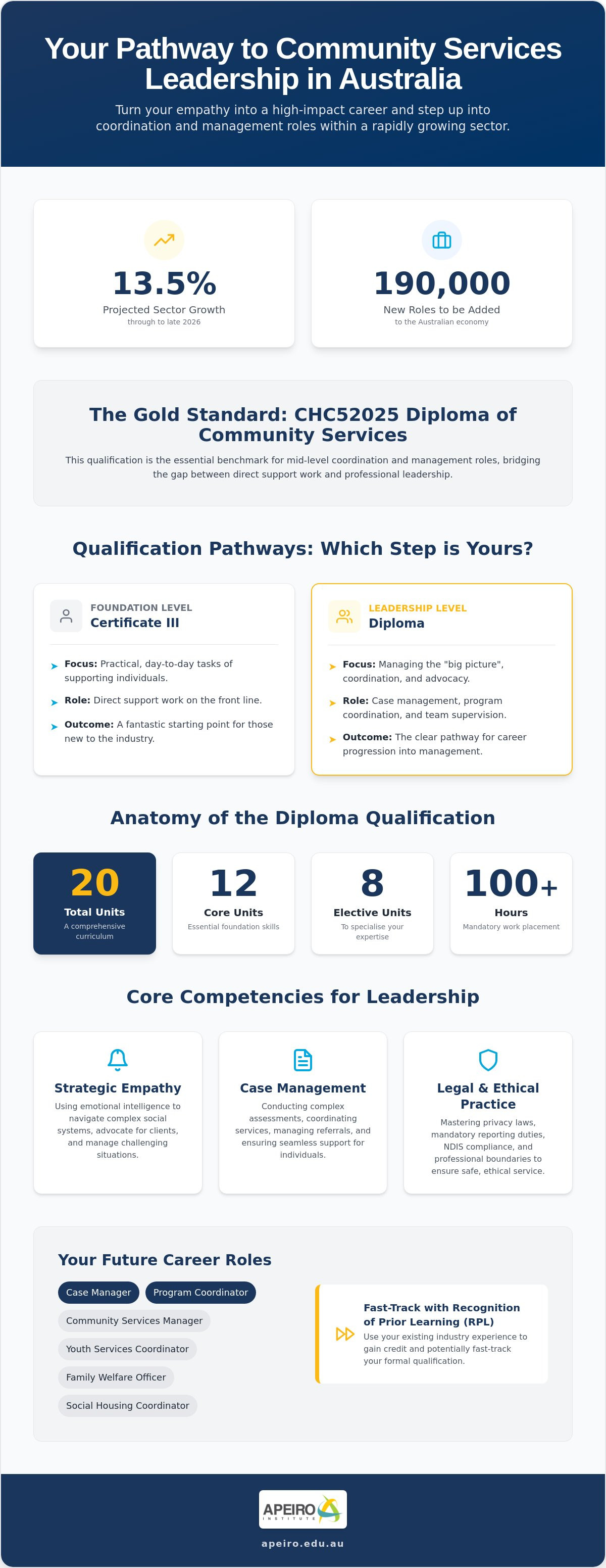
Did you know that Australia’s community and personal service sector is set to grow by 13.5% through to late 2026, adding nearly 190,000 new roles to the economy? If you're someone who naturally steps up to support others, you've likely thought about making it your profession. It's completely normal to feel a bit stuck when looking at the technical side of things. You might be confused by shifting course codes or worried about how to balance a 100 hour work placement with your current life.
Securing a Diploma of Community Services Australia is the most effective way to turn your empathy into a structured, high-impact career. We're here to help you navigate those hurdles with confidence. In this guide, we'll clarify the transition to the new CHC52025 qualification and show you how to use Recognition of Prior Learning to get credit for the skills you already have. We will also explore the pathway to well-paid case management roles where you can start making a genuine difference immediately.
Key Takeaways
- Understand the transition to the CHC52025 qualification and why it is the essential benchmark for mid-level coordination and management roles in the sector.
- Discover how a Diploma of Community Services Australia bridges the gap between direct support work and professional leadership positions like Case Manager or Program Coordinator.
- Learn how to use Recognition of Prior Learning (RPL) to fast-track your career by turning your existing industry experience into a formal, nationally recognised qualification.
- Identify the specific core and elective units required to master "strategic empathy," ensuring you have the practical skills to lead change in diverse communities.
- See how choosing a student-centred provider with a focus on inclusivity can help you balance your study commitments while building a global professional network.
What is the Diploma of Community Services in Australia?
The CHC52025 Diploma of Community Services is widely regarded as the gold standard for anyone looking to step into mid-level leadership within the social sector. While entry-level roles focus on immediate care, this qualification is designed for those ready to take on coordination, management, and high-level advocacy. In the 2026 Australian economy, where the Health Care and Social Assistance industry employs nearly 2.4 million people, having a formalised skill set in service delivery is no longer just an advantage; it's a necessity for career progression.
The curriculum for the Diploma of Community Services Australia focuses heavily on a person-centred approach. This means the individual receiving support is the primary driver of their own care plan. It's a shift from the traditional model of "providing for" someone to "partnering with" them. This philosophy ensures that services are respectful, responsive, and tailored to the unique needs of every Australian, regardless of their background.
The Core Philosophy of Modern Community Work
Community work in Australia has evolved significantly. We've moved away from old charity models that often created dependency. Today, the focus is on empowerment, advocacy, and social justice. This qualification prepares you to work within the broader social work profession, where your goal is to help people overcome systemic barriers. Whether you're working in youth services, refugee support, or family welfare, your role is to be a catalyst for change. You'll learn to identify the root causes of disadvantage and develop strategies that promote long-term independence for your clients.
Why a Diploma is Different from a Certificate III
The main difference between these levels is the degree of autonomy and responsibility you carry. A Certificate III focuses on the practical, day-to-day tasks of supporting individuals. It's a fantastic starting point for those new to the industry. However, the Diploma of Community Services Australia is where you learn to manage the big picture. You'll move into case management and program coordination, where you're responsible for supervising teams and managing complex budgets. If you're currently working on the front line and want to move into the office to lead a team, this is your pathway. If you're just starting your journey, you might consider the Certificate III in Individual Support to build your foundational skills first.
Key Skills and Units in the CHC52025 Framework
The CHC52025 framework isn't just a checklist of subjects; it's a strategic blueprint for leadership. To earn your Diploma of Community Services Australia, you'll need to complete 20 units in total. This consists of 12 core units that provide an essential foundation and 8 elective units that allow you to specialise in areas like mental health, child welfare, or social housing. While you can find the official CHC52015 qualification details and its subsequent updates on the national register, the real value lies in how these units translate to the frontline of Australian society.
One of the most vital professional skills you'll develop is "strategic empathy." In 2026, being a good listener isn't enough. You must be able to use emotional intelligence to navigate complex social systems, advocate for client rights, and manage challenging behaviours while maintaining professional boundaries. You'll also master the legal and ethical landscape, ensuring you're across privacy laws, mandatory reporting, and NDIS compliance standards. To bring this theory to life, you'll complete a minimum of 100 hours of work placement. This is your career launchpad, providing the practical "runs on the board" that employers look for when hiring new coordinators.
Mastering Case Management and Advocacy
A significant portion of your study focuses on facilitating the interests and rights of your clients. Case management is about more than just paperwork; it involves coordinating a web of different services to support one individual's journey. You'll learn how to conduct complex assessments, identify gaps in support, and manage referral processes that actually work. If you're keen to lead these types of high-impact programs, you can explore the Diploma of Community Services specialising in case management to see how these skills apply in the real world.
Leading Diverse Teams and Volunteers
As you move into management, your focus shifts toward supervising other workers and volunteers. This qualification teaches you how to promote workplace diversity and create inclusive environments that reflect the communities you serve. You'll also tackle the administrative side of the sector, which includes reporting to government bodies, managing small budgets, and evaluating the success of community programs. These management skills ensure that the organisations you lead remain sustainable and effective in the long term.
Comparing Community Services Qualifications: Which Path is Yours?
Deciding between different qualification levels can feel like a bit of a maze. It's helpful to view these options through the lens of your long-term career goals. Are you looking to get your foot in the door, or are you ready to lead? The Diploma of Community Services Australia is often the minimum requirement for management and coordination roles in the social sector. It provides the high-level strategic skills that differ significantly from the task-based focus of lower-level certificates. While a certificate gets you into the industry, the Diploma is what keeps you moving up the ladder.
Many students in 2026 take advantage of "nested qualifications." This concept allows you to start with a lower-level certificate and use those completed units as credit toward your Diploma later. It's a practical way to manage your study load while gaining real-world industry experience. The CHC52025 Diploma of Community Services framework is designed to recognise these pathways, ensuring you don't have to repeat learning you've already mastered. This flexibility is a cornerstone of the Australian vocational system, making career advancement much more attainable.
Certificate III vs. Diploma: A Practical Look
A Certificate III in Individual Support is fundamentally hands-on. It's about the daily lives of clients, focusing on direct care, hygiene, and immediate emotional support. It's the "how-to" of the care industry. In contrast, the Diploma of Community Services Australia moves you into a coordination space. You'll transition from following a care plan to creating, managing, and evaluating one. For a deeper dive into starting your journey at the foundational level, our guide on How to Get Your Certificate III in Individual Support explains the entry-level landscape in 2026.
Advancing to the Certificate IV in Ageing Support
The Certificate IV in Ageing Support serves as a vital bridge in the community services ecosystem. It's perfect for those who want to specialise in the aged care sector without moving entirely into generalist community management. This level introduces more complex reporting, supervision of small teams, and specialised clinical support. It's an excellent choice if you want to be a senior support worker or a team leader in a specific niche. By layering these qualifications, you build a robust professional portfolio that shows both deep technical knowledge and broad leadership capability.
Career Outcomes and RPL: Fast-Tracking Your Success
Completing your Diploma of Community Services Australia opens doors to a variety of influential leadership roles. In 2026, the sector isn't just growing; it's evolving to meet more complex social needs. You could find yourself working as a Case Manager, coordinating care for vulnerable individuals, or as a Program Coordinator, designing community initiatives that drive real change. Welfare workers and social housing coordinators are also in high demand across both metropolitan and regional areas. The financial outlook is just as positive. Following the 4.75% increase to the SCHADS Award in July 2026, a Diploma-qualified worker at Level 4 (Pay Point 1) can earn approximately $46.70 per hour. With the Superannuation Guarantee now at 12%, these roles offer both immediate reward and long-term career security.
The Power of RPL for Community Professionals
Many people already working in the sector feel like they don't have the time to go back to the classroom. If you have years of volunteer or paid experience, you don't necessarily need to start your studies from scratch. Recognition of Prior Learning (RPL) allows you to formalise your existing expertise into a national qualification. It's a process of valuing what you already know. You can explore our Trade Pathways for Experienced Workers to see how the assessment works for those already in the field. The evidence gathering process is straightforward; it involves providing workplace logs, employer references, and direct observations. It's a faster way to get the credentials you need for that promotion you've been eyeing.
2026 Job Market: Where the Demand is Highest
The "care economy" is currently Australia's largest employing sector, with nearly 2.4 million workers. Demand is particularly high within the NDIS and aged care sectors as our population ages and support systems expand. Mental health and family support services are also seeing a massive rise in recruitment for qualified coordinators. For a more detailed look at these specific roles, our Diploma of Community Services Career Outcomes guide describes the daily responsibilities and expectations in depth. With typical salaries for Diploma-qualified coordinators ranging between $70,000 and $95,000 per year, it's a career path that offers genuine stability. If you're ready to take the next step, you can view our Diploma course details to see how we can support your journey.
Why Study Your Diploma at Apeiro Institute?
Apeiro Institute stands out because we act as an empowering mentor for your professional journey. As a dual Registered Training Organisation (RTO) and CRICOS provider, we welcome both local Australian residents and students joining us from across the globe. This creates a vibrant, multicultural learning environment where you'll study alongside peers from over 38 different nationalities. It's this diversity that makes our campus a true reflection of the Australian community sector itself. We believe that a supportive, inclusive atmosphere is the best place to build the confidence you need for a career in social service.
Choosing to study your Diploma of Community Services Australia with us means you're never just a number in a lecture hall. We pride ourselves on a student-centred approach that prioritises your personal growth and professional readiness. Whether you're looking for flexible study options to balance your existing work life or you need a practical, hands-on curriculum that prepares you for the 2026 job market, we have designed our programs to meet those specific needs. Our goal is to make the prospect of starting a new educational journey feel attainable and exciting rather than intimidating.
A Nationally Recognised Pathway to Success
Our training is developed by industry experts who understand the current demands of the social sector. When you earn your qualification here, you're gaining a credential that is recognised in every state and territory across Australia. This portability is essential for those who may want to work in regional hubs or move between metropolitan centres like Sydney or Perth. We focus on ensuring our graduates are "job-ready" from the day they finish. You can explore the specific units and enrolment details for the CHC52021 Diploma of Community Services (transitioning to the current CHC52025 framework) on our course page.
Supportive Learning for Every Student
We know that the journey toward a new career can feel like a big step. That's why we provide dedicated mentoring and guidance throughout your entire enrolment. From the moment you start until you complete your 100 hour work placement, our team is there to support you. We even assist in finding suitable placement opportunities to ensure you get the practical experience required for graduation. For those moving to Australia to pursue their dreams, we recommend reading our guide on Vocational Courses for International Students to understand the unique benefits of studying in 2026.
Ready to take the next step? Our friendly admissions team is here to help you navigate the enrolment process, check your eligibility for RPL, and answer any questions about our campus locations in New South Wales and Western Australia. We invite you to reach out today and discover how we can help you turn your passion for helping others into a high-impact, professional career.
Take the Next Step Toward Your Community Leadership Career
The demand for skilled leaders in Australia's care economy has never been higher. By choosing a Diploma of Community Services Australia, you aren't just getting a qualification; you're gaining the strategic skills to manage complex cases and lead diverse teams. Whether you use Recognition of Prior Learning to value your years of industry experience or start fresh in our multicultural community representing over 38 nationalities, your path forward is clear. You'll be entering a sector with a projected growth of nearly 190,000 jobs by late 2026. This offers both career stability and the unique chance to drive genuine social change in your local neighbourhood.
At Apeiro Institute (RTO Code 45394, CRICOS Provider 03703M), we're ready to partner with you on this journey. We provide the mentoring and practical framework you need to succeed in the modern social landscape. It's time to turn your passion for helping others into a professional reality. Enrol in the CHC52021 Diploma of Community Services at Apeiro Institute today and start making a difference. We can't wait to see what you achieve.
Frequently Asked Questions
Is the Diploma of Community Services hard to complete?
The course is designed to be challenging but entirely achievable with the right support and dedication. While it involves a higher level of responsibility than a Certificate III, the focus is on practical leadership and case management skills. Our trainers act as mentors to help you navigate the more complex units, ensuring you feel confident in your ability to lead teams and manage community programs.
Can I get a job while I am still studying my Diploma?
Yes, many students find employment in entry-level roles while they are still completing their studies. Positions such as support worker or lifestyle assistant are often available to those currently enrolled in a Diploma of Community Services Australia. Working while you study is a brilliant way to gain immediate industry experience and see how the theory you learn in class applies to real-life scenarios.
How long does the Diploma of Community Services take to finish in 2026?
Most students complete the qualification within 12 to 24 months, depending on their study load. If you choose to study full-time, you can often finish sooner, whereas part-time study offers more flexibility for those with existing work or family commitments. For experienced workers, the Recognition of Prior Learning (RPL) process can significantly reduce the time needed to graduate by acknowledging your existing skills.
What is the difference between Community Services and Social Work?
The primary difference is the educational pathway and the specific focus of the roles. Community services is a vocational pathway that prepares you for practical coordination, case management, and program leadership. Social work typically requires a four-year university degree and often involves more clinical, therapeutic, or research-based roles. Both fields are essential to the Australian social sector but offer different entry points and career trajectories.
Can I use Recognition of Prior Learning (RPL) for this course?
Absolutely, we highly encourage experienced workers to apply for RPL to fast-track their qualification. If you have been working or volunteering in the sector for several years, you may already have the skills required for many of the units. By providing evidence like workplace logs and references, you can skip the units you've already mastered and focus on gaining new leadership expertise.
Are there any government subsidies available for this qualification?
Yes, there are several government funding options available for eligible students in 2026. In New South Wales, the Smart & Skilled program provides subsidised training for certain courses. Similarly, Western Australian residents may be eligible for support through the Jobs and Skills WA program. Eligibility depends on your residency status and previous qualifications, so it's best to chat with our admissions team for a personalised assessment.
What are the entry requirements for international students?
International students generally need to have completed the equivalent of Australian Year 12 and meet specific English language benchmarks. This usually involves achieving an IELTS score of 5.5 or a PTE equivalent. As a registered CRICOS provider, we support international learners through the entire enrolment process, ensuring you meet all the necessary requirements to study and thrive in the Australian community sector.
What kind of work placement will I need to do?
You'll need to complete a minimum of 100 hours of practical work placement in a relevant community organisation. This could be in a youth centre, a disability support service, or a social housing agency. The placement is a vital part of your Diploma of Community Services Australia, as it allows you to practice your case management and advocacy skills under the supervision of industry professionals.
Disclaimer
The information provided on this blog is for general informational and educational purposes only. While every effort is made to ensure the accuracy and reliability of the content, the author makes no representations or warranties of any kind, express or implied, about the completeness, accuracy, suitability, or availability of the information contained on this blog.
The views and opinions expressed in blog posts are those of the individual author and do not necessarily reflect the official policy or position of any organization, company, or employer.
This blog may contain links to external websites or third-party content. These links are provided for convenience only, and the author has no control over and assumes no responsibility for the content, privacy policies, or practices of any third-party sites.
Nothing on this blog constitutes professional advice (legal, financial, medical, or otherwise). Readers are encouraged to seek appropriate professional guidance before making any decisions based on the information provided here.
By using this blog, you acknowledge that any reliance on the information is at your own risk.


