

Did you know that the health care and social assistance industry is now Australia's largest employing sector, supporting nearly 2.4 million workers? It's a massive field, and it's completely normal to feel a bit lost when trying to figure out which qualification actually opens the door to leadership. You might be asking yourself if a Certificate III is enough to build a long-term career, or if you need something more to secure a stable future as an international student or visa holder.
We're here to help you find that clarity. This guide explores the specific diploma of community services career outcomes available in 2026, from case management to social housing coordination. You'll discover how the latest SCHADS Award pay increases, starting from $27.55 per hour for entry-level roles, impact your earning potential. We'll outline the clear transition from frontline support to coordination, giving you the confidence to step into a sector that's projected to grow by 13.5% in the coming years. Let's look at the job titles, the responsibilities, and the salary figures that define your professional future.
Key Takeaways
- Understand why the care economy is Australia's fastest-growing employment sector in 2026 and how this ensures long-term job security for qualified professionals.
- Explore the specific diploma of community services career outcomes that allow you to step into leadership roles like Case Manager or Community Services Coordinator.
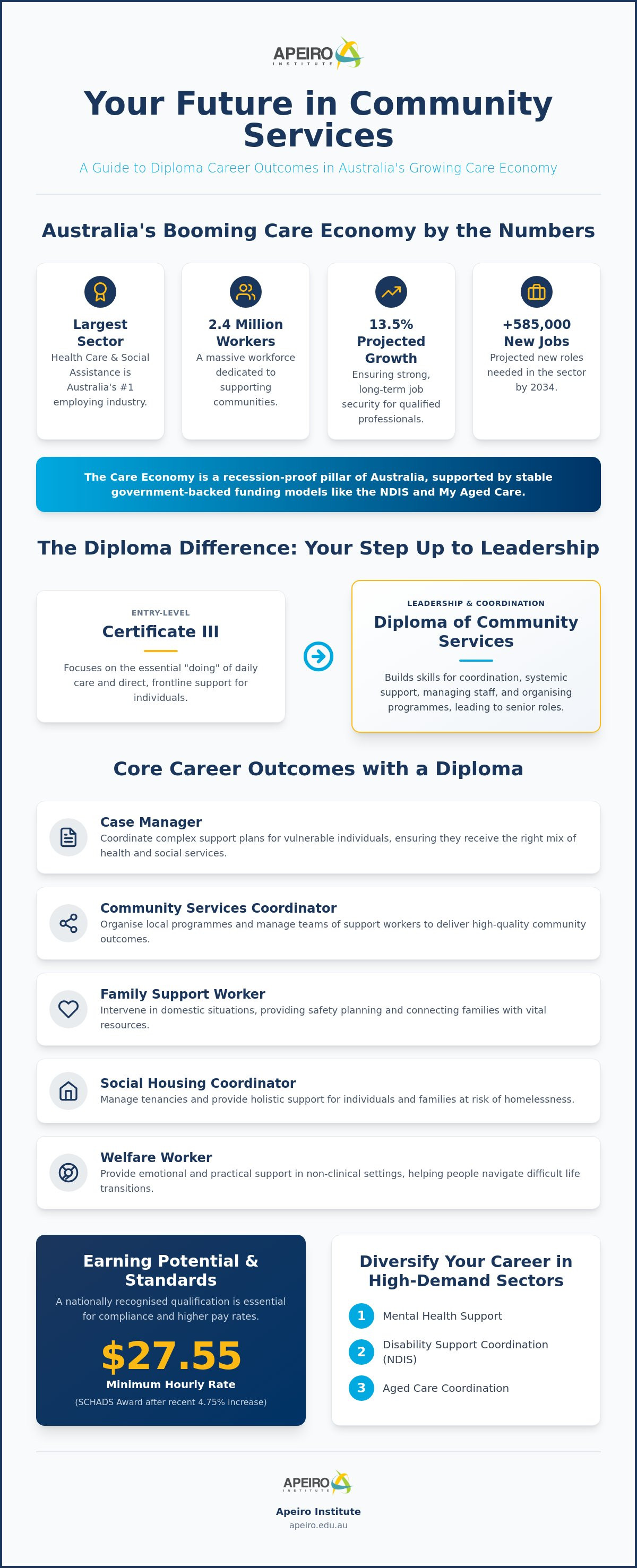
- Learn how to diversify your career across high-demand specialised sectors, including mental health, disability support, and aged care coordination.
- Discover how a Diploma helps you bridge the gap from frontline tasks to systemic organisation, moving you further up the professional career ladder.
- Gain insight into how a supportive, industry-focused learning environment can help you achieve your vocational goals in the current Australian landscape.
The Demand for Community Services Professionals in Australia (2026)
Australia is currently witnessing a massive transformation in its workforce. The health care and social assistance industry has officially become the nation's largest employer, with nearly 2.4 million people dedicated to supporting others. This isn't just a temporary trend; it's a structural shift. As the population ages, the need for skilled professionals who can manage complex care plans is skyrocketing. By 2034, employment in this sector is projected to grow by 585,000 people. It's a field where your work makes a tangible difference every single day.
The National Disability Insurance Scheme (NDIS) has completely revolutionised how we think about support. It has moved us away from a "one size fits all" model to personalised care. This change has created a huge demand for coordinators who understand the profession of social work and can help clients reach their goals. To step into these management roles, understanding the diploma of community services career outcomes is your first step toward professional stability. Employers look for these specific diploma of community services career outcomes when hiring for senior roles because they need people who can manage staff and budgets effectively.
Why the Sector is Recession-Proof
Key Industry Standards and Regulatory Bodies
Working in this sector carries significant responsibility. The Aged Care Quality and Safety Commission sets strict benchmarks that every provider must meet. Similarly, the Fair Work Commission recently announced a 4.75% increase to the SCHADS Award, meaning the minimum hourly rate for a social and community services worker is now $27.55. Having a nationally recognised qualification like the CHC52025 Diploma of Community Services is essential for compliance. It proves you have the skills to handle legal and ethical requirements in a high-stakes environment. This level of professionalism protects both you and the vulnerable people you support.
Core Career Outcomes: What Can You Do with a Diploma?
Earning your qualification is about more than just a piece of paper. It's about opening doors to roles where you can lead, organise, and advocate. While a Certificate III focuses on the essential "doing" of daily care, the diploma of community services career outcomes lean towards coordination and systemic support. You move from providing individual care to managing the frameworks that make that care possible. This shift allows you to take on higher levels of responsibility and enjoy the increased pay rates associated with senior positions.
The variety of roles available is extensive. Depending on your interests, you might find yourself in one of these key positions:
- Case Manager: You'll coordinate complex support plans for vulnerable individuals, ensuring they receive the right mix of health and social services.
- Community Services Coordinator: This role involves organising local programmes and managing teams of support workers to deliver high-quality community outcomes.
- Family Support Worker: You will intervene in domestic situations, providing safety planning and connecting families with vital resources.
- Social Housing Coordinator: You'll manage tenancies and provide holistic support for individuals at risk of homelessness.
- Welfare Worker: This involves providing emotional and practical support in non-clinical settings, helping people navigate difficult life transitions.
Many of these roles involve working closely with federal initiatives. For instance, exploring Department of Social Services careers can give you an idea of the government-level pathways available to those with the right qualifications. If you're ready to take the next step, you might want to explore how a Diploma fits your goals.
The Role of a Case Manager
As a Case Manager, you are the central point of contact for a client. Your day might involve managing intake processes, conducting detailed assessments, and liaising with government departments or healthcare providers. It's a role that requires high-level communication and the ability to develop long-term, goal-oriented support strategies that truly change lives. You are the bridge between a person's needs and the services available to meet them.
Community Development and Advocacy
Advocacy is a core part of the diploma of community services career outcomes. You might work with local councils to improve community facilities or fight for the rights of marginalised groups. A Diploma graduate acts as a vital advocate for NDIS participants by ensuring their individual support plans align with their specific rights and personal goals. This ensures that the people you serve aren't just receiving care, but are being empowered to live their best lives within their community.
Specialised Sectors: From Mental Health to Disability Support
One of the most valuable aspects of this qualification is the sheer versatility it offers. You aren't confined to a single niche. Instead, you gain a transferable skill set that allows you to pivot between diverse social care landscapes as your interests evolve. When you look at the diploma of community services career outcomes, you'll see they span across mental health, youth justice, and child protection services. This cross-sector mobility is a major advantage for those seeking long-term career growth in a changing economy.
In the mental health space, the intersection with community services is vital. While clinical staff handle medical needs, Diploma-qualified professionals manage the social determinants of health. You help clients find stable housing, build social networks, and access education. Similarly, in youth justice and child protection, your role involves managing high-stakes environments where safety and advocacy are paramount. You are trained to understand the legal frameworks that protect vulnerable children and young people, ensuring their rights are upheld while they navigate complex systems.
Disability and NDIS Coordination
Moving into the disability sector with a Diploma often means transitioning from a frontline support worker to a Support Coordinator. This is a significant step up. You'll spend your time navigating the NDIS portal and managing complex funding packages to ensure clients get the most out of their plans. If you're interested in how this sector is evolving, you can read more about The Future of Disability Support: Trends and Courses in Australia for 2026. This management-focused approach ensures that services are not just delivered, but are truly effective and sustainable.
Aged Care Management Pathways
The aged care sector also offers excellent diploma of community services career outcomes for those ready to move beyond basic care. You can transition into facility or programme management; here, your focus shifts to ensuring quality standards and compliance in residential or home care settings. It's a role that demands leadership and a deep understanding of the Aged Care Quality Standards. For those currently working in this space, check out Your Career Advancement Checklist for the Certificate IV in Ageing Support (CHC43015) to see how you can prepare for this leap into coordination and management.
Bridging the Gap: Moving from Frontline Support to Coordination
Transitioning from a support worker to a coordinator is a significant milestone. While entry-level roles focus on the immediate, day-to-day needs of a client, moving into management requires a broader perspective. You stop focusing solely on individual "doing" tasks and start "organising" the systems that keep a facility or programme running. This shift is exactly what defines the most sought-after diploma of community services career outcomes in the current Australian market. Employers aren't just looking for carers; they're looking for leaders who can navigate legal compliance and manage diverse teams.
The Diploma provides the academic and practical framework to make this leap. You'll develop high-level skills in complex case management, ethical decision-making, and staff supervision. Understanding how diploma of community services career outcomes differ from entry-level roles helps you prepare for the increased responsibility of overseeing budgets and inter-agency collaborations. It's about becoming the person who designs the support plan, rather than the one solely responsible for carrying it out.
The 5 Steps to Career Progression
Moving up the career ladder in Australia is a methodical process. Following a clear path ensures you have the right mix of experience and theory to succeed in senior roles. Here is how most professionals manage their growth:
- Gain foundational experience with a Certificate III in Individual Support to understand the industry from the ground up.
- Identify a specialisation that resonates with you, such as Mental Health, Youth Justice, or Aged Care.
- Enrol in the Diploma of Community Services to gain the required coordination skills.
- Document your workplace achievements and responsibilities carefully; this evidence is vital for future career moves.
- Apply for Coordinator or Case Management roles once you've secured your qualification.
Trade Pathways for Experienced Workers
If you've already spent years working in the sector, you might not need to start from scratch. Many experienced professionals have the skills but lack the formal piece of paper to prove it. This is where Trade Pathways for Experienced Workers (TPEW) becomes invaluable. Through Recognition of Prior Learning (RPL), you can formalise your existing industry knowledge into a nationally recognised qualification. This process reduces your study time significantly while maintaining the high professional standards required by Australian regulatory bodies. It’s a practical way to fast-track your move into management without repeating things you already know.
Ready to move beyond frontline support? You can apply for the Diploma of Community Services today and start your journey toward a leadership role.
Why Study Your Diploma of Community Services with Apeiro Institute?
Choosing where to study is just as important as choosing the qualification itself. At Apeiro Institute, we don't just teach theory; we prepare you for the real-world diploma of community services career outcomes that the Australian workforce demands. We've built a supportive and inclusive environment that welcomes a diverse community of over 38 nationalities. This cultural richness is the perfect training ground for a career in community services, where understanding and valuing different backgrounds is a core part of your daily work.
Our training is strictly industry-focused and designed for practical vocational results. Every unit we deliver meets current Australian standards, ensuring your qualification is nationally recognised and respected by employers across the country. Whether you're looking for flexible learning options as a local student or a structured programme as an international learner, we provide the tools you need to succeed. We understand that your goal is a stable and rewarding career. We act as your partner in achieving that success by providing expert guidance every step of the way.
The Apeiro Advantage for International Students
Apeiro Institute is a CRICOS-registered provider. This registration ensures our courses meet the strict quality and compliance standards required for international student visas. We know that building local experience is vital for your future in Australia. That's why we provide practical work placement opportunities that allow you to apply your skills in real community settings before you even graduate. Our expert trainers are active in the sector, bringing current industry insights directly into the classroom. They understand the nuances of the 2026 care economy and can guide you toward the best diploma of community services career outcomes for your specific goals.
Enrolment and Next Steps
Starting your journey is a straightforward and supportive process. The CHC52025 Diploma of Community Services is designed to be comprehensive yet accessible. To enrol, you'll generally need to have completed Year 12 or equivalent, or possess relevant industry experience. The course duration typically spans between 52 and 78 weeks, providing ample time to master complex case management and coordination skills. We also facilitate Recognition of Prior Learning (RPL) for those already working in the field, helping you formalise your expertise faster.
Don't let uncertainty hold you back from a leadership role in Australia's fastest-growing sector. Our team is ready to help you navigate the enrolment process and answer any questions about your future career path. Contact Apeiro Institute today to start your community services career!
Take the Lead in Australia's Growing Care Sector
The Australian care economy is expanding rapidly, offering unparalleled stability for those with the right qualifications. You've seen how moving from frontline support to coordination can transform your professional life, providing both a sense of purpose and a clear path to leadership. By understanding the diverse diploma of community services career outcomes, you can confidently choose a niche that aligns with your passions, whether that's mental health, aged care, or disability support.
Apeiro Institute (RTO 45394 and CRICOS Provider 03703M) provides Nationally Recognised Training led by industry-active expert trainers who are deeply invested in your success. Our focus is on practical results that help you transition seamlessly into senior roles. We act as your mentor and guide, ensuring you have the confidence to meet the high standards of the Australian community services landscape. We're here to help you bridge the gap between your current experience and your future career goals.
Ready to start? Explore our Diploma of Community Services and start your journey. Your future in Australia's most vital sector begins today.
Frequently Asked Questions
What is the average salary for a Diploma of Community Services graduate in Australia?
Salaries in this sector are governed by the SCHADS Award, which saw a significant increase on 1 July 2026. Entry-level social and community services workers now start at a minimum of $27.55 per hour, or roughly $54,438 annually. As you progress into coordination and management roles, pay rates can reach Level 6, which offers $58.37 per hour. This equates to over $115,000 per year for experienced professionals managing complex programs.
Can international students work in community services while studying?
Yes, international students can typically work in the community services sector while completing their qualification. Under current Australian student visa conditions, you are generally permitted to work up to 48 hours per fortnight during term time and unlimited hours during scheduled breaks. Finding a part-time role as a support worker is an excellent way to build local experience and understand the industry while you study.
What is the difference between a Certificate IV and a Diploma of Community Services?
The primary difference lies in the level of responsibility and the scope of the role. A Certificate IV focuses on technical skills and frontline support, preparing you to work directly with clients in a supervised capacity. The diploma of community services career outcomes, however, focus on coordination, case management, and leadership. You'll move from performing tasks to designing support systems and managing teams in more senior positions.
Do I need a police check to work in community services in Australia?
You absolutely need a valid National Police Check to work in any role involving vulnerable people. Most employers also require a Working with Children Check (WWCC) and an NDIS Worker Screening Check if you are in a disability support role. These clearances are essential for maintaining safety and compliance within the sector. It's a standard requirement that ensures the protection of the individuals and communities you serve.
Are there university pathways available after completing this Diploma?
Completing a Diploma often provides a solid foundation for further academic study at a university level. Many Australian universities offer credit transfers for Diploma holders, which can reduce the duration of a related Bachelor's degree, such as Social Work or Social Science. While we focus on vocational outcomes, this qualification is a recognised stepping stone for those who wish to pursue higher academic credentials later in their career.
How long does it take to complete the Diploma of Community Services?
Most students complete the course within 52 to 78 weeks, depending on their study mode and previous experience. This timeframe includes both theoretical learning and practical work placements, ensuring you are fully prepared for the workplace. If you already have extensive industry experience, you might be able to fast-track your progress through Recognition of Prior Learning (RPL), which formalises the skills you have already mastered on the job.
What specific skills will I learn during the course?
You will develop a comprehensive set of leadership and coordination skills tailored to the social care sector. The curriculum covers complex case management, assessing co-existing needs, and managing legal and ethical compliance. You'll also learn how to develop and implement service programs and lead diverse teams. These practical skills are designed to ensure your diploma of community services career outcomes include high-level roles in program coordination and community advocacy.
Is community services a high-demand job for 2026?
Community services remains one of Australia's most high-demand sectors in 2026. The health care and social assistance industry is the nation's largest employer, with nearly 2.4 million workers currently in the field. With community and personal service worker roles projected to grow by 13.5%, the demand for qualified coordinators is higher than ever. This growth is driven by an ageing population and the continued expansion of the NDIS.

Disclaimer
The information provided on this blog is for general informational and educational purposes only. While every effort is made to ensure the accuracy and reliability of the content, the author makes no representations or warranties of any kind, express or implied, about the completeness, accuracy, suitability, or availability of the information contained on this blog.
The views and opinions expressed in blog posts are those of the individual author and do not necessarily reflect the official policy or position of any organization, company, or employer.
This blog may contain links to external websites or third-party content. These links are provided for convenience only, and the author has no control over and assumes no responsibility for the content, privacy policies, or practices of any third-party sites.
Nothing on this blog constitutes professional advice (legal, financial, medical, or otherwise). Readers are encouraged to seek appropriate professional guidance before making any decisions based on the information provided here.
By using this blog, you acknowledge that any reliance on the information is at your own risk.


