

In 2026, disability support has shifted from a manual "care-taking" role to a high-skill profession focused on social advocacy, digital tools, and personal empowerment. Finding the right disability support course Australia offers is now the first step toward becoming a qualified expert in a field that values your strategic thinking as much as your empathy. You might feel a bit uncertain about the latest NDIS pricing arrangements or the new mandatory registration rules taking effect this July. It's completely natural to wonder how these changes impact your daily work or which certificate level will actually help you climb the professional ladder.
We promise to help you make sense of this shifting environment and show you how the right training can launch a rewarding, high-impact career. This article explores the latest industry trends, clarifies the vocational training pathways available, and explains the modern, person-centred techniques you'll use to support participant independence. You will gain the confidence to move from a curious newcomer to a sought-after specialist in the Australian community services sector.
Key Takeaways
- Understand how the 2026 NDIS reforms are professionalising the industry and creating a surge in demand for qualified, skilled experts.
- Explore the shift toward social inclusion and specialised neurodiversity support as the new standard for modern, person-centred care.
- Discover the essential practical and professional skills you'll master in a disability support course Australia wide to ensure you're job-ready for 2026.
- Map out your potential career ladder, moving from entry-level support roles into leadership and case management positions.
- Learn why a mentor-based training approach is the most effective way to build confidence and secure long-term employment in the sector.
The Landscape of Disability Support in Australia (2026)
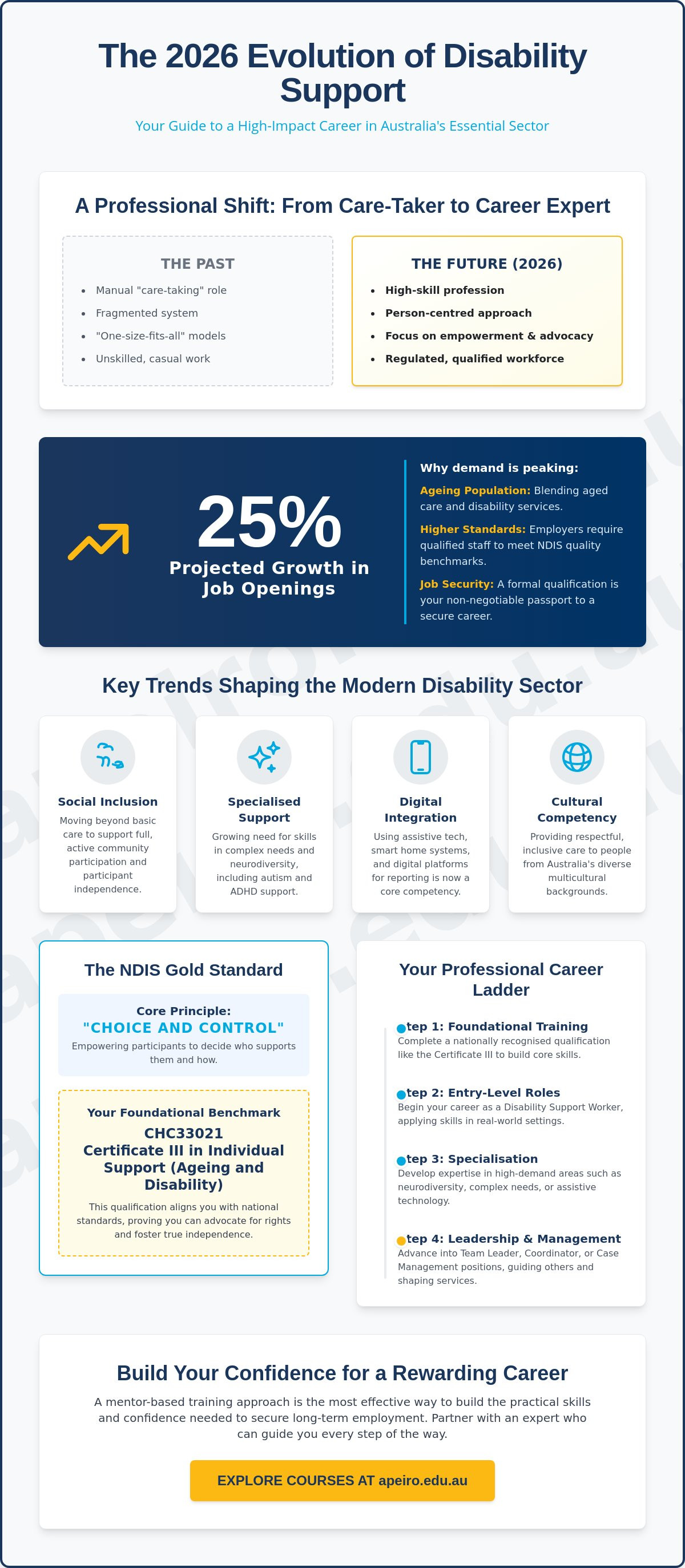
Australia's disability sector has grown into a vital economic pillar that supports hundreds of thousands of citizens every day. According to Disability in Australia statistics, millions of people live with a variety of physical, intellectual, and psychosocial disabilities, making the workforce that supports them essential to our nation's social fabric. The National Disability Insurance Scheme (NDIS) has completely transformed how these services are delivered. It turned a once-fragmented system into a professional market with massive demand for skilled talent. In 2026, the person-centred approach is the gold standard, ensuring that every support plan starts and ends with the participant's unique goals and preferences. We're seeing a major shift away from casual, unskilled work toward a regulated workforce where every frontline staff member is expected to hold a formal qualification.
Why Demand for Qualified Workers is Peaking
The demand for workers is hitting record highs across the country. This is partly due to our ageing population, where many older Australians now require support that blends aged care and disability services. Industry projections suggest a 25% growth rate in job openings over the next few years, which offers incredible job security for new entrants. If you're looking to enter the field, completing a disability support course Australia wide is no longer just a "nice to have" on your resume. It's a non-negotiable requirement for reputable employers. They need to ensure their staff meet strict safety and quality standards from day one. This qualification acts as your professional passport, proving you have the skills to handle complex situations with care and competence.
The Role of the NDIS in Professional Standards
The NDIS Quality and Safeguards Commission now sets the bar for what excellence looks like in the sector. They've moved the industry toward a model of "Choice and Control," giving participants the power to decide who supports them and how. This has effectively ended the old "one-size-fits-all" care models that were common in the past. To meet these high expectations, the CHC33021 Certificate III in Individual Support (Ageing and Disability) has become the foundational benchmark for the industry. It ensures that workers aren't just providing physical help. Instead, they're learning how to advocate for a participant's rights and foster true independence. By enrolling in a disability support course Australia, you're aligning yourself with these national standards, making you a much more attractive candidate for high-quality providers who value professional integrity.
Key Trends Shaping the Disability Sector Today
The disability sector is no longer a static field. It's a dynamic profession that demands constant adaptation. Today, the primary goal has shifted toward social inclusion. This means moving beyond basic care and focusing on how a participant can lead a full, active life in their community. Recent findings in the State of the Disability Sector Report highlight that providers are increasingly focused on resilience and high-quality service delivery. This evolution is also creating a rise in specialised support. Workers now need specific skills to assist those with complex needs or neurodivergent profiles, such as autism or ADHD.
Cultural competency is another vital trend. Australia is a multicultural nation. Support workers must understand how to provide respectful, inclusive care to people from diverse backgrounds. We're also seeing the professionalisation of independent support workers. Many individuals now operate as micro-business owners, managing their own clients and compliance. If you're looking to enter this modern landscape, starting with a disability support course Australia is the best way to ensure you're equipped for these new responsibilities.
Assistive Technology and Digital Integration
Technology is changing the way we support independence. Modern workers use smart home systems and communication apps to help clients control their environment. It isn't just about using gadgets. It's about data. You'll need to collect and report on participant progress using digital platforms. Because of this, tech-literacy is now a core part of vocational training. You don't need to be a computer scientist, but you do need to be comfortable with digital tools. These tools allow for better communication and more precise support delivery.
The Intersection of Mental Health and Disability
There's a growing focus on psychosocial disability. This refers to the functional impact of mental health conditions on a person's life. Modern support workers need to understand trauma-informed care. This approach recognises that many participants have experienced trauma and requires you to provide support that feels safe and empowering. It's a holistic shift. We're looking at emotional well-being just as much as physical health. Learning these skills ensures you can provide deep, meaningful support in any setting, from a private home to a community centre.
Core Competencies: What You Will Learn in a Modern Course
Stepping into the sector requires more than just a big heart. You need a robust set of skills that combine technical knowledge with deep emotional intelligence. The CHC33021 Certificate III in Individual Support (Ageing and Disability) is the gold standard for this training. It's designed to give you a balanced foundation. You'll learn how to provide essential physical assistance while also mastering the "soft" skills needed to build trust with participants. This disability support course Australia focuses heavily on the legal and ethical frameworks that govern our healthcare system. You'll finish your studies knowing exactly how to protect a participant’s privacy and dignity while following national safety standards. Understanding these boundaries is what separates a casual helper from a true professional.
Work placement is another vital part of the learning process. It bridges the gap between theory and the real world. You'll spend time in a genuine industry setting, working alongside experienced mentors who show you the ropes. This hands-on experience is where your confidence truly grows. It's also a fantastic way to network. Many students find that their placement provider becomes their first employer after graduation. It's a practical, supportive way to start your career journey.
Empowerment and Rights-Based Support
A modern course teaches you how to facilitate independence rather than fostering dependence. This is a crucial distinction. You aren't there to do everything for someone. You're there to help them do it for themselves. You'll study the legal rights of people with disabilities in Australia to ensure you're always acting as a strong advocate. Individualised support plans are crafted by identifying a person's specific goals and are then executed through daily actions that move them closer to those objectives. This ensures the support provided is always relevant and empowering.
Health and Safety in the Community
Safety is paramount when working in the community. You will master infection control protocols, manual handling techniques to prevent injury, and the basics of first aid. You'll also learn how to support medication administration safely, which is a high-responsibility task. A support worker acts as the eyes and ears on the ground. You'll be trained to identify potential risks in a home environment and report them immediately to ensure the participant stays safe. This proactive approach is essential for maintaining a high standard of care in every setting.
Career Pathways and Professional Growth
Starting your journey with a disability support course Australia is just the beginning of a multi-stage professional journey. You aren't stuck in one role forever. Instead, you're entering a sector that rewards experience and ongoing education. Most people start as frontline support workers to build their practical skills and understand the day-to-day needs of participants. From there, you can transition into senior support roles, team leader positions, or specialised advocacy. Life-long learning is the secret to staying relevant in the community services sector. By keeping your skills sharp, you ensure you're always ready for the next step on the ladder.
The Diploma of Community Services is the natural progression for those looking to move into management. It provides the strategic knowledge needed to handle more complex scenarios and lead teams effectively. You'll move from implementing support plans to designing them. This transition allows you to have a broader impact on the lives of many participants simultaneously. It's a path that offers both personal fulfilment and a clear trajectory toward senior leadership.
From Frontline Support to Case Management
There's a significant difference between daily support and case management. Daily support is hands-on and focuses on immediate goals. Case management involves coordinating multiple services, managing budgets, and liaising with the NDIS to ensure a participant's long-term needs are met. Holding a Diploma level qualification is often the key that opens doors to leadership roles within government agencies and large NGOs. In the 2026 NDIS ecosystem, case managers are the architects of care. They ensure every piece of the puzzle fits together perfectly, which requires a deep understanding of the system's regulatory requirements.
Specialisation and Niche Support Roles
Experience in the field can also lead to niche roles that don't involve traditional management. You might find your calling in disability advocacy, where you fight for policy changes at a state or national level. Others move into specialised therapy support, working closely with allied health professionals. If you're coming from a different background, you can use Trade Pathways for Experienced Workers to recognise your existing expertise. This is a great way to pivot into a new career without starting from zero. There is also a massive need for qualified professionals in rural and remote Australia. These roles often come with unique challenges but offer incredible professional growth and community connection. Whether you want to stay in the city or head out bush, a disability support course Australia provides the foundation you need.
If you're ready to take the next step in your professional journey, explore our Diploma of Community Services to start your transition into leadership today.
Choosing the Right Training Partner for Your Career
Selecting where to study is a decision that shapes your entire professional future. You don't want to be just another number in a massive, detached institution. Instead, look for a mentor-led approach where your personal growth is the priority. This style of training often leads to much better employment outcomes because you receive direct feedback from experts who care about your success. When researching a disability support course Australia, it's vital to check if the Registered Training Organisation (RTO) has strong industry links and CRICOS registration. These credentials ensure your qualification is respected by employers and meets national standards for quality and safety.
At Apeiro Institute, we organise our programs to ensure a perfect balance between classroom theory and real-world application. We know that starting a new educational journey can feel like a big step. That's why our student support services act as a safety net, helping you build the technical knowledge and professional confidence you need. Our goal is to move you steadily from a curious learner to a job-ready professional.
The Apeiro Advantage: Student-Centred Learning
Our learning environment is built on a foundation of inclusivity and warmth. We take great pride in our multicultural community, which reflects the diverse nature of the Australian workforce. Our trainers aren't just academics. They are active industry professionals who bring current, practical examples into every lesson. This ensures you're learning the most relevant techniques used in the field today. Whether you're a local student or joining us from overseas, we provide the expert guidance needed to help you understand the Australian job market and find your place within it.
Preparing for Your First Industry Placement
Your work placement is perhaps the most exciting part of your disability support course Australia. It acts as a "long interview" where you can showcase your skills and work ethic to a potential employer. We are deeply invested in ensuring every student is work-ready from day one of their placement. By the time you step into a participant's home or a community centre, you'll have the communication and safety skills to make a lasting, positive impression. This hands-on experience is often where our students secure their first job offers.
If you're ready to start a career that truly makes a difference in people's lives, we're here to help you every step of the way. We invite you to enquire about the next intake and join a community dedicated to your professional growth and success.
Take the Lead in Australia's Evolving Disability Sector
The landscape of disability support is changing rapidly. It has moved beyond basic assistance to become a sophisticated, tech-enabled profession that puts the participant's choice and control at the centre of every decision. You now have a clear understanding of the professional ladder, from gaining your first certificate to managing complex cases with a Diploma. By choosing a disability support course Australia that prioritises hands-on experience and modern techniques, you're setting yourself up for long-term job security and immense personal fulfilment.
At Apeiro Institute, we provide Nationally Recognised Training (RTO 45394) that goes well beyond the textbook. Our mentor-led support ensures you're never alone on your educational journey, while our strong industry placement partnerships give you the real-world connections needed to thrive. You don't have to wait for the future to happen. You can start building it right now with a team that's invested in your growth.
Start your journey in community services with Apeiro Institute today. We can't wait to see the incredible impact you'll make in the community as a qualified professional.
Frequently Asked Questions
How long does a disability support course in Australia take to complete?
A disability support course Australia wide typically takes between six and twelve months to complete. The exact duration depends on whether you choose to study full-time or part-time and how quickly you finish your mandatory work placement hours. Most students find this timeframe allows them to balance their studies with other life commitments while gaining necessary hands-on experience.
Can I study the Certificate III in Individual Support while working?
You can certainly study the CHC33021 Certificate III in Individual Support while maintaining your current job. Many training providers offer flexible delivery models, including evening classes or blended learning options, to suit working professionals. This flexibility allows you to gain a qualification without losing your income, making it a popular choice for those pivoting into the community services sector.
What is the difference between a Certificate III and a Certificate IV in disability support?
The Certificate III is the standard entry-level qualification for frontline support work. In contrast, the Certificate IV in Ageing Support or Disability focuses on more complex care needs and provides the skills required for supervisory or leadership roles. While the Certificate III gets you started in the field, the Certificate IV is designed for those ready to take on more responsibility and manage small teams.
Do I need a specific visa to study a disability support course as an international student?
International students generally require a Student Visa (subclass 500) to enrol in a CRICOS-registered disability support course Australia. You must ensure your chosen course is approved for international delivery and that you meet all Department of Home Affairs requirements. It is always best to check the latest visa conditions on the official government website to ensure your stay and study remains compliant.
What kind of jobs can I get with a disability support qualification in 2026?
In 2026, a qualification opens doors to roles such as a disability support worker, lifestyle coordinator, or community access officer. With further experience, you might move into advocacy, house management, or specialised neurodiversity support roles. The sector is expanding rapidly, meaning there are diverse opportunities in residential care, private homes, and community centres across the country, where you can explore Support work with registered providers like Accessible Care.
Is the NDIS worker screening check required before I start my course?
You don't always need the NDIS Worker Screening Check on your first day of class, but it is mandatory before you begin your industry placement. Since this check is a compulsory requirement for anyone in a risk-assessed role, most training providers will help you start the application process early in your course. This ensures you are cleared and ready to work with participants as soon as your practical training begins.
Are there funded or subsidised training options for disability courses in NSW?
Yes, there are several subsidised training options available through the NSW Government's Smart & Skilled program. Eligible students can access government-funded places to reduce the cost of their vocational training. It's important to check your eligibility criteria, such as your residency status and previous qualifications, with your training provider before you enrol to see if you qualify for these benefits.
What is the average salary for a disability support worker in Australia today?
Salaries for disability support workers are typically governed by the SCHADS Award, with rates often ranging between $30 and $40 per hour depending on your level of experience and the time of your shifts. Many workers also benefit from penalty rates for weekend or overnight work, which can significantly increase their take-home pay. As the sector continues to professionalise, competitive wages remain a key factor in attracting skilled talent.

Disclaimer
The information provided on this blog is for general informational and educational purposes only. While every effort is made to ensure the accuracy and reliability of the content, the author makes no representations or warranties of any kind, express or implied, about the completeness, accuracy, suitability, or availability of the information contained on this blog.
The views and opinions expressed in blog posts are those of the individual author and do not necessarily reflect the official policy or position of any organization, company, or employer.
This blog may contain links to external websites or third-party content. These links are provided for convenience only, and the author has no control over and assumes no responsibility for the content, privacy policies, or practices of any third-party sites.
Nothing on this blog constitutes professional advice (legal, financial, medical, or otherwise). Readers are encouraged to seek appropriate professional guidance before making any decisions based on the information provided here.
By using this blog, you acknowledge that any reliance on the information is at your own risk.


