

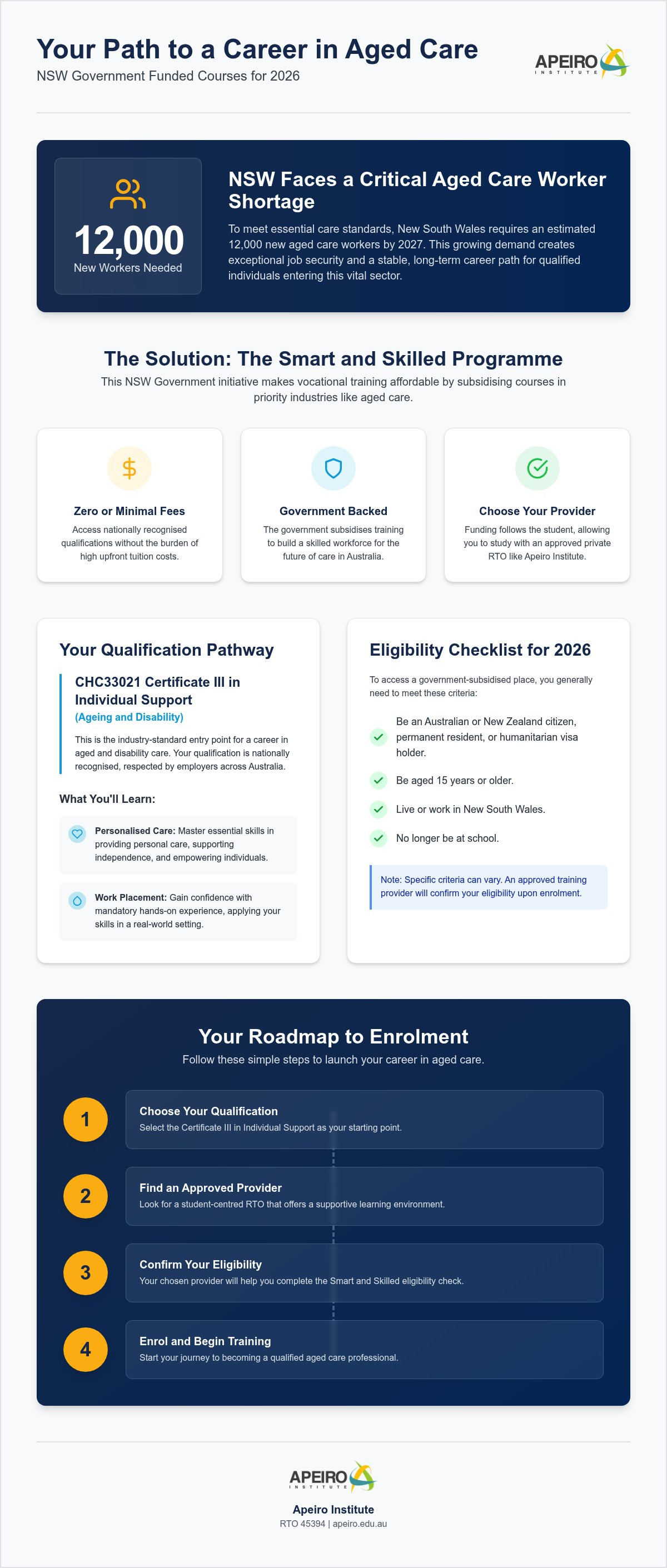
Did you know that New South Wales needs approximately 12,000 new aged care workers by 2027 to meet essential care standards? It's a massive gap to fill, yet many people feel held back by the high cost of private tuition or confusion over how to access NSW government funded aged care courses. You want a career that makes a genuine difference, but you don't want to start your professional life buried under a mountain of debt.
The good news is that your path into this rewarding industry is more accessible than you think. Through the Smart and Skilled programme, you can gain a nationally recognised qualification with zero or minimal upfront costs. We've put together this guide to help you understand your options for 2026. We'll walk you through the eligibility criteria, explain the difference between a Certificate III and IV, and show you how to find a supportive training partner that prioritises your growth and success.
Key Takeaways
- Learn how the Smart and Skilled programme allows you to access NSW government funded aged care courses with zero or minimal upfront tuition fees.
- Identify the right qualification for your career goals, whether you're starting out with a Certificate III or stepping into leadership with a Certificate IV.
- Quickly check your eligibility for 2026 subsidies using our straightforward checklist for NSW residents and Australian citizens.
- Discover the benefits of training in a supportive, multicultural environment that focuses on practical skills and real-world job readiness.
- Get a clear, step-by-step roadmap to navigate the enrolment process and launch your career in one of the state's most in-demand sectors.
Understanding Smart and Skilled: How NSW Funding Makes Aged Care Training Affordable
Smart and Skilled is a government initiative designed to give you the skills needed for real, sustainable careers. It represents a significant reform of the vocational education and training (VET) system in New South Wales. By providing subsidies, the government ensures that tuition costs don't stand in the way of your professional goals. This programme specifically targets "priority industries" where there's a clear need for more workers. Because of this, NSW government funded aged care courses are more accessible than ever, helping to bridge the gap between passionate people and the facilities that need them. To access these benefits, you must study through an approved provider like Apeiro Institute (RTO 45394).
Why the NSW Government Prioritises Aged Care Training
The sector is currently facing a massive workforce challenge. Research indicates that NSW requires approximately 12,000 new aged care staff by 2027 to meet essential care standards. As Aged care in Australia evolves, the focus has shifted toward higher quality, personalised support. The government knows that the only way to achieve this is through a highly trained workforce. By subsidising qualifications like the CHC33021 Certificate III in Individual Support, they're investing in the future of our seniors. For students, this translates to exceptional job security in a field that is growing every single day. You aren't just getting a certificate; you're entering a stable profession with a long-term future.
Fee-Free TAFE vs. Smart and Skilled RTOs
It's a common misconception that government funding is only available at large public colleges. In reality, Smart and Skilled funding follows the student. This means you can choose to study with an approved private Registered Training Organisation (RTO) like Apeiro Institute. While "Fee-Free" places are often limited and subject to specific commencement dates, subsidised places are widely available for eligible learners throughout the year. Choosing an RTO often provides a more student-centred experience. You'll benefit from smaller class sizes, mentors who know your name, and a learning environment that feels like a community. At Apeiro, we take pride in our diverse student body, representing over 38 nationalities. This creates a rich, inclusive atmosphere for everyone starting their journey, ensuring you feel supported from your first day of class to your final assessment.
Essential Aged Care Qualifications Covered by NSW Government Subsidies
Choosing the right qualification is the first step toward a stable and fulfilling career. In New South Wales, the government focuses its support on courses that meet high industry standards. These NSW government funded aged care courses are part of the Australian Qualifications Framework (AQF), which means your certificate is nationally recognised and respected by employers across the country. Whether you're entering the workforce for the first time or looking to move into a leadership role, there's a subsidised pathway designed to get you there. A critical part of this training is the mandatory work placement. This hands-on experience ensures you can apply your classroom learning in a real-world setting, building the confidence you need to provide exceptional care from day one.
Certificate III in Individual Support (Ageing and Disability)
The CHC33021 Certificate III in Individual Support is the industry standard entry point for most care roles. This qualification is highly versatile because it often includes a dual focus on both ageing and disability support. You'll study core units that cover essential skills such as providing personal care, supporting individual independence, and delivering basic palliative care. By mastering these areas, you become an invaluable asset to the Aged Care Industry Association members and other providers who are constantly seeking qualified staff. This course isn't just about technical tasks; it's about learning how to empower vulnerable people to live with dignity. If you're ready to start, you can view our course details to see how we support our students through every module.
Advancing to the Diploma of Community Services
Once you've gained experience in frontline support, you might feel ready to take on more responsibility. The CHC43015 Certificate IV in Ageing Support acts as a perfect bridge for those seeking coordinator or team leader positions. However, for those looking at long-term career planning, the Diploma of Community Services offers a pathway into case management and high-level social support roles. This transition allows you to move from direct physical care to managing complex client needs and coordinating community programmes. To help you understand this progression, our Diploma of Community Services Australia guide provides a detailed look at what to expect in 2026. At Apeiro Institute, we're committed to being your partner throughout this entire journey, providing the mentorship you need to grow from a student into an industry leader.
Eligibility Criteria: Who Can Access Subsidised Aged Care Courses in 2026?
Understanding whether you qualify for financial support is the first step toward your new career. The NSW Government's Smart and Skilled program is designed to be inclusive, ensuring that those who want to work in high-demand areas can get the training they need. While the rules might seem complex at first glance, the basic requirements for NSW government funded aged care courses are quite straightforward. Most people who live or work in the state find they meet the criteria for at least some level of subsidy.
To be eligible for a subsidised place in 2026, you generally need to meet the following checklist:
- Age: You must be 15 years old or over at the time of enrolment.
- Schooling: You've finished school and are no longer enrolled in secondary education.
- Location: You live or work in New South Wales.
- Residency: You're an Australian citizen, a permanent resident, a New Zealand citizen, or a humanitarian visa holder.
There's also a common question regarding the "First Qualification" rule. While some funding is prioritised for people who don't yet have a post-school qualification, the aged care sector is a high-priority industry. This means even if you've studied something else in the past, you may still be eligible for significant subsidies to retrain. Additionally, Aboriginal and Torres Strait Islander students, as well as students with a disability, often qualify for fee exemptions, making their training completely free of tuition costs.
Understanding the Fee-Free NSW Initiative
For 2026, the government has extended support for specific priority areas. To be eligible for a "NSW Fee Free" place, you must commence your training in a priority course before June 30, 2026. This initiative is a game-changer for career changers. It removes the financial barrier entirely for many students entering the care sector. If you miss out on a fee-free place because they've reached capacity, don't worry. Most students still qualify for the standard Smart and Skilled subsidy, which keeps out-of-pocket costs very low compared to private tuition fees.
Concession Fees and Exemptions
If you're currently receiving Commonwealth Government benefits, such as a JobSeeker or Disability Support Pension, you'll likely qualify for a concession fee. This is a flat, reduced rate that applies to qualifications up to Certificate IV. When you enrol, you'll just need to provide your current Centrelink documentation to prove your status. Our team at Apeiro Institute is here to act as your guide through this process. We'll help you check your eligibility and ensure you're accessing every bit of support you're entitled to. You don't have to navigate the paperwork alone; we're here to make your start as smooth as possible.
How to Apply for a Funded Aged Care Course in NSW: A Step-by-Step Process
Starting a new career is an exciting milestone, and the application process should feel like a welcoming door rather than a barrier. Navigating the requirements for NSW government funded aged care courses is straightforward when you have a clear roadmap. By following a logical sequence, you can move from an interested applicant to a confident student without unnecessary stress. Our team acts as your mentor throughout this journey, ensuring you have the support needed to complete each stage successfully.
Your journey typically follows these five steps:
- Step 1: Choose your course level. Decide if you're starting with the foundational Certificate III or moving into leadership with a Certificate IV.
- Step 2: Verify your eligibility. Use the Smart and Skilled Student Estimator or contact us directly for a personalised check.
- Step 3: Gather your evidence. You'll need your Unique Student Identifier (USI) and proof that you live or work in NSW.
- Step 4: Complete a pre-enrolment assessment. This ensures the course matches your current skills and career objectives.
- Step 5: Finalise your enrolment. Once your subsidy is confirmed, you're ready to begin your training.
The Importance of the USI
Every student in Australia needs a Unique Student Identifier (USI). Think of it as your lifelong education number that keeps all your training records in one secure place. It's essential for anyone accessing NSW government funded aged care courses because funding cannot be processed without it. If you don't have one yet, you can create it in minutes at the official USI website. If you've studied before, you likely already have one; you can use the "find my USI" tool to retrieve your details. It is a small but vital piece of the puzzle that ensures your hard-earned qualifications are always recognised.
Preparing for Your Work Placement
Hands-on experience is where your classroom theory truly comes to life. All funded aged care qualifications require a mandatory work placement in a registered facility. This isn't just a requirement; it's your chance to build industry connections and prove your skills to potential employers. At Apeiro Institute, we don't leave you to find these opportunities alone. We support you in finding suitable placement hosts that align with your learning needs. You'll also need to prepare specific NSW compliance documents, such as a National Police Check and, in some cases, a Working with Children Check (WWCC). Having these ready early ensures your transition into the workplace is seamless.
Enrol in a subsidised aged care course today
Why Study Aged Care with Apeiro Institute in 2026?
Our training team doesn't just deliver lectures; they act as empowering mentors. We understand that starting a new educational journey can feel intimidating, especially if you're returning to study after a long break. That's why our approach is built on warm, person-to-person support. We bridge the gap between the classroom and employment by focusing on practical, vocational outcomes. Accessing NSW government funded aged care courses should feel like a partnership in your success. Our trainers bring years of industry experience, ensuring you're ready to handle real-world scenarios with confidence. For a broader look at how these subsidies work across different sectors, you can explore our Smart and Skilled funded courses NSW guide.
Flexible Pathways and Future Opportunities
Your career doesn't have to stop at frontline support. We believe in lifelong learning and providing clear avenues for progression. A Certificate III can be the first step toward leadership roles or even different trade sectors. For example, some students use their initial training as a foundation to explore Trade Pathways for Experienced Workers later in their careers. This flexibility is a hallmark of our institute. We encourage you to check out our resource on Trade Pathways for Experienced Workers Australia to see how your skills can transfer across industries.
We're locally grounded but globally aware. Our goal is to see you succeed in a career that offers both stability and personal fulfilment. If you're ready to take the next step, our friendly team is here to help. Reach out to us today for a personalised career consultation. We'll help you navigate the enrolment steps for 2026 and ensure you're on the right path to a rewarding future in aged care.
Your Future in Aged Care Starts Today
You now have a clear roadmap to navigate the 2026 eligibility rules and enrolment steps. By choosing NSW government funded aged care courses, you can gain nationally recognised skills without the burden of heavy tuition debt. This pathway is designed to fill the critical workforce gap in New South Wales while providing you with a stable, fulfilling career. Whether you begin with a foundational Certificate III or aim for leadership roles, the opportunities in this sector are vast and growing every day.
At Apeiro Institute (RTO 45394), we're ready to act as your mentor and guide. Our NSW Smart and Skilled approved training focuses on practical outcomes, ensuring you feel confident and job-ready from your very first day on the job. We've built a supportive, multicultural community where your personal growth is our priority. Your new career is within reach, and we're here to help you every step of the way.
Enquire about your funded aged care course at Apeiro Institute today
Take that first step toward a role that truly matters. We can't wait to see the incredible difference you'll make in the lives of seniors across our state. Your journey into the heart of community care starts with one simple conversation.
Frequently Asked Questions
Is aged care training really free in NSW in 2026?
Yes, fee-free places are available for eligible students in priority courses like the Certificate III in Individual Support. These spots are limited and subject to availability, so it's best to apply early. To secure a fee-free place under the current initiative, you must commence your training before June 30, 2026. If a fee-free spot isn't available, the course is still heavily subsidised, significantly reducing your out-of-pocket tuition costs.
Can I study an aged care course online with government funding?
While you can complete theory components online, NSW government funded aged care courses require hands-on practical experience. Most providers use a blended learning model that combines flexible online modules with face-to-face practical sessions. You'll also need to complete a mandatory work placement in a registered facility. This ensures you develop the physical skills and confidence needed to provide safe, high-quality care to seniors in a real-world environment.
What is the difference between a subsidised course and a fee-free course?
A fee-free course means the NSW government covers the entire cost of your tuition, resulting in zero upfront debt. In a subsidised course, the government pays a large portion of the fee, while you contribute a smaller student fee. Both options are part of the Smart and Skilled programme. Your eligibility for either depends on your personal circumstances, residency status, and the specific funding allocations available at your chosen provider.
Do I need to be working in aged care to get Smart and Skilled funding?
No, you don't need to be currently employed in the sector to access funding for entry-level qualifications. Smart and Skilled is specifically designed to help people enter high-demand industries, making it perfect for career changers or those seeking their first job. However, if you're already working in the field, you might qualify for higher-level training, such as a Certificate IV, to help you move into leadership or coordination roles.
How long does it take to complete a Certificate III in Individual Support?
Most students complete this qualification within six to twelve months, depending on their study load. This timeframe includes your classroom learning, self-paced study, and the mandatory 120 hours of work placement. We offer flexible schedules to help you balance your training with family or existing work commitments. Our mentors work closely with you throughout the programme to ensure you stay on track and feel supported as you progress through each module.
What happens if I have already completed a different Certificate III in the past?
You may still be eligible for funding even if you already hold a post-school qualification. Because aged care is a high-priority sector with significant staff shortages, the government often waives the "first qualification" rule for NSW government funded aged care courses. This allows people with existing skills in other industries to retrain and enter the care workforce. We recommend checking your specific eligibility with our enrolment team to see your current options.
Are there any hidden costs in government-funded aged care courses?
While the government covers tuition through subsidies, you should plan for minor out-of-pocket expenses related to your training. These usually include the cost of a National Police Check and a Working with Children Check, which are mandatory for your work placement. You might also need to purchase a uniform or specific textbooks. We're always transparent about these requirements from the start, so you won't face any unexpected surprises during your journey.
How do I find an approved Smart and Skilled provider in NSW?
You can find approved providers by searching the official Smart and Skilled website or looking for the "Smart and Skilled" logo on a training organisation's site. Apeiro Institute is a proud, approved provider (RTO 45394). When choosing, look for an organisation that offers nationally recognised qualifications and strong student support. It's important to pick a partner that prioritises practical outcomes and helps you feel ready for the local workforce.

Disclaimer
The information provided on this blog is for general informational and educational purposes only. While every effort is made to ensure the accuracy and reliability of the content, the author makes no representations or warranties of any kind, express or implied, about the completeness, accuracy, suitability, or availability of the information contained on this blog.
The views and opinions expressed in blog posts are those of the individual author and do not necessarily reflect the official policy or position of any organization, company, or employer.
This blog may contain links to external websites or third-party content. These links are provided for convenience only, and the author has no control over and assumes no responsibility for the content, privacy policies, or practices of any third-party sites.
Nothing on this blog constitutes professional advice (legal, financial, medical, or otherwise). Readers are encouraged to seek appropriate professional guidance before making any decisions based on the information provided here.
By using this blog, you acknowledge that any reliance on the information is at your own risk.


