

Why should you spend four years as an apprentice when you have already spent a decade mastering your craft on site? It is a common frustration for many skilled tradespeople who find themselves stuck in lower-paying roles despite having more practical knowledge than the site supervisor. If you are tired of being overlooked because you lack a formal "ticket," you aren't alone. Many people feel overwhelmed by the idea of returning to school or getting lost in a sea of acronyms like RPL and TPEW. You deserve recognition for the work you have already done; your experience is a valuable asset that should be working for you.
This guide is designed to simplify the trade pathways experienced workers Australia can use to secure a nationally recognised qualification in 2026. We promise to show you how to turn your years on the tools into a formal trade certificate through flexible, adult-friendly options that respect your time. We will explore the latest government-funded programs, explain how the assessment process actually works, and provide a clear roadmap to help you increase your earning potential. Discover how to gain the formal recognition you need to work anywhere in Australia without the need to start your career from scratch.
Key Takeaways
- Learn how the Australian Qualifications Framework (AQF) guarantees your trade ticket is recognised and respected in every state and territory.
- Compare the benefits of accelerated certification against traditional apprenticeships to find a path that suits your current financial needs and lifestyle.
- Discover the specific eligibility criteria for trade pathways experienced workers Australia, including the standard three-year rule for local and international experience.
- Follow a clear, step-by-step guide to gathering your evidence and preparing for a professional interview with an industry expert.
- Understand how formalising your skills can lead to higher wages and career progression in high-demand sectors like electronics and civil construction.
Understanding Trade Pathways for Experienced Workers in Australia
Securing your trade ticket doesn't have to feel like starting from scratch. Trade Pathways for Experienced Workers (TPEW) is a specialised certification route designed for those who have already spent years on the tools. Unlike a standard apprenticeship that usually takes four years, these pathways acknowledge the mastery you've already gained. This process validates your career within the Australian vocational education and training (VET) system. By aligning your experience with the Australian Qualifications Framework (AQF), you ensure your qualification is nationally recognised. Whether you're in Queensland, where there's a shortage of 60,000 tradespeople, or working in NSW, your ticket remains valid across the country.
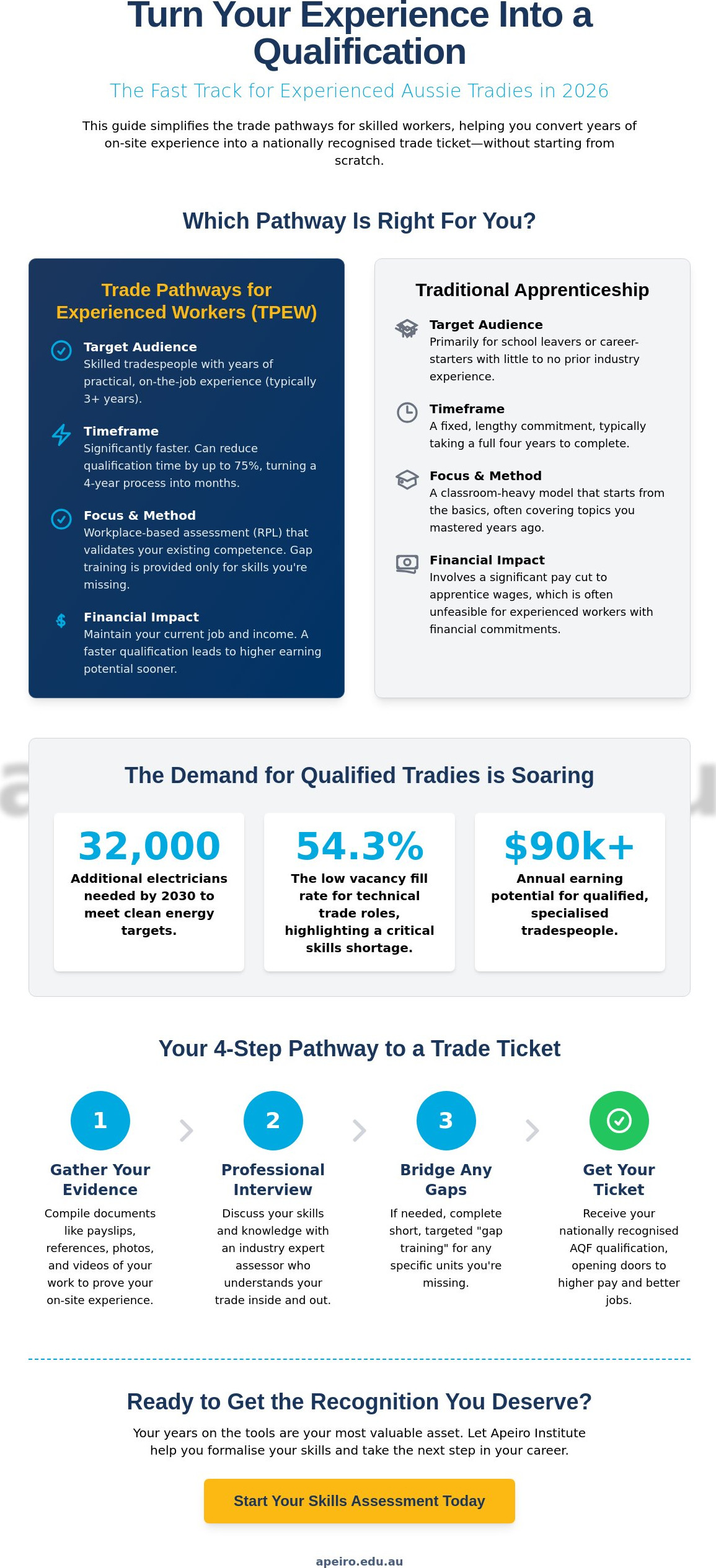
2026 marks a turning point for the Australian workforce. With major infrastructure projects and clean energy targets requiring 32,000 additional electricians by 2030, the demand for qualified tradespeople is at an all-time high. A "trade ticket" carries more weight than a basic vocational certificate. It signifies that you meet the rigorous national standards required for licensing and higher-level site responsibilities. For many, trade pathways experienced workers Australia offers are the only way to keep pace with an industry where the vacancy fill rate for technical roles has dropped to just 54.3%.
The Value of Your "Sweat Equity" on the Tools
Your time on site is worth more than just a weekly wage. In the eyes of an assessor, those years are "sweat equity" that can be converted into academic credits. Industry employers often prioritise workers who pair real-world problem-solving with formal papers. It's a combination that leads to higher earning potential. According to current industry data, qualified tradespeople can earn between $65,000 and $90,000 annually, with specialists often exceeding that range. Beyond the money, there is a significant psychological boost in finally being called "qualified." It changes how you're viewed by clients, colleagues, and the building commission.
TPEW vs. Recognition of Prior Learning (RPL)
It's easy to get confused by the terminology. Recognition of Prior Learning (RPL) is the specific assessment tool used to check your existing skills. However, Trade Pathways for Experienced Workers (TPEW) is the broader program. The main advantage of TPEW is that it often includes funded gap training. If the assessment shows you're missing a specific modern technique or safety unit, the pathway helps you bridge that gap without starting a full course. When you speak to a mentor at Apeiro, using the right terms helps us find the fastest route to your ticket. We focus on what you already know so you don't waste time in a classroom learning things you've been doing for years.
TPEW vs. Traditional Apprenticeships: A Solution Comparison
Traditional apprenticeships are the standard four-year marathon. While this model works well for school leavers, it's often a poor fit for someone with a mortgage and a decade of experience. The trade pathways experienced workers Australia offers provide a realistic alternative. They move away from the classroom-heavy model and focus on workplace-based assessments. This approach respects your professional maturity. You aren't treated like a beginner; you're treated like a professional proving your standard. It's about validating the skills you use every day on site rather than listening to lectures on things you mastered years ago.
Choosing between these two routes usually comes down to how much "seat time" you actually need. If you've already spent years performing the tasks, an apprenticeship can feel like a waste of time. Trade pathways prioritise your existing competence, allowing you to bypass the basics and focus only on any specific gaps in your knowledge. This creates a more streamlined experience that values your history on the tools.
Timeframes and Career Momentum
Speed is the biggest factor for most adult learners. While a standard apprentice waits years for their certificate, an experienced worker can often wrap things up much faster. By leveraging your existing knowledge, TPEW can reduce qualification time by up to 75 per cent. This allows you to keep your current job and maintain your career momentum. You don't need to sit through basic safety inductions you've done a hundred times. Instead, you focus on the specific units required for your Certificate III. This efficiency means you can reach your goals without putting your life on hold.
The Financial Logic of Trade Pathways
Most mature workers cannot afford to drop down to a first-year apprentice wage. It is a financial trap that prevents many talented people from getting certified. TPEW allows you to keep earning your current rate while the assessment happens in the background. It is based on the principle that Real Skills Deserve Real Recognition. In states like NSW, the TPEW program is often fee-free for eligible students through government funding. This removes the financial barrier to entry entirely. Some of the key financial benefits include:
- Minimal downtime away from the job site and regular income
- Assessments that happen while you perform your daily tasks
- Access to government-funded training for any necessary gap units
- No requirement to sit in a classroom with teenagers
Considering that qualified tradespeople in Australia can expect to earn between $65,000 and $90,000 annually, the investment in your certification pays for itself quickly. If you're ready to see how your history stacks up, you can explore our TPEW options to start the process today. Formalising your skills is the most direct way to secure your financial future in a competitive market.
Eligibility and Evidence: How to Prove Your Trade Mastery
Proving your expertise doesn't mean you need to write a thesis. The most common requirement across trade pathways experienced workers Australia provides is the "3-year rule." This generally means you must demonstrate at least three years of full-time experience in your chosen trade. For workers in specific states like New South Wales, the criteria often specify that at least 12 months of this work must have been performed within Australia. This ensures you are familiar with local safety regulations and building codes. If you are a skilled migrant, your overseas experience is highly valuable, but it must be verified. This is where Trades Recognition Australia (TRA) plays a vital role in assessing international skills against the Australian standard.
The biggest hurdle for many is the psychological barrier of gathering evidence. It's easy to feel like your daily work is "just a job," but to an assessor, those daily tasks are proof of mastery. At Apeiro Institute, we don't expect you to navigate this alone. We provide a dedicated mentor to guide you through the documentation phase. We help you translate your practical site history into the formal language that assessors need to see. You don't need to be an academic; you just need to be a good tradesperson with a history of solid work.
The Evidence Portfolio Checklist
Your portfolio is a collection of "proof points" that show you can do the job safely and correctly. If you've been working as a subcontractor, your evidence might look slightly different, involving contracts or tax records. For most applicants, the checklist includes:
- Workplace Photos and Videos: Clear shots of you performing specific tasks, such as wiring a switchboard or diagnosing an engine fault.
- Job Cards and Invoices: Documentation that proves the variety and complexity of the projects you've handled.
- Employer References: Letters from licensed tradespeople who can vouch for your technical skills and reliability.
- Qualifications and Training: Any previous certificates, even if they are from overseas or related industries.
Bridging the Gaps with Gap Training
It's perfectly normal to be competent in 80 or 90 per cent of a qualification but lack experience in a few niche areas. This shouldn't stop your progress. When an assessment identifies a missing skill, we use targeted gap training to bridge it. This isn't a full course. It's a precise, short-term learning module designed to give you exactly what you need to meet the national standard. All gap training provided through our TPEW programs is industry-current and nationally recognised. This ensures that once you receive your ticket, there are no "asterisks" next to your name; you are fully qualified in every aspect of the trade.
Step-by-Step Guide to Getting Your Trade Ticket
Getting your trade ticket shouldn't feel like a mystery. It is a logical, structured progression that respects the time you've already spent on site. The journey begins with a simple self-assessment. You look at the tasks you perform every day and match those skills to a specific Certificate III qualification. This is the foundation of the trade pathways experienced workers Australia relies on to fill critical skill shortages. It's about being honest regarding your strengths and identifying any niche areas where you might need a quick refresher to meet national standards.
Once you've identified your path, you'll sit down for an expert interview with an Apeiro assessor. This is a professional conversation, not a high-pressure exam. You'll discuss your work history, the types of projects you've managed, and the technical problems you solve daily. Following this, we develop a personalised training and assessment plan. This roadmap clearly outlines which units are covered by your existing experience and which ones require a final practical check. It keeps the process transparent and ensures you aren't wasting time on things you already know.
Selecting Your Trade Specialisation
Choosing the right qualification is essential for ensuring your ticket matches current industry requirements. For automotive professionals looking to formalise their mechanical expertise, the AUR30620 Certificate III in Light Vehicle Mechanical Technology is the primary choice. If your expertise lies in circuitry and technical systems, you can explore electronics pathways with the UEE30920 Certificate III in Electronics and Communications. Selecting an RTO that uses the most current training package codes is vital; it ensures your qualification is future-proof and recognised by licensing bodies across all states.
The Assessment Process Explained
The assessment phase is where your mastery is officially recorded. This involves practical demonstrations where you show us what you can do in a real-world setting. We want to see your skills in action, whether that's diagnosing a complex fault or installing a system to Australian standards. We also use knowledge tests to confirm you understand the technical "why" behind your work. These tests focus on safety, regulations, and the logic of your trade rather than academic theory. After the final sign-off, your nationally recognised qualification is issued, opening doors to higher pay and better roles.
Ready to move from "experienced" to "qualified"? Apply for a TPEW assessment today and get the professional recognition you've earned through years of hard work.
Why Experienced Workers Choose Apeiro Institute
Choosing a training provider is about finding a partner who values your history. Apeiro Institute isn't just another cold institution; we act as a supportive mentor throughout your entire journey. We understand the unique challenges of trade pathways experienced workers Australia must navigate, especially when balancing site responsibilities with the need for formal papers. Our community is built on incredible diversity, with students from over 38 nationalities bringing a global perspective to local Australian industries. Whether you are in automotive, electronics, or civil construction design, you are joining a group that celebrates practical mastery and personal growth.
For those based in New South Wales, the process is even more accessible through government support. We help eligible workers navigate Smart and Skilled funding, which can significantly reduce the cost of your training and assessment. This initiative ensures that financial hurdles don't stand in the way of your career progression. Our team handles the complexities of the application process, allowing you to focus on your work while we manage the administrative details. We believe that your years of hard work deserve a clear, affordable path to recognition.
Support Beyond the Certificate
Getting your trade ticket is often just the first step in a much larger career story. We help you look ahead to your next move, whether that involves site management, business ownership, or a shift into leadership. For those interested in moving into human-centred leadership or support roles, you might consider exploring our Diploma of Community Services. This transition from technical work to management is a common path for experienced tradespeople looking for longevity in their careers. We pride ourselves on being an RTO that feels like a partner, staying invested in your success long after your initial assessment is complete.
Getting Started Today
Ready to make it official? Booking your initial trade pathway consultation is the best way to clear up any confusion and get a clear timeline for your certification. To speed up the process, bring your current identification, recent payslips, and a few examples of job cards or site photos to your first meeting. These documents give our assessors a clear picture of your expertise from the very first minute. Your experience is worth a lot; it is time to turn that hard-earned "sweat equity" into a nationally recognised ticket. Let's work together to secure the professional future you have already built on the tools.
Secure the Professional Recognition You Have Earned
Your years on site have built a foundation of skill that is ready to be formalised. We have explored how the trade pathways experienced workers Australia offers can bypass the traditional four-year wait; moving you straight toward the professional recognition you deserve. By choosing this route, you ensure your mastery is backed by a nationally recognised qualification that is respected in every state. It's a practical, logical solution for mature workers who need to maintain their income while they step up. You've already done the hard work on the tools. Now, it's simply about making that expertise official.
At Apeiro Institute (RTO Code 45394), our supportive RPL mentors are here to help you navigate the documentation and assessment process with ease. We don't just provide a certificate; we provide a partnership that values your professional history and future goals. Our commitment to your growth means you are never alone in the process. Don't let your experience go unrecognised for another year when the solution is right in front of you.
Get your trade experience recognised with Apeiro Institute today. It is time to take the final step and secure the career you've already spent years building. You have the skills; we have the pathway to make them count.
Frequently Asked Questions
Am I eligible for Trade Pathways if I learned my trade overseas?
Yes, you are certainly eligible if your overseas experience matches Australian standards. We look at your international work history and help you align it with the local Certificate III requirements. You will generally need to provide specific documentation to verify your skills before we begin the formal assessment process.
How much does the Trade Pathways for Experienced Workers program cost?
The total cost depends on your eligibility for government subsidies and the amount of gap training you might need. In New South Wales, many eligible students can access fee-free training through the Smart and Skilled program. We recommend a consultation to check your eligibility for these funding options and discuss your specific needs.
Do I need to attend classes every day to get my trade qualification?
No, you don't need to sit in a classroom every day because this pathway prioritises workplace-based assessment. Most of the process happens while you are on the tools or through scheduled interviews with your mentor. If you require gap training, we organise flexible sessions that fit around your current work commitments.
What is the difference between TPEW and a standard RPL certificate?
TPEW is a comprehensive program designed specifically for the trade pathways experienced workers Australia requires to fill critical skill gaps. While Recognition of Prior Learning (RPL) is the assessment tool used to check your skills, TPEW is a broader pathway that often includes funded gap training. This ensures you get a full trade ticket even if you are missing a few specific units.
Can I get a trade ticket if I have been out of the industry for a few years?
Yes, you can still apply if you have previous experience, provided you meet the currency requirements. Generally, you should have worked in the trade within the last five years to ensure your technical skills are still industry-standard. We will review your history to determine if your previous experience is sufficient for a successful assessment.
How long does the entire process take from application to graduation?
The timeframe is significantly shorter than a traditional four-year apprenticeship and often takes only a few months. The exact duration depends on how quickly you gather your evidence and whether you need any gap training. Most workers find they can complete the process much faster than they expected once they start the documentation phase.
What happens if I fail one of the practical assessments?
If you don't meet the standard in a practical assessment, we simply identify it as a skill gap that needs bridging. We don't view it as a failure; instead, we provide targeted gap training to help you master that specific unit. Once you have gained the necessary skill, you can be reassessed to prove your competency.
Is an Apeiro Institute qualification the same as one from TAFE?
Yes, a qualification from Apeiro Institute is nationally recognised and holds the same weight as one from TAFE. Both institutions issue certificates under the Australian Qualifications Framework (AQF). This ensures your trade ticket is valid across all Australian states and territories and is fully respected by licensing bodies and employers.

Disclaimer
The information provided on this blog is for general informational and educational purposes only. While every effort is made to ensure the accuracy and reliability of the content, the author makes no representations or warranties of any kind, express or implied, about the completeness, accuracy, suitability, or availability of the information contained on this blog.
The views and opinions expressed in blog posts are those of the individual author and do not necessarily reflect the official policy or position of any organization, company, or employer.
This blog may contain links to external websites or third-party content. These links are provided for convenience only, and the author has no control over and assumes no responsibility for the content, privacy policies, or practices of any third-party sites.
Nothing on this blog constitutes professional advice (legal, financial, medical, or otherwise). Readers are encouraged to seek appropriate professional guidance before making any decisions based on the information provided here.
By using this blog, you acknowledge that any reliance on the information is at your own risk.


