

Did you know that the hourly rate for a Certificate III direct care worker has jumped by 47% since 2022? If you're researching the aged care trainee salary australia landscape for 2026, you'll find a sector that finally values your contribution with competitive, legally protected pay. It's completely normal to feel some financial stress when you're planning a career change. You want to ensure your time spent training won't leave you struggling to cover the essentials, and the complex maze of Award rates can often feel a bit overwhelming.
We're here to act as your guide and clear up that confusion. This guide provides a transparent breakdown of the 2026 pay scales, including the $32.61 entry-level rate and the jump to $36.23 once you're qualified. We'll explore how penalty rates for weekends and public holidays significantly boost your weekly take-home pay. You'll also discover how to access funded training through initiatives like Smart and Skilled, ensuring you start your new professional life with confidence rather than debt. By the end of this guide, you'll see exactly why aged care is a rewarding and viable long-term career path.
Key Takeaways
- Learn how the 2026 pay landscape provides financial security with entry-level trainee rates now starting at over $32 per hour.
- Understand how the SCHADS Award protects your aged care trainee salary australia and ensures your pay increases as you progress through your training.
- Discover how to maximise your weekly take-home pay by leveraging shift penalties, weekend loadings, and essential laundry or travel allowances.
- Explore how to access fee-free training for your Certificate III in Individual Support through NSW Smart and Skilled funded pathways.
- Gain a clear roadmap for your career growth, showing the transition from a trainee wage to the higher salary brackets of a qualified carer.
What to Expect from an Aged Care Trainee Salary in 2026
An aged care traineeship is a unique career entry point. It's a structured arrangement where you're employed to work while simultaneously completing a nationally recognised qualification. In the context of Aged care in Australia, this model ensures that the workforce remains highly skilled and professional. Unlike traditional study where you might spend years in a classroom before seeing a paycheck, this approach puts you on the floor from day one. You're earning a legal wage while building the practical skills needed for a long-term career.
2026 marks a historic high point for wages in the sector. Following several significant Fair Work Commission reviews, the aged care trainee salary australia has seen substantial growth. These changes weren't just minor adjustments. They represent a fundamental shift designed to reflect the vital nature of the work you do. With the national minimum wage now at $26.44 per hour and award rates for direct care workers starting even higher, the financial barrier to entering the industry has never been lower.
The "Earn While You Learn" Financial Advantage
Many students are rightfully worried about the student debt trap. University-based health degrees can often leave graduates with HELP debts exceeding $21,000. Choosing a traineeship flips this script. Instead of paying to learn, you're getting paid to grow. In many cases, employer-sponsored training can even cover your course fees entirely. This means you can focus on your professional development without the weight of a massive loan hanging over your head. It's a practical solution for anyone looking to balance financial stability with career progression.
Trainee vs. Qualified Carer: The Pay Gap
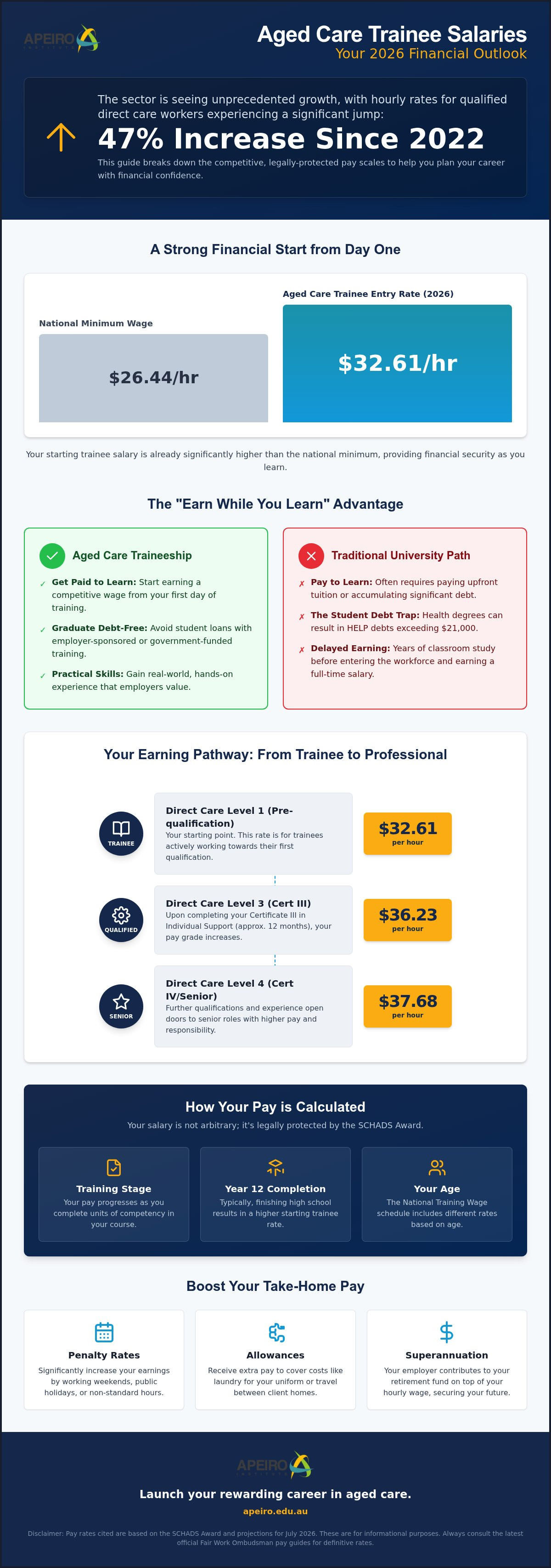
It's helpful to view your trainee wage as a starting block rather than a finish line. As of July 2026, an entry-level Direct Care Level 1 worker, which includes those without a qualification, earns $32.61 per hour. This is your foundation. Once you complete your Certificate III in Individual Support, your value in the market increases immediately. Most traineeships last about 12 months, and once you graduate, you'll see a clear jump in your pay packet.
- Direct Care Level 1 (Trainee/Pre-qualification): $32.61 per hour.
- Direct Care Level 3 (Certificate III Qualified): $36.23 per hour.
- Direct Care Level 4 (Senior/Certificate IV Qualified): $37.68 per hour.
The Australian aged care industry is currently experiencing a period of unprecedented demand. As our population ages, the need for skilled carers will continue to climb. This ensures that your earning potential doesn't stop at your first certificate. There are clear, structured pathways that allow you to move from an entry-level trainee role into senior care coordinator positions with corresponding increases in pay and responsibility.
How Aged Care Trainee Pay is Calculated: The SCHADS Award
Your paycheck isn't a random number decided by your employer. In Australia, your earnings are strictly regulated by the Social, Community, Home Care and Disability Services Industry Award (SCHADS Award). This legal document ensures that every worker in the sector receives fair compensation for their time and expertise. For those entering the field, the Fair Work Commission sets a National Training Wage. This specific schedule outlines exactly what you should be paid based on the "Training Stage" you've reached in your course.
Several personal factors influence your starting aged care trainee salary australia. For instance, if you've completed Year 12, your starting rate is typically higher than someone who left school earlier. Your age also plays a significant role. The system is designed to be progressive. As you move through your units of competency and gain more hands-on experience, your pay rate moves up through predetermined stages. It's a transparent system that rewards your growth and commitment to the profession.
Understanding the SCHADS Award Structure
The SCHADS Award is divided into different levels that reflect your skills and responsibilities. Recently, the "Work Value Case" led to a massive uplift in these base rates. The Fair Work Commission recognised that aged care work has become more complex and demanding, requiring a higher level of skill than in previous decades. This means the legal minimum you can be paid is now significantly higher than it was just a few years ago. You are legally protected from being underpaid, and your employer must adhere to these industry-wide standards, providing you with a secure financial foundation while you study.
Hourly Rates: A 2026 Forecast
As of July 2026, the national minimum wage has risen to $26.44 per hour. However, many trainees in the aged care sector are paid under the Direct Care classifications. An entry-level trainee (Level 1) can expect a base rate of approximately $32.61 per hour. If you're an adult trainee (21 years or older), you'll generally start on a higher rate compared to a junior school-leaver. For a school-leaver, the National Training Wage might start around $540.50 per week, but many providers choose to pay above this to attract talent. When you receive your payslip, check that your classification matches your current training stage to ensure you're getting every cent you're entitled to.
Starting your career with the right guidance makes all the difference. If you're ready to take the first step, exploring a Certificate III in Individual Support can help you navigate these entry-level requirements with ease. It's about more than just a job; it's about entering a regulated profession that values your contribution from day one.
Key Factors that Impact Your Trainee Take-Home Pay
While the base aged care trainee salary australia provides a solid foundation, your actual bank balance at the end of the week depends on several variables. Your employment contract, the type of organisation you join, and even your past work history all play a role in determining your final earnings. It's not just about the hourly rate; it's about how you structure your working life to maximise your financial outcomes while you study.
One factor that often surprises new starters is the recognition of previous experience. If you've worked in a related field or have completed some units of a Certificate III in Individual Support previously, you might be eligible to start at a higher pay point. Also, your commitment to your studies directly affects your wallet. Under the SCHADS Award Pay Rates, pay increments are often tied to the successful completion of specific training stages. Falling behind in your coursework doesn't just delay your graduation; it can literally stall your next pay rise.
Employment Status and Your Weekly Income
Choosing between full-time, part-time, or casual work is a major decision for any trainee. Casual trainees often receive a 25% loading on top of their base hourly rate. This extra cash is designed to compensate for the lack of paid annual leave and sick pay. While the higher hourly figure looks attractive, many trainees find that permanent part-time roles offer better long-term security. These roles provide a steady income floor, making it easier to budget for rent and groceries while you balance your study commitments. If you're working a standard 38-hour week, your annualised salary will be more predictable, allowing you to plan for the future with greater certainty. You'll also build up leave entitlements that provide a safety net if you need a break.
Salary Packaging in the Not-for-Profit Sector
In the Australian aged care landscape, who you work for is just as important as how many hours you do. Not-for-profit providers often offer a benefit called salary packaging. Because these organisations are frequently exempt from Fringe Benefits Tax (FBT), they can allow you to pay for certain living expenses, like your mortgage or groceries, using your pre-tax income. This effectively increases your tax-free threshold and reduces the amount of income tax you pay. You might find that a not-for-profit offering a slightly lower gross aged care trainee salary australia actually results in a higher net take-home pay than a private provider. It's a powerful tool for reducing financial stress during your training year. Taking the time to compare these offers can make a significant difference to your lifestyle while you're earning your qualification.
Maximising Your Earnings: Allowances, Super, and Incentives
Calculating your aged care trainee salary australia requires looking beyond the base hourly rate. The aged care sector is known for its "total reward" structure, which includes various add-ons that can significantly increase your monthly income. While your base pay covers your standard hours, allowances for uniforms, laundry, and travel provide extra cash to cover work-related expenses. If you're working in home care, travel reimbursements are particularly vital; they ensure you aren't out of pocket for moving between clients. These small amounts might seem minor individually, but they add up to thousands of dollars over the course of your training year.
Beyond these daily additions, the Australian government often provides specific incentives for trainees in high-demand sectors. Because the nation needs more skilled carers, programmes like the NSW Smart and Skilled initiative offer funded, fee-free training. This doesn't just save you money on course fees. It effectively increases your net wealth by removing the need for student loans. It's a strategic way to start your career with a clean financial slate and a clear focus on your professional growth.
Working the Clock: Penalty Rates Explained
The most effective way to boost your take-home pay is by understanding shift penalties. Under the SCHADS Award, working outside standard business hours triggers significant pay increases. If you work a Saturday shift, you'll typically earn a 50% loading. Sundays are even more lucrative, offering a 75% increase on your base rate. For trainees willing to work on public holidays, the reward is a massive 150% loading. For instance, a trainee on a base rate of $32.61 would see their hourly earnings jump to over $81 on a public holiday. Balancing your study schedule to include a few weekend shifts can make a dramatic difference to your weekly budget without requiring extra hours on the floor.
Superannuation and Your Future
Your long-term wealth starts the moment you begin your traineeship. For the 2026 financial year, the Super Guarantee rate is 12%. This is a mandatory contribution your employer pays into your nominated super fund on top of your base aged care trainee salary australia. It's not deducted from your pay; it's an extra benefit. Starting these contributions as a trainee is a savvy financial move because of the power of compound interest. Always check your payslip to ensure your employer is calculating this 12% correctly on your gross earnings. It's your money. Ensuring it's paid correctly now sets you up for a much more comfortable future.
Start your career with a CHC33021 Certificate III in Individual Support
Launching Your Career: Qualifications and Funded Training Pathways
Starting a new career path is as much about the right education as it is about the right paycheck. While understanding the aged care trainee salary australia helps you plan your budget, the qualification you choose defines your long-term trajectory. The industry standard for anyone entering the field is the Certificate III in Individual Support. This nationally recognised qualification provides the essential skills to support older people in residential care or community settings. It acts as the bridge between being an entry-level trainee and becoming a fully qualified, confident professional.
Apeiro Institute acts as your mentor throughout this transition. As a registered training organisation (RTO 45394), we don't just provide textbooks; we provide a supportive community. We understand that balancing work and study is a challenge. Our approach focuses on practical outcomes, ensuring that the theory you learn in the classroom is immediately applicable to your daily tasks on the floor. This makes the learning process feel natural and rewarding rather than intimidating.
Choosing the Right Qualification
The Certificate III is your foundation, but it's certainly not the end of the road. Many of our students eventually progress to a Diploma of Community Services. This higher-level qualification opens doors to management and case coordination roles, which come with significantly higher salary brackets. By studying with a mentor-focused RTO, you gain the confidence to look beyond your initial training year. You'll see that aged care isn't just a job; it's a structured career with multiple layers of progression.
Accessing Government Subsidies
One of the biggest advantages for trainees in 2026 is the availability of Smart and Skilled funded courses. If you live or work in NSW, you may be eligible for fee-free training. This funding reduces the financial burden on both you and your employer. It makes the "earn while you learn" model even more viable because you aren't sacrificing a portion of your aged care trainee salary australia to pay for your education. It's a win-win situation that encourages more people to enter this vital workforce.
Ready to start? Follow this simple checklist to kickstart your journey:
- Check your eligibility: Visit the NSW Smart and Skilled website to see if you qualify for fee-free training.
- Find a host employer: Look for aged care providers that offer traineeship positions.
- Contact Apeiro Institute: We can help you navigate the enrolment process and connect you with the right training plan.
- Commit to the journey: Remember that your pay increases as you hit your training milestones.
Your Path to a Rewarding Career Starts Now
The landscape for an aged care trainee salary australia in 2026 offers a level of financial security and professional respect that was once hard to find. You now have a clear understanding of how Award rates, shift penalties, and salary packaging work together to support your lifestyle while you study. This "earn while you learn" model is a practical, debt-free alternative to traditional degrees, allowing you to build wealth from your very first shift.
Apeiro Institute (RTO 45394) is ready to support your journey with expert trainers who bring real-world aged care experience to every lesson. We help you navigate the enrolment process and access NSW Smart and Skilled fee-free training, ensuring your focus remains on your personal growth and your patients. It's time to turn your passion for helping others into a sustainable and rewarding professional life.
Start your aged care career with our funded training options today!
Your future in the Australian healthcare sector is waiting for you. We're excited to partner with you as you take this important step toward a secure and fulfilling career.
Frequently Asked Questions
What is the minimum hourly rate for an aged care trainee in Australia in 2026?
As of July 2026, the entry-level rate for a Direct Care Level 1 worker is $32.61 per hour. This rate applies to trainees who haven't yet completed their formal qualification. It's important to recognise that this is significantly higher than the national minimum wage of $26.44, reflecting the specialised skills required in the sector. Your specific aged care trainee salary australia may be higher depending on your employer's enterprise agreement.
Do I get paid for the time I spend studying during my traineeship?
Yes, you certainly do. One of the primary benefits of the Australian traineeship model is that your employer pays you for the time you spend in structured training. Whether you're attending a workshop at a training centre or completing online modules during your rostered hours, this time is treated as work. You'll receive your standard hourly rate for these study periods, ensuring your income remains stable throughout your qualification.
Can I do an aged care traineeship part-time while balancing other commitments?
Absolutely. Many aged care providers offer part-time traineeships to accommodate workers with family responsibilities or other commitments. While your total weekly take-home pay will be lower than a full-time staff member, your hourly rate and legal protections remain exactly the same. This flexibility makes the sector an excellent choice for career-changers who need to maintain a work-life balance while they gain their nationally recognised Certificate III qualification.
Is there an age limit for starting an aged care traineeship?
There is no upper age limit for entering the industry. In fact, many providers actively seek mature-age trainees because of the life experience and empathy they bring to the role. Whether you're a school-leaver or looking for a fresh start in your 50s, the pathway is open. Adult trainees, defined as those aged 21 and over, often start on higher base rates compared to junior school-leavers under the National Training Wage.
Will my salary increase automatically once I finish my Certificate III?
Yes, finishing your qualification is a major financial milestone. Once you successfully complete the CHC33021 Certificate III in Individual Support, you're no longer classified as a trainee. You'll move from Direct Care Level 1 to Level 3 on the pay scale. This transition increases your base rate to $36.23 per hour. It's a clear reward for your hard work and marks your official entry as a qualified professional.
Are there any government bonuses for completing an aged care traineeship?
While direct cash bonuses aren't always guaranteed, the most significant financial boost comes from government-funded training. Programmes like NSW Smart and Skilled can make your course fee-free, saving you thousands of dollars in tuition costs. Additionally, the federal government occasionally introduces retention payments or regional incentives for aged care workers. These initiatives are designed to grow the workforce and reward those who commit to the aged care trainee salary australia pathway.
Do I need to pay for my own police check and vaccinations as a trainee?
In most cases, you'll need to cover the initial cost of your National Police Check and mandatory vaccinations, such as the flu and COVID-19 shots. These are essential legal requirements for working with vulnerable people. However, many supportive employers will reimburse these expenses once you've successfully started your traineeship. It's always a good idea to clarify this during your interview so you can budget for these small upfront costs accordingly.
What is the difference between an aged care apprentice and a trainee?
In the Australian healthcare sector, the term "trainee" is the standard designation. Apprenticeships are generally reserved for traditional trades like carpentry or plumbing and typically last three to four years. Traineeships, however, are shorter and usually completed within 12 months. They focus on service-based qualifications, providing a faster route to becoming a fully qualified worker while still offering the same "earn while you learn" legal protections and structured support.

Disclaimer
The information provided on this blog is for general informational and educational purposes only. While every effort is made to ensure the accuracy and reliability of the content, the author makes no representations or warranties of any kind, express or implied, about the completeness, accuracy, suitability, or availability of the information contained on this blog.
The views and opinions expressed in blog posts are those of the individual author and do not necessarily reflect the official policy or position of any organization, company, or employer.
This blog may contain links to external websites or third-party content. These links are provided for convenience only, and the author has no control over and assumes no responsibility for the content, privacy policies, or practices of any third-party sites.
Nothing on this blog constitutes professional advice (legal, financial, medical, or otherwise). Readers are encouraged to seek appropriate professional guidance before making any decisions based on the information provided here.
By using this blog, you acknowledge that any reliance on the information is at your own risk.


