

The quickest way to get into the aged care workforce isn't always the one that makes the most sense for your bank account or your long-term career goals. You likely already know that Australia's care sector is crying out for passionate people; however, the choice between an aged care traineeship vs certificate iii direct study path can feel like a major hurdle. It's completely normal to feel a bit stuck when you're trying to weigh up immediate pay against the flexibility of independent study.
We're here to help you clear up that confusion and find the right fit for your lifestyle. In this article, you'll discover how each pathway impacts your budget, your schedule, and your eligibility for government funding like the Smart and Skilled programme. We'll explore the practical differences between earning while you learn and fast-tracking your CHC33021 Certificate III in Individual Support. By the end, you'll have a clear roadmap to start your career with confidence and minimal out-of-pocket costs.
Key Takeaways
- Understand that both pathways lead to the same nationally recognised CHC33021 Certificate III in Individual Support, ensuring you meet the latest industry standards.
- Weigh up the financial pros and cons of an aged care traineeship vs certificate iii direct study to decide if you prefer earning a trainee wage or finishing your course faster.
- Discover how government-funded training options like Smart and Skilled can significantly reduce your study costs and remove financial barriers.
- Compare the flexibility of direct enrolment with the structured, on-the-job environment of a traineeship to find your ideal learning pace.
- Learn how to use a simple three-question self-assessment to identify which pathway aligns with your current financial needs and long-term career goals.
Understanding the Basics: Is there a Difference Between an Aged Care Traineeship and a Certificate III?
When you're looking at starting a career in Aged Care in Australia, the terminology can get a bit confusing. You'll often see people debating the merits of an aged care traineeship vs certificate iii as if they're completely different qualifications. In reality, they both lead to exactly the same outcome: becoming a qualified care worker ready to make a difference in the community.
The main thing to understand is that the CHC33021 Certificate III in Individual Support is the qualification itself. It's the industry standard that employers across the country look for. A traineeship, on the other hand, is simply the way you choose to complete that qualification. Think of the Certificate III as your destination and the traineeship as one of the possible roads to get there. Whether you study first or work while you learn, you'll end up with the same nationally recognised certificate.
What is a Certificate III in Individual Support?
The CHC33021 Certificate III in Individual Support (Ageing and Disability) is a nationally recognised qualification under the Australian Qualifications Framework (AQF). It's designed to give you the practical skills needed to support people who require help due to ageing or disability. You'll learn how to provide person-centred care, follow safe work practices, and support the independence of those you care for.
This course covers several key areas:
- Personal care and hygiene support
- Empowering people with disabilities to reach their goals
- Supporting individuals living with dementia
- Working safely and effectively in community or residential settings
What Defines an Aged Care Traineeship?
A traineeship is a formal, legal arrangement between you and your employer. It's often called "earning while you learn." Instead of studying the theory first and then looking for a job, you're hired as a trainee from day one. You'll spend part of your week working on the floor and another part focused on your studies. Your employer pays you a trainee wage for both your work hours and your dedicated training time.
Your journey is supported by a Registered Training Organisation (RTO) like Apeiro Institute. We work alongside your employer to ensure the training you receive on the job matches the strict requirements of the CHC33021 qualification. We'll visit your workplace to assess your skills in a real-world environment, making sure you're building the confidence needed to excel in your new career. It's a structured, supportive way to enter the workforce without the financial stress of full-time study.
The Traineeship Pathway: Earning While You Learn in the Care Sector
Choosing an aged care traineeship vs certificate iii direct study often comes down to your financial priorities. If you need a steady income immediately, the traineeship is a fantastic option. This pathway is a formal commitment that usually spans 12 to 24 months. While this is a longer duration than a standard classroom course, you're gaining seniority and workplace experience from day one. Eligibility typically requires you to be an Australian citizen or permanent resident, though some visa holders may also qualify depending on specific state funding rules.
According to the Australian Government's Your Career website, traineeships are designed to combine employment with training, providing a secure pathway into high-demand industries. It's a structured way to build a career without the stress of balancing a separate job and study schedule.
The Benefits of On-the-Job Training
One of the biggest perks is the total immersion. You aren't just reading about person-centred care in a textbook; you're practising it daily with real residents. This immediate exposure helps you build professional networks within a facility, making you a known and trusted face before you even graduate. You'll develop essential soft skills like empathy and clear communication under the watchful eye of experienced supervisors. This hands-on environment ensures that the theory you learn in your modules is immediately applied to real-world scenarios.
Financial Considerations for Trainees
Finances are a major factor for most students. As a trainee, you're paid under the National Training Wage, which applies to your hours spent working and your hours spent in formal training. While the entry-level rate is lower than a fully qualified worker, you're essentially getting paid to learn. Many trainees also benefit from government initiatives like Smart and Skilled, which can lead to fee-free or heavily subsidised training. This means you can walk away with a qualification without the burden of a large student debt. Plus, most host organisations are keen to keep their trainees on as permanent staff, providing excellent long-term job security.
If you're ready to explore how this works in practice, you can view our Certificate III in Individual Support options to see which delivery mode fits your life.
The Direct Study Pathway: Fast-Tracking Your CHC33021 Certificate III
If you prefer to hit the books and enter the workforce as a fully qualified professional, direct enrolment is likely your best bet. When comparing an aged care traineeship vs certificate iii direct study, the most obvious difference is the timeline. While a traineeship is a marathon, direct study is more of a sprint. It allows you to focus entirely on your education without the immediate pressure of balancing a full-time employment contract from day one.
Direct study is particularly popular for career changers who aren't yet employed in the sector. You have the freedom to choose a Registered Training Organisation (RTO) that fits your specific schedule and location. This means you can keep your current job or manage family commitments while you study, rather than being tied to the roster of a single aged care facility before you've even learned the basics. It's about maintaining control over your learning journey.
Flexibility and Speed of Completion
Speed is a major advantage here. Most students completing the CHC33021 Certificate III in Individual Support via direct enrolment finish within 6 to 12 months. This is significantly faster than the 12 to 24 months typically required for a traineeship. By combining intensive theory with a concentrated block of practical experience, you can qualify sooner and start earning a full care worker's wage. It's a high-impact approach that suits those who are eager to start their new career as quickly as possible.
Securing Work Placement
Even without a traineeship, practical experience is non-negotiable. To graduate, you must complete a mandatory work placement of at least 120 hours in a real-world care environment. At Apeiro Institute, we take a supportive role in this process. We help our students find suitable facilities where they can apply their skills under professional supervision. This ensures you aren't left struggling to find a spot to finish your qualification.
Think of your 120 hours as a "working interview." Many of our students impress their placement hosts so much that they're offered permanent roles before they've even finished their final assessments. It's a low-risk way to test the waters at a specific facility while building vital skills like empathy and active listening. You get the benefit of professional exposure without being locked into a long-term trainee contract.
Side-by-Side Comparison: Traineeship vs. Direct Enrolment
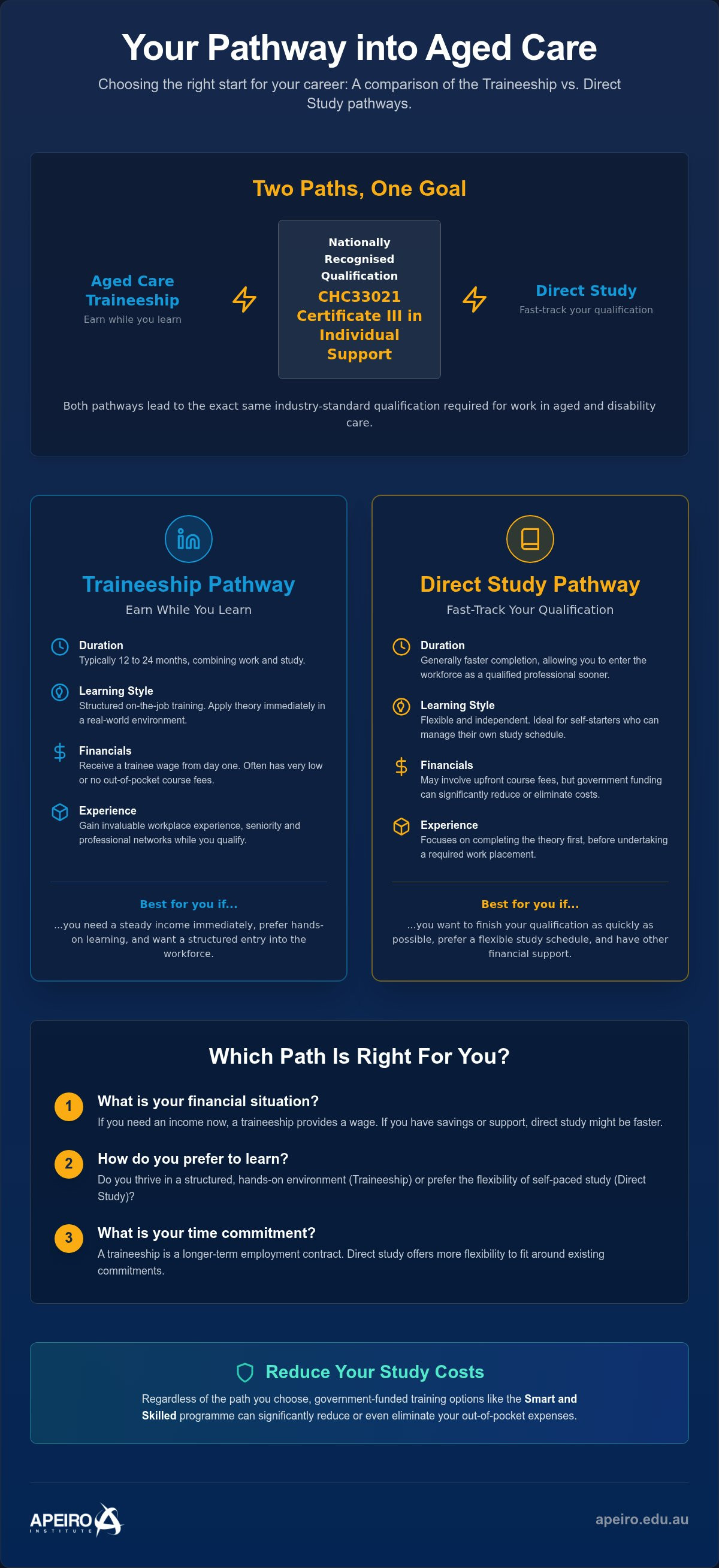
Choosing between an aged care traineeship vs certificate iii direct study isn't just about the name on the certificate. It's a choice between two different life rhythms. One offers a steady, long-term immersion in a single workplace, while the other provides a fast-tracked entry into the broader industry. Your decision will likely hinge on whether you value immediate income or a quicker path to your full qualification.
Financially, these paths are opposites. Trainees earn a wage from day one, which helps manage cost-of-living pressures. Direct study students usually pay course fees, though many qualify for Smart and Skilled subsidies. While trainees get constant support from their employer, direct study students often receive more intensive, one-on-one guidance from their RTO trainers during the theory phase. This balance of support ensures that regardless of your choice, you'll have an expert guide helping you succeed.
Which Pathway is Faster?
Direct study is the "express" route to your new career. Most students finish their qualification in 6 to 12 months. This is because you can focus heavily on the theory and then complete your 120 hours of placement in a concentrated block. A traineeship is a "slow and steady" journey. It usually takes up to 24 months because your learning is spread out across your working week. If you already have experience in the sector, you might be eligible for Trade Pathways for Experienced Workers. This pathway uses Recognition of Prior Learning (RPL) to acknowledge your existing skills, which can shorten your study time significantly.
Pros and Cons Summary
To help you decide, we've summarised the key points for each delivery mode:
Aged Care Traineeship:
- Pro: No student debt and a guaranteed income while you study.
- Pro: Deep integration into a facility's culture and long-term job security.
- Con: A lower trainee wage compared to fully qualified staff.
- Con: A longer time commitment (up to 24 months) to become fully qualified.
Direct Certificate III Study:
- Pro: The fastest route to a full care worker's salary (approx. $36.23 per hour as of July 2026).
- Pro: Flexibility to study around family or existing work commitments.
- Con: The 120 hours of mandatory work placement are usually unpaid.
- Con: Potential up-front course costs if you don't qualify for government funding.
Compare our flexible study options today
Making the Choice: How to Start Your Aged Care Career with Apeiro Institute
Deciding on an aged care traineeship vs certificate iii direct study path is a personal choice that depends entirely on your current situation. It's about finding the rhythm that suits your life today while building the career you want for tomorrow. To help you find the right fit, we suggest a quick three-question self-assessment:
- Do I need a steady income right now to cover my daily living expenses?
- Is my main priority to finish my qualification in the shortest possible time?
- Am I looking for the security of a single employer, or do I want the flexibility to explore different facilities after I graduate?
Your Career Pathway: Beyond Certificate III
Your professional journey doesn't have to stop once you've earned your CHC33021. While a Certificate III qualifies you as a Personal Care Worker, the industry offers many opportunities for those who want to lead. Moving into a supervisory role often requires the CHC43015 Certificate IV in Ageing Support. This qualification builds on your existing skills and prepares you for the responsibilities of a team leader or care coordinator. For those with long-term goals in case management or community advocacy, the Diploma of Community Services provides a clear pathway into senior management roles. We're committed to supporting your growth at every stage of your career.
Next Steps to Enrolment
Starting your enrolment is a straightforward process designed to get you into the classroom or the workplace without delay. Your first step is to reach out to one of our friendly admissions advisors. They'll walk you through the available funding options and help you choose the study mode that aligns with your specific career goals. To make the process faster, you should begin preparing a few key items. You'll need your Unique Student Identifier (USI), a current National Police Check, and any documents proving your prior experience if you're seeking Recognition of Prior Learning. We're ready to help you take that first step toward a rewarding career in aged care.
Take the Next Step Toward Your Rewarding Career in Aged Care
Choosing between an aged care traineeship vs certificate iii is ultimately a decision about your preferred learning pace and financial needs. Both pathways lead to the same nationally recognised CHC33021 qualification, ensuring you meet the latest industry standards. While a traineeship allows you to earn a wage while you learn over 24 months, direct study provides a fast-tracked route to full-time employment in as little as six months. As a proud NSW Smart and Skilled provider, Apeiro Institute (RTO 45394) offers the expert guidance you need to navigate these options with confidence.
Your journey into the care sector is an investment in your future and the well-being of the community. Our industry-expert trainers and assessors are dedicated to your personal growth and professional success. We're here to help you check your funding eligibility and find a study schedule that respects your existing family or work commitments.
Enquire about our Aged Care and Community Services courses today
We look forward to helping you start this rewarding new chapter and seeing you thrive in the Australian care workforce.
Frequently Asked Questions
How long does an aged care traineeship take to complete?
An aged care traineeship typically takes between 12 and 24 months to finish. This duration is longer than direct study because your learning is integrated into your working week. You'll spend most of your time on the floor gaining practical skills while setting aside specific hours for your formal modules. This steady pace allows you to master complex care tasks while earning a trainee wage throughout the entire process.
Do I get paid for work placement if I am not a trainee?
Standard work placements for direct study students are usually unpaid. When you enrol directly into the CHC33021 Certificate III in Individual Support, you must complete at least 120 hours of practical experience. These hours are considered part of your educational requirements rather than employment. However, many students find that these placements lead directly to paid job offers once the facility sees their dedication and skills in action.
Can I switch from direct study to a traineeship midway through?
You can often switch from direct study to a traineeship if you secure a formal employment contract with an aged care provider. This is a common move for students who start their course independently but find a "paid to learn" opportunity midway through. Your RTO will credit the units you've already completed, meaning you won't have to repeat any work when comparing an aged care traineeship vs certificate iii independent pathway.
What is the difference between aged care and individual support?
Individual support is the name of the national qualification, while aged care is the specific industry where you apply those skills. The CHC33021 Certificate III in Individual Support is a broad course that covers ageing, disability, and home and community care. Most students choose to specialise in the ageing stream, which prepares them specifically for roles in residential facilities or providing support to seniors in their own homes.
Is there government funding available for the Certificate III in 2026?
Government funding remains available in 2026 for eligible students through initiatives like the Smart and Skilled programme. This funding can significantly reduce or even eliminate your tuition fees for the Certificate III in Individual Support. Eligibility usually depends on your residency status and previous qualifications. It's a great idea to speak with an admissions advisor to confirm if you qualify for these subsidies before you begin your enrolment.
What are the entry requirements for an aged care course in Australia?
Entry requirements generally focus on your legal and physical readiness to work in a care environment. You'll need a Unique Student Identifier (USI) and a clear National Police Check. Most providers also require a basic level of English literacy and numeracy to ensure you can follow care plans safely. You should also be prepared to provide evidence of current vaccinations, such as the annual flu shot, which is mandatory in most facilities.
Can international students apply for an aged care traineeship?
What jobs can I get with a Certificate III in Individual Support?
Completing this qualification opens doors to several rewarding roles across the health and community sectors. The most common career path is becoming a Personal Care Worker in a residential aged care facility. Other opportunities include working as a Community Support Worker, a Respite Care Worker, or a Planned Activity Assistant. These roles are currently in high demand across Australia, providing excellent job security for newly qualified professionals.

Disclaimer
The information provided on this blog is for general informational and educational purposes only. While every effort is made to ensure the accuracy and reliability of the content, the author makes no representations or warranties of any kind, express or implied, about the completeness, accuracy, suitability, or availability of the information contained on this blog.
The views and opinions expressed in blog posts are those of the individual author and do not necessarily reflect the official policy or position of any organization, company, or employer.
This blog may contain links to external websites or third-party content. These links are provided for convenience only, and the author has no control over and assumes no responsibility for the content, privacy policies, or practices of any third-party sites.
Nothing on this blog constitutes professional advice (legal, financial, medical, or otherwise). Readers are encouraged to seek appropriate professional guidance before making any decisions based on the information provided here.
By using this blog, you acknowledge that any reliance on the information is at your own risk.


