

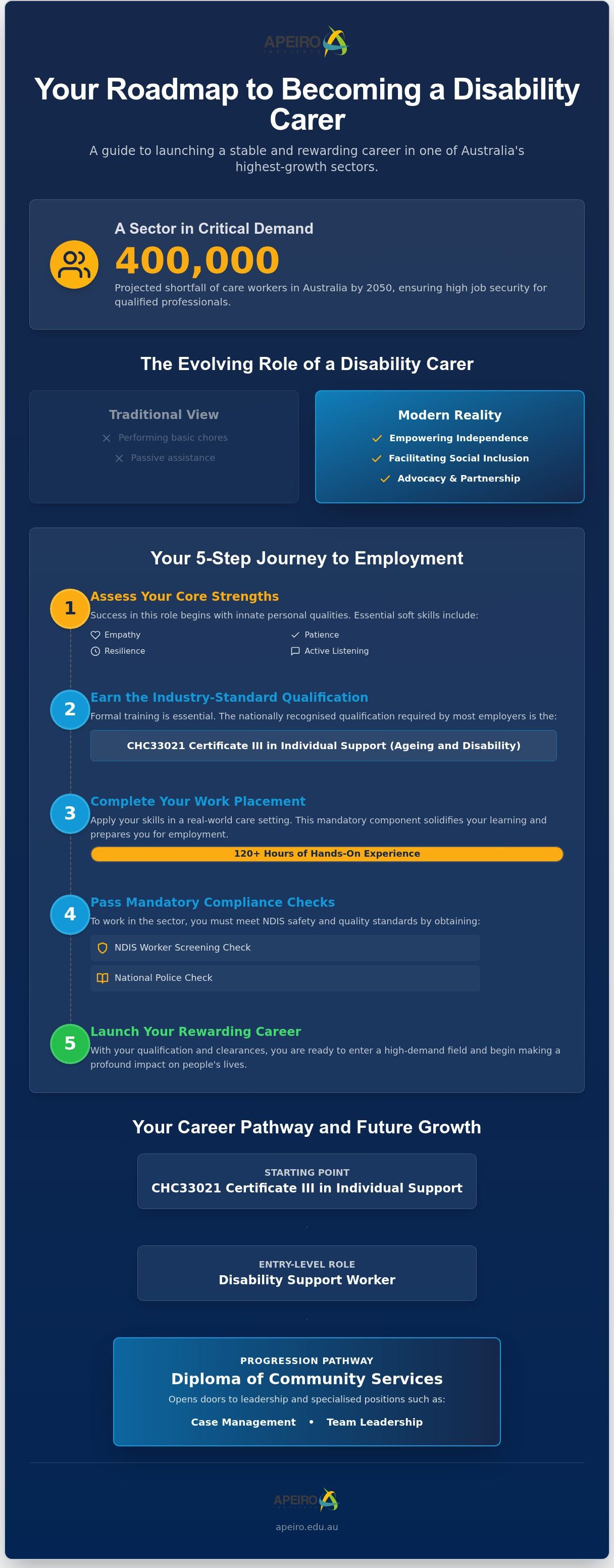
Australia is projected to face a shortfall of 400,000 care workers by 2050, which means your skills are in higher demand than ever before. If you've been searching for a career that combines job security with a profound sense of purpose, understanding how to become a disability carer is the first step toward a life-changing transition. It's a role where your daily efforts directly improve someone else's quality of life, making it one of the most rewarding paths you can choose.
You probably already have the heart for this work, but the paperwork and regulations can feel like a lot to take in. It's common to feel confused about NDIS compliance or which qualification actually gets you through the door. We're here to clear up that uncertainty and provide a straightforward 5-step roadmap to employment. You'll discover the exact qualifications required, the latest 2026 screening costs, and how to tell the difference between aged care and disability support roles. By the end of this guide, you'll have the confidence to choose the right training path and start your journey with ease.
Key Takeaways
- Learn why the modern disability carer role focuses on promoting independence and social inclusion rather than just physical support.
- Discover why the CHC33021 Certificate III in Individual Support is the essential industry standard for entering the sector with confidence.
- Get a clear breakdown of the mandatory NDIS Worker Screening and National Police Checks you'll need to meet professional compliance.
- Explore our practical 5-step roadmap on how to become a disability carer and launch a stable, rewarding career in a high-growth field.
- Understand how progressing to a Diploma of Community Services can open pathways into case management and leadership positions.
Understanding the Role of a Disability Support Worker
The modern disability carer is a far cry from the traditional image of someone who just performs domestic chores. Today, the role is focused on partnership and advocacy. You're a facilitator of independence, helping NDIS participants live life on their own terms. This shift toward social inclusion is why so many people are currently asking how to become a disability carer. You aren't just there to "do things" for someone; you're there to empower them to do things for themselves.
Why is the demand for these professionals surging across Australia in 2026? We're facing a significant workforce challenge. Recent projections show a shortfall of 400,000 care workers by 2050. This means that for anyone entering the sector now, job security is incredibly high. A Caregiver in the disability sector is a vital professional who supports the rights and dignity of some of the most vulnerable members of our community. It's a career that offers both stability and a deep sense of personal achievement.
The Daily Impact of Disability Support
Your daily responsibilities will vary depending on the needs of the individuals you support. You might assist with personal hygiene or domestic tasks, always ensuring the client's dignity is maintained. Facilitating community access is another major part of the job. This could involve supporting a client at a social event, a medical appointment, or even a local sporting match. You'll follow individualised support plans that are tailored to each person's unique goals. These plans ensure that every bit of support you provide helps the participant move closer to the life they want to lead.
Is Disability Care the Right Career for You?
While you'll learn the technical side of the job through training, certain soft skills are essential from day one. Empathy and patience are non-negotiable. You also need resilience, as the work can be emotionally taxing at times. Active listening is a core skill. You'll often need to interpret non-verbal cues to understand a client's needs or frustrations. It's also worth assessing your physical suitability, as the role can involve manual handling and being active throughout the day. If you have a genuine passion for helping others, learning how to become a disability carer by enrolling in a CHC33021 Certificate III in Individual Support (Ageing and Disability) is a powerful way to start your new career journey.
Essential Qualifications for Disability Carers
When you're researching how to become a disability carer, you'll quickly find that most employers require a formal qualification. While your lived experience and soft skills are valuable, the disability sector is highly regulated. A nationally recognised certificate proves you've mastered the safety protocols, ethical standards, and technical skills needed to provide high-quality care. It's about ensuring you can support NDIS participants safely while following the strict guidelines set by the NDIS Quality and Safeguards Commission.
The industry gold standard is the CHC33021 Certificate III in Individual Support (Ageing and Disability). This qualification is designed to give you a broad understanding of the community services sector while allowing you to focus on the specific needs of people living with disabilities. By choosing a Registered Training Organisation (RTO) like Apeiro Institute, you ensure your training meets national standards and is respected by providers across Australia.
The Certificate III in Individual Support
This course isn't just about ticking boxes. You'll dive deep into core units that cover the intricacies of the human body, healthy body systems, and the principles of person-centred care. You'll learn how to support people with complex needs, facilitate social inclusion, and manage the legal and ethical requirements of the role. Choosing the disability specialisation within this certificate is particularly beneficial. It gives you a competitive edge by focusing on things like empowering people with disabilities and assisting with self-advocacy, which are central to the modern NDIS philosophy. If you're ready to start your journey, you can enrol in our Certificate III program today to gain these vital skills.
Work Placement: Gaining Real-World Experience
Theory is only half the story. To graduate with your Certificate III, you'll need to complete a mandatory work placement, which usually requires at least 120 hours of hands-on experience in a real care setting. This is where your classroom learning truly comes to life. During your first week, you'll likely shadow an experienced carer, observing how they interact with clients and manage daily routines. It's a chance to build your confidence and refine your communication style in a supportive environment.
Many students find that their work placement is their best foot in the door. If you show initiative, empathy, and a strong work ethic, it's very common for placement hosts to offer permanent positions once you've finished your hours. It's the ultimate way to prove you've got what it takes while building a professional network in the sector. Learning how to become a disability carer is a practical journey, and this hands-on time is arguably the most rewarding part of the entire process.
Compliance, Checks, and NDIS Requirements
Securing your qualification is a major milestone, but you can't step into a professional role without the right legal clearances. These checks act as a safeguard for both you and the NDIS participants you'll support. Understanding the compliance side of the industry is a vital part of learning how to become a disability carer in Australia's highly regulated market. While the paperwork might seem daunting, most of these checks are straightforward and designed to ensure the safety of the community.
The NDIS Worker Screening Check is the primary requirement. It replaced the old state-based "Yellow Card" systems to create a unified national standard. As of May 2026, the application fees vary depending on where you live. For example, the check costs $107 in New South Wales, $145 in Western Australia, and $156 in Queensland. This clearance is valid for five years and is nationally portable. This means if you move to a different state or change employers, your clearance stays with you.
Most employers will also ask for a National Police Check and a Working with Children Check (WWCC). Even if you plan to work exclusively with adults, many organisations require a WWCC because you'll likely encounter children in community centres or shared residential settings. Keeping these documents organised and up to date is essential for staying employable.
The NDIS Worker Screening Process
Applying for your screening is a digital process that starts with your state or territory's worker screening unit. You'll need to provide several forms of identification and nominate your employer or a prospective employer. Once you submit the application, your employer must log into the NDIS Commission portal to verify they intend to engage you. After this verification, the government conducts a risk assessment. You can track your progress online, and once cleared, your status is visible to any NDIS-registered employer through the national database.
Mandatory Health and Safety Certifications
Beyond background checks, you must maintain current health and safety certificates to remain compliant. The HLTAID011 Provide First Aid unit is the industry standard you'll need to hold. While the full certificate lasts for three years, the CPR component must be refreshed every 12 months to stay valid. Manual handling training is another essential requirement. It provides practical techniques for assisting clients with mobility, ensuring you don't sustain a back injury while performing your duties. In our post-pandemic landscape, you'll also be expected to follow strict infection control protocols. These standards are in place to protect vulnerable participants and ensure you can provide care in a safe, hygienic environment. If you want to ensure your training covers all these bases, exploring how to become a disability carer through a reputable provider like Apeiro Institute is a great way to stay ahead of the requirements.
Career Pathways and Specialisations in Community Services
Many people view entry-level support work as a destination, but it's actually the starting point of a dynamic career path. Once you've mastered the basics of how to become a disability carer, you can look toward leadership roles that influence how care is delivered at a systemic level. Moving from a frontline support worker to a team leader or supervisor allows you to mentor new staff and ensure high standards of NDIS compliance. This progression isn't just about a title change. It's about taking on responsibility for the safety and wellbeing of your entire team and the participants you serve. You'll move from performing daily tasks to overseeing the broader strategy of a client's support plan.
Advancing to the Diploma of Community Services
Stepping into senior management or case coordination requires moving beyond the Certificate III level. A Diploma of Community Services is the primary vehicle for this transition. It equips you with the skills to manage complex cases and coordinate multi-disciplinary teams, including occupational therapists, NDIS plan managers, and family advocates. You'll find opportunities for leadership within government agencies and non-profit organisations, where your voice can contribute to social advocacy and community-wide changes. If you want to see the full scope of where this path can lead, check out our Diploma of Community Services Australia guide for a detailed look at 2026 career outcomes. This level of education moves you into a space where you can advocate for better resources and more inclusive local services.
Specialising in High-Needs Care
Another rewarding pathway involves narrowing your focus to a specific niche where your unique talents shine. Some carers choose to specialise in high-needs care, working with participants who have complex physical disabilities or profound neurodivergence. There is also a significant and growing intersection between mental health and disability support, often referred to as psychosocial recovery coaching. Specialising in these areas often requires targeted post-graduate short courses or specific on-the-job training. By becoming an expert in a niche field, you increase your value to employers while providing more effective support to those with specific requirements. This is a natural next step for those who have already established themselves and understand the core fundamentals of how to become a disability carer. It's about turning a job into a lifelong vocation.
Advance your career with a Diploma of Community Services today.
Starting Your Disability Care Journey with Apeiro Institute
Choosing where to study is just as important as deciding how to become a disability carer. You need a training provider that doesn't just hand out certificates but actually prepares you for the realities of the Australian healthcare sector. Apeiro Institute stands out because our approach is deeply rooted in industry needs. We don't just teach theory; we focus on the practical skills that NDIS providers are actively looking for in 2026. Whether you're a local student looking for a career change or an international student entering the Australian workforce, we provide the steady guidance you need to succeed.
Our trainers aren't just academics. They're experienced professionals who've spent years working on the front lines of community services. This means you get insights that you won't find in a textbook. You'll learn the nuances of client interaction, the complexities of NDIS documentation, and the best ways to manage challenging situations with empathy. We've designed our flexible learning options to fit around your life. We know that many of our students balance work and family commitments, so we've made sure our programmes are accessible without compromising on quality.
Supportive Learning Environment
We pride ourselves on creating a space where every student feels they belong. Our inclusive community celebrates students from over 38 different nationalities, bringing a rich diversity of perspectives to every classroom. For those wishing to further their cultural outreach, programmes like the Cook Islands Language Academy can provide the language skills needed to support specific community groups more effectively. This global outlook is paired with local reliability. We provide tailored guidance to ensure that students from all backgrounds can navigate the Australian vocational system with ease. Beyond our modern campus facilities and online resources, we offer hands-on assistance with securing high-quality work placements. As we discussed earlier, these 120 hours of placement are the bridge to your first job, and we're here to help you find the right environment to thrive.
When you study with us, you're earning a nationally recognised qualification that employers trust. Our RTO (Code 45394) and CRICOS (Provider 03703M) status ensure your training meets the highest Australian standards. We also focus on long-term growth. While you might start by learning how to become a disability carer through our CHC33021 Certificate III in Individual Support, we also provide clear pathways to the Diploma of Community Services. This commitment to your professional journey means you're not just getting a job; you're building a career. Taking the first step is simple. Reach out to our admissions team today to discuss your goals, and let's start your journey toward a rewarding career in disability support together.
Launch Your Career in Disability Support
Learning how to become a disability carer is about more than just finding a job; it's about finding a purpose. You now have a clear understanding of the essential CHC33021 qualification, the necessary NDIS Worker Screening checks, and the rewarding career pathways that lie ahead. By focusing on person-centred care and building your technical skills, you're preparing to enter one of Australia's fastest-growing sectors with confidence.
At Apeiro Institute (RTO 45394), we're committed to your success through expert trainers with real-world industry experience and dedicated work placement support. We act as your partner, bridging the gap between your current circumstances and your future professional goals. The demand for compassionate, skilled carers has never been higher.
Enrol in the Certificate III in Individual Support at Apeiro Institute today
Your journey toward making a genuine difference in the lives of NDIS participants starts with a single, decisive step. We look forward to welcoming you into our inclusive community and helping you achieve your professional objectives with ease and security.
Frequently Asked Questions
Do I need a university degree to become a disability carer in Australia?
Completion times generally vary between six and twelve months depending on your study load. This duration covers your classroom or online learning modules plus the mandatory 120 hours of work placement in a real care setting. Vocational training is designed to be flexible, allowing you to balance your studies with existing family or work commitments. Choosing a supportive training provider can help you stay on track to graduate and enter the workforce sooner.
Can I work in disability support while I am still studying?
Yes, many disability service providers hire students who are currently enrolled in a relevant qualification. Finding an entry-level role while you study is a fantastic way to gain practical experience and build your professional network. It's one of the most effective methods for understanding how to become a disability carer because you can apply your classroom knowledge to real-life situations immediately. Just ensure you have your mandatory screening checks in place before you start.
What is the difference between an aged care worker and a disability carer?
The primary difference lies in the core philosophy and the specific goals of the support provided. Aged care workers focus on assisting older Australians with daily living and maintaining comfort as they age. In contrast, disability support is centred on the NDIS philosophy of social inclusion and empowering participants to achieve personal independence. While both roles involve personal care, disability support often involves more active community participation and facilitating a participant's unique lifestyle goals.
How much do disability support workers earn in Australia in 2026?
As of July 2026, pay rates are governed by the SCHADS Award following a recent 4.75% wage increase. Entry-level permanent workers at Level 1, Pay Point 1 earn $27.55 per hour, while casuals at the same level earn $34.44. With more experience or higher qualifications, you can move to Level 2 or 3, where permanent rates start at $36.22 and $40.49 per hour respectively. These rates provide a stable and competitive income for your essential work.
Is the NDIS Worker Screening Check the same as a Police Check?
No, these are two different clearances with distinct purposes. A National Police Check is a point-in-time record of your criminal history, while the NDIS Worker Screening Check is a comprehensive, ongoing risk assessment. The NDIS check is specifically designed to determine if a person poses a risk to people with disability. It is nationally portable and valid for five years, offering a much higher level of protection for participants than a standard police check alone.
Can international students study disability care in Australia?
Yes, international students can certainly study disability care through CRICOS-registered training providers. This is an excellent way to gain an Australian qualification that is highly respected within our diverse healthcare sector. International students bring valuable multicultural perspectives to the role, which is a significant advantage in our community. While you must adhere to your visa's work hour conditions, completing a Certificate III provides a clear pathway to a meaningful career while living in Australia.
What happens if I fail my NDIS Worker Screening Check?
If you receive an "unsubstantiated" result or a notice of an interim bar, you'll be legally prohibited from working in risk-assessed NDIS roles. You'll receive a formal notice explaining the decision and outlining your right to request a review or appeal the finding. It's important to remember that the commission's primary focus is the safety of participants. Being transparent during your application is the best way to manage the process and ensure your career remains on track.

Disclaimer
The information provided on this blog is for general informational and educational purposes only. While every effort is made to ensure the accuracy and reliability of the content, the author makes no representations or warranties of any kind, express or implied, about the completeness, accuracy, suitability, or availability of the information contained on this blog.
The views and opinions expressed in blog posts are those of the individual author and do not necessarily reflect the official policy or position of any organization, company, or employer.
This blog may contain links to external websites or third-party content. These links are provided for convenience only, and the author has no control over and assumes no responsibility for the content, privacy policies, or practices of any third-party sites.
Nothing on this blog constitutes professional advice (legal, financial, medical, or otherwise). Readers are encouraged to seek appropriate professional guidance before making any decisions based on the information provided here.
By using this blog, you acknowledge that any reliance on the information is at your own risk.


