

What if you could step into a rewarding new career without the stress of unpaid placements or the burden of upfront tuition fees? You've likely heard that the aged care sector is looking for compassionate people, but the path to getting started often feels like a maze of paperwork and fine print. It's completely normal to feel a bit confused about how the "earn while you learn" process actually works or whether you meet the latest medical and legal compliance standards. Understanding the specific aged care traineeship requirements is the first step toward securing your future in this essential industry.
We're here to clear the air and show you that starting your journey is more attainable than you might think. This guide provides a straightforward checklist of everything you need, from the core CHC33021 Certificate III in Individual Support qualification to the latest 2026 worker screening checks. You'll discover how to balance your studies with paid work and exactly what steps to take to begin making a real difference in your community. Let's break down the prerequisites so you can move forward with confidence and clarity.
Key Takeaways
- Identify the core units of the CHC33021 Certificate III in Individual Support that form the industry gold standard for entry-level care roles.
- Understand the essential aged care traineeship requirements, including age prerequisites, residency status, and specific visa conditions for international students.
- Navigate the 2026 compliance landscape with a clear breakdown of the National Police Check and the NDIS Worker Screening Check.
- Learn how to leverage Recognition of Prior Learning (RPL) to turn your existing industry experience into a nationally recognised qualification.
- Discover how the "earn while you learn" model works and how to find a training provider that supports your specific career goals.
What are the Basic Aged Care Traineeship Requirements?
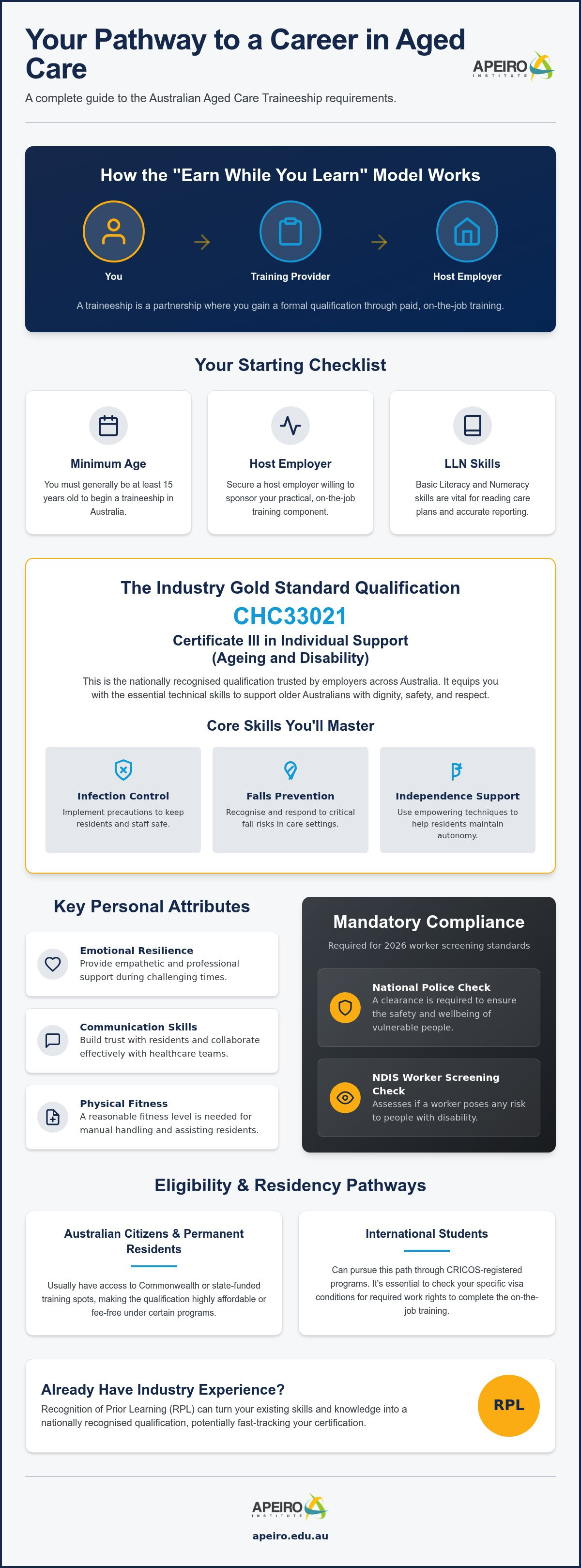
Starting a career in care is an exciting step toward a stable and meaningful profession. Unlike a standard classroom course, a traineeship is a partnership between you, a training provider, and a host employer. To get started, you'll need to meet specific aged care traineeship requirements that ensure you're ready for both the academic and practical sides of the role. Generally, you must be at least 15 years old to begin a traineeship in Australia. You also need a host employer who is willing to sponsor your on-the-job training, as this "earn while you learn" model relies on having a real workplace where you can apply your skills.
You don't need a university degree to start, but basic literacy and numeracy (LLN) skills are vital. You'll be responsible for reading care plans, documenting resident observations, and reporting to healthcare teams accurately. Clear communication is a safety requirement, not just a preference. For a broader context of how these roles fit into the national system, you can look at this overview of aged care in Australia to see the various service types and policy frameworks you might work within.
Personal Attributes and Suitability
Aged care is a physically active profession. You'll need a reasonable level of physical fitness to assist with manual handling, such as helping residents move safely or using specialised equipment. Beyond the physical, your "soft skills" are just as important. You'll need strong communication skills to build trust with diverse residents and collaborate with nurses and doctors. Emotional resilience is also key. Providing person-centred care means being there for residents during challenging times, which requires a high level of empathy and a steady, professional hand.
Legal and Residency Status
Your eligibility often depends on your residency and working rights. Australian citizens and permanent residents usually have access to Commonwealth or state-funded training spots, making the qualification very affordable. If you're an international student, you can still pursue this path through CHC33021 Certificate III in Individual Support (Ageing and Disability) programs registered under CRICOS. It's essential to check your specific visa conditions to ensure you have the required work rights to complete the on-the-job component of the traineeship. Understanding these aged care traineeship requirements early on helps you choose the right pathway for your unique circumstances.
Educational Standards: The CHC33021 Qualification
To work as a professional care assistant, you need a qualification that employers trust and respect. The CHC33021 Certificate III in Individual Support (Ageing and Disability) is the industry gold standard. It provides the essential technical skills required to support older Australians with dignity and respect. This qualification is officially listed on the national register as the CHC33021 Certificate III in Individual Support, which means your training is recognised by every provider in the country. It acts as a universal language for quality care, ensuring that every trainee meets the same high benchmarks of safety and professionalism.
Core Units of Competency
The 2026 training package focuses heavily on safety, ethics, and person-centred care. These units ensure you have the foundational knowledge to handle the complexities of modern aged care. You'll spend time learning how to support healthy body systems and how to work legally and ethically within the community services sector. Key aged care traineeship requirements include mastering the following core areas:
- Infection Control: Implementing standard and transmission-based precautions to keep residents and staff safe.
- Falls Prevention: Recognising and responding to the risk of falls, which remains a critical safety priority in residential settings.
- Independence Support: Using empowering techniques that help residents maintain their autonomy and quality of life for as long as possible.
Specialisation Options
One of the biggest advantages of this qualification is the ability to combine Ageing and Disability specialisations. This dual focus offers incredible career flexibility, allowing you to work in residential aged care facilities, community centres, or private homes. These elective units are the building blocks of your future career. For example, completing this certificate creates a clear pathway toward a Certificate IV in Ageing Support if you want to move into supervisory roles. Alternatively, you might choose to shift into case management by pursuing a Diploma of Community Services.
Your Registered Training Organisation (RTO) is your mentor through this process. They deliver the theory and assess your competency, but you can't graduate on classroom work alone. You must complete a minimum of 120 hours of mandatory work placement. This is a non-negotiable part of the aged care traineeship requirements, ensuring you have proven your skills in a real-world environment. If you're ready to begin your journey, exploring a nationally recognised qualification can help you see which elective units best match your long-term career goals.
Mandatory Compliance: Checks and Clearances for 2026
While gaining your qualification is a vital part of the journey, meeting the legal and medical aged care traineeship requirements is what truly clears your path into the workforce. These standards exist to protect the safety and well-being of some of the most vulnerable members of our community. In 2026, the compliance landscape is more thorough than ever, requiring a combination of criminal history checks and health clearances before you can step onto the floor of a residential facility or enter a client’s home.
You'll need a National Police Check that is no more than three years old. It's important to understand that certain convictions will automatically disqualify you from the sector. These include murder, sexual assault, or any form of assault that resulted in a prison sentence. If you're working within the Commonwealth Home Support Program (CHSP), convictions related to dishonesty or child abuse material within the last five years will also prevent your employment. You can find more detailed resources on these standards through official Aged Care Worker Education and Training portals provided by the Commission.
Criminal History and Conduct
In addition to a standard police check, most trainees now require an NDIS Worker Screening Check. This is a more comprehensive assessment that looks at national criminal records and work misconduct history. It's particularly essential if your role involves supporting NDIS participants within an aged care setting. While a police check is a snapshot of your past, the NDIS screening is an ongoing monitoring process. Most employers will also put you through their own internal code of ethics training to ensure you understand the specific conduct expected within their organisation.
Health and Medical Prerequisites
Your health status is a key component of the aged care traineeship requirements. In 2026, residential aged care providers are required by law to offer free influenza and COVID-19 vaccinations to all staff. While national mandates have shifted, workers are strongly encouraged to receive a COVID-19 vaccination every 12 months to maintain a high level of protection for residents. Beyond vaccinations, you'll need to meet specific physical safety standards:
- First Aid and CPR: You must hold a current HLTAID011 Provide First Aid certificate.
- Manual Handling: You'll undergo specific training to learn how to lift and move residents safely using equipment like hoists and slide sheets.
- WWCC: If your community support role involves interacting with minors, a Working with Children Check may also be necessary.
Meeting these compliance milestones ensures you're ready for the practical component of your CHC33021 Certificate III in Individual Support. By staying on top of these checks, you show potential employers that you're a professional, reliable, and safe pair of hands.
Recognition of Prior Learning (RPL) and Trade Pathways
Not everyone starting a career in care is a complete beginner. You might have spent years supporting residents in an informal capacity or working in a related field without ever receiving a formal certificate. If so, you don't necessarily need to start from scratch. Using Recognition of Prior Learning (RPL) is a smart way to meet your aged care traineeship requirements while acknowledging the skills you've already mastered. This process evaluates your existing knowledge against the national standards of the CHC33021 qualification. It's about proving your competency through real-world evidence rather than just sitting in a classroom.
Apeiro Institute specialises in Trade Pathways for Experienced Workers (TPEW). This approach is specifically designed for those who are already embedded in the care sector but need to formalise their professional status. To succeed, you'll need to provide a comprehensive portfolio of evidence. This isn't just about a resume; it's about showing how you handle infection control or resident mobility in real scenarios. Evidence typically includes detailed logbooks, supervisor testimonials, and third-party reports that verify your daily performance and technical skills.
The RPL Assessment Process
The journey begins with an initial self-assessment where you gather your portfolio of evidence. This is your chance to showcase your years of hard work. Your RTO then conducts a thorough gap analysis to identify any specific units where you might need further training. This ensures you only study what you don't already know, saving you time and energy. Finally, you'll participate in a practical observation or a technical interview. These steps allow an expert mentor to see your skills in action, confirming you meet the high standards required for modern care delivery in Australia.
Benefits for Experienced Support Workers
For many workers, the biggest advantage is the significant reduction in study time. You avoid redundant training and can often complete your qualification much faster than a traditional student. It's an empowering way to formalise years of "on-the-job" knowledge into a national certificate that boosts your employability and sense of security. RPL is also a cost-effective alternative to full-course enrolment. It respects your unique history in the industry and helps you meet the aged care traineeship requirements without unnecessary delays or repetition of things you already do every day.
Apply for a Trade Pathway assessment today
How to Organise Your Aged Care Traineeship with Apeiro Institute
Once you understand the legal and educational benchmarks, the next step is putting the pieces together. Organising a traineeship involves a three-way partnership between you, your host employer, and your Registered Training Organisation (RTO). Your host employer provides the workplace and the "earn while you learn" opportunity, while Apeiro Institute manages your formal education and assessments. In 2026, every trainee must have a formal training plan and a signed traineeship contract. This document is essential. It outlines your work hours, your study time, and the specific skills you'll develop on the job, ensuring a healthy balance between your professional duties and your academic progress.
Meeting the aged care traineeship requirements is simpler when you have a dedicated mentor by your side. From your initial enquiry to your very first day on the job, our team provides the expert guidance you need to navigate the paperwork. We help you understand your rights under the 2026 SCHADS Award and ensure your training aligns with current industry standards. Whether you're a local student looking for a career change or an international student building a future in Australia, we act as the bridge between your current skills and your professional goals.
Why Study with Apeiro?
We pride ourselves on creating a supportive, student-centred environment that prioritises your personal growth. Our trainers aren't just academics; they're industry veterans with years of real-world experience in Australian residential and community care. This means the advice you get is practical, current, and deeply relevant to the challenges you'll face on the floor. We also value diversity. Our flexible pathways respect your unique cultural background and any existing expertise you bring to the table. We don't just teach the CHC33021 units; we help you build the confidence to deliver high-quality, person-centred care from day one.
Enrolment and Application Steps
Getting started is a methodical but rewarding process. You'll need to gather your essential documents first, including your proof of ID, residency status or visa details, and any previous certificates for RPL assessment. We also conduct a Language, Literacy, and Numeracy (LLN) assessment. Don't let this intimidate you. It's simply a tool we use to identify if you need extra support with care documentation or reporting requirements. Once these steps are complete, we'll help you finalise your enrolment so you can start your journey in individual support with total clarity.
By choosing a provider that understands the latest aged care traineeship requirements, you're setting yourself up for long-term success. The care sector is growing, and there's never been a better time to step into a role that offers both job security and the chance to make a genuine difference in people's lives. We're ready to help you take that first step toward a fulfilling new career.
Take the First Step Toward Your Care Career
Meeting the aged care traineeship requirements is about more than just checking boxes; it's about preparing yourself to provide high-quality support to those who need it most. By securing your CHC33021 qualification and staying current with 2026 compliance standards, you're building a career on a foundation of safety and professionalism. Whether you're entering the workforce for the first time or using Recognition of Prior Learning to formalise years of experience, the path forward is clear and attainable.
Apeiro Institute (RTO 45394) is here to act as your expert mentor. We specialise in nationally recognised Australian qualifications and tailored RPL pathways that respect your unique history in the sector. You don't have to navigate the enrolment process alone.
Enquire about the CHC33021 Certificate III in Individual Support today
Your future in the care sector starts with a single conversation. We're excited to help you transform your passion for helping others into a rewarding, lifelong profession.
Frequently Asked Questions
Do I need any prior experience to start an aged care traineeship?
No, you don't need any prior experience to begin. Traineeships are specifically designed as entry-level pathways where you learn on the job. Employers look for personal attributes like empathy and a strong work ethic rather than a background in healthcare. As long as you meet the basic aged care traineeship requirements, such as age and residency status, you can start your career from scratch with the right mentor.
How much do aged care trainees get paid in Australia?
Trainee wages are set by the Social, Community, Home Care and Disability Services (SCHADS) Industry Award. As of 1 July 2026, the minimum base rate for a Level 1 worker is $27.55 per hour. Casual workers receive a 25% loading, which brings their rate to $34.44 per hour. These rates increase as you gain more experience and complete higher levels of your qualification, providing a clear path for financial growth.
Can I do an aged care traineeship part-time?
Yes, part-time traineeships are a common and flexible option. This allows you to balance your work and study commitments with other personal responsibilities. You'll still need to meet the minimum work hours agreed upon in your training contract to ensure you gain enough practical experience. It's a great way to maintain a steady income while working toward your Certificate III at a pace that suits your specific lifestyle and needs.
What is the difference between an aged care apprenticeship and a traineeship?
The main difference lies in the industry and the duration of the training. Apprenticeships are generally for traditional trades like plumbing or electrical work and often last three to four years. Traineeships focus on vocational sectors like aged care and are usually completed in one to two years. Both models use the "earn while you learn" approach, but traineeships are the standard pathway for the individual support sector in Australia.
How long does it take to complete a Certificate III in Individual Support through a traineeship?
Most trainees complete their Certificate III in Individual Support within 12 to 24 months. The exact timeframe depends on whether you're working full-time or part-time and how quickly you progress through your units of competency. If you have existing experience, you might be able to fast-track this process through Recognition of Prior Learning (RPL), which reduces the amount of formal study required to meet the aged care traineeship requirements.
What happens if I already have some units of competency from another course?
You can apply for a credit transfer or Recognition of Prior Learning (RPL) if you've already completed relevant units. This means you won't have to repeat subjects you've already mastered in a previous course. You'll just need to provide your Statement of Attainment or official transcripts to your RTO. This is an excellent way to save time and focus your energy on learning new skills that advance your career goals.
Are there any government subsidies or fee-free options for aged care training in 2026?
Yes, various government subsidies are available in 2026 to help reduce the cost of your training. Programs like "Smart and Skilled" offer funded spots for eligible students pursuing priority qualifications. These subsidies can significantly lower your tuition fees, sometimes making the course fee-free. It's best to check with your training provider to see which funding options apply to your specific situation, residency status, and the state where you'll be working.
Can international students apply for an aged care traineeship?
International students can apply if they hold a visa with valid work rights and enrol with a CRICOS-registered provider. You must ensure your specific visa conditions allow for the "on-the-job" training component required by the traineeship model. It's a fantastic way to gain local work experience while earning a nationally recognised Australian qualification. Always verify your current visa limitations before signing a training contract to ensure you remain in full compliance.

Disclaimer
The information provided on this blog is for general informational and educational purposes only. While every effort is made to ensure the accuracy and reliability of the content, the author makes no representations or warranties of any kind, express or implied, about the completeness, accuracy, suitability, or availability of the information contained on this blog.
The views and opinions expressed in blog posts are those of the individual author and do not necessarily reflect the official policy or position of any organization, company, or employer.
This blog may contain links to external websites or third-party content. These links are provided for convenience only, and the author has no control over and assumes no responsibility for the content, privacy policies, or practices of any third-party sites.
Nothing on this blog constitutes professional advice (legal, financial, medical, or otherwise). Readers are encouraged to seek appropriate professional guidance before making any decisions based on the information provided here.
By using this blog, you acknowledge that any reliance on the information is at your own risk.


