

What if your lack of industry history was actually an advantage rather than a barrier? Many people feel stuck because they believe they're unqualified for entry-level roles, or they simply can't afford to stop working to study full-time. It's a common concern, especially when NDIS requirements seem like a confusing maze of red tape. You shouldn't have to choose between a stable income and pursuing a career that actually makes a difference in people's lives.
Finding a disability support worker traineeship no experience required is the most practical way to start your journey. It's a pathway that lets you "earn while you learn," turning your natural empathy and positive attitude into professional skills. This article explains exactly how to secure a traineeship, gain a nationally recognised CHC33021 Certificate III in Individual Support (Ageing and Disability), and build a stable career. We will break down the application process, the financial benefits of vocational training, and why your personal qualities are exactly what the sector needs right now. By the end of this guide, you'll have a clear roadmap to transition into a meaningful role with confidence.
Key Takeaways
- Understand how a disability support worker traineeship no experience required lets you earn a legal wage while you work towards a professional career.
- Explore the financial and practical advantages of vocational training, including how to gain industry skills without the burden of student debt.
- Learn about the CHC33021 Certificate III in Individual Support, which is the essential qualification for providing high-quality care under the NDIS.
- Identify the transferable skills you already have and learn how to find community organisations that value your life experience.
- Discover how Apeiro Institute acts as your mentor, providing the supportive learning environment you need to succeed in the disability sector.
What is a Disability Support Worker Traineeship?
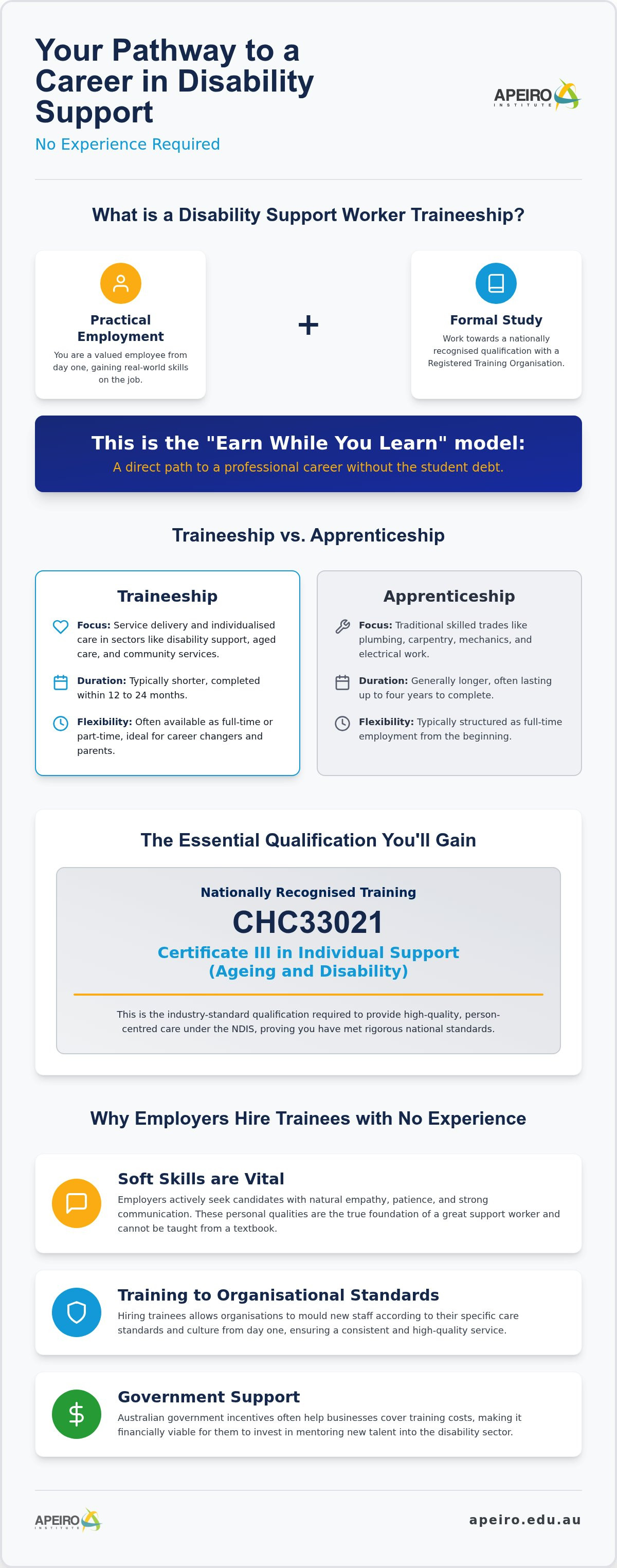
A traineeship is a structured training arrangement that combines employment with formal study. It's a formal agreement between you, your employer, and a Registered Training Organisation (RTO) like Apeiro Institute. Instead of sitting in a classroom full-time, you spend most of your week on the job, gaining practical skills while earning a legal wage. This approach ensures that your learning is always grounded in real-world scenarios.
This "Earn While You Learn" model is particularly effective for those seeking a disability support worker traineeship no experience because it removes the financial barrier of unpaid study. You aren't just a student; you're a valued employee from day one. In 2026, the National Disability Insurance Scheme (NDIS) continues to drive immense demand for qualified staff across Australia. This means providers are constantly looking for people with the right heart, even if they don't have the right certificate yet. These roles, often referred to globally as Direct Support Professionals (DSPs), are the backbone of the sector. They provide the essential, person-centred care that allows Australians with disabilities to live more independent lives.
The Difference Between an Apprenticeship and a Traineeship
While both involve training and employment, they differ in scope and duration. Apprenticeships usually focus on traditional trades like plumbing or mechanics and can last up to four years. Traineeships in the care sector are much shorter. Most are completed within 12 to 24 months. The focus is on service delivery and individualised care rather than manual trades. Traineeships also offer significant flexibility. They can be organised as full-time or part-time roles. This makes them a perfect fit for career changers, parents returning to work, or young people looking for their first professional role. You can balance your study requirements with your personal life while still maintaining a steady income.
Why Employers Hire Trainees with No Experience
Many organisations actually prefer candidates with a "blank slate." It allows them to train you in their specific care standards and organisational culture from day one. In this industry, technical knowledge is important, but soft skills are vital. Employers look for empathy, patience, and strong communication skills. If you have these, you're already halfway there. You'll gain the technical side through the CHC33021 Certificate III in Individual Support (Ageing and Disability). Additionally, the Australian government often provides incentives to businesses that take on new trainees, making it easier for you to find a disability support worker traineeship no experience required. These incentives help cover the costs of training, allowing employers to focus on mentoring you as you grow into the role.
The Benefits of Starting Your Career via a Traineeship
Starting a career in the care sector is a significant life choice. Choosing a disability support worker traineeship no experience is a smart move for those wanting immediate financial security. You don't have to worry about accumulating student debt because you're being paid to learn. This wage allows you to cover your living expenses while you work toward a professional goal. There is also extensive government support for trainees available in Australia, ensuring you have the resources needed to succeed from day one.
Practical experience is another cornerstone of this model. While theory is necessary, the nuances of individualised care are best learned in person. You'll develop on-the-job skills like using assistive technology or managing complex behaviours under the guidance of experienced mentors. This hands-on approach builds confidence much faster than a textbook ever could. For anyone pursuing a disability support worker traineeship no experience, this immersion is the fastest way to become a competent professional in a high-demand industry.
Completing your training leads to a nationally recognised qualification. This means your skills are valid nationwide, whether you choose to work in a bustling city or a regional area. Employers across the country value this certification because it proves you've met rigorous industry standards. Many trainees find that their host employer offers them a permanent position as soon as their training period ends. It's a direct, secure route into stable employment that benefits both you and the community.
Building a Foundation for Community Services
A traineeship isn't just a job; it's the first step in a long-term career. Once you've mastered the basics, you can move into specialised roles or leadership positions. Your initial training provides the perfect groundwork for further study, such as a Diploma of Community Services Australia. This progression allows you to move into case management or social advocacy, expanding your impact on the sector and increasing your earning potential over time.
Personal Growth and Community Impact
The emotional rewards of this work are profound. You'll see the direct result of your efforts in the smiles and increased independence of the people you support. This role fosters immense personal growth, teaching you resilience and professional boundaries in a supportive environment. You're not just an employee; you're a vital thread in the Australian healthcare fabric. If you're ready to start, exploring the CHC33021 Certificate III in Individual Support is a great way to begin your journey toward a rewarding career.
Essential Qualifications: CHC33021 Certificate III in Individual Support
To build a career in the NDIS landscape, you need the right credentials. The CHC33021 Certificate III in Individual Support is the recognised industry benchmark across Australia. While you can start a disability support worker traineeship no experience, this qualification provides the formal framework for your practical work. Apeiro Institute specialises in delivering this course through a dual stream that covers both ageing and disability. This approach significantly boosts your employability. It allows you to work across multiple care settings, from residential facilities to private home care, making you a versatile asset to any employer.
What You Will Learn During Your Training
The training moves beyond basic care tasks to focus on the philosophy of person-centred support. This means learning how to tailor your assistance to a client's specific goals and life choices. You won't just be reading from a textbook; you'll be learning how to apply these concepts to real-world scenarios. During your studies, you'll focus on several core areas:
- Facilitating community participation: Learning how to help clients engage in social activities and reduce isolation.
- Individualised care plans: Understanding how to follow and implement strategies that promote client independence.
- Safe work practices: Mastering the technical side of direct care, such as infection control and safe manual handling.
- Social inclusion: Developing techniques to ensure clients feel valued and connected to their local community.
These units are designed to turn your natural empathy into professional expertise. By the time you complete your training, you'll have a deep understanding of how to support the wellbeing of diverse individuals with complex needs, often in coordination with mental health and mediation services like WJW Counselling & Mediation.
Balancing Study with Workplace Responsibilities
Success in a disability support worker traineeship no experience depends on a strong partnership between you, your employer, and Apeiro Institute. We coordinate closely with your workplace to ensure your study schedule aligns with your rostered shifts. A critical part of this arrangement is "off-the-job" training hours. These are dedicated times where you step away from your regular duties to focus entirely on your coursework.
We understand that everyone learns differently. That's why we offer flexibility through online components combined with practical on-campus support. This methodical approach ensures you're never overwhelmed by information. You can apply what you've just learned in a theory session directly to the person you're supporting that afternoon. It's a steady, supportive way to gain a nationally recognised qualification while maintaining your financial independence.
How to Secure a Disability Support Traineeship with No Experience
Securing a disability support worker traineeship no experience required starts with a change in perspective. You don't need a history in healthcare to be a great candidate. Employers in 2026 are looking for people who possess the right character traits. They value reliability, patience, and a genuine desire to help others. By focusing on your personal strengths and preparing your documentation early, you can stand out in a competitive job market. Showing initiative by researching the sector proves that you're ready for the responsibility of a professional role.
Researching the service standards of established NDIS providers, such as WithCare Support Services, can provide valuable insight into the professional expectations and quality of care required in the sector.
Highlighting Transferable Skills on Your Resume
Your resume should focus on the skills you've gained in other areas of life. If you've worked in retail or hospitality, you already have experience in communication and problem-solving. These are vital in a support role. Perhaps you've cared for a family member or volunteered at a local community centre. These experiences are highly relevant. When writing your cover letter, don't just list your past jobs. Explain your "why." Tell the employer why you're passionate about disability support and how your background has prepared you for this transition. This personal touch often carries more weight than technical experience.
Preparing for the Interview
Interviews for entry-level support roles often focus on your values. You'll likely be asked how you would handle specific scenarios. Be prepared to discuss your understanding of dignity, respect, and privacy. These aren't just buzzwords; they're the foundation of quality care. Show that you're willing to learn and adapt to the unique needs of different clients. A disability support worker traineeship no experience is a learning journey, and employers want to see that you're coachable. Being honest about what you don't know, while expressing a strong desire to master new skills, shows maturity and self-awareness.
Meeting Mandatory Requirements
Before you can step into a workplace, you must clear several compliance hurdles. The most important is the NDIS Worker Screening Check. This process ensures that people working in the sector don't pose a risk to participants. It's a good idea to start this application as soon as you begin your job search. You'll also need a current First Aid and CPR certificate. Most providers consider these a prerequisite for any role. Having a valid Australian Driver’s Licence is also a major advantage. Many support tasks involve transporting clients to social outings or appointments, so being mobile makes you a much more attractive hire.
Explore the CHC33021 Certificate III in Individual Support to prepare for your traineeship
Enrolling with a quality RTO like Apeiro Institute shows prospective employers that you're committed to your new career path. It proves you've already taken the first step toward gaining your qualification. We can help you understand how to balance your study with your new workplace responsibilities, ensuring you have the support you need to succeed from your very first shift.
Start Your Journey with Apeiro Institute
Choosing the right Registered Training Organisation (RTO) is the most important decision you'll make when launching your career. Apeiro Institute (RTO 45394) is a preferred partner for vocational education because we prioritise your personal growth alongside your professional skills. We understand that starting a disability support worker traineeship no experience can feel like a massive leap. Our role is to act as your mentor, providing the steady guidance you need to navigate the NDIS landscape with confidence. We don't just teach theory; we focus on industry-aligned outcomes that ensure you're job-ready from the moment you step into your host workplace.
Bridging the gap between having zero experience and becoming a competent support worker requires a specific kind of environment. We've designed our programs to be inclusive and accessible, acknowledging the existing life skills you bring to the table. Whether you're a career changer or a recent school leaver, we help you translate your natural empathy into a nationally recognised qualification. Our methodical approach to training ensures you're never overwhelmed. We break down complex regulations and care standards into practical, digestible steps that you can apply immediately in your traineeship role.
A Supportive Learning Environment
At Apeiro Institute, you're part of a vibrant and diverse community. Our student body represents over 38 nationalities, creating a rich learning environment where different perspectives on care and community are valued. This diversity prepares you for the reality of the Australian disability sector, which serves people from all walks of life. You'll have direct access to experienced trainers who have spent years working in the field. They understand the current challenges of the sector and provide personalised guidance to help you navigate your workplace responsibilities. If you hit a snag or feel unsure about a specific unit, our team is there to offer the security and support you need to keep moving forward.
Enrol in the CHC33021 Certificate III Today
Securing a disability support worker traineeship no experience is much easier when you have a clear training plan in place. By enrolling in our Individual Support and Community Services programs, you're telling prospective employers that you're serious about your future. This qualification is the gold standard for entry-level roles, and our dual-stream focus on ageing and disability gives you the widest possible range of employment options. It's a stable, rewarding career path that offers both financial security and the chance to make a genuine impact.
We're currently accepting enquiries for our 2026 intake dates. Don't let a lack of experience hold you back from a career you'll love. Reach out to our friendly team today to discuss your enrolment options and career goals. We'll help you understand the flexibility of our vocational training and how it fits into your life. Take that first step with a partner who is deeply invested in your success.
Take the First Step Toward Your New Career
You've discovered how a disability support worker traineeship no experience required can transform your professional life. It's a unique opportunity to gain a nationally recognised CHC33021 Certificate III in Individual Support while earning a steady income. By focusing on your natural empathy and choosing a supportive training partner, you can overcome the common barriers of entry into the NDIS sector. This pathway ensures you aren't just gaining a certificate; you're building a foundation of real-world skills that employers across Australia value.
Start your disability support career with Apeiro Institute today
At Apeiro Institute (RTO 45394), we're committed to industry-focused vocational outcomes and providing a student-centred learning environment. Your transition from a beginner to a qualified professional is a journey we're proud to support. We believe that everyone has the potential to make a difference, and we're here to provide the expert guidance to make it happen. You have the heart for this work; let us help you gain the professional expertise to succeed.
Frequently Asked Questions
Can I really get a disability support job with no experience?
Yes, you can absolutely secure a position through a disability support worker traineeship no experience required. Many NDIS providers prioritise empathy, reliability, and communication skills over technical history. A traineeship provides the formal training path while you work, allowing you to learn necessary clinical and person-centred care skills on the job. This model turns your natural compassion into a professional career.
How much does a disability support trainee get paid in Australia?
Trainees are paid a legal wage under the relevant Australian award, which is typically the SCHADS Award. Your specific rate depends on factors like your age, whether you've finished school, and the level of the traineeship. Unlike traditional students, you earn an income for every hour you spend working and often for your dedicated study time. This provides essential financial security while you gain your qualification.
How long does a Certificate III in Individual Support traineeship take?
Most traineeships for the CHC33021 Certificate III in Individual Support take between 12 and 24 months to complete. The exact duration depends on your employment hours and how quickly you progress through the specific units of competency. This timeframe allows you to deeply integrate your classroom learning with daily workplace tasks. It ensures you become a highly competent support professional by the end of the program.
Do I need an NDIS Worker Screening Check before I start?
Yes, a valid NDIS Worker Screening Check is a mandatory requirement for anyone working in risk-assessed roles within the sector. You should apply for this check as early as possible, as it's a prerequisite for most employers. It ensures the safety of NDIS participants by screening out individuals who may pose a risk. You'll also likely need a First Aid certificate and a Working with Children Check.
Is there government funding available for disability support traineeships in 2026?
Yes, various government funding initiatives, such as the Smart and Skilled program in NSW, remain available for eligible trainees in 2026. These subsidies can significantly reduce or even eliminate the cost of your training. Because disability support is a high-demand sector, the government provides these incentives to encourage new workers. Our team at Apeiro Institute can help you check your eligibility for current funding options.
What is the difference between a disability support worker and an aged care worker?
The main difference lies in the goals and setting of the care provided. Disability support workers focus on empowering individuals to live independently and achieve specific NDIS goals. Aged care workers typically provide support to older Australians, often in residential facilities, focusing on age-related health needs. However, the CHC33021 qualification covers both streams, giving you the flexibility to work in either environment based on your career preference.
Can I do a disability support traineeship part-time?
Yes, many employers offer part-time traineeships to suit your lifestyle or other commitments. You'll still need to meet a minimum number of weekly work and study hours to satisfy the national training contract requirements. This flexibility makes a disability support worker traineeship no experience a great option for parents or those transitioning from other industries. It allows you to maintain a work-life balance while building a career.
What are the career progression opportunities after a traineeship?
Completing a traineeship is just the beginning of your professional journey in the community sector. You can progress into senior support roles, team leader positions, or specialised areas like behaviour support. Many graduates eventually pursue a Diploma of Community Services to move into case management or advocacy. The experience you gain on the ground provides an invaluable perspective that helps you succeed in higher-level leadership roles within healthcare.

Disclaimer
The information provided on this blog is for general informational and educational purposes only. While every effort is made to ensure the accuracy and reliability of the content, the author makes no representations or warranties of any kind, express or implied, about the completeness, accuracy, suitability, or availability of the information contained on this blog.
The views and opinions expressed in blog posts are those of the individual author and do not necessarily reflect the official policy or position of any organization, company, or employer.
This blog may contain links to external websites or third-party content. These links are provided for convenience only, and the author has no control over and assumes no responsibility for the content, privacy policies, or practices of any third-party sites.
Nothing on this blog constitutes professional advice (legal, financial, medical, or otherwise). Readers are encouraged to seek appropriate professional guidance before making any decisions based on the information provided here.
By using this blog, you acknowledge that any reliance on the information is at your own risk.


