

Did you know a Certificate III qualified direct care worker in Australia now earns roughly 47% more than they did just four years ago? It is a massive shift that reflects how much our society values those who care for our ageing population. If you have been looking for a way to enter this stable, rewarding sector without the burden of upfront tuition fees, learning how to get an aged care traineeship is your first step toward a new career.
You might feel overwhelmed by technical jargon or worried about finding an employer willing to take a chance on someone without experience. We understand that the difference between an apprenticeship and a traineeship can be confusing, and the thought of balancing study with bills is daunting. This guide is designed to clear that path for you. We will show you exactly how to secure a position where you earn while you learn, often starting at A$34.42 per hour as you work toward your qualification.
By the time you finish reading, you will have a clear roadmap to employment. We will break down the specific qualifications you need, such as the CHC33021 Certificate III in Individual Support, and explain how to access government funding like Smart and Skilled. You are about to discover how to turn your passion for helping others into a professional, well-paid reality.
Key Takeaways
- Understand the formal agreement that allows you to gain a nationally recognised qualification while receiving a trainee wage.
- Discover the exact process of how to get an aged care traineeship, from finding the right employer to partnering with an Australian Apprenticeship Support Network.
- Learn about the essential compliance requirements, such as the NDIS Worker Screening Check and National Police Check, that are standard across the industry.
- Explore how various government funding initiatives across Australia can help you access fee-free or subsidised training for your Certificate III.
- Gain a clear, step-by-step roadmap for preparing your resume and securing an employment offer in this high-demand sector.
What is an Aged Care Traineeship and Why Start One in 2026?
An aged care traineeship is a formal, legally binding agreement between you, your employer, and a Registered Training Organisation (RTO). Unlike a standard college course where you might spend months in a classroom paying tuition fees, this model is built on the "earn while you learn" principle. You are employed from day one, receiving a trainee wage while you work towards a nationally recognised qualification like the CHC33021 Certificate III in Individual Support. It is a practical, hands-on way to start your career without pausing your income.
Understanding the current state of Aged Care in Australia is essential for anyone entering the field. The sector is currently facing a projected shortfall of 400,000 workers by 2050. Because of this, aged care remains a top priority on the National Skills Priority List in 2026. This status means the government provides significant incentives for employers to take on new staff. If you are researching how to get an aged care traineeship, you will find that facilities are more eager than ever to recruit and train dedicated individuals.
The Benefits of a Traineeship Pathway
Choosing a traineeship means you avoid the trap of student debt. Many programs are fully subsidised through initiatives like NSW Smart and Skilled; this allows you to graduate with zero tuition debt. You also gain immediate financial security. As of July 2026, a first-year trainee with a Certificate III often starts at Direct Care Level 2, earning A$34.42 per hour. Most importantly, you develop practical skills on the job. No textbook can replicate the experience of supporting a resident through their morning routine or building a genuine connection with a family.
Key Roles and Responsibilities
Your daily life as a trainee is focused on providing person-centred support. This means you aren't just ticking off tasks; you are helping elderly Australians live with dignity. You will assist with daily living activities such as personal care, mobility, and meal times. Beyond physical help, you play a vital role in supporting emotional well-being. Whether it is facilitating a social outing or simply having a chat over tea, your presence helps combat social isolation. It is a role that requires empathy and patience. When you look into how to get an aged care traineeship, remember that employers value these human qualities just as much as your technical ability.
Eligibility and Entry Requirements for Australian Trainees
Before you dive into the application process, you must ensure you meet the baseline criteria set by both the government and the industry. To be eligible for most government-funded positions, you must be an Australian or New Zealand citizen, or hold permanent residency. While some specific visas are considered on a case-by-case basis, the right to work in Australia is a non-negotiable starting point. If you are unsure about your specific situation, visiting the Australian Apprenticeships official site provides a wealth of information on current eligibility standards.
Aged care is a highly regulated environment. You will need to undergo a National Police Check and an NDIS Worker Screening Check. These are standard safety measures designed to protect vulnerable residents. Additionally, you will likely complete a Language, Literacy, and Numeracy (LLN) assessment with your chosen training provider. This isn't a pass or fail test in the traditional sense; it's a way for us to ensure you have the foundational skills needed to complete the CHC33021 Certificate III in Individual Support successfully. Taking the time to understand these requirements is a vital part of learning how to get an aged care traineeship.
Don't overlook the physical nature of the work. You will be on your feet for long periods and may need to assist with manual handling. Good mobility and physical stamina are essential for your safety and the safety of those in your care. If you enjoy staying active and prefer a job that keeps you moving, this career path is an excellent fit.
Essential Documentation and Checks
Preparing your paperwork early is a smart way to speed up the process of how to get an aged care traineeship. You can apply for a National Police Certificate through your state's police force or an accredited agency. While aged care focuses on the elderly, some providers also require a Working with Children Check if their facility interacts with younger visitor groups or multi-generational programmes. Vaccination is another critical area. Most Australian healthcare facilities require up-to-date records for influenza and COVID-19 to ensure workplace safety and compliance with health orders.
Soft Skills That Employers Value
Employers look for more than just a clean record. They want to see genuine empathy. In a high-pressure environment, the ability to remain patient and calm is invaluable. You will be communicating with diverse client groups, including those with dementia or from non-English speaking backgrounds. Clear, respectful communication is vital. Reliability is equally important; your team and your residents depend on you being there. Showing a commitment to ethical care standards during your interview is often the deciding factor in securing your spot.
How to Find an Employer and an RTO
Securing a position is a collaborative process involving three key parties: you, your employer, and your Registered Training Organisation (RTO). If you are wondering how to get an aged care traineeship, you need to understand that these entities work together to facilitate your growth and access government funding. It is not just about finding a job; it is about finding a workplace that is committed to your long-term education. This partnership is formalised by the Australian Apprenticeship Support Network (AASN), which manages the training contract and ensures both you and your employer meet your legal obligations.
Identifying "traineeship-friendly" providers is your first hurdle. Many large residential facilities and home care organisations have established programmes because they recognise the value of training staff from the ground up. You can find insights into reputable providers through the Aged Care Industry Association (ACIA), which represents many of the leading organisations in the sector. These employers often have direct links with RTOs and understand how to navigate the NSW Smart and Skilled funding system to reduce or eliminate your training costs.
Searching for Opportunities
Start your search on major job boards like SEEK, Workforce Australia, and Jora. Don't just search for "aged care worker". Use specific keywords such as "Trainee Assistant in Nursing" or "Care Worker Trainee" to filter for roles that include a training component. Cold-calling local facilities can also be surprisingly effective. Many managers are looking for staff but haven't posted an ad yet. A polite enquiry about their willingness to take on a trainee shows initiative and a genuine interest in their specific centre. Community service hubs and local councils often have noticeboards for entry-level vocational opportunities as well.
Selecting Your Training Partner
Your choice of RTO is just as important as your choice of employer. You need a partner with a strong reputation for delivering the CHC33021 Certificate III in Individual Support. Look for an RTO that offers flexible delivery modes. Some students prefer campus-based learning for the social connection, while others need a purely on-the-job model that fits around their work shifts. Ask about the support services available. Will you have a dedicated trainer to visit you at work? How quickly do they respond to enquiries? A supportive RTO makes the difference between feeling overwhelmed and feeling empowered. When you are learning how to get an aged care traineeship, remember that the right training partner acts as your mentor throughout the entire journey.
Step-by-Step Roadmap to Securing Your Traineeship
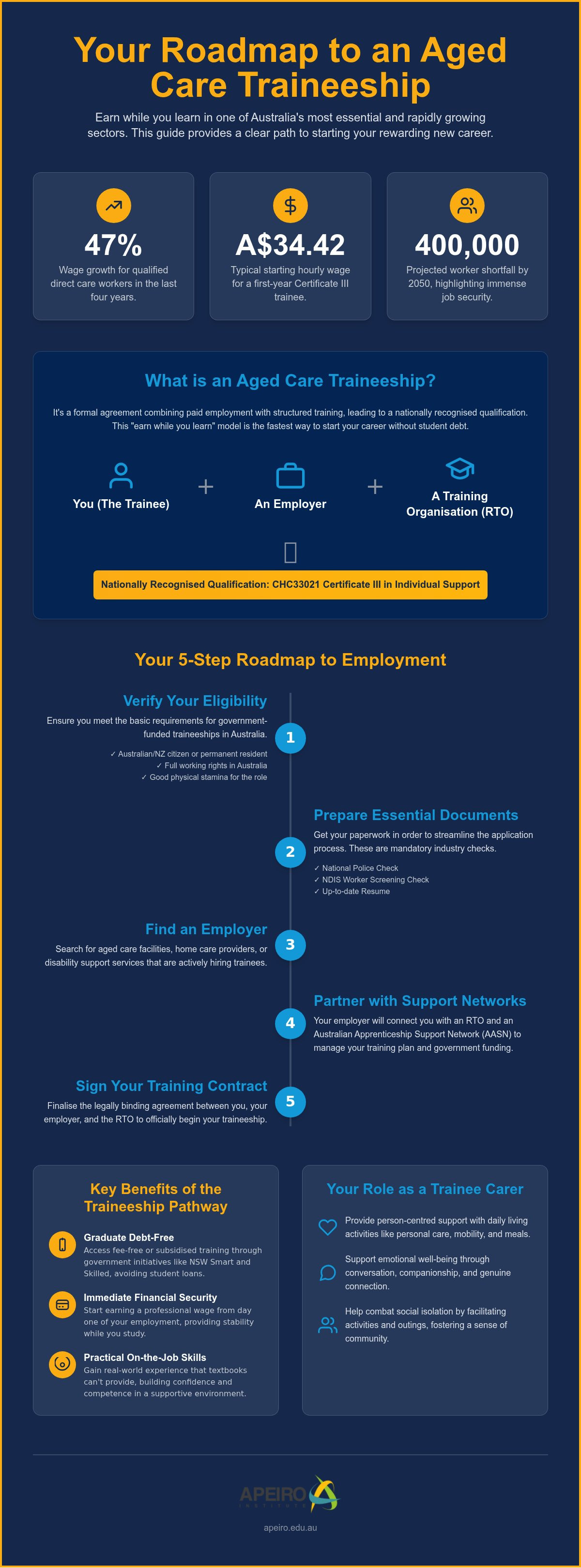
Learning how to get an aged care traineeship is about more than just applying for a job; it is a structured journey that transforms you from a motivated beginner into a qualified professional. This five-step roadmap ensures you don't miss any critical legal or educational milestones along the way.
- Step 1: Prepare your resume. Focus on transferable soft skills like teamwork, communication, and reliability. If you have experience in retail or hospitality, highlight your ability to handle customer needs with patience.
- Step 2: Secure an employment offer. Apply to aged care providers that specifically mention traineeship opportunities. You need a formal job offer before the training contract can be initiated.
- Step 3: Nominate your RTO. Once you have the job, you and your employer will choose a training provider like Apeiro Institute to deliver your CHC33021 Certificate III in Individual Support.
- Step 4: Sign the Training Contract. This is a legal agreement between you and your employer, registered by an Australian Apprenticeship Support Network (AASN) provider.
- Step 5: Apply for funding. If you are in NSW, check your eligibility for Smart and Skilled subsidies to potentially access fee-free training.
Winning the Interview
Aged care managers look for heart and resilience. During your interview, you will likely face questions like, "Can you describe a time you showed compassion to someone in distress?" or "How do you manage your time when tasks pile up?" Use specific examples from your past work or personal life to demonstrate empathy. Don't forget to ask about your training schedule. Knowing whether your study time is blocked out or integrated into your daily shifts shows you are serious about your educational commitments.
Navigating the Paperwork
The paperwork phase can feel technical, but it is there to protect your rights as a learner. Your Training Contract outlines the duration of your traineeship and the qualification you will receive. The AASN representative will facilitate this signing and explain the government incentives available to you. It is vital to ensure your qualification is nationally recognised. This ensures that once you finish your traineeship, your skills are valid in every state and territory across Australia.
Many people assume a Certificate III is the end of the road, but it is actually a springboard. Once you complete your initial training, you can easily transition into a Certificate IV in Ageing Support or even a Diploma of Community Services. A traineeship provides the foundational confidence you need to eventually move into leadership or case management roles. We act as your mentor through this entire progression, helping you bridge the gap between entry-level work and a long-term career.
Enquire about our aged care traineeship pathways today
Advance Your Career with Apeiro Institute
At Apeiro Institute, we pride ourselves on being more than just a training provider. We act as your partners in professional growth. Our expertise in delivering the CHC33021 Certificate III in Individual Support ensures you receive a nationally recognised qualification that meets the highest industry standards. If you are still researching how to get an aged care traineeship, we simplify the process by bridging the gap between your career goals and the practical requirements of the sector.
For those based in New South Wales, we specialise in Smart and Skilled funded courses. This government initiative is a game-changer for trainees. It allows eligible students to access subsidised or even fee-free training. We handle the administrative complexity of these programs, working directly with your employer and the AASN to ensure your enrolment is seamless. This means you can focus on your residents and your studies without worrying about the financial burden of tuition fees.
Career longevity in this sector comes from continuous learning. Once you have mastered the basics, we offer clear pathways to leadership through the Certificate IV in Ageing Support. This qualification prepares you for more senior roles, such as a team leader or care supervisor. Our trainers are industry experts who bring real-world experience into every session, fostering a community-focused learning environment where every student feels seen and supported.
Why Choose Apeiro for Your Traineeship?
Next Steps: How to Enrol
Taking the next step in how to get an aged care traineeship starts with a simple conversation. We encourage you to book a consultation with our careers team. During this session, we will help you verify your eligibility for fee-free training and discuss which qualification best aligns with your goals. We also maintain a strong network of industry partners. This can be invaluable when you are looking for an employer willing to support a new trainee. Your journey toward a rewarding career in aged care is just one phone call away.
Launch Your Rewarding Career in Aged Care
The path to a fulfilling career in Australia's aged care sector is clearer than ever. By following a structured roadmap, from preparing your resume to securing an employer and a training partner, you can bypass the burden of upfront tuition fees. You have seen how the "earn while you learn" model provides both financial security and invaluable hands-on experience that classroom study alone cannot match.
Understanding how to get an aged care traineeship is the first hurdle. Now, it's about taking that final step toward enrolment. With nationally recognised qualifications and industry-expert trainers, we are here to guide you through every stage of your development. As a registered training organisation (RTO 45394), we specialise in helping students access Smart and Skilled funding to make their education as affordable as possible.
Start your aged care journey with Apeiro Institute today
Your future in community health is waiting. We look forward to helping you build the skills and confidence needed to make a genuine difference in the lives of elderly Australians.
Frequently Asked Questions
How much do aged care trainees get paid in Australia in 2026?
As of July 2026, a first-year trainee under the Aged Care Award typically earns A$34.42 per hour at Direct Care Level 2. This reflects a significant 47% increase in wages since 2022, following the Fair Work Commission’s review of the sector's value. Casual trainees can earn even more, with rates reaching approximately A$43.03 per hour. These competitive wages ensure you are fairly compensated while you build your professional skills.
Can I do an aged care traineeship part-time?
Yes, you can complete your traineeship on a part-time basis. Most Australian aged care providers offer flexible arrangements to suit your personal circumstances, though you must still work enough hours to meet the requirements of your training contract. This flexibility makes it easier to balance your studies with family or other commitments. We recommend discussing your preferred schedule with your employer before signing your formal agreement.
Do I need any prior experience to start an aged care traineeship?
No, you do not need any prior industry experience to start. The primary goal of a traineeship is to provide you with entry-level skills through on-the-job training. Employers often prioritise "soft" skills like empathy, patience, and strong communication over technical knowledge. If you have a genuine desire to help others and a reliable work ethic, you are an ideal candidate for learning how to get an aged care traineeship.
How long does a Certificate III in Individual Support traineeship take to complete?
A Certificate III in Individual Support traineeship usually takes between 12 and 24 months to complete. The exact duration depends on whether you are working full-time or part-time and how quickly you progress through your units of competency. Because you are learning on the job, you will find that you can apply your classroom theory to real-world scenarios immediately, which often helps students stay motivated and on track.
What is the difference between an aged care traineeship and an apprenticeship?
The main difference lies in the industry and the duration of the training. Apprenticeships generally apply to traditional trades like plumbing or electrical and last three to four years. Traineeships are designed for vocational sectors like aged care and are typically shorter, often finishing within two years. Both pathways involve a legal contract between you and your employer, ensuring you receive a nationally recognised qualification while you work.
Is the training fee-free for aged care trainees in NSW?
Many aged care trainees in New South Wales are eligible for fee-free training through the Smart and Skilled program. This government initiative aims to remove financial barriers for those entering priority sectors. When you are looking into how to get an aged care traineeship, we can help you check your eligibility for these subsidies. This ensures you can graduate with your Certificate III without the stress of a tuition debt.
What happens after I finish my traineeship?
Once you finish your traineeship, you will hold a nationally recognised Certificate III in Individual Support and typically transition into a permanent, qualified role. You will also see a pay increase to Direct Care Level 3, which currently sits at A$36.23 per hour. From here, many graduates choose to advance their careers by enrolling in a Certificate IV in Ageing Support or a Diploma of Community Services to move into leadership positions.
Can international students apply for aged care traineeships?
International students can apply for traineeships if they hold a visa with the appropriate work and study rights. The Australian government has positioned the aged care sector as a viable pathway to permanent residency through specific labour agreements and employer-sponsored visas. This makes it an excellent option for those looking to build a long-term future in Australia while contributing to a sector that is in high demand across the country.

Disclaimer
The information provided on this blog is for general informational and educational purposes only. While every effort is made to ensure the accuracy and reliability of the content, the author makes no representations or warranties of any kind, express or implied, about the completeness, accuracy, suitability, or availability of the information contained on this blog.
The views and opinions expressed in blog posts are those of the individual author and do not necessarily reflect the official policy or position of any organization, company, or employer.
This blog may contain links to external websites or third-party content. These links are provided for convenience only, and the author has no control over and assumes no responsibility for the content, privacy policies, or practices of any third-party sites.
Nothing on this blog constitutes professional advice (legal, financial, medical, or otherwise). Readers are encouraged to seek appropriate professional guidance before making any decisions based on the information provided here.
By using this blog, you acknowledge that any reliance on the information is at your own risk.


