

What if the biggest barrier to your career as a mechanic isn't your lack of experience, but the confusing mountain of jargon standing in your way? With a shortage of over 38,000 workers in the Australian industry, there has never been a better time to understand the automotive apprenticeship requirements needed to get your foot in the garage door. Whether you're worried about not finishing Year 12 or you're simply unsure if you should focus on light or heavy vehicles, the path forward often feels cluttered with talk of RTOs, GTOs, and complex training packages.
It's completely normal to feel a bit lost when looking at schooling levels or wondering if the apprentice pay rates will cover your bills. This guide provides a straightforward checklist of entry requirements, current 2026 wage facts, and the specific certifications you'll need. We'll also explore alternative options like Trade Pathways for Experienced Workers (TPEW) for those who already have skills but lack the official paperwork. You'll gain a clear understanding of how to navigate the system and how to potentially fast-track your journey toward becoming a fully qualified automotive technician.
Key Takeaways
- Understand the fundamental "earn while you learn" model that balances practical workshop time with structured training through a Registered Training Organisation (RTO).
- Get a clear checklist of the essential automotive apprenticeship requirements, from minimum age and legal work status to the role of the Australian Apprentice Support Network (AASN).
- Compare specialisations like the Certificate III in Light Vehicle Mechanical Technology against heavy vehicle paths to find the right fit for your career goals.
- Learn how to fast-track your qualification using Recognition of Prior Learning (RPL) or Trade Pathways for Experienced Workers (TPEW) if you have existing industry experience.
- Identify the next steps for career progression, such as moving from a Certificate III to a Certificate IV in Automotive Mechanical Diagnosis to become a master technician.
What is an Automotive Apprenticeship and Why Pursue One in 2026?
An automotive apprenticeship is a legally binding training agreement between you and your employer. It's the most effective way to enter the trade because it blends practical, on-the-job experience with formal technical education. Unlike a university degree where you might spend years studying theory before touching a vehicle, an apprenticeship puts you in the workshop from day one. This structure is a core part of the Apprenticeship system in Australia, ensuring that every technician enters the workforce with a consistent and high level of skill.
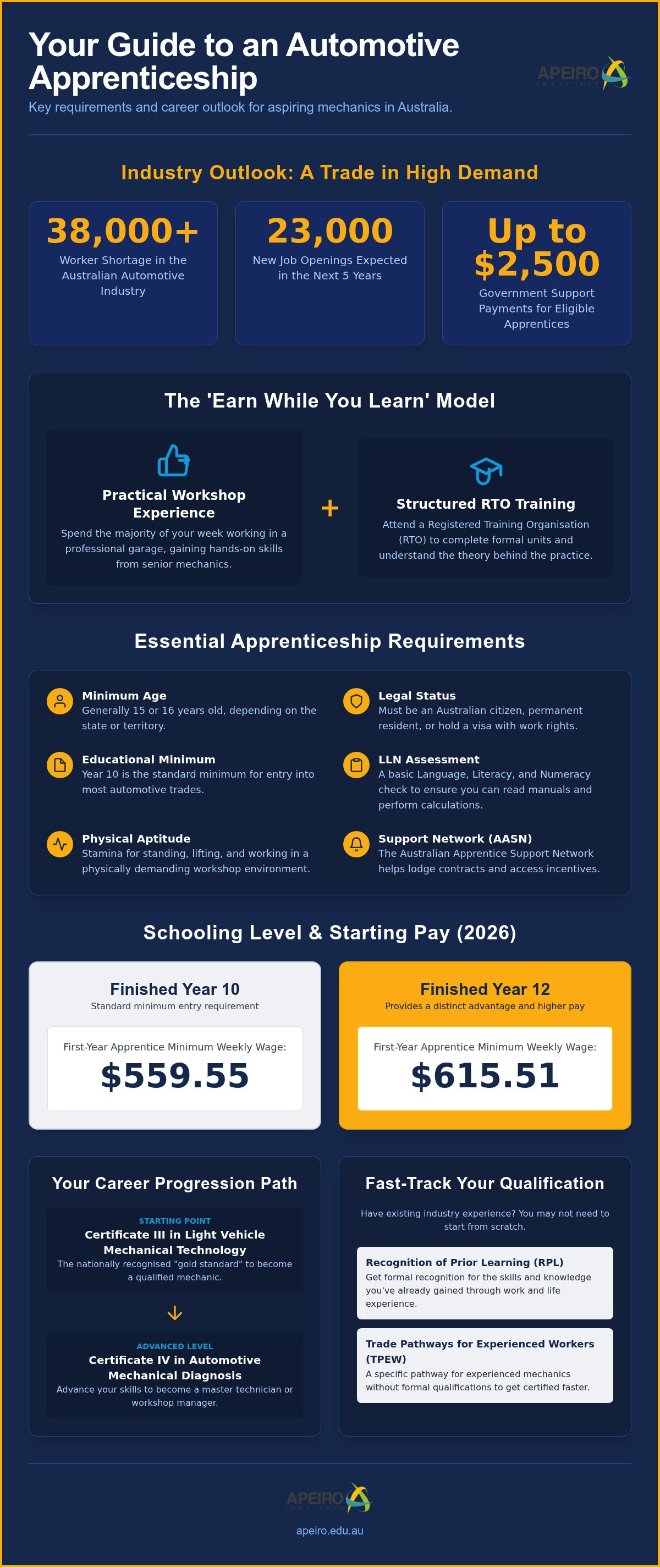
The "Earn While You Learn" model is the standout benefit of this pathway. You'll spend the majority of your week working in a professional garage, earning a legal wage and learning from senior mechanics. For the remaining time, you'll attend a Registered Training Organisation (RTO) to complete your formal units. This balance ensures you understand the "why" behind the "how," turning you into a well-rounded professional who can solve complex mechanical problems. Meeting the initial automotive apprenticeship requirements is your first step toward this stable, hands-on career.
The Value of a Nationally Recognised Qualification
Completing a AUR30620 Certificate III in Light Vehicle Mechanical Technology is the industry gold standard. Once you're trade qualified, your skills are portable and recognised across the entire country, meaning you won't need to retrain if you relocate. Beyond job security, being qualified drastically increases your earning potential. As of July 2026, the national minimum wage for an adult apprentice is $26.44 per hour, providing a solid financial foundation while you master your craft.
Automotive Industry Outlook for 2026
There has never been a more strategic time to enter the automotive sector. The industry is currently facing a shortage of over 38,000 workers, with roughly 23,000 new job openings expected over the next five years. Modern workshops are no longer just about oil changes; they're high-tech hubs. The shift toward hybrid and electric vehicles (EVs) means today's apprentices are becoming "mechatronic" specialists who understand advanced diagnostics and electronics. Because these roles are on the Australian Government’s Apprenticeship Priority List, eligible apprentices can access support payments of up to $2,500 over their first two years, making the transition into the trade more accessible than ever before.
Essential Automotive Apprenticeship Requirements: Eligibility and Schooling
Meeting the initial automotive apprenticeship requirements is less about having a perfect academic record and more about demonstrating a commitment to the trade. To begin, you must be an Australian citizen, a permanent resident, or hold a valid visa with work rights. While the minimum age varies slightly by state, most people start their journey at 15 or 16 years old. The Australian Apprentice Support Network (AASN) plays a vital role here; they're the ones who help you and your employer lodge the training contract and ensure you're eligible for any government incentives or loans.
Beyond the paperwork, you'll need a genuine "hands-on" aptitude. Modern mechanics spend their days standing, lifting, and manoeuvring in tight spaces, so physical stamina is essential. You'll also undergo a Language, Literacy, and Numeracy (LLN) assessment. Don't let this intimidate you. It's simply a way for your training provider to ensure you can read technical manuals, follow safety signs, and perform the basic calculations needed for torque settings and fluid ratios.
Educational Prerequisites: Year 10 vs. Year 12
Year 10 is the standard minimum for entry into most automotive trades. If you've completed Year 10, you can legally start a Certificate III. However, finishing Year 12 provides a distinct advantage, especially as vehicles become more computer-reliant. In 2026, the financial difference is also clear. A first-year apprentice who has completed Year 12 earns a minimum of $615.51 per week, while a junior apprentice who didn't finish Year 12 starts at $559.55. If you left school early, you can still enter the trade by completing a pre-apprenticeship course or showing relevant work experience.
Legal and Practical Requirements
One of the most overlooked automotive apprenticeship requirements is a manual driver's licence. You'll constantly be moving customer vehicles in and out of service bays, and many of these will be manual. If you only have an automatic licence, most workshops will require you to upgrade it quickly. You also need to find a "Host Employer" willing to take you on, or sign up with a Group Training Organisation (GTO) that can place you with different workshops throughout your training. If you're ready to take that first step, exploring the Certificate III in Light Vehicle Mechanical Technology can help you understand the specific units you'll be mastering on the job.
Choosing Your Specialisation: Light Vehicle vs. Specialist Trades
Deciding which branch of the trade to enter is a pivotal moment in your career. This choice influences the specific automotive apprenticeship requirements you must fulfil and shapes your daily work environment. While many envision a mechanic working on suburban cars, the Australian industry offers several distinct pathways. Each requires a slightly different focus during your training years.
The primary choice for most is between light and heavy vehicles. Here is how they generally compare:
- Light Vehicle: Focuses on passenger cars, SUVs, and light vans. You'll work in dealerships or local workshops, handling a high volume of diverse mechanical issues.
- Heavy Commercial: Involves trucks, buses, and massive earthmoving machinery. These roles are common in logistics, mining, and construction, often offering higher wages due to the scale of the equipment.
- Automotive Electrical: A rapidly growing field focused on the complex wiring, sensors, and computer systems that power modern vehicles.
Choosing a path that matches your long-term goals is vital. If you enjoy the variety of suburban car culture, light vehicle is the way to go. If you prefer the power of industrial machinery and don't mind working in more rugged environments, the heavy vehicle path might be your calling.
AUR30620 Certificate III in Light Vehicle Mechanical Technology
The AUR30620 Certificate III in Light Vehicle Mechanical Technology remains the most popular entry point for a reason. It provides a comprehensive foundation in engine repairs, transmissions, steering, and suspension. This qualification is incredibly versatile; it allows you to work in almost any town across Australia. Because the skills you learn are so fundamental to meeting standard automotive apprenticeship requirements, it serves as a perfect springboard into more specialised areas later in your career.
Advanced Specialisations and Post-Apprenticeship Paths
Once you've mastered the basics, you can pursue advanced certifications to stay ahead of industry trends. Moving into a Certificate IV in Automotive Mechanical Diagnosis allows you to become the "brain" of the workshop, focusing on complex electronic faults that standard tools might miss. If you have your sights set on running a business, a Diploma of Automotive Technology provides the management skills needed to lead a team. These post-apprenticeship paths ensure that your career remains high-growth and high-income as vehicle technology continues to evolve.
Fast-Tracking Your Qualification: RPL and Trade Pathways
Not everyone starts their career from zero. If you've spent years in a workshop but never got your papers, the standard automotive apprenticeship requirements might seem like a step backwards. However, the Australian system allows for Recognition of Prior Learning (RPL). This process acknowledges your existing skills and applies them toward a formal qualification. It's a practical way to turn years of "backyard" or uncertified experience into a nationally recognised trade certificate without spending four years as a junior.
This focus on practical, skill-based progression is a hallmark of modern trade education. If you are also exploring options in the building sector, you can learn more about YTA Training for information on their intensive construction courses.
For those looking into other technical career paths, such as electrical or HVAC work, the National Technical Institute (NTI) offers accelerated training programs that provide a fast-track into these essential trades.
Eligibility usually depends on having several years of full-time experience in the trade. You'll need to prove your expertise through a portfolio of evidence. This isn't just about a CV; it involves providing photos of your work, videos of you performing specific tasks, and solid references from previous employers. These documents act as your voice, showing an assessor that you already meet the standard automotive apprenticeship requirements expected of a qualified mechanic.
How TPEW Works for Seasoned Mechanics
The Trade Pathways for Experienced Workers (TPEW) is an assessment-only pathway designed for people who have the skills but lack the certificate. Instead of attending every single class, an assessor evaluates your skills against the national training package. If you have a few small areas where your knowledge is out of date, you only complete gap training for those specific units. This focused approach saves time and gets you onto a qualified wage much faster than a standard four-year term.
Get your experience certified through TPEW today
The RPL Evidence Checklist
To get started, you'll need to gather a comprehensive evidence kit. This often includes a detailed tool list to show you have the equipment of the trade, payslips to prove your employment history, and workplace logs detailing the types of vehicles you've serviced. For a deeper dive into how this works in the current market, check out our Trade Pathways for Experienced Workers Australia: The 2026 Guide. An RTO assessor will then validate these documents, often visiting your workplace to see you in action.
How to Start Your Automotive Career with Apeiro Institute
Starting your trade career is a significant milestone that requires the right support. At Apeiro Institute, we see ourselves as more than just a training provider; we are your partner in professional growth. We understand that meeting all the automotive apprenticeship requirements can feel like a heavy lift, especially when you're also managing the demands of a full-time job. Our team focuses on providing a supportive, student-centred environment where both local and international learners can thrive. As a nationally recognised RTO (45394), we ensure our training remains strictly industry-aligned so you graduate with the practical skills modern workshops actually need.
Our approach is built on the belief that education should be accessible and outcome-focused. We bridge the gap between your current circumstances and your future career goals by offering flexible learning options and expert guidance. Whether you are just starting out or looking to formalise years of experience, we provide the steady, methodical path you need to succeed in the Australian automotive sector.
Enrolment Steps for New Apprentices
The process of joining the trade is straightforward when you have a clear roadmap. Follow these steps to begin your journey:
- Step 1: Secure a host employer. This is your first priority. If you're struggling to find a workshop, we can offer guidance on what employers look for in a new apprentice.
- Step 2: Training Plan development. Once you have a workshop and have contacted an AASN, we'll develop a customised training plan and conduct the required LLN assessment. This ensures you have the right support from day one.
- Step 3: Begin your hands-on journey. You'll start your units at our professional training centre, applying what you learn directly to the vehicles you work on at your job.
Why Apprentices Trust Apeiro Institute
Personalised mentoring is at the heart of our philosophy. Our trainers are industry experts who have spent years on the tools themselves. They don't just teach from a textbook; they share real-world insights that help you solve difficult diagnostic problems. Our class sizes are kept small to ensure you get the individual attention you deserve. This supportive atmosphere is why so many students choose us to help them navigate the automotive apprenticeship requirements and build a lasting career. For more detailed information on the specific units you will study, take a look at our Certificate III in Light Vehicle Mechanical Technology: Your 2026 Guide.
Take Control of Your Automotive Future
The automotive sector is moving faster than ever, with a massive demand for skilled technicians who understand both the mechanical and electronic sides of modern vehicles. You now have a clear roadmap of the automotive apprenticeship requirements, from educational benchmarks to the practical necessity of a manual licence. Whether you're a school leaver or an uncertified mechanic looking to fast-track your career through Trade Pathways for Experienced Workers (TPEW), the opportunity for growth is immense.
At Apeiro Institute, we provide the nationally recognised training and industry-aligned workshops you need to succeed. Our expert mentors are dedicated to your personal growth, ensuring you don't just get a certificate; you gain the confidence to lead in a professional workshop. Your journey from an apprentice to a master technician is a steady, rewarding path that we're ready to walk with you. By choosing a partner that values your success as much as you do, you're setting yourself up for a lifetime of job security and professional pride.
Start your automotive journey with Apeiro Institute today
Take the first step toward a secure and high-tech career today. We're here to help you turn your passion for vehicles into a lifelong profession.
Frequently Asked Questions
Do I need a Year 12 certificate to start an automotive apprenticeship?
No, you don't need a Year 12 certificate to begin your career. Year 10 is the standard minimum for most automotive trades. While finishing school isn't a strict rule for automotive apprenticeship requirements, it does impact your starting wage. Completing Year 12 qualifies you for a higher award rate, which makes a noticeable difference in your weekly take-home pay during those first two years in the workshop.
How much does an automotive apprentice get paid in 2026?
As of July 1, 2026, the national minimum wage for adult apprentices aged 21 or over is $26.44 per hour. For juniors, the rates vary based on school completion. A first-year apprentice who finished Year 12 earns approximately $615.51 per week. Those who didn't finish Year 12 start at $559.55 per week. These rates are protected under the Vehicle Repair, Services and Retail Award 2020.
Can I finish my automotive apprenticeship in less than four years?
Yes, it's possible to finish earlier than the standard term. The Australian apprenticeship system is competency-based, meaning you can qualify as soon as you prove you've mastered the required skills. If you're a fast learner or have previous experience, your RTO and employer can sign off on your units ahead of schedule. This flexibility is a major advantage for dedicated students who want to reach a qualified wage sooner.
What is the difference between an RTO and a GTO?
An RTO like Apeiro Institute provides your formal education and technical training. A GTO acts as your legal employer and places you with various host workshops. While you study at an RTO to get your qualification, a GTO handles your pay and ensures you have a steady place to work. If one workshop runs out of projects, the GTO will find you a new placement to continue your training.
Do I have to buy my own tools as an apprentice mechanic?
Most apprentices are expected to build their own tool kit over time. While your employer provides heavy workshop equipment, having your own set of spanners, sockets, and screwdrivers is standard industry practice. To help with the cost, eligible apprentices can access the Australian Apprenticeship Support Loan. This provides up to $27,048 as an interest-free loan to cover essential expenses like tools, equipment, and transport.
Is there an age limit for starting an apprenticeship in Australia?
There is no upper age limit for starting an apprenticeship in Australia. Mature-age or adult apprenticeships are very common, especially for career changers. Employers often value the life experience and reliability that older workers bring to the garage. If you're over 21, you'll simply be paid at the adult apprentice rate. This rate is higher than the junior rate to reflect your existing financial responsibilities.
Can international students apply for automotive apprenticeships?
Yes, international students can apply for automotive vocational programs. While the traditional "apprenticeship" model often requires residency for government subsidies, international students can enrol in the Certificate III in Light Vehicle Mechanical Technology on a vocational student visa. This allows you to gain the same high-quality Australian qualification and valuable workshop experience while living and studying in Australia, opening doors to global career opportunities.
What happens if my host employer runs out of work?
If your host employer can no longer provide work, you don't lose your progress. If you're with a GTO, they'll simply find you a new placement to continue your training contract. If you're directly employed, you can transfer your training contract to a new workshop. Your RTO will keep your records of completed units safe, so you can pick up exactly where you left off without repeating any study.

Disclaimer
The information provided on this blog is for general informational and educational purposes only. While every effort is made to ensure the accuracy and reliability of the content, the author makes no representations or warranties of any kind, express or implied, about the completeness, accuracy, suitability, or availability of the information contained on this blog.
The views and opinions expressed in blog posts are those of the individual author and do not necessarily reflect the official policy or position of any organization, company, or employer.
This blog may contain links to external websites or third-party content. These links are provided for convenience only, and the author has no control over and assumes no responsibility for the content, privacy policies, or practices of any third-party sites.
Nothing on this blog constitutes professional advice (legal, financial, medical, or otherwise). Readers are encouraged to seek appropriate professional guidance before making any decisions based on the information provided here.
By using this blog, you acknowledge that any reliance on the information is at your own risk.


