

What if the only thing standing between you and a rewarding automotive career isn't a lack of tools, but simply knowing which door to knock on first? You might feel anxious about being the "newbie" in a fast-paced workshop or overwhelmed by the technicalities of the apprenticeship process. It's common to wonder if you need a university degree or years of backyard experience just to be taken seriously by an employer. The truth is, learning how to become a mechanic with no experience is entirely achievable when you have a clear map to follow.
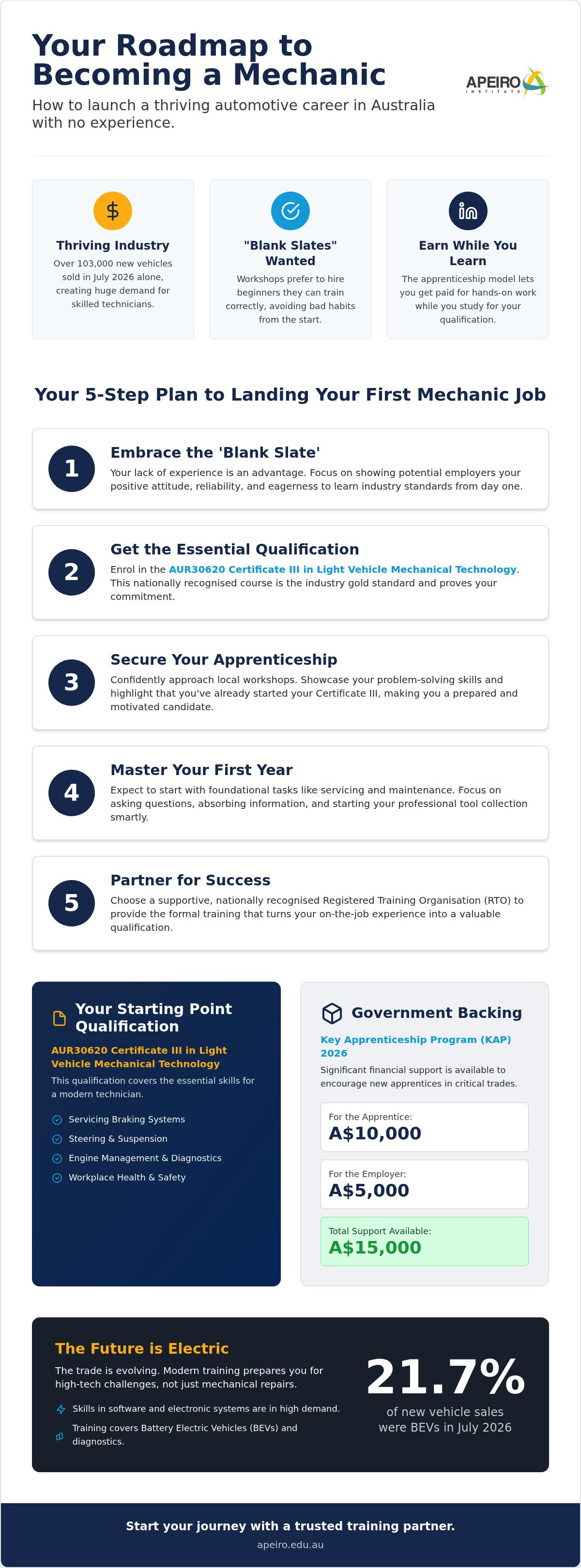
We understand that starting a new journey can feel intimidating, but the Australian automotive industry is currently thriving, with over 103,000 new vehicles sold in July 2026 alone. This guide provides a supportive, 5-step plan to help you secure your first role and explains why the AUR30620 Certificate III in Light Vehicle Mechanical Technology is the essential qualification you need. You will discover how to find the right apprenticeship, understand the latest government incentives like the Key Apprenticeship Program, and gain the confidence to approach local workshops as a prepared and motivated candidate.
Key Takeaways
- Learn why starting from scratch is often preferred by workshops looking for motivated individuals ready to be trained the right way from day one.
- Discover exactly how to become a mechanic with no experience by pursuing the AUR30620 Certificate III in Light Vehicle Mechanical Technology, the industry's essential qualification.
- Master a clear five-step strategy to land your first apprenticeship, including how to showcase reliability and problem-solving skills to potential employers.
- Prepare for the reality of your first year on the tools, focusing on foundational maintenance tasks and smart ways to start your professional tool collection.
- Understand how partnering with a supportive, nationally recognised training provider can bridge the gap between your current skills and a successful automotive career.
Can You Really Become a Mechanic with Zero Experience?
The short answer is a resounding yes. In fact, many workshop owners across Australia actually prefer it that way. While you might feel like you're behind because you haven't spent your weekends under a bonnet, the Australian automotive industry is specifically structured to turn beginners into experts. It's a trade built on the foundation of the apprenticeship, which is a system designed for people starting from scratch. Learning how to become a mechanic with no experience is more about your mindset and reliability than how many tools you currently own.
Workshops often value a "blank slate" over a hobbyist who may have picked up bad habits from backyard tinkering. A professional auto mechanic must follow strict safety protocols and industry standards that backyard garages often ignore. By starting with no prior experience, you can be trained correctly from day one. You'll learn to use professional diagnostic equipment and follow manufacturer specifications, which is the difference between being a hobbyist and a qualified light vehicle mechanical technician.
The Australian Apprenticeship Model Explained
This pathway uses a practical "earn while you learn" structure. Your week is typically split between the workshop floor and a Registered Training Organisation (RTO). While you're at work, you're getting paid to watch, learn, and eventually perform maintenance tasks under supervision. Your RTO provides the theoretical foundation and formal assessments. It's a steady, logical progression. You start with basic tasks and move toward complex diagnostics as your skills grow. This supportive environment ensures you're never left to figure things out on your own in a dangerous setting.
Myth-Busting: Do You Need to Be a "Car Expert" to Start?
You don't need to know how to rebuild a gearbox before you apply for a job. Modern workshops in 2026 are looking for people with a positive attitude and basic mechanical aptitude. The trade is changing rapidly. With Battery Electric Vehicles (BEVs) making up 21.7% of new vehicle sales in July 2026, employers need people who can learn new software and electronic systems just as much as they need people who can turn a spanner.
The Australian Government is also heavily backing new entrants. Through the Key Apprenticeship Program (KAP), up to A$15,000 in total support is available for apprentices in critical sectors during 2026. This includes A$10,000 directly for the apprentice and A$5,000 for the employer, making it a very attractive time for workshops to hire someone with no experience. Taking the first step by enrolling in the Certificate III in Light Vehicle Mechanical Technology shows employers you're serious about the career, even if you've never changed a tyre before.
The Essential Qualification: AUR30620 Certificate III in Light Vehicle Mechanical Technology
If you are researching how to become a mechanic with no experience, the journey truly begins with one specific qualification: the Certificate III in Light Vehicle Mechanical Technology. This course is widely regarded as the gold standard because it covers the comprehensive skill set required to maintain and repair modern cars. It's a nationally recognised qualification, meaning once you've earned it, you have a passport to work in any workshop across Australia.
The curriculum is designed to move you from a total beginner to a competent technician. You'll study core units that include servicing braking systems, steering and suspension, and cooling systems. The modern trade is about more than just mechanical parts; you'll also learn the complexities of engine management and electronic diagnostics. These skills are vital for servicing the high-tech vehicles on Australian roads today. This foundational knowledge is also the perfect stepping stone if you eventually want to specialise through a Certificate IV in Automotive Mechanical Diagnosis.
What You Will Learn on Campus
The beauty of starting your training at a dedicated centre is the controlled environment. You get to build your confidence on real engines and vehicle systems before you ever have to face a paying customer. You'll learn to use professional diagnostic scan tools, which are essential for identifying faults in modern vehicle computers. Safety is paramount, and you will spend significant time mastering workplace health and safety (WHS) protocols to ensure you can look after yourself and your workmates in a busy shop.
Flexible Study Options for Modern Learners
We know that not everyone fits into the rigid schedule of a traditional public institution. Private RTOs like Apeiro Institute often provide more flexible intake dates and smaller class sizes. This personalised approach is a huge advantage for those who might feel overwhelmed by large groups. It's also an excellent pathway for international students who want to enter the Australian automotive sector while receiving mentor-like support. This flexibility is crucial for anyone figuring out how to become a mechanic with no experience while balancing other life commitments. If you're ready to take that first step, you can enrol in our industry-focused training to begin your professional journey.
5 Steps to Secure Your First Mechanic Job with No Experience
Securing your first role in a workshop requires a mix of initiative and the right approach. While job boards are a starting point, the automotive trade still values old-school grit and face-to-face interaction. If you are wondering how to become a mechanic with no experience, following a structured plan will help you stand out from other applicants.
- Show Initiative: Don't wait for a job to start learning. Enrolling in your Certificate III proves to an employer that you are committed to the trade. It changes the conversation from "I want to be a mechanic" to "I have already started my training."
- Highlight Transferable Skills: Your resume should focus on reliability, a knack for problem-solving, and teamwork. If you've worked in retail, construction, or even hospitality, you already have the "soft skills" workshops desperately need.
- The Cold Call Strategy: In 2026, visiting local workshops in person is still the most effective way to get hired. Dress in tidy work gear, bring a printed resume in a plastic sleeve, and ask to speak with the workshop manager during a quiet time, like mid-morning.
- Ace the Trial Day: Most workshops will ask you to come in for a few hours. Wear steel-capped boots, bring a notebook, and stay off your phone. Showing that you can follow safety instructions and keep a bay clean is more important than knowing how to fix a car on day one.
- Use RTO Connections: Training providers like Apeiro Institute have deep roots in the industry. We often hear about "hidden" job openings before they ever hit a public job board.
Nailing the Workshop Interview
When the manager asks why you want this career, avoid clichés. Instead, talk about your interest in the shifting market dynamics, such as the fact that EV market share reached 13.3% in the first half of 2026. This shows you are looking at the long-term future of the trade. Ask about their workshop culture and what kind of mentorship they provide to new apprentices. Employers love candidates who are eager to learn the right way through nationally recognised training rather than those who think they already know it all.
The 'Trade Pathways' Advantage
Perhaps you aren't a total beginner. If you have spent years working on cars informally but lack the "paper" to prove it, you might be eligible for Trade Pathways for Experienced Workers (TPEW). This program uses Recognition of Prior Learning (RPL) to assess your existing skills. It allows you to skip the basics you already master and focus on the gaps in your knowledge. This is a fast-track way to turn years of "under the bonnet" experience into a formal Australian qualification without starting from year one of a standard apprenticeship.
What to Expect in Your First Year as a Grease Monkey
The first year of an apprenticeship is often a culture shock for those who have spent time researching how to become a mechanic with no experience. While you might imagine yourself pulling apart high-performance engines immediately, the reality is much more grounded. You'll spend most of your time performing oil changes, rotating tyres, and carrying out basic inspections. This isn't just "busy work"; it's how you learn the rhythm of a workshop and develop a "feel" for different vehicle makes and models. These repetitive tasks build the muscle memory you'll need when you move on to complex diagnostics later in your career.
As of July 1, 2026, minimum award wages for apprentices increased by 4.75%, meaning a first-year apprentice can expect to earn between A$615 and A$724 per week. While this is an entry-level wage, remember that it's a paid education. You're being compensated to learn a trade that will provide a lifetime of job security.
Building your "Roll Cab" or tool collection is another major first-year milestone. It's tempting to buy every shiny tool you see, but a better approach is to invest in high-quality basics first. If you need to raise funds for these essential items, you might check out Houston Empire Gold Buyers to see how selling precious metals can provide a quick financial boost. Start with a solid set of spanners, sockets, and screwdrivers, and always check with your boss before making a major purchase, as a senior technician would rather see you with a few quality tools than a cheap kit that breaks on the first stubborn bolt.
Admin is just as important as the spanners. You'll need to stay on top of your apprentice logbook, ensuring every practical hour you spend on the workshop floor is signed off by your supervisor. This logbook is your proof of competency and is essential for moving through the stages of your qualification. If you let it slide, you'll find it incredibly difficult to catch up later, which can delay your progression to becoming a fully qualified technician.
Common Tasks for First-Year Apprentices
Your days will be filled with foundational maintenance. You'll master battery tests and cooling system checks while learning the "art of the hoist"-ensuring every vehicle is lifted safely and correctly. A significant part of your role involves keeping the workshop ship-shape. A clean bay isn't just about appearances; it's a critical safety requirement. By keeping floors clear of oil spills and putting tools back in their place, you prove you're a professional who respects the environment and your workmates.
Overcoming the 'Newbie' Learning Curve
Mistakes are part of the learning process when you're figuring out how to become a mechanic with no experience. Whether it's a small oil spill or a stripped thread, the key is to own it immediately. Senior technicians value honesty over excuses. They've all been in your shoes and will respect you more for admitting a slip-up so it can be fixed correctly. Finding a mentor in the shop is the best way to navigate this curve. Look for the tech who is patient and willing to explain the logic behind a task.
Start your automotive career with industry-focused training
Why Choose Apeiro Institute for Your Automotive Journey?
Choosing where to study is just as important as deciding to start your trade. At Apeiro Institute, we pride ourselves on being more than just a training provider; we are your friendly, expert guide through the early stages of your career. If you are researching how to become a mechanic with no experience, you need a partner that understands the Australian market and provides a supportive environment to build your confidence.
We are a nationally recognised Registered Training Organisation (RTO 45394). This means our qualifications meet the strict standards required by the Australian automotive industry. We foster a diverse and inclusive community, with students representing over 38 different nationalities. Whether you are a local apprentice or an international student, you will find a welcoming space where your personal and professional growth is our top priority. We act as a bridge between your current circumstances and your future career goals.
Our Student-Centred Approach
We believe every student deserves a "fair go". Our small class sizes ensure you aren't just a number in a crowded lecture hall. You will receive the individual attention and hands-on guidance necessary to master complex mechanical systems. Our trainers are industry-aligned professionals who are passionate about mentoring the next generation of technicians. To help you get started sooner, we offer flexible enrolment periods that work around your schedule rather than making you wait for a traditional semester start.
Beyond the Workshop: A Career for Life
An automotive qualification provides incredible long-term career security. While your journey might begin with spanners and diagnostic tools, the skills you gain in problem-solving and management can lead to diverse roles later in life. Some technicians eventually move into workshop management, while others expand their technical expertise into drone technology with AINautics University. Some even pivot into human-centric roles by pursuing a Diploma of Community Services. This versatility is one of the greatest benefits of the trade.
By joining our community, you are investing in a future that offers both stability and the flexibility to grow in whatever direction you choose. Learning how to become a mechanic with no experience is the first step toward a professional journey where your skills will always be in demand. We are here to support you at every turn, from your first day on campus to your final assessment as a qualified technician.
Your Future in the Automotive Industry Starts Now
Starting a new career path might feel like a massive shift, but the Australian automotive industry is built to support your growth. You've seen that workshops often prefer a blank slate, provided you have the right attitude and a commitment to professional learning. By focusing on the AUR30620 Certificate III in Light Vehicle Mechanical Technology, you gain a nationally recognised qualification that serves as your professional passport across the country. Understanding how to become a mechanic with no experience is simply the first step in a journey that leads to long-term job security and technical expertise.
Start your automotive career today with Apeiro Institute’s AUR30620 course
At Apeiro Institute (RTO 45394), we provide nationally recognised training delivered by expert industry mentors who are invested in your success. Whether you're a local school leaver or a mature-age career changer, we're here to help you turn your interest in cars into a lifelong profession. Don't let a lack of experience hold you back from a thriving trade. The road ahead is full of opportunity, and we're ready to help you navigate every turn with confidence.
Frequently Asked Questions
Do I need to buy my own tools before starting a mechanic apprenticeship?
You don't need to buy a full tool kit before figuring out how to become a mechanic with no experience. Most workshops provide the basic equipment you need for your initial tasks or have communal tools available. As you gain confidence, you can slowly build your own collection. Many apprentices use their wages to buy professional-grade tools that will serve them for decades in the trade.
How much does a first-year apprentice mechanic earn in Australia in 2026?
As of July 1, 2026, a junior first-year apprentice can expect to earn between A$615 and A$724 per week following a 4.75% increase in award wages. If you are an adult apprentice aged 21 or older, you are entitled to at least the national minimum wage of A$26.44 per hour. This works out to approximately A$1,004.90 per week for a standard full-time workload while you learn.
Is there an age limit to becoming a mechanic in Australia?
There is no upper age limit for starting an apprenticeship in Australia. Many workshops actively seek mature-age apprentices because they bring reliability and life experience to the team. While the pay rates for adult apprentices are higher than for juniors, the training requirements are identical. It's a popular choice for career changers who want a hands-on profession with long-term job security and a clear pathway.
Can I study to be a mechanic if I am on an international student visa?
International students can study to become a mechanic if they enrol in a CRICOS-registered program. Many RTOs offer vocational courses specifically designed for international learners to gain a Certificate III in Light Vehicle Mechanical Technology. You'll need to ensure your course meets your visa requirements and provides the practical hours needed. It's a fantastic way to gain industry-recognised skills while experiencing the Australian trade firsthand.
How long does it take to become a fully qualified light vehicle mechanic?
A standard apprenticeship usually takes four years to complete. This duration ensures you have enough time to master everything from basic servicing to complex engine diagnostics. For those researching how to become a mechanic with no experience, this four-year path is the most reliable way to gain full competency. Your time is split between hands-on workshop experience and structured learning at a training centre like Apeiro Institute.
What is the difference between a mechanic and an automotive technician?
While both roles involve vehicle repair, an automotive technician typically focuses more on computerised diagnostics and complex electrical systems. A mechanic traditionally handles more of the physical mechanical repairs and routine servicing. In 2026, the lines are blurring as vehicles become more advanced. Most modern workshops now require the high-tech skills of a technician to navigate the software and sensors found in new electric vehicles.
Are there government subsidies for mechanic courses in NSW?
Yes, the NSW Government offers subsidies through the Smart and Skilled program to make vocational training more accessible. These funded places are often available for the Certificate III in Light Vehicle Mechanical Technology. Your eligibility for a subsidised spot depends on factors like your residency and existing qualifications. It's always worth checking the current 2026 funding status with your training provider before you enrol in your chosen course.
What happens if I start my apprenticeship but want to change workshops?
You can certainly change workshops if your current environment isn't the right fit for your goals. The apprenticeship system in Australia allows you to transfer your training contract to a new employer without losing the progress you've already made. This flexibility ensures you can find a supportive mentor and a workshop culture that helps you thrive. Your RTO will help you update your records for a smooth transition.

Disclaimer
The information provided on this blog is for general informational and educational purposes only. While every effort is made to ensure the accuracy and reliability of the content, the author makes no representations or warranties of any kind, express or implied, about the completeness, accuracy, suitability, or availability of the information contained on this blog.
The views and opinions expressed in blog posts are those of the individual author and do not necessarily reflect the official policy or position of any organization, company, or employer.
This blog may contain links to external websites or third-party content. These links are provided for convenience only, and the author has no control over and assumes no responsibility for the content, privacy policies, or practices of any third-party sites.
Nothing on this blog constitutes professional advice (legal, financial, medical, or otherwise). Readers are encouraged to seek appropriate professional guidance before making any decisions based on the information provided here.
By using this blog, you acknowledge that any reliance on the information is at your own risk.


