

What if your first year in a workshop was less about sweeping floors and more about diagnosing the high-voltage systems of a brand-new EV? It's a common worry for those starting out, but the reality of the modern workshop is changing fast. If you're asking yourself, what does an automotive apprentice do, you'll find that the role is a sophisticated blend of mechanical skill and digital diagnostic expertise. With electric vehicles reaching a record 16.4% of new sales in early 2026, you aren't just a grease monkey. You're a high-tech problem solver.
We know that the transition from the classroom to the garage can feel overwhelming. You might worry about the difficulty of modern vehicle electronics or feel confused about how the 'earn while you learn' model actually works. This guide will give you total clarity on the daily reality of the trade. We'll outline your core responsibilities, explain the balance between the workshop and your Certificate III studies, and map out a career path that offers long-term security in an industry currently short of 38,000 workers.
Key Takeaways
- Understand the 'earn while you learn' model, which combines full-time workshop experience with structured training over a four-year period.
- Get a clear breakdown of what does an automotive apprentice do daily, from mastering basic servicing in your first year to complex diagnostic work as you progress.
- Learn how to balance practical workshop time with formal studies at an RTO like Apeiro Institute to ensure your skills are nationally recognised.
- Identify the essential traits, like logical problem-solving and attention to detail, that turn a trainee into a respected senior technician.
- Discover the diverse career pathways available after qualification, including high-demand specialisations in electric vehicles and heavy diesel.
What is an Automotive Apprenticeship in Australia?
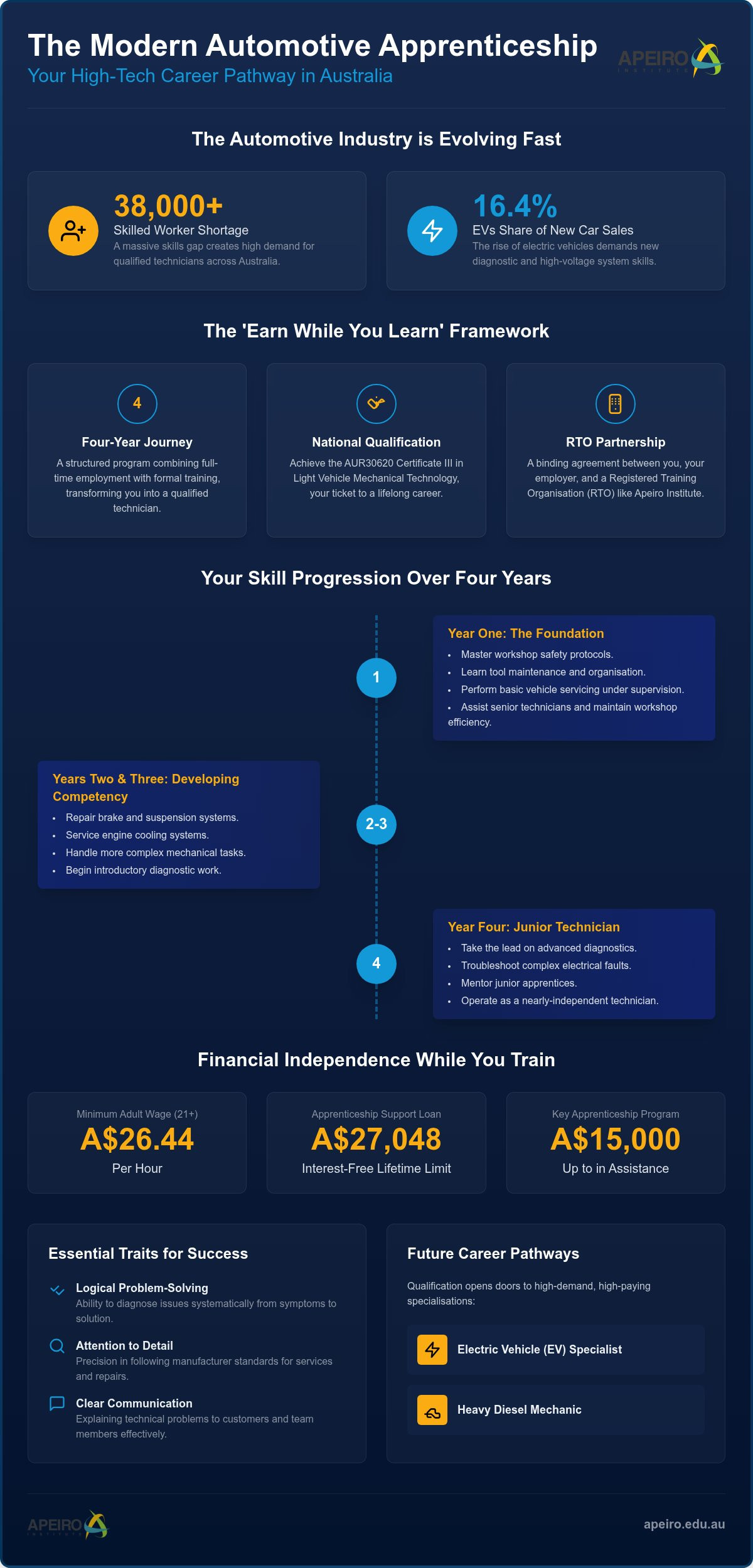
An automotive apprenticeship is a structured, four-year journey that transforms a curious beginner into a qualified technician. It's built on a foundation of "earning while you learn," which means you're employed full-time while completing a nationally recognised qualification. Right now, the Australian automotive industry is facing a massive skills shortage. According to the Victorian Automotive Chamber of Commerce, there's a shortfall of over 38,000 workers. This gap makes it an ideal time to start your career. When people ask, what does an automotive apprentice do, the answer begins with a legal training contract. This is a three-way binding agreement between you, your employer, and a Registered Training Organisation (RTO) like Apeiro Institute. Your primary goal is to achieve the AUR30620 Certificate III in Light Vehicle Mechanical Technology, which serves as your ticket to a lifelong career.
The 'Earn While You Learn' Model
One of the biggest draws of this pathway is the ability to maintain financial independence while you study. Under the Fair Work Ombudsman guidelines, your wages are protected by the Vehicle Repair, Services and Retail Award 2020. As of 1 July 2026, the national minimum wage for adult apprentices aged 21 or older is A$26.44 per hour. If you're a career changer, this baseline ensures that starting fresh doesn't mean starting from zero financially. Beyond your hourly rate, you can access the Australian Apprenticeship Support Loan. For the 2026,27 period, this interest-free loan has a lifetime limit of A$27,048. It's designed to help cover the cost of high-quality tools and everyday living expenses. Additionally, the Key Apprenticeship Program (KAP) currently offers up to A$15,000 in assistance for apprentices in critical sectors, providing a significant boost during your training years.
The Role of the Registered Training Organisation (RTO)
While the workshop is where you'll get your hands dirty, the RTO provides the essential theory that makes sense of the grease and gears. You can't just learn modern diagnostics by trial and error; you need to understand the complex physics and electronics behind the machinery. To understand the foundational skills expected of a professional, reading about What is an Auto Mechanic? provides a great baseline for the industry's standards. Apeiro Institute supports your journey by providing structured "off-the-job" training days. These sessions allow you to step away from the daily pressure of the workshop to master complex concepts in a controlled environment. When exploring what does an automotive apprentice do, it's clear that this balance of practical work and formal study is what builds true competency. Your RTO instructors act as mentors, ensuring you're meeting national standards while your workshop supervisor signs off on your practical skills in the garage.
Daily Tasks: What Does a Typical Day Look Like?
A typical day in a workshop starts early, usually around 7:30 am, with a quick team huddle to discuss the day's bookings. You'll likely begin by prepping your bay and ensuring your tools are clean and organised. When people ask, what does an automotive apprentice do, they often imagine just oily rags and heavy lifting. While those are part of the job, the role is a sophisticated mix of manual labour, digital diagnostics, and professional communication. You'll spend your morning working through service checklists, but you'll also spend time explaining technical issues to customers in a way they can actually understand. It's a busy, varied environment where no two days are exactly the same.
Your responsibilities will evolve as you progress through your four-year journey. In your first year, you're the backbone of workshop efficiency. You'll focus on mastering workshop safety, maintaining high-quality tools, and performing basic servicing under close supervision. By years two and three, your mentor will trust you with more complex systems. You'll move into repairing brakes, adjusting suspension, and managing engine cooling systems. By your fourth year, you're essentially a junior technician. You'll take the lead on advanced diagnostics and troubleshooting electrical faults that would baffle a beginner. This structured growth ensures you're always learning something new without feeling out of your depth.
Core Mechanical Responsibilities
Mechanical work remains the foundation of your training. You'll spend a significant portion of your week performing logbook services and oil changes to strict manufacturer standards. This isn't just a routine task; it's a vital safety check. You'll learn to identify and replace worn components like brake pads, rotors, and tyres before they lead to a breakdown. As you gain experience, you'll assist senior mechanics with major engine or transmission overhauls. This hands-on experience is essential for meeting the requirements of Official Automotive Qualifications in Australia. Every bolt you tighten and every gasket you replace builds the muscle memory needed for a successful career.
The Digital Shift: Diagnostics and Electronics
Modern vehicles are essentially high-powered computers on wheels. This means what does an automotive apprentice do now looks very different than it did twenty years ago. You'll use OBD-II scanners to interpret fault codes and pinpoint electronic issues that aren't visible to the naked eye. Testing batteries, alternators, and complex wiring looms is now a daily requirement. With the rapid rise of EVs and Chinese automotive brands in the Australian market, you'll also learn to update vehicle software and recalibrate Advanced Driver Assistance Systems (ADAS). If you're ready to master these high-tech systems, exploring the AUR30620 Certificate III is an excellent way to start. It's a career that perfectly blends traditional mechanical skill with the future of digital technology.
Balancing the Workshop and the Classroom
Success in this trade isn't just about how well you handle a spanner. It's about how you bridge the gap between the workshop floor and the classroom. Your training schedule usually follows one of two paths: day release or block release. Day release means you'll head to a campus like Apeiro Institute once a week, while block release involves spending a full week in intensive training every few months. When considering what does an automotive apprentice do, it's vital to look at the 'off-the-job' component. This is where you learn the "why" behind the "how," turning practical habits into professional expertise. There is significant Industry Support for Apprentices across Australia, ensuring that your time spent studying is respected as a core part of your employment.
The classroom is where you master the physics and maths that modern vehicles demand. You'll study gear ratios, hydraulic pressure, and Ohm's Law to understand electrical circuits. Without this theoretical foundation, diagnosing a complex fault in a hybrid powertrain becomes almost impossible. To prove your competency, you'll maintain a detailed logbook. This isn't just paperwork; it's a legal record of your growth. Your workshop mentor plays a critical role here, observing your work and signing off on specific tasks once you've proven you can perform them safely and consistently to industry standards.
The AUR30620 Certificate III Curriculum
The core of your training is the Certificate III in Light Vehicle Mechanical Technology. This qualification covers a broad spectrum of units designed to make you a versatile technician. You'll dive deep into testing and repairing electrical systems, which is increasingly important as the market shifts toward EVs. Other units focus on servicing steering and suspension systems, ensuring you have a holistic understanding of vehicle safety. Every unit you complete brings you one step closer to your final assessment. Once you pass, you're no longer an apprentice; you're a qualified tradesperson with a nationally recognised credential.
Trade Pathways for Experienced Workers (TPEW)
What if you've already spent years working in a garage but never got your papers? Many people ask, what does an automotive apprentice do if they already have the skills? For these workers, Trade Pathways for Experienced Workers offers a streamlined solution. Instead of starting a four-year apprenticeship from scratch, you can use Recognition of Prior Learning (RPL). This process assesses your existing workshop experience against the national standards. It allows you to skip the basics you already know and focus only on the gaps in your knowledge, significantly fast-tracking your journey to becoming a fully qualified mechanic.
Essential Skills and Traits for a Successful Apprentice
Technical knowledge is vital, but the mindset you bring to the workshop often determines how quickly you'll progress. When exploring what does an automotive apprentice do to stand out, you'll find that logical problem-solving is their greatest asset. Modern vehicles are complex machines where a single symptom could have a dozen different causes. You need the patience and logic to trace a fault to its source without simply guessing and replacing parts. This analytical approach turns a trainee into a specialist who can handle the pressure of a busy workshop.
Attention to detail is another non-negotiable trait. In this trade, "near enough" is never good enough. A loose bolt or a slightly misaligned sensor can have catastrophic consequences for vehicle safety. You must take pride in the precision of your work. Furthermore, understanding what does an automotive apprentice do in terms of digital diagnostics is now just as important as knowing how to use a torque wrench. You should feel comfortable using computers and specialized software to recalibrate systems. Finally, you'll need physical resilience. You'll be on your feet for most of the day, moving between the hoist, the tool chest, and the engine bay in a fast-paced environment.
The Importance of 'Soft Skills' in the Trade
You aren't just working with engines; you're working with people. Effective communication is essential for a smooth-running workshop. You'll need to explain technical issues clearly to service advisors so they can provide accurate quotes to customers. Time management is also a critical factor. Most workshops operate on "flat rate" or scheduled service times. Learning to work efficiently without sacrificing quality is a skill you'll hone throughout your four-year journey. Maintaining a professional attitude and keeping your work bay clean also demonstrates that you respect the workshop and the high-value assets customers have entrusted to you.
Health and Safety (WHS) Awareness
Enrol in the Certificate III in Light Vehicle Mechanical Technology today
Career Progression: Where Can an Apprenticeship Take You?
Completing your four-year journey is a significant milestone, but it's really just the starting line for a diverse range of professional pathways. Once you've earned your "ticket," you'll likely step into a role as a Senior Technician. From there, many move into supervisory positions such as a Workshop Foreman or Service Manager, where they oversee a team of mechanics and manage workshop flow. If you have an entrepreneurial spirit, your trade skills provide the perfect foundation for business ownership. Opening an independent service centre allows you to build your own brand and community presence. For those aiming for high-level technical or corporate roles, further study in the AUR50216 Diploma of Automotive Technology can prepare you for advanced diagnostic and management positions within the industry.
Specialisation is another exciting avenue. You might choose to focus on high-performance tuning, working on race teams or luxury vehicles. Alternatively, the heavy diesel sector offers lucrative opportunities in mining and logistics. When people ask, what does an automotive apprentice do to prepare for the future, the answer is often about versatility. The skills you learn today are transferable across many sectors, ensuring your career remains resilient regardless of how the market shifts.
The Future of the Trade: Electric Vehicles (EVs)
The Australian automotive landscape is changing at a rapid pace. As of July 2026, EVs account for 13.1% of the total vehicle market, with sales reaching record highs earlier in the year. This shift is fundamentally altering what does an automotive apprentice do on a daily basis. Traditional "grease" skills are being supplemented by high-level electronics and software knowledge. To stay relevant, you'll need to embrace continuous professional development. Mastering high-voltage systems and digital recalibration will make you an invaluable asset in a world where petrol-only sales are steadily declining.
How to Start Your Journey Today
Starting your career requires a proactive approach. You can begin by finding a "Host Employer" directly or by signing up with a Group Training Organisation (GTO). GTOs can be helpful because they manage your employment and can rotate you through different workshops to broaden your experience. Once you've secured a position, you'll need to enrol with a supportive RTO. Exploring the AUR30620 Certificate III in Light Vehicle Mechanical Technology at Apeiro Institute is a great way to ensure you have the expert guidance needed to succeed. When drafting your resume, focus on your practical interests, your reliability, and any hands-on hobbies you have. Workshops value apprentices who are eager to learn and show up ready to work every single day.
Start Your Journey in the Australian Automotive Industry
Starting a career in the automotive industry is no longer just about getting your hands dirty; it's about becoming a high-tech specialist. We have explored what does an automotive apprentice do on a daily basis, from mastering the fundamentals of engine cooling to navigating the complex software of modern electric vehicles. With a national shortage of over 38,000 workers, your skills are in higher demand than ever before. This path offers a future-proof career in a rapidly evolving landscape.
Whether you are a school leaver or an experienced hand seeking a formal qualification through our Trade Pathways for Experienced Workers, the road ahead is full of opportunity. Our industry-experienced trainers are here to guide you through every unit of your Nationally Recognised Training (RTO 45394). We focus on building your confidence and ensuring you have the practical expertise to thrive in any Australian workshop.
Kickstart your mechanical career with Apeiro Institute’s Certificate III today
Your journey toward becoming a qualified tradesperson starts with a single step. We're ready to partner with you to achieve your professional goals and help you secure a rewarding future in the trade. Reach out to our team to discuss your enrolment options today.
Frequently Asked Questions
How much does an automotive apprentice get paid in Australia in 2026?
Adult apprentices earn at least A$26.44 per hour as of 1 July 2026. Junior rates vary depending on your year of schooling and your current apprenticeship stage. Most employers follow the Vehicle Repair, Services and Retail Award 2020. It's important to check your specific employment contract to understand your exact entitlements, including overtime, tool allowances, and weekend penalty rates.
Do I need to buy my own tools as a first-year apprentice?
Yes, most workshops expect you to gradually build your own toolkit. While you'll often borrow specialized equipment from the workshop, having your own basic set of spanners and sockets is essential. To help with these costs, eligible apprentices can access the Australian Apprenticeship Support Loan. This offers up to A$27,048 in interest-free support for the 2026 to 2027 period to cover tools and living expenses.
How long does a light vehicle mechanic apprenticeship take to complete?
A standard light vehicle apprenticeship usually takes between three and four years to complete. Because the Australian system is competency-based, you can finish sooner if you demonstrate the required skills ahead of schedule. Your progress depends on how quickly you master the tasks in your logbook and complete your formal units at an RTO like Apeiro Institute.
Can I start an apprenticeship if I didn't finish Year 12?
You certainly can start your career without a Year 12 certificate. Most employers look for a minimum of Year 10 completion, focusing more on your reliability and mechanical aptitude. If you're wondering what does an automotive apprentice do to prepare, focusing on basic maths and communication skills will give you a significant advantage during your initial training and help you succeed.
What is the difference between a mechanic and an automotive technician?
These terms are often used interchangeably, but 'technician' usually implies a focus on electronic diagnostics and complex systems. While a traditional mechanic might focus on mechanical repairs, a modern technician spends significant time using scan tools and software. As vehicles become more computerized, the role naturally shifts toward this high-tech diagnostic work to meet modern industry standards.
Is an automotive apprenticeship hard for beginners with no experience?
It's designed specifically for beginners, so no prior experience is required to start. Your first year focuses on the absolute basics, such as workshop safety and tool maintenance. When asking what does an automotive apprentice do in the early stages, it's mostly about observing and assisting. The learning curve is manageable because your mentor and RTO instructors support you through every step.
Can international students do an automotive apprenticeship in Australia?
Yes, international students can undertake vocational training in this field through CRICOS-registered providers like Apeiro Institute. While the structure might differ slightly from a domestic apprenticeship contract, you will still complete the same nationally recognised AUR30620 qualification. This pathway provides the practical skills needed to work in workshops across Australia or even back in your home country.
What happens if I want to change employers during my apprenticeship?
You can transfer your apprenticeship to a new employer if both parties agree to the change. Your training contract is legally binding, but it can be reassigned so you don't lose the progress you've already made. This flexibility ensures that you can find a workshop environment that best supports your personal growth while continuing your Certificate III studies without interruption.

Disclaimer
The information provided on this blog is for general informational and educational purposes only. While every effort is made to ensure the accuracy and reliability of the content, the author makes no representations or warranties of any kind, express or implied, about the completeness, accuracy, suitability, or availability of the information contained on this blog.
The views and opinions expressed in blog posts are those of the individual author and do not necessarily reflect the official policy or position of any organization, company, or employer.
This blog may contain links to external websites or third-party content. These links are provided for convenience only, and the author has no control over and assumes no responsibility for the content, privacy policies, or practices of any third-party sites.
Nothing on this blog constitutes professional advice (legal, financial, medical, or otherwise). Readers are encouraged to seek appropriate professional guidance before making any decisions based on the information provided here.
By using this blog, you acknowledge that any reliance on the information is at your own risk.


