

What if the standard four-year timeline to become a mechanic was actually just a suggestion rather than a strict rule? Many aspiring technicians feel stuck between wanting a career they love and fearing a long commitment on a low apprentice wage. It's completely natural to wonder how long does a mechanic apprenticeship take and whether you can afford the time it requires. You might be confused by different certificate levels or worried that your years of backyard experience won't count for anything.
In this guide, you'll discover the exact timeframe for becoming a qualified mechanic in Australia, moving beyond the nominal 48-month duration. We'll show you how to fast-track your qualification through competency-based training and Recognition of Prior Learning (RPL). We'll provide a clear roadmap to the AUR30620 Certificate III in Light Vehicle Mechanical Technology, explaining how you can earn while you learn. By the end of this article, you'll understand how to turn your passion for cars into a professional career without spending a day longer in training than you absolutely need to.
Key Takeaways
- Understand why the standard 48-month nominal duration is often flexible depending on your individual progress and dedication to the trade.
- Discover how competency-based training prioritises your actual hands-on skills over the total number of hours spent in the workshop.
- Learn exactly how long does a mechanic apprenticeship take when considering different variables like school-based programmes or part-time arrangements.
- Uncover the pathways to fast-tracking your qualification using Recognition of Prior Learning (RPL) if you already have significant industry experience.
- Identify how a supportive learning environment can help you transition smoothly from a learner to a fully qualified light vehicle mechanic.
The Standard Timeline: Understanding the Four-Year Mechanic Apprenticeship
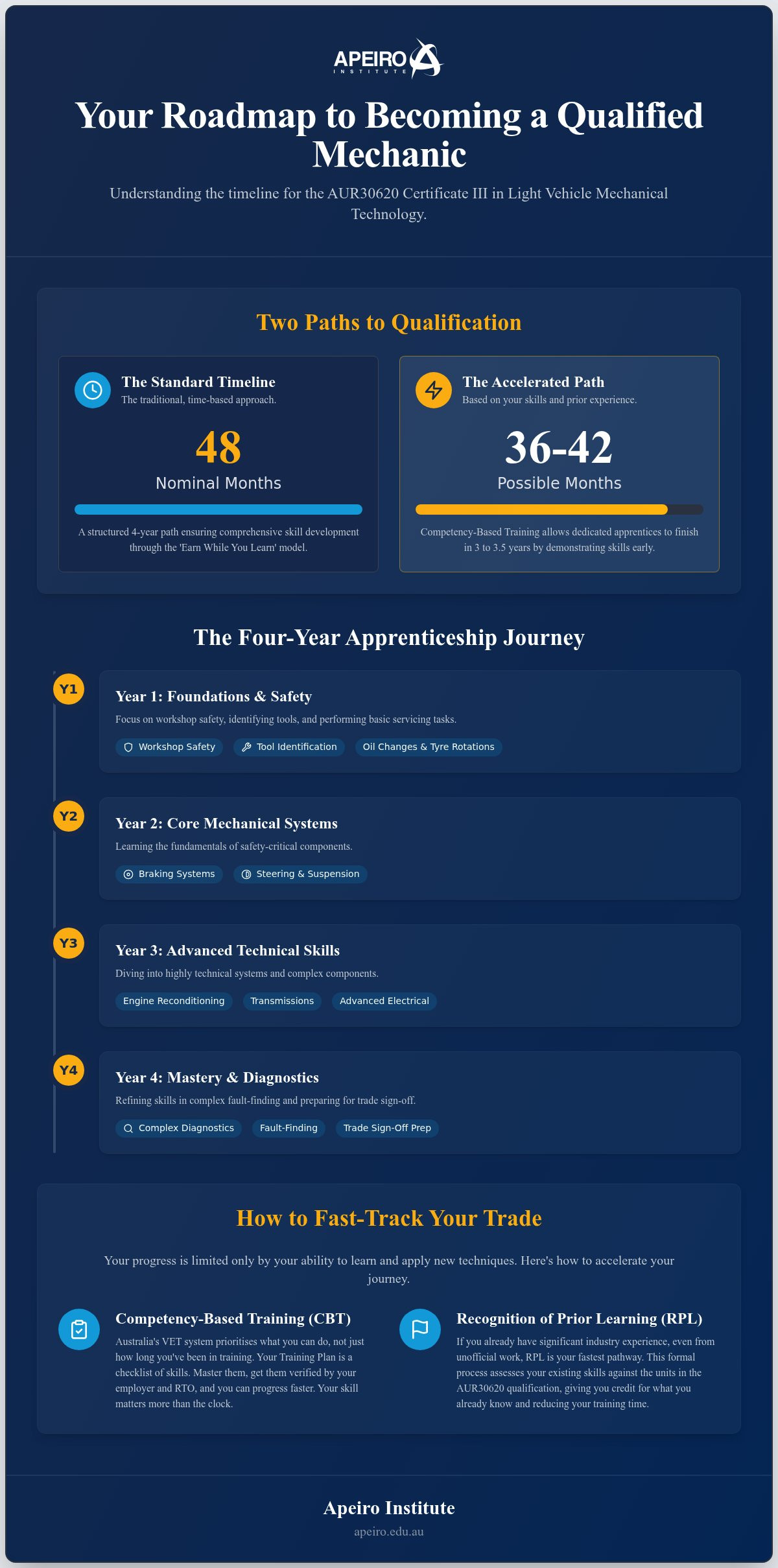
In Australia, the journey to becoming a fully qualified light vehicle mechanic follows a structured and well-regulated path. If you're asking how long does a mechanic apprenticeship take, the standard answer is 48 months of full-time training. This four-year nominal term is designed to give you enough time to master the complex systems found in modern vehicles while working directly on the tools. This period is governed by Vocational Education in Australia standards, ensuring every apprentice receives a consistent level of quality training across the country.
The beauty of this system is the 'Earn While You Learn' model. You aren't just sitting in a classroom; you're a paid employee with a formal training contract. This contract is a legal agreement between you and your employer, overseen by the Australian Apprenticeship Support Network (AASN). It protects your rights, ensures you receive the correct award wages, and guarantees you get the supervised training you need. Throughout these four years, you'll work towards the AUR30620 Certificate III in Light Vehicle Mechanical Technology, which is the essential qualification for the industry.
Year-by-Year Breakdown of Skills
The four-year journey is broken down into logical stages that build your confidence and technical ability incrementally. It's a steady progression from basic tasks to complex engineering solutions.
- Year 1: You'll focus on workshop safety, identifying specialised tools, and performing basic servicing like oil changes and tyre rotations.
- Year 2: The focus shifts to safety-critical components. You'll learn the fundamentals of braking systems, steering, and suspension.
- Year 3: This is where the training gets highly technical. You'll dive into engine reconditioning, transmissions, and advanced electrical systems.
- Year 4: Your final year is about refinement. You'll master complex fault-finding and diagnostics, preparing for your final trade sign-off and independent work.
The Role of the Registered Training Organisation (RTO)
While your employer provides the daily hands-on experience, an RTO like Apeiro Institute delivers the essential 'off-the-job' component. We provide the theoretical knowledge and simulated practical assessments that complement your workshop tasks. This collaboration is vital. We work closely with your employer to track your progress and ensure you're meeting national standards. Choosing a high-quality RTO ensures your training is nationally recognised, giving you the freedom to work anywhere in Australia once you've finished. It's a partnership designed to turn your passion for cars into a lifelong career.
Competency-Based Training: Why Your Skill Level Matters More Than the Clock
While many people assume a trade is a strict four-year sentence, Australia's Vocational Education and Training (VET) system actually prioritises what you can do over how long you have been there. This shift to Competency-Based Training (CBT) means that when you ask how long does a mechanic apprenticeship take, the answer depends largely on your own aptitude and dedication. In the automotive world, competency is defined as the ability to perform a specific task, such as diagnostic testing or brake machining, to industry standards consistently and safely.
Every apprentice has a Training Plan, which acts as a living roadmap for their career. It isn't a rigid schedule; it's a comprehensive checklist of skills. As you master each unit of the AUR30620 qualification, your employer and RTO verify your skills. Hitting these milestones early doesn't just build your confidence. It creates a documented case for an early sign-off. This system ensures that your progression is limited only by your ability to learn and apply new techniques on the workshop floor.
Accelerating Your Progression
If you're quick on the tools, you don't have to wait for the calendar to flip to the next year. By working closely with your supervisor, you can proactively demonstrate your skills as you master them. Previous experience, even if it was unofficial work in a family garage, can significantly impact your training timeline. Dedicated apprentices who show initiative often find they can complete their requirements in 3 to 3.5 years. This flexibility is a core feature of the modern system, as detailed on the Official Australian Apprenticeships Portal.
The Sign-Off Process
Completion is a collaborative milestone. It requires a tripartite agreement, which means you, your employer, and your RTO must all agree that you have met every requirement of the AUR30620 qualification. Once the final assessment is complete and the paperwork is processed, you are officially signed off. This is the pivotal moment you transition from apprentice wages to full tradesperson rates, which can nearly double your take-home pay. If you already have substantial industry experience, you might want to explore our Trade Pathways for Experienced Workers to see how your existing skills can be formally recognised even faster.
Factors That Influence Your Apprenticeship Duration
While the nominal 48-month term is the standard, several variables can either stretch or shorten your path. When people ask how long does a mechanic apprenticeship take, they often forget that the type of workshop they choose plays a massive role. Working in a high-volume dealership might give you rapid-fire experience with specific brands. Conversely, an independent workshop exposes you to a vast variety of makes and models. Both pathways adhere to Automotive Industry Standards, but the breadth of work can influence how quickly you feel confident across all units of your qualification.
Government incentives also play a part. Certain funding models often require apprentices to maintain a specific pace of progression to stay eligible for support. If you're accessing the Australian Apprenticeship Support Loan, staying on track with your training plan ensures you remain eligible for the full range of financial benefits. It's about balancing your daily workload with the formal requirements of your training contract to ensure you're always moving forward.
Part-Time and School-Based Options
Flexible working arrangements are increasingly common in the modern trade. If you choose a part-time apprenticeship, your duration will naturally extend, sometimes taking up to six years to complete. This is a popular choice for those balancing family or other commitments. Alternatively, School-Based Apprenticeships and Traineeships (SBATs) allow students to start their career in Year 11 or 12. By the time you finish secondary school, you could already be entering the second year of your trade. This gives you a massive head start on your peers.
Previous Qualifications and Credits
If you've already spent time in a workshop or completed a pre-apprenticeship, you aren't starting from scratch. Credit Transfer allows you to bypass units you've already completed in a Certificate II in Automotive, directly reducing your classroom time. This is distinct from Recognition of Prior Learning (RPL), which focuses on your hands-on skills rather than previous certificates. Choosing an experienced RTO like Apeiro Institute is vital here. We ensure your Certificate III in Light Vehicle Mechanical Technology training plan accounts for every bit of your previous experience. You won't have to repeat work you already know.
Fast-Tracking Your Trade: RPL and Pathways for Experienced Workers
For many skilled individuals who have spent years under a bonnet, the thought of entering a four-year entry-level programme is frustrating. If you're already an experienced hand, asking how long does a mechanic apprenticeship take might lead to a surprising answer. Through the Trade Pathways for Experienced Workers (TPEW) model, you can bypass the traditional timeline entirely. Recognition of Prior Learning (RPL) is a formal process that turns your existing "on-the-tools" experience into a nationally recognised qualification.
Instead of the standard 48-month commitment, an RPL-based qualification typically takes between three to six months. This pathway is designed for local mechanics who never finished their papers and international professionals looking to align their skills with Australian standards. To qualify, you generally need to demonstrate at least three to four years of full-time experience in the trade. It is a practical solution for those who have the skills but lack the formal certificate to prove it.
The RPL Assessment Process
The process is designed to be practical rather than academic. You'll start by gathering a portfolio of evidence that proves your competence. This includes photos and videos of you performing specific tasks, references from previous employers, and detailed work logs. A qualified assessor then conducts a practical observation to see your skills in action. If the assessment shows you're missing a few specific units of competency, we help you bridge those gaps with targeted training. This ensures you meet the full requirements of the AUR30620 qualification without repeating what you already master.
Benefits for International Professionals
Australia's automotive sector relies heavily on global talent, but overseas qualifications aren't always directly equivalent. Mapping your international experience to the Australian Certificate III is a vital step for your career. Obtaining an RPL Certificate is often a requirement for specific visa subclasses and is essential for obtaining a motor mechanic's licence in most Australian states. Apeiro Institute specialises in supporting students from diverse backgrounds, providing a clear bridge between your past career and your future in the Australian workforce.
Start your Trade Pathways for Experienced Workers assessment today
Launching Your Automotive Career with Apeiro Institute
Choosing the right training partner is just as important as choosing the trade itself. At Apeiro Institute, we don't just provide a certificate; we act as a mentor throughout your entire professional journey. We understand that the question of how long does a mechanic apprenticeship take is often tied to your desire to start earning a full tradesperson's wage as soon as possible. Our delivery of the AUR30620 Certificate III in Light Vehicle Mechanical Technology is designed with this efficiency in mind. We focus on providing high-quality, industry-aligned training that respects your time and your career goals.
Our institute supports a diverse range of learners, from local school leavers to international professionals seeking Australian recognition. For those with significant experience, we provide a streamlined Trade Pathways for Experienced Workers programme. We take the stress out of the administrative side of an apprenticeship by helping you navigate training contracts and employer requirements. This student-centered support ensures you can focus entirely on mastering the mechanical skills that will define your future career.
Flexible Learning Environments
Success in the automotive trade requires a balance between hands-on workshop experience and structured theoretical knowledge. We organise our training to complement your workshop commitments, using structured blocks that minimise disruption to your employer. You'll have access to expert trainers who are deeply embedded in the current Australian automotive landscape. Our state-of-the-art facilities are designed to simulate real-world mechanical challenges. This environment allows you to practice complex diagnostics and repairs on modern systems before you ever have to perform them on a customer's vehicle.
Next Steps for Your Trade Qualification
Taking the first step is simple. We recommend booking a free assessment of your current skills and experience. This allows our team to identify any potential credit transfers or RPL opportunities that could shorten your training duration. We can also help you understand your eligibility for various government-funded training options, which can significantly reduce your out-of-pocket costs. Our goal is to find the specific training pathway that fits your life and gets you qualified as quickly as your skills allow.
Contact Apeiro Institute today to discuss your mechanic apprenticeship pathway!
Drive Your Future in the Automotive Trade
Navigating your career path becomes much simpler once you understand that the answer to how long does a mechanic apprenticeship take is largely in your hands. While the standard 48-month term provides a solid foundation for newcomers, the Australian competency-based system rewards those who master skills quickly. Whether you're starting fresh from school or looking to have years of experience recognised through RPL, there's a pathway designed to get you qualified and onto a tradesperson's wage as efficiently as possible.
Apeiro Institute (RTO 45394) is here to support you with nationally recognised training, industry-expert trainers, and modern workshop facilities. We specialise in Trade Pathways for Experienced Workers, ensuring that your existing knowledge isn't wasted. You're not just a student in a classroom; you're a future professional in a high-demand industry. Taking that first step toward your trade papers is a decision that secures your professional future and opens doors across the country.
Start Your Journey as a Qualified Mechanic with Apeiro Institute
Your passion for vehicles is the engine that will drive your success. We look forward to helping you reach your professional goals and welcoming you into our community of skilled tradespeople.
Frequently Asked Questions
Can I finish my mechanic apprenticeship in 3 years?
Yes, you can complete your training in three years if you demonstrate competency at an accelerated pace. Since the Australian system is competency-based, your progression depends on how quickly you master specific tasks rather than just the time spent on the clock. If your employer and RTO agree you've met all industry standards, you can receive an early sign-off. This flexibility answers the common query about how long does a mechanic apprenticeship take for dedicated learners.
What is the difference between a light vehicle and heavy vehicle apprenticeship?
A light vehicle apprenticeship focuses on passenger cars, SUVs, and small vans, typically working towards the AUR30620 qualification. In contrast, a heavy vehicle apprenticeship involves working on trucks, buses, and large agricultural machinery. While the technical focus differs, both paths generally share a four-year nominal duration. Choosing between them depends on whether you prefer the variety of consumer vehicles or the complex systems of heavy industrial transport.
Do I get paid more as I progress through my apprenticeship?
Yes, your pay increases as you move through each year or stage of your training. Most awards, such as the Vehicle Repair, Services and Retail Award, provide for percentage-based increases as you gain more skills. As of July 2026, junior apprentices who have completed Year 12 start at approximately $615.51 per week. These rates rise significantly in your third and fourth years as you take on more responsibility in the workshop.
Can I do a mechanic apprenticeship if I am over 21?
Absolutely, many people start their trade journey as adult apprentices after the age of 21. You'll bring valuable life experience to the workshop, which employers often appreciate. As an adult apprentice, you are entitled to the national adult minimum wage of $26.44 per hour as of 1 July 2026. This higher base rate helps make the transition into a new career more financially viable for mature-age learners.
What happens if I lose my job during my apprenticeship?
If you lose your job, your apprenticeship isn't automatically cancelled; it's usually placed in a suspended state. You'll need to find a new employer willing to take over your training contract to continue your studies. Your RTO and the Australian Apprenticeship Support Network (AASN) can provide guidance during this transition. Any units of competency you've already completed will remain on your record, so you won't have to start from scratch.
Is a mechanic apprenticeship the only way to get a trade certificate?
No, an apprenticeship isn't the only path if you already have significant hands-on experience. The Trade Pathways for Experienced Workers (TPEW) model allows you to use Recognition of Prior Learning (RPL) to gain your certificate. This process assesses your existing skills against national standards. It's a much faster way to get qualified for those who have worked on the tools for years without formal papers.
How do I find a workshop to take me on as an apprentice?
Finding a workshop often involves a mix of direct contact and using official resources. You can approach local mechanics with a resume or check online job boards. Many people ask how long does a mechanic apprenticeship take when they are still looking for a host employer. Registering with a Group Training Organisation (GTO) is another smart move. GTOs employ apprentices and place them in workshops, providing a steady start to your career.
Will my Australian mechanic qualification be recognised overseas?
Australian automotive qualifications are highly respected and often recognised in countries with similar standards, such as New Zealand, the UK, and parts of Europe. While your AUR30620 Certificate III provides a strong global foundation, you should always check the specific licensing requirements of the country where you intend to work. In some cases, you may need to complete a small bridging assessment to align with local regulations or specific vehicle types.

Disclaimer
The information provided on this blog is for general informational and educational purposes only. While every effort is made to ensure the accuracy and reliability of the content, the author makes no representations or warranties of any kind, express or implied, about the completeness, accuracy, suitability, or availability of the information contained on this blog.
The views and opinions expressed in blog posts are those of the individual author and do not necessarily reflect the official policy or position of any organization, company, or employer.
This blog may contain links to external websites or third-party content. These links are provided for convenience only, and the author has no control over and assumes no responsibility for the content, privacy policies, or practices of any third-party sites.
Nothing on this blog constitutes professional advice (legal, financial, medical, or otherwise). Readers are encouraged to seek appropriate professional guidance before making any decisions based on the information provided here.
By using this blog, you acknowledge that any reliance on the information is at your own risk.


