
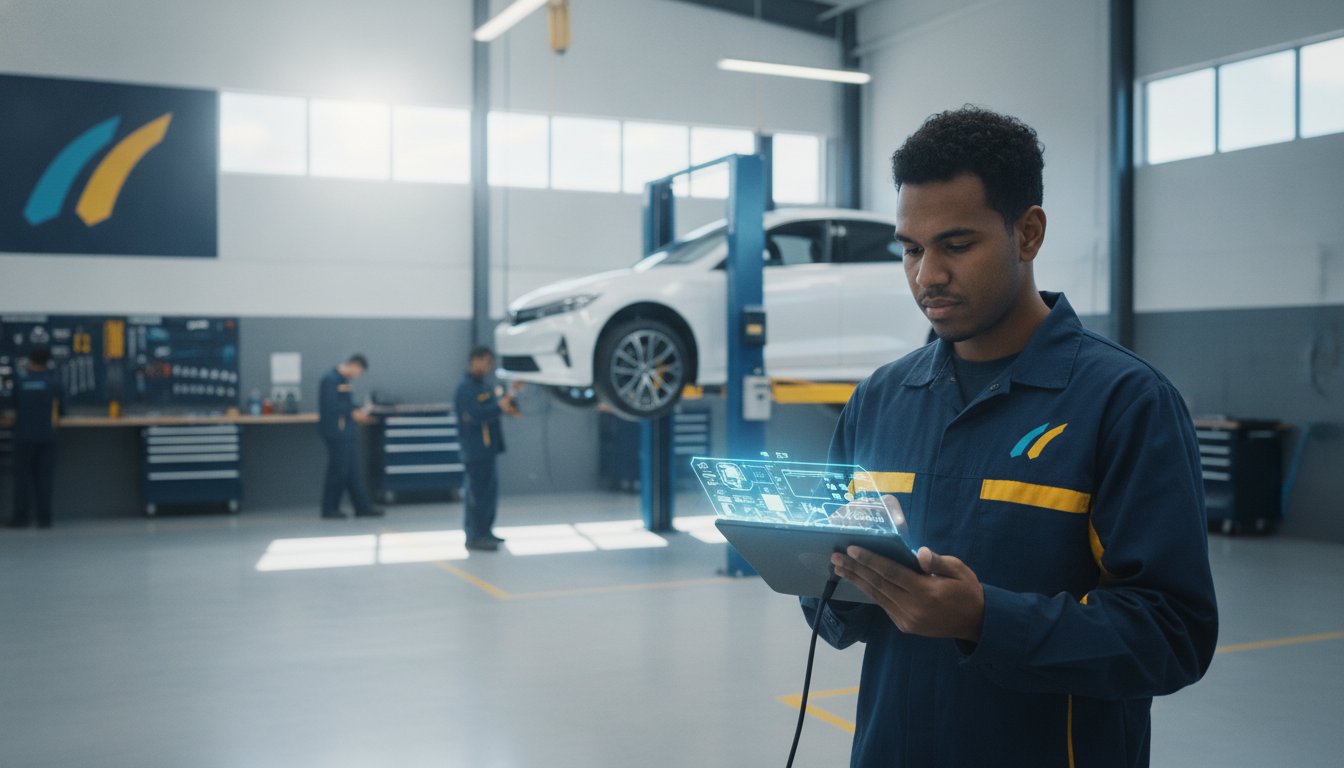
Did you know that nearly one in four new cars hitting Australian roads today is electric? With battery electric vehicles making up 23.3% of new sales as of June 2026, the traditional grease-monkey era has evolved into a sophisticated, high-tech profession. If you're looking to jump into this fast-paced industry, the Certificate III light vehicle mechanical technology is your essential first step. It's completely normal to feel a bit overwhelmed by the shift from mechanical basics to complex vehicle electronics, or to feel confused about whether to start as an apprentice or a student.
We understand that you want a career that offers more than just a job; you're looking for a clear pathway to becoming a "Shed Boss" or even owning your own workshop one day. This guide breaks down the AUR30620 qualification in plain English, covering the core units you'll master and the national recognition you'll earn. You'll gain the confidence to handle modern diagnostics while securing a role in an industry that saw over 140,000 new vehicle sales in a single month this year. Let's explore how you can turn your mechanical interest into a qualified trade.
Key Takeaways
- Understand why the AUR30620 is the industry gold standard for servicing passenger cars and commercial vehicles up to 4.5 tonnes.
- Discover the essential core units you will master to bridge the gap between traditional workshop skills and advanced vehicle diagnostics.
- Learn how the Certificate III light vehicle mechanical technology prepares you for a "white-coat" career in a high-tech, computerised automotive landscape.
- Get a clear five-step roadmap to qualification, whether you are starting an apprenticeship or seeking Recognition of Prior Learning (RPL).
- Explore diverse career pathways that lead from being a service technician to owning your own mobile mechanic business or workshop.
What is the Certificate III in Light Vehicle Mechanical Technology (AUR30620)?
The Certificate III in Light Vehicle Mechanical Technology (AUR30620) is the essential benchmark for anyone wanting to work as a qualified mechanic in Australia. It's often called the "gold standard" because it provides the legal and technical foundation required to service the millions of vehicles on our roads. This qualification specifically focuses on "light vehicles," which include passenger cars, utes, and small commercial vans weighing up to 4.5 tonnes. If you've ever dreamt of working on a Ford Ranger or a BYD Sealion, this is the course that gets you under the bonnet. Beyond just gaining skills, completing this certificate is your primary path to earning a tradesperson's certificate or a contractor licence. These documents are non-negotiable if you want to sign off on logbook services or run your own shop one day.
National Recognition and Industry Standards
When you study a "Nationally Recognised Training" course, your qualification carries weight from Perth to Sydney. It means that if you move states, you don't have to start your training over again. The AUR30620 curriculum is strictly regulated and delivered by a Registered Training Organisation (RTO) to ensure every student meets the same high standards. Because the automotive world moves fast, industry bodies constantly update these units. By 2026, the curriculum has been refined to ensure you aren't just learning about old internal combustion engines, but also the sophisticated safety and environmental systems found in the newest models. This oversight gives employers confidence that you've been trained on equipment and methods that actually matter in a modern workshop.
Light Vehicle vs. Other Automotive Trades
It's easy to get confused between the different branches of the trade. While Heavy Diesel mechanics focus on massive trucks and buses, and Mobile Plant technicians work on construction machinery like excavators, light vehicle specialists deal with the transport most Australians use daily. Choosing to study the Certificate III light vehicle mechanical technology means you are entering a field with the broadest employment opportunities in local suburbs rather than being restricted to remote mines or industrial depots. The "Mechanical Technology" part of the title is key. It signifies that you aren't just a parts replacer. You become a skilled auto mechanic who understands the "how" and "why" behind complex systems. You'll learn to diagnose faults in steering, suspension, and transmissions, giving you a broad skill set that is always in high demand.
Core Skills and Units: What You'll Master in the Workshop
Mastering the trade requires a careful balance between classroom theory and practical, hands-on application. You won't just be reading manuals; you'll be applying that knowledge directly to vehicles in a modern learning centre. The Certificate III light vehicle mechanical technology is structured around core units that ensure you're trade-ready from day one. These units are designed to build your confidence, starting with workshop safety and environmental best practices. In 2026, sustainability is a major focus. You'll learn how to handle fluids and waste responsibly, reflecting the industry's shift toward greener operations. You can find the full list of these requirements in the official qualification details.
As you progress, you'll start documenting your work in a logbook or portfolio of evidence. This isn't just paperwork; it's a vital record of your growth. It proves to assessors and future employers that you've successfully performed specific tasks on a variety of makes and models. If you're eager to see which specific skills you'll be ticking off, you can explore our Certificate III in Light Vehicle Mechanical Technology course overview for a detailed breakdown.
Internal Combustion Engines and Drivelines
The heart of the course involves tearing down and reassembling internal combustion engines. You'll gain detailed guidance on cooling and lubrication systems, ensuring you understand how to keep an engine running at peak performance. Beyond the block, you'll master transmissions, clutches, and final drive assemblies. A driveline is the group of components that deliver power from the engine to the wheels. Understanding how these parts interact is essential for diagnosing complex vibrations or power delivery issues.
Steering, Suspension, and Braking Systems
You'll spend significant time mastering wheel alignments and shock absorber replacements. While traditional hydraulic brake servicing remains a core skill, the curriculum now highlights the transition to electronic power steering and advanced safety systems. You'll learn how ABS and stability control systems function to keep drivers safe on Australian roads. It's a blend of old-school spanner work and modern system calibration.
Electrical Systems and Battery Technology
Electrical work is often considered a "dark art," but you'll learn to navigate circuits with ease. You'll study starting and charging systems while getting comfortable with battery management. Even before you move into specialised EV training, you'll learn the basics of high-voltage safety. You'll become proficient with multi-meters and learn to read basic oscilloscope patterns. These tools are the "stethoscopes" of the modern mechanic, allowing you to see what's happening inside a vehicle's computerised brain.
The Modern Mechanic: Beyond Spanners and Oil Changes
The image of a mechanic covered in grease from head to toe is rapidly becoming a thing of the past. While you will certainly still get your hands dirty, the 2026 technician is more of a high-tech diagnostic specialist. It is now a "white-coat" profession where clean labs and digital tablets are just as common as oily rags. Modern vehicle models are packed with computerised systems that require a sharp mind and a methodical approach. When you enrol in the Certificate III light vehicle mechanical technology, you are preparing for this digital revolution. You aren't just learning to fix cars; you are learning to manage complex mobile computers.
Critical thinking is now your most valuable tool in the workshop. Physical strength used to be a prerequisite for the trade, but today, your ability to trace a fault through a complex wiring diagram is what truly counts. You aren't just replacing parts based on a hunch. You are solving intricate puzzles using data and logic. This shift also extends to how you interact with clients. Modern service centres rely on digital reporting and clear communication to explain technical issues to everyday drivers. Being able to translate "computer-speak" into helpful advice for a customer is a core part of the job.
Advanced Diagnostic Scan Tools
Understanding the digital heartbeat of a car is essential. Scan tools are now the primary way you communicate with a vehicle's ECU (Engine Control Unit). During your training, you will explore Vehicle Communication Systems and Body Control units, which manage everything from power windows to advanced braking sensors. A mechanic in 2026 must be as comfortable with a laptop as they are with a spanner. If you can't navigate the software, you can't service the hardware. This technical literacy is a major focus of the AUR30620 curriculum.
Introduction to Hybrid and Electric Vehicle (EV) Awareness
While this certificate focuses on light vehicles, it now includes foundational awareness of hybrid and EV systems. With battery electric vehicles making up 23.3% of new sales in June 2026, you simply cannot ignore the electric elephant in the room. You will learn the vital safety protocols required when working around high-voltage components to ensure the workshop remains a safe environment. This basic knowledge serves as the perfect stepping stone if you eventually decide to pursue the Certificate IV in Automotive Mechanical Diagnosis to become a master technician. Starting with a solid foundation in the Certificate III light vehicle mechanical technology ensures you are ready for whatever rolls into your bay next.
Pathways to Qualification: Apprentices, International Students, and RPL
Starting your journey toward becoming a qualified mechanic shouldn't feel like a maze. We follow a clear five-step roadmap to get you trade-ready: Enrolment, Training, Workplace Experience, Assessment, and Certification. Whether you are a "school-based" apprentice starting while still in high school or an "adult" apprentice looking for a fresh start, the Certificate III light vehicle mechanical technology provides a structured yet flexible path. Modern Registered Training Organisations (RTOs) provide the flexibility to fit your life. One of the biggest concerns we hear is the time commitment. You might think, "I don't want to spend four years if I already know the basics." The good news is that your training can be tailored to your existing knowledge, ensuring you aren't wasting time on things you've already mastered.
Recognition of Prior Learning (RPL) and TPEW
If you've spent years under a bonnet but lack the formal "paper," you don't have to start from scratch. Experienced workers can use Trade Pathways for Experienced Workers (TPEW) to fast-track their Certificate III light vehicle mechanical technology qualification. RPL is a process that assesses your existing skills against national standards to grant credit. To succeed, you'll need to gather evidence of your expertise. This usually includes detailed work photos, references from previous employers, and practical "challenge" tests in a workshop environment. It's a respectful way to acknowledge your hard-earned skills while filling any remaining gaps in your technical knowledge.
The International Student Pathway (CRICOS)
Australia is a premier destination for automotive training, attracting learners from all over the globe. If you are an international student, it's vital to choose a CRICOS vocational course to ensure you meet your visa requirements. The Certificate III in Light Vehicle Mechanical Technology is particularly popular because of its practical, hands-on nature. You'll gain world-class skills that are highly regarded both in Australia and internationally. This pathway provides the perfect balance of structured learning and real-world application, helping you build a global career in the automotive sector.
Ready to turn your experience into a formal trade? Explore how our Trade Pathways for Experienced Workers can help you get qualified faster.
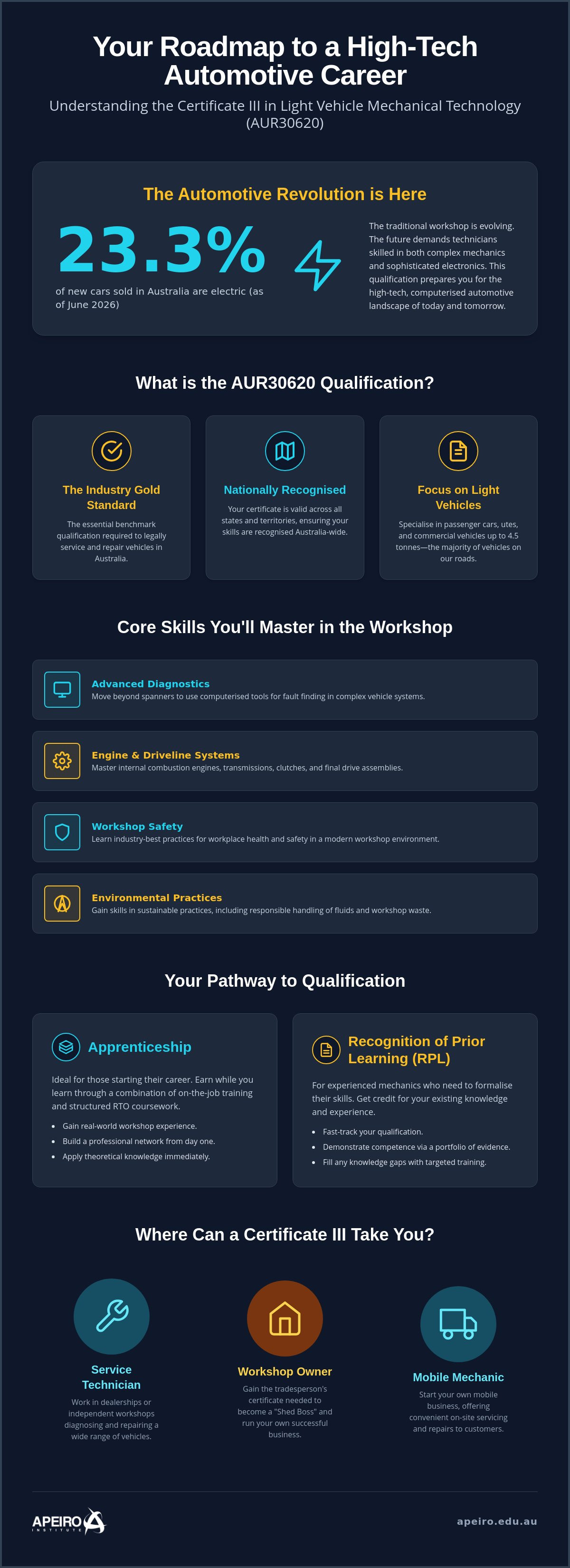
Career Outcomes: Where Can a Cert III Take You?
In 2026, the Australian automotive industry is booming. With record-breaking vehicle sales reaching over 140,000 in June alone, the demand for qualified technicians has never been more urgent. Completing your Certificate III light vehicle mechanical technology doesn't just give you a job; it gives you a career with multiple pathways. You'll likely start your journey as a Service Technician, but the skills you've mastered allow you to quickly pivot into specialised roles like Diagnostic Specialist or Workshop Foreman. It's a field where your expertise is directly linked to your value in the workshop.
Many graduates also find that this trade is the perfect launchpad for business ownership. Because the Cert III is the legal requirement for obtaining a tradesperson's certificate, it's your first step toward getting a contractor licence. Whether you dream of running a fleet of mobile mechanic vans or opening a local workshop, this qualification provides the technical and legal foundation you need. It's incredibly empowering to know that your skills can build a business that serves your local community while giving you complete professional independence.
Specialisation and Career Progression
You don't have to remain a "General Practitioner" for your entire career. Many technicians choose to specialise in niche areas like performance tuning, advanced diesel systems, or even motorsport engineering. If you enjoy the organisational side of the trade, you can transition into service advising or workshop management roles. For those who want to reach the very top of the profession, this course is the essential prerequisite for the Diploma of Automotive Technology. This master technician pathway is where you truly master the complex electronic systems of the future.
Earning Potential and Job Security
One of the greatest benefits of the automotive trade is its "essential service" nature. Rain or shine, people need their vehicles to remain safe and reliable for work and family life. This creates a level of job security that many other industries simply lack. Industry trends show consistent salary growth for technicians who hold a Certificate III light vehicle mechanical technology, especially as vehicles become more complex and require higher levels of skill to maintain. Plus, your trade is portable. You can find high-quality work in any corner of Australia, from the outback to the city centre, knowing your skills are in high demand everywhere you go.
Drive Your Future Forward in the Automotive Trade
The Australian automotive sector is transforming rapidly. From the rise of electric vehicles to the sophisticated diagnostic software used in every modern service centre, the role of a mechanic has never been more rewarding. Earning your Certificate III light vehicle mechanical technology is the essential step to securing a portable, high-demand trade that offers genuine job security. You now have a clear roadmap from the workshop floor to potential business ownership or master technician status.
Apeiro Institute (RTO 45394) provides the supportive environment you need to master these skills. Our industry-expert trainers bring real-world workshop experience to the classroom, ensuring you're ready for the 2026 market. With flexible pathways like RPL and TPEW, we make sure your prior experience is valued and your training is efficient. Your future in the automotive industry is waiting for you. Start your automotive journey with Apeiro Institute's AUR30620 course today! We're ready to partner with you on this rewarding professional path.
Frequently Asked Questions
How long does it take to complete a Certificate III in Light Vehicle Mechanical Technology?
A standard apprenticeship typically takes three to four years to complete. This timeframe allows you to balance on-the-job training with your formal studies at a training centre. If you have prior experience or are a particularly fast learner, some training plans allow for competency-based progression. This means you can finish your qualification sooner if you can demonstrate your skills to the required national standard.
Can I study a mechanic course if I don't have an apprenticeship?
Yes, you can enrol in the Certificate III light vehicle mechanical technology as a non-apprentice student. This is a common pathway for international students or locals who want to gain foundational skills before seeking employment. While you won't have a formal training contract with an employer, you will still spend significant time in a workshop environment to complete the practical assessments required for the course.
What is the difference between AUR30620 and AUR30616?
AUR30620 is the current, nationally recognised qualification code for light vehicle mechanics in Australia. It replaced the older AUR30616 version to better reflect the rapid changes in automotive technology and modern workshop practices. If you are starting your training in 2026, you will be enrolled in the AUR30620 to ensure your skills align with the latest industry standards and vehicle safety requirements.
Do I need to be good at maths to become a mechanic?
You need a solid grasp of practical, everyday mathematics rather than advanced academic theory. Mechanics use maths for tasks like measuring engine tolerances, calculating torque settings, and reading electrical values on a multi-meter. Most training providers offer support to help you master these trade-specific calculations. If you can handle basic addition, subtraction, and decimals, you will find the technical side of the trade quite manageable.
Can I get my mechanic qualification through RPL if I have worked in a garage for years?
Yes, Recognition of Prior Learning (RPL) is a perfect pathway for experienced but uncertified workers to get their trade papers. If you've spent years under the bonnet, you can provide evidence of your expertise to gain credit toward the Certificate III light vehicle mechanical technology. This process involves a review of your work history, references, and a practical assessment to ensure you meet all current national standards.
What tools do I need to buy before starting the course?
Most students aren't required to purchase a full professional toolkit before they begin their studies. Your training organisation will generally provide the specialised tools and diagnostic equipment needed for your workshop sessions. If you are starting an apprenticeship, your employer might suggest a basic list of hand tools, such as spanners and sockets, to get you started. Many apprentices also qualify for government tool loans to help manage these initial costs.
Is the Certificate III in Light Vehicle Mechanical Technology recognised overseas?
Australian trade qualifications are highly regarded internationally because of our rigorous training and assessment standards. While your certificate is a powerful credential, you should be aware that every country has its own specific licensing and registration requirements. If you plan to work in the UK, Canada, or New Zealand, you might need to undergo a brief local skills assessment or complete a few bridging units to meet their specific regulations.
Are there any government subsidies or funded spots available for this course?
There are often various government initiatives available to help reduce the cost of trade training for eligible students. Programs like Smart & Skilled in New South Wales or other state-funded traineeship schemes can provide significant financial support. Because eligibility depends on your location, previous qualifications, and residency status, it is best to speak directly with your training provider to see which current funding options apply to your situation.

Disclaimer
The information provided on this blog is for general informational and educational purposes only. While every effort is made to ensure the accuracy and reliability of the content, the author makes no representations or warranties of any kind, express or implied, about the completeness, accuracy, suitability, or availability of the information contained on this blog.
The views and opinions expressed in blog posts are those of the individual author and do not necessarily reflect the official policy or position of any organization, company, or employer.
This blog may contain links to external websites or third-party content. These links are provided for convenience only, and the author has no control over and assumes no responsibility for the content, privacy policies, or practices of any third-party sites.
Nothing on this blog constitutes professional advice (legal, financial, medical, or otherwise). Readers are encouraged to seek appropriate professional guidance before making any decisions based on the information provided here.
By using this blog, you acknowledge that any reliance on the information is at your own risk.


