
Your dream of becoming a qualified motor mechanic in Australia depends less on your passion for engines and more on your understanding of the strict regulatory framework that governs international study. Choosing the correct CRICOS vocational course automotive pathway is the most critical decision you'll make before you even pack your bags. We know it's daunting to face a mountain of paperwork while worrying if your chosen course will actually lead to a job. It's frustrating when you're unsure which qualification level suits your goals or how to navigate the 2026 updates to visa fees and entry requirements.
We're here to clear the air and help you move forward with total confidence. This guide explains how to launch your career through registered training, moving from foundational skills in a Certificate III to the high-level expertise of an advanced diagnostic diploma. You'll get a clear look at the 2026 study pathways, an honest breakdown of mandatory costs like the $2,000 subclass 500 visa fee, and a roadmap to the practical career outcomes waiting for you after graduation. Let's map out your journey to the workshop floor.
- Understand why choosing a CRICOS vocational course automotive is mandatory for your Student visa and how it ensures your training meets high Australian standards.
- Map out your career progression from foundational light vehicle mechanics to high-level diagnostic technology and workshop management.
- See how modern training moves you beyond basic repairs into the world of electronic systems and computerised scanning tools.
- Check the enrolment steps you'll need to take, including English language proficiency and academic history.
- Learn how to turn your existing workshop experience into a formal Australian qualification through Recognition of Prior Learning to save time and money.
Why Study a CRICOS Vocational Course in Automotive Technology?
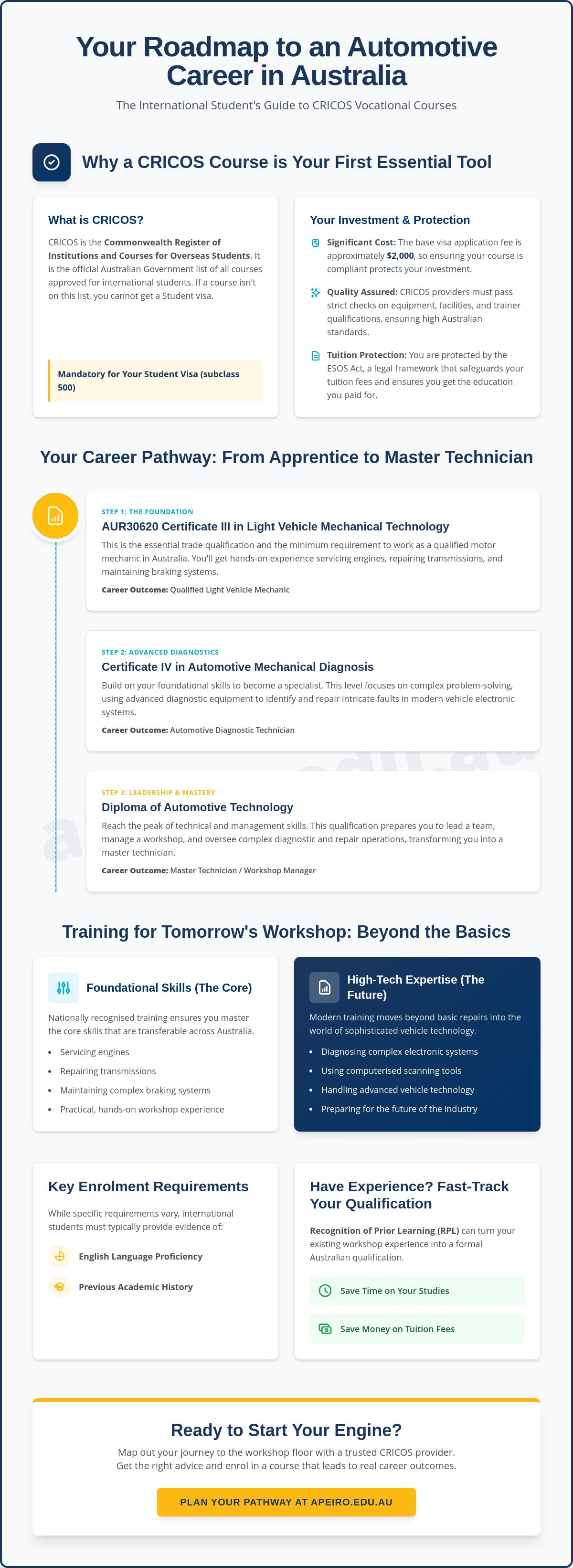
Choosing to study in Australia is a big move. If you're looking at the automotive trade, you'll quickly see the term CRICOS everywhere. It stands for the Commonwealth Register of Institutions and Courses for Overseas Students. It's a list of every course and school that the Australian Government has approved to teach international students. If a course isn't on this list, you won't be able to get your Student visa (subclass 500). With the base visa application fee now at $2,000 as of July 2025, ensuring your course is compliant is the first step in protecting your investment.
Starting a CRICOS vocational course automotive program is about more than just legal paperwork. It's your ticket into a high-demand industry. In 2026, Australia continues to face a significant shortage of qualified technicians. As vehicles become more complex, the need for people who can handle both a spanner and a diagnostic scanner has never been higher. By training here, you're entering a system with a massive global reputation for excellence.
The Benefits of Nationally Recognised Training
When you study a course like the AUR30620 Certificate III in Light Vehicle Mechanical Technology, you're gaining a qualification that is recognised across the country. This is part of the National Training System, which ensures that a mechanic in Perth has the same core skills as one in Sydney. These skills are highly transferable. If you eventually decide to take your expertise to another country, an Australian trade qualification carries serious weight. The focus is always on practical, hands-on experience. You'll spend your time in workshops, learning how engines actually work rather than just reading about them in a textbook.
CRICOS vs. Non-CRICOS: What You Need to Know
You might find cheaper courses that aren't CRICOS-registered, but they won't help you stay in Australia. A CRICOS vocational course automotive provider must pass strict quality checks to ensure they have the right equipment and qualified trainers. You're also protected by the ESOS Act. This law looks after international students by protecting your tuition fees and ensuring you receive the education you paid for. It's a safety net that domestic students don't always have.
Before you sign anything, use this quick checklist to verify your provider:
- Look for the CRICOS Provider Code, which is usually at the bottom of the school's website.
- Search the official CRICOS register to ensure the specific course is active.
- Confirm the specific campus location is registered for that course.
- Check that the course duration matches your visa requirements.
The Automotive Qualification Pathway: Cert III to Diploma
Understanding the Australian vocational system can feel like trying to read a complex wiring diagram without a manual. Many international students arrive thinking they only need one course to become a mechanic; however, the reality is a structured ladder of learning. Each level of a CRICOS vocational course automotive pathway is designed to build your expertise incrementally. This progression transforms you from a student learning the basics into a highly skilled "Master Technician" capable of leading a workshop. By choosing "stackable" qualifications, you can often save both time and tuition costs by receiving credit for units you've already completed.
It's vital to choose a pathway that aligns with where you want to be in five years. Do you want to be on the tools every day, or are you aiming for a management role? Your journey starts with the fundamentals and moves toward sophisticated electronic systems. This structured approach is overseen by the Automotive Skills Alliance, ensuring that every step you take meets current industry requirements.
AUR30620 Certificate III in Light Vehicle Mechanical Technology
This is the essential "trade" qualification. It's the foundation of your career and the minimum requirement to work as a qualified motor mechanic in Australia. In this course, you'll get your hands dirty with the core mechanics of modern cars. You'll learn how to service engines, repair transmissions, and maintain complex braking systems. If you're ready to pick up your first set of tools, exploring a Certificate III in Light Vehicle Mechanical Technology is the best place to start your professional journey.
Advancing to Certificate IV and Diploma Levels
Once you've mastered the basics, the focus shifts from manual labour to advanced intelligence. The AUR40216 Certificate IV in Automotive Mechanical Diagnosis is where you learn complex fault-finding. You'll move beyond simple parts replacement and start using logic to solve difficult engine management and electronic issues. This is the "Master Technician" level that top-tier workshops look for.
For those who want to lead, the Diploma of Automotive Technology provides the bridge to management. This level covers the business side of the trade, including workshop leadership and high-level technical analysis. It prepares you to run a team or manage a service centre, shifting your daily focus from the workshop floor to the supervisor's office. This CRICOS vocational course automotive progression ensures you have a long-term career, not just a job.
Essential Skills and Technologies in Modern Automotive Training
Gone are the days when a mechanic's job was defined solely by oil changes and heavy lifting. In 2026, the industry has shifted significantly. You're now training to be a diagnostic technician. This role requires a sophisticated blend of mechanical grit and digital savvy. A CRICOS vocational course automotive program reflects this change. It moves beyond the "grease monkey" stereotype to focus on the high-tech brains of the vehicle. You'll spend just as much time with a laptop as you do with a socket set.
Safety is the backbone of every Australian workshop. You'll learn strict Workplace Health and Safety (WHS) protocols from your very first week. It's not just about wearing steel-capped boots; it's about risk management and environmental responsibility. Additionally, the 2026 curriculum has a growing focus on hybrid and electric vehicle (EV) components. Understanding high-voltage systems is no longer an optional extra. It's a core requirement for the next generation of technicians. You can verify which providers offer these updated modules by searching the Official CRICOS Course Register.
Diagnostic Expertise and Fault Finding
Mechanical diagnosis is currently the most sought-after skill in the Australian automotive sector. Modern cars are essentially computers on wheels. You'll learn to use oscilloscopes and advanced scan tools to track down intermittent faults that a visual check would never find. Interpreting complex technical wiring diagrams becomes second nature. It's like solving a high-stakes puzzle where the pieces are electronic signals and sensor data. Mastering this logic ensures you're a valuable asset to any modern service centre.
Practical Workshop Experience
A typical day in your training isn't spent just sitting in a classroom. You'll find a healthy balance between theory and "under-the-bonnet" practice. You might spend the morning learning about fuel injection logic and the afternoon actually testing it on a live engine. Training involves working on a variety of vehicle makes and models. This diversity is crucial. It ensures you don't just learn one brand, but understand the universal principles of automotive engineering. Hands-on training in a Certificate III in Light Vehicle Mechanical Technology workshop prepares you for the fast pace of a real-world workshop.
Entry Requirements and Enrolment for International Students
Enrolling in a CRICOS vocational course automotive programme is a methodical process that requires careful attention to detail. It isn't just about showing you can fix a car; it's about proving you have the academic foundation and language skills to succeed in a high-pressure technical environment. The Australian Government and training providers use a structured five-step process to move you from an applicant to a student. This begins with meeting English proficiency standards and ends with securing your Student visa (subclass 500) after paying the $2,000 application fee and organising your Overseas Student Health Cover (OSHC).
The journey to the workshop floor follows this logical path:
- Step 1: Meet the English language proficiency requirements (typically IELTS or equivalent).
- Step 2: Provide evidence of successful completion of Year 10 or 12 (or equivalent academic history).
- Step 3: Submit a formal application to a CRICOS-registered provider like Apeiro Institute.
- Step 4: Receive a Letter of Offer and a Confirmation of Enrolment (CoE) once fees are paid.
- Step 5: Finalise your student visa application with your CoE and OSHC documentation.
English Language Requirements
Technical manuals and workshop safety instructions in Australia are precise and complex. A solid grasp of English is vital for your safety and the safety of your colleagues. Most providers accept scores from IELTS, PTE Academic, or TOEFL iBT. If you don't meet the requirements initially, don't worry. Many students choose an ELICOS pathway. This allows you to study English in Australia first, building your confidence before you pick up a spanner in your CRICOS vocational course automotive modules.
Academic and Age Prerequisites
To enrol in trade-based vocational courses, you generally need to be at least 18 years old. You'll also need to provide transcripts showing you've completed the equivalent of Australian Year 10 or 12. A major focus for 2026 is the "Genuine Student" (GS) requirement. This means you must demonstrate that your primary reason for coming to Australia is to gain skills and that you have a clear understanding of your career pathway. Interestingly, you don't need prior mechanical experience to start a Certificate III. We welcome beginners who are eager to learn the trade from the ground up.
Ready to take the first step toward your mechanical career? You can start your journey today by viewing the entry criteria for the AUR30620 Certificate III in Light Vehicle Mechanical Technology.
Trade Pathways and Recognition of Prior Learning (RPL)
If you've spent years in a workshop in your home country, starting a CRICOS vocational course automotive programme from the absolute beginning might feel like a step backward. You don't have to repeat what you already know. Recognition of Prior Learning (RPL) is a formal process that acknowledges your existing expertise and turns it into an official Australian qualification. It's a practical, student-centred way to save time and reduce your overall tuition costs. By choosing the Trade Pathways for Experienced Workers (TPEW) programme, you can fast-track your certification and focus on the skills you actually need to master for the Australian market.
Many international students find that RPL is the most efficient bridge between their past career and their future in Australia. Instead of spending months in a classroom learning things you've done for a decade, you can have those skills verified and credited. This doesn't just save money; it also allows you to use your qualification as a stepping stone to the advanced diagnostic diplomas we explored earlier. It's about respecting the hard work you've already put into your trade while ensuring you meet the high standards required by Australian employers.
How RPL Works for Automotive Professionals
The RPL process is based on evidence rather than just exams. You won't be expected to sit through hours of theory on topics you've mastered. Instead, you'll gather proof of your competence from your daily work life. This typically includes photos and videos of you performing specific repairs, detailed work logs, and references from previous employers or supervisors. An expert assessor then reviews this portfolio, mapping your experience against the specific units of competency in the Australian training system. For a detailed breakdown of the evidence you'll need, our Trade Pathways for Experienced Workers Australia guide provides a clear roadmap for preparation.
Fast-Tracking Your Career
RPL helps you enter the local workforce much sooner than a traditional study path. If your evidence covers the majority of a course, you'll only need to complete what we call "gap training" for the remaining units. This is often necessary for specific Australian safety regulations or newer technologies like the hybrid and EV systems that are becoming standard in 2026. This hybrid approach ensures you're fully compliant with local laws without wasting time on redundant study. We strongly encourage you to formalise your trade experience to significantly boost your employability. It shows Australian workshops that you're not just a student, but a seasoned professional with the paperwork to prove your value.
Your Future in the Australian Automotive Industry Starts Here
You now have a clear roadmap for your mechanical career in Australia. From understanding the legal necessity of CRICOS registration to exploring the advanced diagnostic skills required in 2026, the path forward is structured and attainable. Whether you're starting from scratch or using your previous experience to fast-track your studies through RPL, the goal remains the same: becoming a highly skilled technician in a high-demand market.
Selecting a CRICOS vocational course automotive program is about joining a professional community that values your growth. At Apeiro Institute (CRICOS Provider 03703M; RTO 45394), we provide Nationally Recognised Training to a diverse student body representing over 38 nationalities. We're dedicated to helping you bridge the gap between your current skills and your professional goals on the workshop floor.
Ready to get started? Start your Australian automotive career journey with Apeiro Institute today. We're excited to help you turn your passion for engines into a successful, long-term career.
Frequently Asked Questions
Can I work while studying a CRICOS automotive course in Australia?
Yes, you can work while you're enrolled in your studies. International students on a Subclass 500 visa generally have work rights for up to 40 hours per fortnight while your course is in session. During scheduled course breaks, you can work unlimited hours. This is a great way to gain experience in a local workshop while you complete your CRICOS vocational course automotive training and build your professional network.
What is the difference between a Certificate III and a Certificate IV in Automotive?
The main difference lies in the level of technical complexity and your future career role. A Certificate III is the foundational trade qualification required to work as a qualified motor mechanic. It focuses on essential servicing and repairs. In contrast, a Certificate IV moves into advanced diagnostics and complex fault-finding. It's designed for those who want to become master technicians or move into specialised diagnostic and logic-based roles.
How long does it take to complete a vocational automotive course?
Duration depends on the specific qualification or the course package you choose. A Certificate III typically takes about one year of full-time study to complete. If you choose to package your qualifications, such as combining a Certificate III, Certificate IV, and a Diploma, the total duration can extend to two years or more. This structured timeline ensures you have enough time to master both theory and practical workshop skills.
Do I need to find my own workshop for the practical components?
No, you don't need to find your own workshop for your core training. CRICOS-registered providers must have fully equipped, on-campus workshop facilities that meet strict industry standards. You'll perform your practical tasks and assessments using the tools and vehicles provided by the institute. However, finding part-time work in a local garage can be a fantastic way to supplement your learning and build your confidence in a real-world environment.
Is the AUR30620 Certificate III recognised in other countries?
Yes, Australian automotive qualifications are highly regarded worldwide. The AUR30620 Certificate III is part of a nationally standardised system that meets rigorous global industry benchmarks. While specific licensing requirements vary between different countries, having an Australian trade certificate on your resume is a significant advantage. It demonstrates that you've been trained to a high technical and safety standard in a modern, well-regulated training environment.
Are there scholarships available for international automotive students?
Scholarship availability varies between different training providers and sometimes depends on your home country. While large-scale government scholarships for vocational trades are less common than for university degrees, some institutes offer merit-based or region-specific tuition assistance. It's best to check directly with your chosen provider's admissions team to see what support options might be available for your specific intake and circumstances.
What happens if I have already worked as a mechanic in my home country?
You can use your existing experience to fast-track your qualification through Recognition of Prior Learning (RPL). If you've worked as a mechanic before, you won't need to repeat units you're already competent in. This process involves providing evidence of your skills, such as work logs, photos, and references. It's a smart way to complete your CRICOS vocational course automotive requirements sooner and at a lower overall cost.
What are the career prospects for automotive graduates in Australia for 2026?
Career prospects remain very strong due to a persistent nationwide shortage of skilled technicians. In 2026, the industry is specifically looking for graduates who understand electronic management systems and hybrid technologies. You could find work as a light vehicle mechanic, a diagnostic specialist, or even a workshop manager. The shift toward more complex vehicles means your skills will be in high demand for many years to come.
Disclaimer
The information provided on this blog is for general informational and educational purposes only. While every effort is made to ensure the accuracy and reliability of the content, the author makes no representations or warranties of any kind, express or implied, about the completeness, accuracy, suitability, or availability of the information contained on this blog.
The views and opinions expressed in blog posts are those of the individual author and do not necessarily reflect the official policy or position of any organization, company, or employer.
This blog may contain links to external websites or third-party content. These links are provided for convenience only, and the author has no control over and assumes no responsibility for the content, privacy policies, or practices of any third-party sites.
Nothing on this blog constitutes professional advice (legal, financial, medical, or otherwise). Readers are encouraged to seek appropriate professional guidance before making any decisions based on the information provided here.
By using this blog, you acknowledge that any reliance on the information is at your own risk.


