

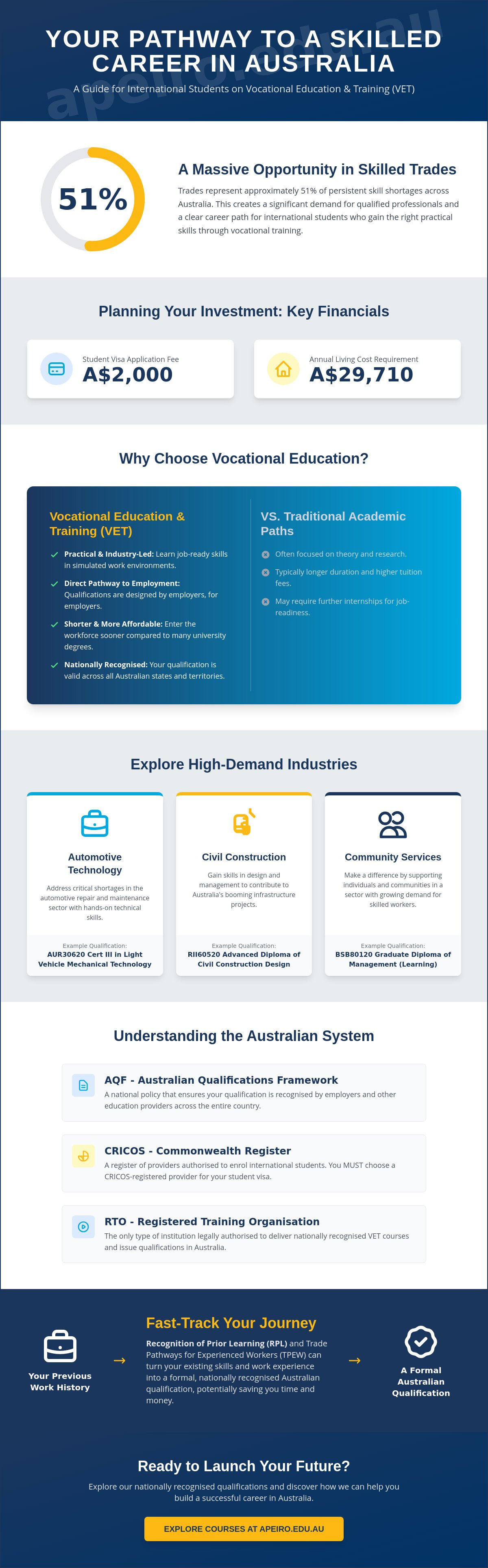
Did you know that trades account for approximately 51% of persistent skill shortages across Australia? This statistic represents a massive opportunity for anyone looking to find the best vocational courses international students Australia offers to build a stable, high-demand career. We understand that the path to studying abroad often feels like a balancing act. Between the A$2,000 student visa application fee and the A$29,710 annual living cost requirement, the financial stakes are high. You're likely wondering if your chosen provider is reputable or if your previous work experience even counts in the local market.
This comprehensive guide is designed to help you confidently select the right trade or business qualification to launch your future. We'll show you how to secure a nationally recognised qualification while gaining the practical skills local employers value. We will explore the 2026 visa regulations, compare tuition costs for popular programs, and explain how Recognition of Prior Learning (RPL) can fast-track your journey toward professional certification. Whether you're interested in automotive technology or community services, we're here to help you map out a clear pathway to success.
Key Takeaways
- Understand how the Australian Qualification Framework (AQF) and CRICOS standards ensure your education is legally recognised and meets student visa requirements.
- Identify the highest-demand industries, including automotive, construction, and community services, where your skills can help address critical local shortages.
- Discover how to choose the best vocational courses international students Australia offers to gain practical, industry-led experience that employers value.
- Learn how Recognition of Prior Learning (RPL) and Trade Pathways for Experienced Workers (TPEW) can turn your previous work history into a formal qualification.
- Navigate the enrolment journey with ease by mastering essential steps like obtaining your Unique Student Identifier (USI) and preparing for orientation.
Understanding VET: Why International Students Choose Vocational Training in Australia
Vocational Education and Training (VET) is a practical, industry-led approach to learning that focuses on giving you the specific skills required for the Australian workforce. Unlike purely academic paths, VET is built directly on the needs of employers. This aligns perfectly with the Australian "Fair Go" culture; a social philosophy where your ability to perform a task effectively is often valued more than a prestigious job title. It's about what you can do on the tools or in the office, not just what you know in theory. This practical focus makes you a more competitive candidate when you start applying for local roles.
Many choose Technical and Further Education (TAFE) or private vocational providers because they offer a more direct route to employment. When comparing options, vocational courses international students Australia provides are typically more affordable and shorter in duration than university degrees. They allow you to enter the workforce sooner while maintaining high educational standards. With over 38 different nationalities represented in the VET sector, you'll join a vibrant, global community of learners focused on achieving tangible professional outcomes.
The Benefits of Practical, Hands-on Learning
Studying in a simulated work environment ensures you're ready for the local labour market from day one. If you're enrolled in a program like the AUR30620 Certificate III in Light Vehicle Mechanical Technology, you'll spend your time in workshops rather than just lecture halls. We focus on competency-based assessments. This means you demonstrate your skills through practical tasks, ensuring you meet the exact standards required by Australian industry. This immediate applicability is vital in high-demand sectors like automotive trades and community services, where technical precision and safety are paramount.
VET as a Pathway to Professional Certification
A vocational qualification is often the first step toward a long-term career and Australian trade licensing. Completing a Certificate III or IV serves as the necessary foundation for various professional registrations across all Australian states and territories. For those looking to move into a leadership position, qualifications like the BSB80120 Graduate Diploma of Business Management (Learning) or the RII60520 Advanced Diploma of Civil Construction Design provide a clear bridge to management. These programs ensure your expertise is recognised nationally, giving you the flexibility to build your career and pursue professional certification anywhere in the country.
Navigating the Australian Qualification Framework (AQF) and CRICOS Standards
When you begin searching for vocational courses international students Australia offers, you will quickly encounter the term "RTO." This stands for Registered Training Organisation. In Australia, only an RTO is legally authorised to deliver nationally recognised training and issue formal qualifications. These organisations are monitored by the Australian Skills Quality Authority (ASQA), which is the national regulator for the vocational sector. ASQA ensures that every provider meets strict standards for training delivery, assessment, and student support. This regulatory oversight means you can trust that the skills you learn are exactly what Australian employers expect on the job.
Understanding the structure of these qualifications is essential for planning your career. The Australian Qualifications Framework (AQF) is the national policy that links all Australian qualifications into one single, easy-to-understand system. It ensures that a qualification earned in one state is recognised across all other states and territories. This consistency allows you to move between different levels of study or different parts of the country with total confidence that your hard work will be recognised by both educators and industry bodies.
Choosing a CRICOS Registered Provider
For international students, there is one more critical layer of protection. You must ensure your chosen course is listed on the Commonwealth Register of Institutions and Courses for Overseas Students (CRICOS). A CRICOS registration is a legal requirement; without it, a provider cannot enrol students on a Subclass 500 visa. This system is governed by the ESOS Act, which provides strong consumer protection for international learners, including the security of your tuition fees. Before you commit, you should always verify the provider's CRICOS number on the official register. If you are ready to start your journey with a compliant and supportive partner, you can view Apeiro Institute's range of CRICOS-registered programs today.
AQF Levels: Which One is Right for You?
The AQF levels help you match your education to your current experience and future goals. Here is how they generally break down:
- Certificate III and IV: These levels focus on entry-level trade skills and technical knowledge. For instance, the AUR30620 Certificate III in Light Vehicle Mechanical Technology is the standard starting point for anyone wanting to work as a qualified mechanic.
- Diplomas and Advanced Diplomas: These qualifications prepare you for technical design or management roles. A Diploma of Civil Construction Design is ideal if you want to move from manual labour into the planning and drafting side of the industry.
- Graduate Diplomas: These are high-level qualifications designed for strategic leadership. A Graduate Diploma of Business Management (Learning) is perfect for experienced professionals looking to oversee large-scale operations or corporate training departments.
High-Demand Industries: From Automotive Trades to Civil Construction Design
Australia is currently facing a significant workforce gap. Trades account for approximately 51% of persistent skill shortages across the country. This is why choosing the right vocational courses international students Australia offers is more than just an education; it's a strategic move into sectors that desperately need your talent. Automotive, construction, and community services are at the forefront of this demand. By selecting a "nationally recognised" course, you ensure your training meets the rigorous standards set by the Australian government and is respected by every employer in the country.
Modern industry in Australia is shifting rapidly towards advanced technology and electronics. This evolution means that even traditional trades now require a high level of digital literacy and technical precision. Whether you are looking to work on the tools or in a design office, the focus remains on practical competency. Employers value your ability to apply your knowledge to real-world problems. This practical approach is what makes Australian vocational graduates so highly regarded both locally and internationally.
Automotive and Engineering Technology
The automotive sector is evolving at a record pace. It often starts with the AUR30620 Certificate III in Light Vehicle Mechanical Technology, which provides the core skills needed for general repair and service. However, modern vehicles require advanced diagnostics. Progressing to the AUR40216 Certificate IV in Automotive Mechanical Diagnosis allows you to specialise in complex electrical and mechanical systems. Australian automotive standards are respected globally because of this focus on technical precision and safety. It's a career path that offers both stability and constant growth.
Civil Construction Design and Electronics
Australia’s infrastructure boom is driving a massive need for skilled designers and technicians. The RII50520 Diploma of Civil Construction Design places you at the heart of major projects, from roadworks to urban development. For those with a tech-minded approach, the UEE30920 Certificate III in Electronics and Communications offers a pathway into the digital backbone of our society. You can future-proof your career by moving into Advanced Diplomas, bridging the gap between technical hands-on work and high-level project management.
Community Services and Aged Care
The "Care Economy" is one of Australia's fastest-growing sectors. With an ageing population, there is a constant demand for skilled workers in individual support and disability care. You can start with the CHC33021 Certificate III in Individual Support (Ageing and Disability) and progress to a CHC52025 Diploma of Community Services. This sector offers deep emotional rewards and professional security. It’s a field where your empathy and dedication directly improve the lives of others while providing a clear, long-term career trajectory.
Trade Pathways and Recognition of Prior Learning (RPL) for Skilled Learners
Many international students arrive in Australia already possessing years of hands-on experience from their home countries. If you have spent significant time working as a mechanic, a technician, or a site supervisor, you shouldn't have to start your education from the very beginning. This is where Trade Pathways for Experienced Workers (TPEW) come into play. These pathways are specifically designed to respect the expertise you already bring to the table. When looking for vocational courses international students Australia provides, it's vital to choose a provider that understands how to value your global background.
Recognition of Prior Learning (RPL) is a formal assessment process that converts your existing work history and life experience into a nationally recognised Australian certificate. This process isn't a "shortcut" that bypasses quality; rather, it's a rigorous validation of your current competence. Because you aren't forced to repeat units you've already mastered, you can enjoy substantial savings on tuition fees and complete your qualification in a fraction of the usual time. You should feel confident knowing the final certificate you receive is identical to the one earned by students who complete the full duration of classroom study.
How the RPL Assessment Process Works
The journey to formalising your skills is methodical and highly organised. It's designed to be a supportive experience that guides you through three main stages:
- Step 1: Evidence collection. You will compile a portfolio that proves your skills. This often includes photos and videos of your work, references from previous employers, and detailed work logs or payslips.
- Step 2: Technical interview. You'll have a one-on-one conversation with a qualified Australian assessor. This is your chance to talk through your technical knowledge and explain how you handle industry-specific challenges.
- Step 3: Practical observation. In some cases, an assessor may observe you performing tasks. If there are small areas you haven't covered before, we can provide "gap training" to ensure you meet every Australian standard.
Formalising Global Experience into Australian Qualifications
In the Australian labour market, being "trade qualified" is the primary key to unlocking higher pay scales and securing more senior responsibilities. Without a local qualification, your international expertise might not be fully recognised by employers or state licensing boards. This is particularly important in technical fields like Automotive, Civil Construction, and Electronics. By formalising your experience, you ensure you're treated as a professional from the moment you step onto a job site. If you're ready to turn your years of hard work into a local qualification, apply for an RPL assessment and take the next step in your career.
Planning Your Future: How to Enrol and Succeed in Australian Vocational Education
Starting your journey in the vocational courses international students Australia depends on for career growth is an exciting transition. This process requires a methodical approach to ensure your application is successful and your transition to Australian life is smooth. One of the first and most critical steps is obtaining your Unique Student Identifier (USI). This is your lifelong education number in Australia. It creates a secure online record of all your recognised training and qualifications attained here. Without a USI, you cannot receive your statement of attainment or your final qualification, so it's essential to set this up early in your enrolment journey.
Choosing the right provider means looking beyond just the course list. You should seek a supportive, student-centred environment where your personal growth is as important as your technical skills. We believe that a welcoming atmosphere helps you build the confidence needed to excel in a new country. You'll be joining a vibrant community with students from over 38 nationalities, offering a unique opportunity to build a global network. This diversity enriches your learning experience and prepares you for the multicultural nature of the modern Australian workforce.
Entry Requirements and Documentation
To secure your place, you'll need to meet specific English language proficiency standards. Most vocational programs require a minimum IELTS score of 6.0 or an equivalent result from a recognised provider. Along with your academic transcripts, you must prepare a compelling Statement of Purpose (SOP) for your student visa application. This document explains your reasons for studying in Australia and how the course aligns with your career goals. Once your application is accepted and your initial fees are paid, your RTO will issue a Confirmation of Enrolment (CoE), which is the primary document required to lodge your Subclass 500 visa.
Setting Yourself Up for Success in Australia
Success in Australia involves finding a healthy balance between your studies and your personal life. Under current visa conditions, you can work up to 48 hours per fortnight while your course is in session. This allows you to gain local work experience and support your living costs without compromising your academic performance. We encourage you to actively engage with student support services and attend industry networking events. These connections often lead to valuable insights into the local job market and can help you secure your first role after graduation. If you're ready to take the next step, you can explore CRICOS-registered courses at Apeiro Institute and start planning your future today.
Take the First Step Toward Your Professional Future
You now have the roadmap to navigate the Australian vocational landscape with total confidence. By choosing the right vocational courses international students Australia provides, you aren't just earning a qualification; you're securing your place in a workforce that values practical expertise and technical precision. Whether you are leveraging your global experience through Recognition of Prior Learning or starting fresh in a high-demand trade, the path forward is clear and attainable. Success in the local market comes down to quality training and a supportive learning environment that understands your unique journey.
At Apeiro Institute, we act as your mentor and partner throughout this entire process. As a Nationally Recognised Training provider (RTO 45394) and a registered CRICOS Provider (03703M), we ensure your education meets the highest national standards for excellence. You'll join a diverse, inclusive community representing over 38 nationalities, all working toward the same goal of professional success. We're ready to help you turn your career dreams into a reality. Start your Australian career journey with Apeiro Institute today and build the future you deserve.
Frequently Asked Questions
What are the best vocational courses for international students in Australia?
The best courses are those that align with Australia's current skills shortages, such as automotive technology, community services, and civil construction design. Programs like the AUR30620 Certificate III in Light Vehicle Mechanical Technology and the CHC52025 Diploma of Community Services are highly valued by employers. These vocational courses international students Australia chooses provide practical, hands-on training that leads directly to roles in high-demand sectors across the country.
Can I get a student visa for a vocational trade course?
You can certainly obtain a Student Visa (Subclass 500) for a vocational trade course, provided the course and provider are CRICOS-registered. The base application charge for this visa is A$2,000. You'll also need to demonstrate financial capacity of at least A$29,710 for living costs and provide a valid Confirmation of Enrolment (CoE) from your chosen Registered Training Organisation (RTO).
How much do vocational courses cost for international students?
Tuition fees for the first year of a vocational program typically range from A$7,545 to A$17,184, depending on the specific field and level of study. Beyond tuition, you should budget for compulsory Overseas Student Health Cover (OSHC), which starts from approximately A$643 per year for a single student. These costs vary between providers, so it's essential to check the specific fee schedule for your chosen qualification.
What is the difference between a TAFE and a private RTO?
The primary difference lies in ownership and delivery style, as TAFE is government-run while private Registered Training Organisations (RTOs) are independent businesses. Private RTOs often offer more specialised industry focus, smaller class sizes, and flexible intake dates that suit international learners. Both types of providers must be registered with ASQA and deliver nationally recognised training that meets the same high Australian standards.
How long does a vocational course take to complete?
Most vocational courses international students Australia enrol in take between six months and two years to finish. A Certificate III or IV typically requires one year of study, while a Diploma or Advanced Diploma often spans 1.5 to 2 years. If you have existing skills, Recognition of Prior Learning (RPL) can significantly reduce this timeframe by acknowledging the expertise you've already gained through work experience.
Can I work in Australia while studying a vocational course?
International students are permitted to work up to 48 hours per fortnight while their course is in session. During official scheduled course breaks, you can work unlimited hours. This is a great way to gain local experience and supplement your income, with the National Minimum Wage currently set at A$24.95 per hour as of July 2025. It's a supportive system that helps you balance study with life.
What is Recognition of Prior Learning (RPL) and can I apply?
Recognition of Prior Learning (RPL) is a formal assessment that converts your existing work experience and skills into a nationally recognised qualification. If you have worked in a trade or business role in your home country, you can apply for an RPL assessment. This process involves providing evidence like work logs and references, potentially saving you months of classroom study and reducing your overall tuition costs.
Are Australian vocational qualifications recognised internationally?
Australian vocational qualifications are highly respected and recognised globally due to the rigorous standards of the Australian Qualifications Framework (AQF). Because the training is industry-led and competency-based, employers worldwide value the practical skills Australian graduates possess. Whether you choose to build a career in Australia or eventually move elsewhere, your Certificate or Diploma serves as a powerful, credible testament to your professional expertise.

Disclaimer
The information provided on this blog is for general informational and educational purposes only. While every effort is made to ensure the accuracy and reliability of the content, the author makes no representations or warranties of any kind, express or implied, about the completeness, accuracy, suitability, or availability of the information contained on this blog.
The views and opinions expressed in blog posts are those of the individual author and do not necessarily reflect the official policy or position of any organization, company, or employer.
This blog may contain links to external websites or third-party content. These links are provided for convenience only, and the author has no control over and assumes no responsibility for the content, privacy policies, or practices of any third-party sites.
Nothing on this blog constitutes professional advice (legal, financial, medical, or otherwise). Readers are encouraged to seek appropriate professional guidance before making any decisions based on the information provided here.
By using this blog, you acknowledge that any reliance on the information is at your own risk.


