

What if the only thing standing between you and a high-paying trade career wasn't a $2,000 tuition bill, but simply knowing which form to sign? With the cost of living rising across Sydney and regional areas, it's completely normal to feel hesitant about committing to a multi-year qualification while worrying about upfront training costs. You want to build a stable future, but government jargon and complex eligibility rules often make starting out feel more like a hurdle than a helping hand.
We understand that the path to becoming a qualified tradie should be about your skills, not your bank balance. This guide will show you exactly how to access fee-free apprenticeships NSW through the latest government-funded initiatives. By taking advantage of the current fee-free period extension to 30 June 2027, you can launch or formalise your career without the financial strain of student fees. We'll break down the difference between apprenticeships and traineeships, clarify the 2026 eligibility criteria, and help you find a supportive training provider that truly cares about your long-term professional success.
Key Takeaways
- Learn how to save up to $2,000 on your training costs by accessing government-funded initiatives designed to remove financial barriers for new tradies.
- Identify if you meet the 2026 eligibility criteria for Fee-free apprenticeships NSW, including residency requirements and the specific rules for "New Entrants".
- Pinpoint high-demand trade qualifications like Electronics and Communications that offer long-term job security and essential skills for the modern workforce.
- Follow a clear, step-by-step roadmap to secure your apprenticeship contract and find a Registered Training Organisation that supports your specific career goals.
- See how the right mentorship from industry experts at Apeiro Institute can help you navigate your training journey with confidence and practical support.
What are Fee-Free Apprenticeships in NSW?
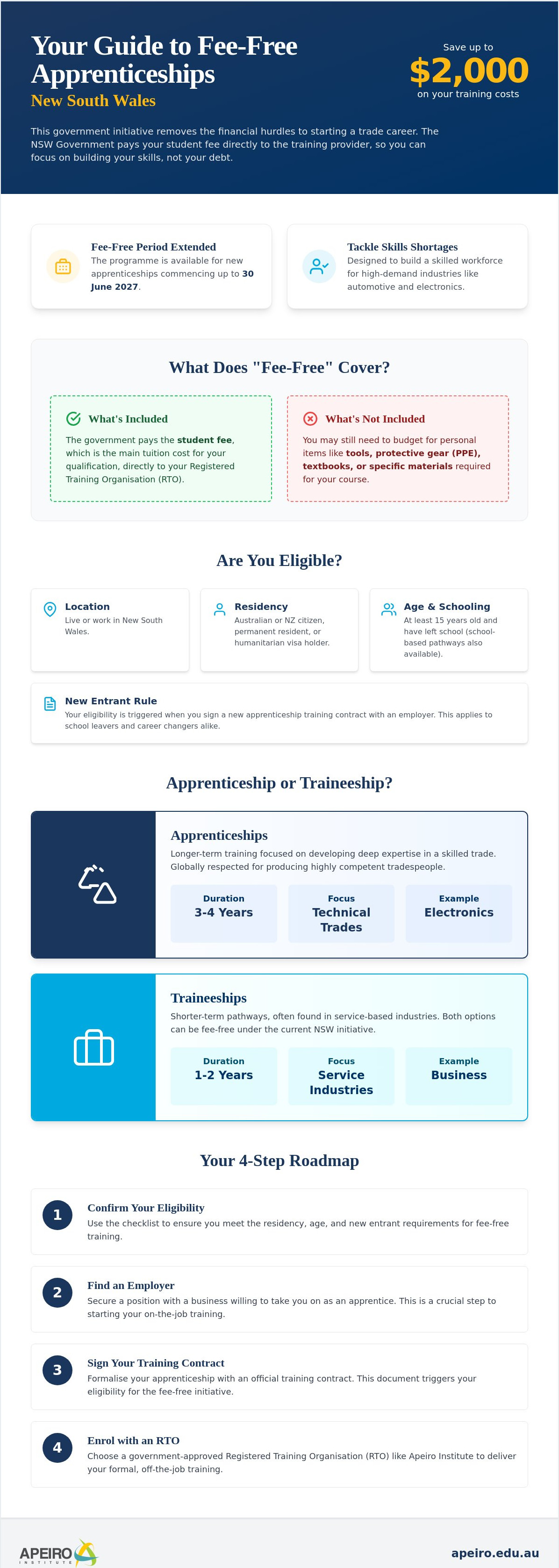
The NSW Fee-Free Apprenticeship Initiative is a strategic government programme designed to remove the financial barriers of entering a trade. Traditionally, students might face fees of up to $2,000 to cover their training. Under this initiative, the NSW Government pays that student fee directly to the training provider. This means you can focus on mastering your craft rather than worrying about upfront tuition costs. Accessing fee-free apprenticeships NSW allows you to jumpstart your career with financial peace of mind.
This programme isn't just a short-term fix. It remains a core priority for the state government, with fee-free places currently extended through to 30 June 2027. The primary objective is to tackle the critical skills shortage across the country. Industries like automotive and electronics are crying out for qualified professionals. By making these pathways more accessible, the government is ensuring a steady pipeline of skilled workers for major infrastructure projects and local businesses alike.
It's helpful to clarify what "fee-free" actually covers. While the government takes care of the student fee, which is the tuition component, you may still need to budget for personal equipment, protective gear, or specific materials required for your course. Think of it as the government providing the education, while you provide the dedication and the boots on the ground.
The Role of Smart and Skilled Funding
Smart and Skilled is the policy framework the NSW Government uses to subsidise vocational education and training. It's the engine that powers Smart and Skilled funded courses NSW, making high-quality education accessible to a much broader demographic. To offer these fee-free spots, a Registered Training Organisation (RTO) must be an approved provider. This ensures that the training you receive meets strict quality standards and leads to a nationally recognised qualification.
Apprenticeships vs. Traineeships: What is the Difference?
While both pathways combine work with structured training, they differ in duration and focus. A trade apprenticeship, such as the UEE30920 Certificate III in Electronics and Communications, typically lasts three to four years. This model is common in technical fields where deep expertise is built over time. In contrast, traineeships usually take one to two years and are often found in service-based industries like business or community services.
The Apprenticeship system in Australia is globally respected for its ability to produce highly competent tradespeople. Whether you choose a longer apprenticeship or a shorter traineeship, both currently offer fee-free options in NSW under specific conditions. This flexibility allows you to choose the pace and industry that best fits your career goals.
Eligibility Criteria for Fee-Free Training in 2026
Understanding the entry requirements for fee-free apprenticeships NSW is the first step toward your new career. The criteria are designed to be inclusive, ensuring that as many people as possible can access quality trade training. To qualify, you must live or work in New South Wales and be an Australian citizen, a New Zealand citizen, a permanent resident, or a humanitarian visa holder. You also need to be at least 15 years old and have left school, though there are specific pathways for those still completing their secondary education.
The "New Entrant" rule is a vital part of this initiative. Essentially, when you sign a new apprenticeship contract with an employer, it triggers your eligibility for the fee waiver. This applies regardless of your age. Whether you are a 17-year-old school leaver or a 40-year-old looking for a career change, the government prioritises your transition into a high-demand trade. It's also worth noting that if you previously started an apprenticeship before July 2018 and are now returning to the trade under a new employer or course, you may still be eligible for fee-free training for the remainder of your studies.
School-based apprentices can also get a head start. These students begin their trade journey while still working toward their HSC. By the time they graduate, they have already completed a significant portion of their training and practical work, all without incurring student fees. This pathway provides a seamless transition from school to the workforce with a clear professional trajectory.
Are You an Existing Worker?
If you are already working in an industry but don't have the formal papers to back up your skills, you haven't been forgotten. The Trade Pathways for Experienced Workers (TPEW) programme is specifically designed for people like you. It allows experienced workers to have their current skills recognised and then transition into a funded apprenticeship to finish their qualification. This is a practical way to increase your earning potential without starting from scratch. If you're unsure where your current experience fits, you can chat with our team about a skills assessment to see which credits you already hold.
Special Eligibility for Priority Groups
The NSW Government provides additional layers of support for specific community groups to ensure equitable access to education.
- Aboriginal and Torres Strait Islander students: Often eligible for fee-free training across a wider range of courses beyond just apprenticeships.
- Students with a disability: May receive fee exemptions or concessions, along with additional learning support from their RTO.
- Long-term unemployed: Specific programmes help those who have been out of the workforce for a significant period to re-skill in priority areas like electronics or automotive technology.
Unlike some other educational subsidies, having a prior qualification (like a university degree or an old certificate) usually doesn't block you from accessing a fee-free apprenticeship. The focus is on filling current skill gaps, so the government is more interested in your future potential than your past academic history.
High-Demand Trades: Electronics and Communications
The digital economy relies on the silent work of electronics technicians. Choosing the UEE30920 Certificate III in Electronics and Communications puts you at the heart of this growth. Unlike some traditional manual trades that focus purely on physical labour, this field combines technical precision with advanced problem-solving. One day you might be working on intricate circuit designs; the next, you could be maintaining large-scale communications infrastructure that keeps a city connected. It is a diverse role that suits those who enjoy using both their hands and their heads.
Earning potential in this sector is particularly strong. Because the work requires specialised technical knowledge, qualified technicians often command higher starting salaries than those in more general labour roles. Your career doesn't have to stop at the Certificate III level, either. Many students use their initial training as a springboard into a Certificate IV or even a Diploma. This progression allows you to move into supervisory roles or engineering support positions. Taking up fee-free apprenticeships NSW in this field isn't just about getting a job; it's about building a career with a very high ceiling.
The TPEW Pathway for Electronics
Many people have spent years working in the industry but lack the official "piece of paper" to prove it. This is where the Trade Pathways for Experienced Workers (TPEW) programme becomes a game-changer. At Apeiro Institute, we specialise in assessing the skills you've already mastered on the job. We use a "gap training" model. This means we identify what you already know and only teach you the specific units required to round out your qualification. It's a faster, more respectful way to get certified without sitting through classes on things you've been doing for a decade.
Why Electronics is a "Future-Proof" Trade
The world is moving toward renewable energy, smart home systems, and advanced telecommunications. Every one of these sectors needs electronics experts. By securing a nationally recognised qualification, you ensure your skills are portable and valid anywhere in Australia. Whether it's installing 5G hardware or maintaining solar inverter systems, your expertise remains in high demand. We encourage you to look at the tech-heavy side of trades. It offers long-term job security that is resistant to the fluctuations of the standard construction cycle. Accessing fee-free apprenticeships NSW in electronics is a smart, strategic move for anyone looking to stay ahead of the curve.
How to Start Your Fee-Free Journey: A Step-by-Step Guide
Securing a spot in a government-funded programme might feel like a lot of paperwork, but it's actually a very logical progression. Unlike a university degree where you apply to a campus and hope for the best, fee-free apprenticeships NSW are employment-led. This means your journey begins in the real world, not a classroom. You'll need to find a business willing to take you on as an apprentice before you can formalise your training. While this sounds like a high bar, it's actually a great way to ensure you're earning while you learn from day one.
At Apeiro Institute, we don't just wait for you to show up with a signed contract. We act as a mentor throughout the initial application phase. If you're confused about which forms to fill out or how to talk to a potential employer about government subsidies, our team is here to help. We want to make sure you feel supported before you even step into a workshop.
Step 1: Finding an Employer and RTO
Your first task is to approach local businesses in your chosen field. If you're interested in the automotive sector, for example, you might look for workshops that can support a Certificate III in Light Vehicle Mechanical Technology. Similarly, those exploring HVAC trades can look at established Sydney businesses like Peninsula Air Conditioning (PenAir) to see the technical troubleshooting skills required in the field. Don't be afraid to walk in and ask if they're looking for an apprentice; many employers value that kind of direct initiative. You'll also need to work with an Australian Apprenticeship Support Network (AASN) provider. They are the matchmakers who help facilitate the legal side of the relationship between you and your boss. They'll help you verify that your chosen Registered Training Organisation (RTO) is an approved Smart and Skilled provider.
Step 2: The Training Contract and Enrolment
Once you've found an employer, you'll sign a formal training contract. This is a legal document that must be registered with Training Services NSW. During this phase, you'll also need your Unique Student Identifier (USI). It's a single reference number that keeps all your Australian training records in one place. Your RTO will then sit down with you to develop a Personalised Training Plan. This is the roadmap for your entire qualification. It's crucial to confirm your fee-free status during this paperwork phase. Ask your RTO directly to verify that your course is covered under the current fee-free apprenticeships NSW initiative so there are no surprises later.
If you're ready to take the first step but aren't sure where to start, contact Apeiro Institute for expert guidance on finding the right trade pathway for you.
Why Choose Apeiro Institute for Your NSW Apprenticeship?
Choosing the right training provider is just as important as choosing the right trade. At Apeiro Institute, we pride ourselves on being a student-centred Registered Training Organisation. We know that starting a new qualification can be intimidating. That’s why we treat every learner as an individual with unique goals, rather than just another enrolment in a database. Our trainers aren't just academics; they are industry veterans who bring years of real-world experience into the classroom. They understand the daily challenges of the workshop and the site, providing you with practical insights that go far beyond a textbook.
Our community is one of our greatest strengths. We welcome students from over 38 different nationalities, creating a vibrant and inclusive environment where everyone feels at home. This diversity enriches the learning experience and prepares you for the global nature of modern trades. We also know that life doesn't stop when you start an apprenticeship. Our flexible delivery options are designed to work around your existing job and personal commitments, ensuring you can balance your studies with your lifestyle. By choosing us for your fee-free apprenticeships NSW, you’re joining a supportive network dedicated to your growth.
Expertise in Trade Pathways and RPL
Apeiro Institute is a leader in trade pathways. We specialise in Recognition of Prior Learning (RPL), a process that acknowledges the hard work you’ve already put into your industry. If you have years of experience but lack a formal qualification, we can assess your skills to fast-track your certification. This saves you time and ensures you aren't repeating units you've already mastered. As an approved Smart and Skilled provider, we make accessing fee-free apprenticeships NSW a reality for both new entrants and seasoned workers looking to formalise their expertise.
Support Beyond the Classroom
Our commitment to your success doesn't end when the training session finishes. We provide ongoing mentoring and career guidance to help you navigate the transition from student to qualified professional. You’ll train in modern facilities using industry-standard equipment, ensuring you're job-ready the moment you graduate. We believe that education should be a partnership. We’re here to guide you through the funding paperwork, the technical training, and the next steps in your career. Your trade journey starts with a single conversation. If you're ready to build a better future, our team is ready to help you get there.
Build Your Future Without the Financial Burden
Launching your career in the trades has never been more accessible. With government funding extended through June 2027, you have a clear window to secure a qualification in high-demand fields like electronics or automotive technology. By removing the student fee, fee-free apprenticeships NSW allow you to focus on developing technical skills without the stress of upfront costs. Whether you are a school leaver or an experienced worker formalising your expertise through RPL, the right support turns a daunting process into a simple roadmap.
Apeiro Institute (RTO 45394) is an approved Smart and Skilled provider specialising in nationally recognised training. Our team offers mentor-led support to help you navigate the application process and find a pathway that fits your life. Don't let confusion over eligibility hold you back from a stable, high-paying career. Enquire about your fee-free apprenticeship spot at Apeiro Institute today and take the first step toward a qualification that lasts a lifetime. You've got the drive; we've got the expertise to help you succeed.
Frequently Asked Questions
Is there an age limit for fee-free apprenticeships in NSW?
No, there is no upper age limit for these programmes as long as you are at least 15 years old and have left school. The NSW Government prioritises "New Entrants" of all ages to help address critical skills shortages in technical fields. Whether you are a school leaver or a mature-age worker looking for a career change, you can access the same fee-free benefits.
Can I get a fee-free apprenticeship if I already have a university degree?
Yes, you can still qualify for a fee-free spot even if you hold a university degree or other higher-level qualifications. Unlike some other educational subsidies that limit funding based on your previous study, the Smart and Skilled apprenticeship programme focuses on your current employment. This makes it a fantastic option for graduates who want to pivot into a practical trade like electronics or automotive technology.
What costs are NOT covered by the fee-free initiative?
The initiative specifically covers the student tuition fee, but you'll still need to budget for personal protective equipment, tools, and specific course materials. While the government removes the tuition barrier, you remain responsible for incidental costs such as textbooks or specialised electronics kits. It's a good idea to chat with your employer about whether they provide a tool allowance to help cover these essentials.
How long do I have to apply for a fee-free spot in NSW?
You must commence your Smart and Skilled training before 30 June 2027 to take advantage of the current fee-free arrangements. The government has extended this period to ensure a steady pipeline of skilled workers for the state's major infrastructure projects. Because spots are subject to RTO availability and funding caps, it's wise to start your application process as soon as you've secured an employer.
Can I do a fee-free apprenticeship part-time?
Yes, you can undertake your training on a part-time basis if your employer agrees and it's legally established in your training contract. This flexibility is perfect for those balancing family commitments or other responsibilities while working toward a qualification. The fee-free status applies to the course itself, regardless of whether you're studying full-time or part-time over a longer duration.
What happens to my fee-free status if I change employers?
Your fee-free status generally continues for the remainder of your course if you move to a new employer, provided you remain an apprentice in a funded course. You'll need to work with your new boss and an Apprenticeship Network Provider to register a new training contract. This ensures your records are updated with Training Services NSW and your tuition remains covered without any out-of-pocket expenses.
Are traineeships also fee-free in NSW for 2026?
Yes, traineeships are included in the fee-free initiative, with the government covering student fees for 70,000 traineeship courses until 30 June 2027. While apprenticeships usually cover 3-4 year trades, Fee-free apprenticeships NSW and traineeships both provide a pathway to gain essential skills without upfront training costs. You can commence a maximum of three fee-free traineeships under the current government rules.

Disclaimer
The information provided on this blog is for general informational and educational purposes only. While every effort is made to ensure the accuracy and reliability of the content, the author makes no representations or warranties of any kind, express or implied, about the completeness, accuracy, suitability, or availability of the information contained on this blog.
The views and opinions expressed in blog posts are those of the individual author and do not necessarily reflect the official policy or position of any organization, company, or employer.
This blog may contain links to external websites or third-party content. These links are provided for convenience only, and the author has no control over and assumes no responsibility for the content, privacy policies, or practices of any third-party sites.
Nothing on this blog constitutes professional advice (legal, financial, medical, or otherwise). Readers are encouraged to seek appropriate professional guidance before making any decisions based on the information provided here.
By using this blog, you acknowledge that any reliance on the information is at your own risk.


