

What if your previous university degree or old certificates didn't actually stop you from starting a brand new career in a high-demand trade? Many people assume they're locked out of government support because of past studies, but checking your Smart and Skilled eligibility NSW often reveals a much more encouraging path forward. It's completely normal to feel overwhelmed by complex government jargon or worried about the rising costs of private education. You want to be sure you're making the right choice for your future without the stress of hidden fees or confusing rules.
We're here to help you clear away the uncertainty and find the support you need. In this guide, you'll discover exactly how to qualify for NSW Government-subsidised training and how to take advantage of fee-free priority courses available through to the end of 2026. We'll break down the latest July 2026 fee schedules, explain the difference between fee-free and subsidised options, and show you how a reputable RTO can act as your mentor. By the end of this article, you'll have a clear, logical plan to kickstart your professional journey with confidence and security.
Key Takeaways
- Understand the core age, residency, and citizenship requirements that determine your baseline eligibility for government-funded training in 2026.
- Quickly confirm your Smart and Skilled eligibility NSW to see if your previous qualifications still allow you to access fee-free or subsidised courses.
- Identify high-demand sectors like electronics, automotive, and community services where funding is prioritised to help you secure a stable career.
- Learn the practical steps to gather your documentation and use the NSW Skills List to find the right course for your professional goals.
- Discover how experienced workers can fast-track their qualifications through specialised pathways like Trade Pathways for Experienced Workers (TPEW).
Understanding Smart and Skilled: A Pathway to Subsidised Training in NSW
Smart and Skilled is a NSW Government initiative designed to help you gain the specific skills needed to thrive in the local workforce. It isn't just another education program; it's a strategic investment in your potential. By providing government subsidies for certain qualifications, the program ensures that high-quality training remains affordable and accessible for everyone. Whether you're looking to start your first job or you're an experienced worker aiming to formalise your expertise, checking your Smart and Skilled eligibility NSW is the first step toward a more secure career.
As of July 2026, the government has placed a significant focus on addressing critical skill shortages. This means that qualifications in sectors like electronics, automotive, and the care economy are often highly prioritised. Unlike a standard student loan that you might have to pay back later, a subsidy is a direct contribution from the government toward your tuition fees. This support makes vocational training much more attainable than full-fee private courses. This system works alongside Technical and Further Education (TAFE) and approved private providers to create a robust network of learning opportunities across the state.
The NSW Government invests in your education because a skilled workforce drives the local economy. When you study a course on the NSW Skills List, you're filling a gap in the market. This creates a win-win situation where you gain a stable career path and the state gains the expertise it needs to grow. It's a supportive framework that removes the financial barriers often associated with upskilling.
The Benefits of Government-Subsidised Training
The most immediate advantage is the significant reduction in your out-of-pocket expenses. You'll receive the same nationally recognised training as any full-fee student, but at a fraction of the cost. This allows you to focus on your studies rather than worrying about a mounting debt. Because these courses are strictly aligned with the NSW Skills List, you can be confident that the skills you're learning are exactly what employers are looking for right now. It's a practical way to boost your employability and join a community of skilled professionals.
Smart and Skilled vs. Fee-Free Training
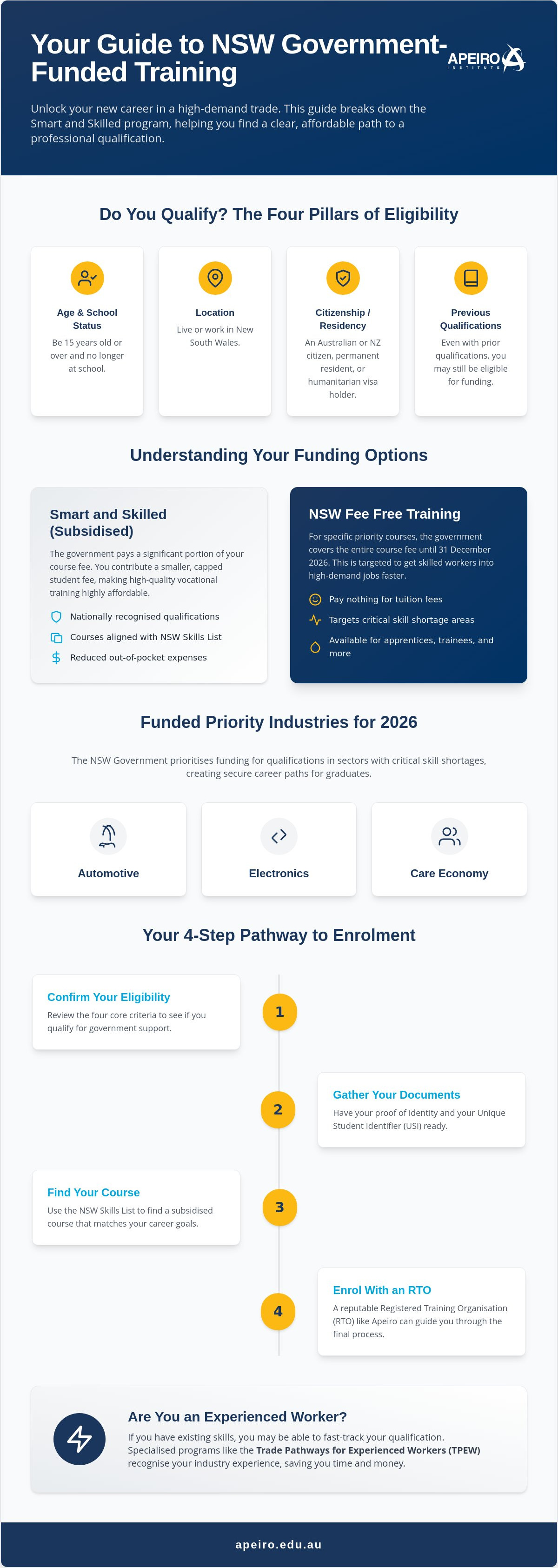
It's helpful to understand that while many courses are subsidised, some are completely fee-free. The NSW Fee Free program, which runs until 31 December 2026, targets specific priority areas to get people into work faster. Your Smart and Skilled eligibility NSW can determine if you fall into a category that pays nothing at all. This often includes apprentices, trainees, or young people aged 15 to 30. If your course isn't fully fee-free, the government still covers a large portion of the price, leaving you with a manageable student fee that is capped for many trade qualifications. Identifying which category you belong to helps you plan your finances with clarity and peace of mind.
Core Eligibility Criteria: Do You Qualify for Funding?
Confirming your Smart and Skilled eligibility NSW is the first practical step toward your new career. While government forms can sometimes feel like a maze, the baseline requirements for 2026 are actually quite straightforward. The program is designed to be inclusive, ensuring that as many people as possible can access the training they need to succeed in the local workforce. If you're ready to move forward, you'll need a Unique Student Identifier (USI). This is your lifelong education number in Australia, and it's essential for securing your government funding and keeping your training records in one place.
The Four Pillars of Eligibility
To access subsidised training, you generally need to meet four primary criteria. First, you must be at least 15 years old at the time you enrol. Second, you must no longer be at school; the program is intended for post-school vocational pathways, though some exceptions exist for school-based apprentices. Third, you must live or work in New South Wales. This geographic anchor ensures the investment stays within the state's economy, although people living in certain border areas who work in NSW may also qualify. Finally, you must be an Australian citizen, a New Zealand citizen, a permanent resident, or a humanitarian visa holder. You can find more details or start the process when you enrol in a Smart and Skilled course through an approved provider.
Does Your Previous Education Affect Eligibility?
A common misconception is that having a past qualification, like a university degree or an old certificate, automatically disqualifies you. In 2026, the "Second Chance" rule is more important than ever. The NSW Government recognises that industries change and people need to retrain. For most courses up to Certificate III level, your previous qualifications won't stop you from accessing a subsidy. This is a significant shift from older policies, allowing you to pivot into high-demand trades even if you've studied in a different field before.
While your first Certificate III is generally a guaranteed entitlement, higher-level qualifications like a Certificate IV, Diploma, or Advanced Diploma are also heavily subsidised if they sit on the NSW Skills List. These are often targeted at sectors with critical worker shortages. Special considerations are also in place to support diversity; for instance, Aboriginal and Torres Strait Islander students often qualify for full fee exemptions regardless of their previous schooling. If you're an older worker looking to formalise years of on-the-job experience, you might find that Trade Pathways for Experienced Workers (TPEW) is the perfect way to use these subsidies to your advantage.
Priority Trades and Funded Apprenticeships in 2026
The NSW Government actively targets industries facing worker shortages by offering enhanced subsidies for specific qualifications. If you meet the Smart and Skilled eligibility NSW criteria, you can access pathways that lead directly into high-growth sectors. These priority trades are selected based on the evolving needs of the local economy. This ensures your training isn't just affordable; it's also highly relevant to what employers are seeking right now. By focusing on these areas, the state helps build a workforce that's ready for future challenges.
Fee-Free Apprenticeships and Traineeships
There's a significant commitment in NSW to support those entering the workforce through practical, on-the-job training. Apprentices who commence their Smart and Skilled training before the end of 2025 are eligible for fee-free training, which can save students and their employers up to $2,000 in fees. This initiative removes the financial burden from both parties, making it easier for businesses to take on new talent. It's a fantastic way to earn a wage while you gain a nationally recognised qualification. For those interested in the care economy, the Certificate III in Individual Support provides a funded pathway into aged care and disability services. These sectors remain top priorities through 2026, offering long-term job security and the chance to support vulnerable members of our community. You can enrol in the Smart and Skilled program through an approved provider to begin this rewarding journey.
Electronics and Communication: A Future-Proof Choice
Technical trades are evolving rapidly, and the demand for skilled technicians is reaching new heights. The UEE30920 Certificate III in Electronics and Communications is a high-priority qualification for 2026. This course prepares you for a career in telecommunications, security systems, and complex electronic equipment repair. Because it's a priority sector, your Smart and Skilled eligibility NSW could mean you pay very little for a high-quality education that leads to a stable career. Transitioning from an apprentice to a qualified technician is a steady, supported process. With government subsidies, you can focus on mastering the intricate systems that power our digital world without the stress of high tuition costs.
Automotive trades also receive significant government backing. The Certificate III in Light Vehicle Mechanical Technology is a popular choice for those who enjoy hands-on work and problem-solving. Completing this funded qualification opens doors to roles in major dealerships or independent workshops. By choosing a priority trade, you aren't just earning a certificate. You're entering an industry where your skills will be in high demand for the long term. This strategic focus helps you build a career that is both personally fulfilling and economically sound.
How to Check Your Eligibility and Enrol Step-by-Step
Moving from researching to enrolling is an exciting step. The process is designed to be methodical and supportive. Your first point of reference is always the NSW Skills List. This list is a live document that confirms which qualifications are currently receiving government investment. If your chosen course is on that list and you meet the baseline requirements, you're well on your way. While the government sets the rules, your Registered Training Organisation (RTO) acts as your expert guide; they help you confirm your final Smart and Skilled eligibility NSW status before you start your studies.
The Enrolment Checklist
Preparing your documentation early makes the process much smoother. When you're ready to take the next step, follow these practical stages:
- Step 1: Verify your USI. You must have a Unique Student Identifier. If you don't have one, it only takes a few minutes to create on the official government website.
- Step 2: Check the Skills List. Ensure the course you want is currently funded. Priorities can shift, so it's best to check the latest 2026 updates.
- Step 3: Gather your evidence. You'll need proof of residency and citizenship. A current NSW Driver Licence or a recent utility bill are the most common ways to prove you live or work in the state.
- Step 4: Connect with a provider. Reach out to an approved RTO like Apeiro Institute. They'll review your documents and give you a formal quote for any remaining student fees.
Understanding Student Fees and Concessions
Even when a course is subsidised, there is often a "Student Fee" that covers a portion of the training costs. As of July 2026, the government uses Version 17.0 of the qualification price schedule to ensure these fees remain fair and consistent across all providers. If you're receiving a Commonwealth Government benefit, you may be eligible for a flat concession fee. This significantly reduces the cost of courses up to Certificate IV level. Students with a disability, or their dependents, also qualify for these lower rates. In some cases, such as for Aboriginal and Torres Strait Islander students, you may be entitled to a full fee exemption. This means you pay nothing at all for your training. To get started with a partner who understands these pathways, you can explore Trade Pathways for Experienced Workers (TPEW) and see how your background fits the current funding models.
Preparing for your first conversation with a training provider doesn't have to be intimidating. Think of them as your mentor in this process. They're there to ensure you understand your Smart and Skilled eligibility NSW and to help you choose the right course for your career goals. Having your USI and residency documents ready will allow them to give you a clear, honest answer about your funding options right away.
Start Your Trade Career with Apeiro Institute: Funded Pathways
Choosing an RTO is about finding a partner who values your personal growth as much as your technical skills. At Apeiro Institute (RTO 45394), we pride ourselves on being more than just a training provider; we're your mentors. We understand that the transition into formal education can feel daunting, especially when trying to decipher government regulations. Our team is dedicated to providing clear, student-centred support that simplifies the process. By helping you navigate the nuances of Smart and Skilled eligibility NSW, we ensure you can focus on what matters most: building a sustainable and rewarding career in sectors like electronics, automotive, or community services.
From Experience to Qualification
If you've spent years working in a trade but lack the formal certificate, you're in a unique position to benefit from current funding models. Many people don't realise that Recognition of Prior Learning (RPL) can work in perfect synergy with government-subsidised training. Through Trade Pathways for Experienced Workers (TPEW), we help you turn your existing skills into a nationally recognised qualification. This pathway is a game-changer for skilled migrants and locals who want to formalise their expertise without repeating basic training. It's an efficient way to respect the expertise you've already gained while securing the credentials you need for the future.
Our specialised Trade Pathways Australia guide explains how to leverage your background to fast-track your certification. When you combine RPL with Smart and Skilled funding, you significantly reduce both the time and cost required to become a qualified technician. Our approach is methodical and steady; we provide personalised mentoring to help you manage the evidence collection and the practical assessments. This ensures the journey feels organised and achievable, moving you logically from your current experience to a professional outcome that is recognised across the country.
Your Next Steps to Success
Your path to professional success begins with a simple, confidential conversation. We'll review your circumstances and confirm your Smart and Skilled eligibility NSW status, giving you an honest assessment of the subsidies available to you. Once you're enrolled, you'll join a community that values diversity and personal connection. At our Sydney campus, your first week is designed to be reassuring. You'll meet your expert guides, explore our practical training facilities, and receive a clear roadmap for your vocational outcomes. It's an environment where you can feel confident and secure as you learn.
We believe that financial barriers should never stand in the way of ambition. The NSW Government's investment in your skills is a powerful tool, and we're here to help you use it effectively. Whether you're aiming for a Diploma of Community Services or a Certificate III in Light Vehicle Mechanical Technology, the right support makes all the difference. Reach out today to see how we can partner in your success and help you kickstart the next chapter of your career with confidence.
Ready to Transform Your Professional Future?
Navigating the path to a new career is much easier when you have the right support by your side. You now have a clearer understanding of how the NSW Skills List works and how your previous studies often won't prevent you from accessing vital subsidies. By confirming your Smart and Skilled eligibility NSW, you're opening doors to high-demand sectors like electronics, automotive, and community services. This isn't just about getting a certificate; it's about gaining the practical expertise that local employers are actively looking for right now.
At Apeiro Institute, we act as your mentor through every stage of the enrolment process. As a provider of Nationally Recognised Training (RTO 45394), we've supported students from over 38 different nationalities to achieve their vocational goals. Our specialised expertise in Trade Pathways for Experienced Workers (TPEW) means we know exactly how to turn your existing skills into a formal qualification efficiently. Don't let uncertainty about fees or paperwork hold you back from the career you deserve. Check your Smart and Skilled eligibility with Apeiro Institute today and start your journey with confidence. We're here to help you succeed.
Frequently Asked Questions
Can I get Smart and Skilled funding if I already have a university degree?
Yes, having a university degree doesn't automatically stop you from qualifying for a subsidised course. Under current 2026 policies, your previous higher education qualifications don't affect your eligibility for courses up to Certificate III level. This allows you to retrain in a high-demand trade even if you've already completed a degree in a different field. For higher-level qualifications like Diplomas, your previous studies may impact the specific fee you pay, but they won't necessarily disqualify you from receiving a subsidy.
What is the NSW Skills List and how often is it updated?
The NSW Skills List is a definitive register of all qualifications that the government has chosen to subsidise to meet local workforce needs. It is updated regularly, often annually or in response to emerging industry shortages, to ensure training remains relevant to the economy. By choosing a course from this list, you're gaining skills that are in high demand across the state. Our team can help you check the latest version to see if your preferred trade is currently receiving government support.
How do I prove I live or work in NSW for eligibility purposes?
You can prove your residency or employment status by providing standard identification documents during the enrolment process. A current NSW Driver Licence is the most common proof of residency, but a recent utility bill, rates notice, or bank statement with your NSW address is also acceptable. If you live in a border area but work in NSW, a recent payslip or an employment contract from your NSW-based employer will satisfy the geographic requirements for your Smart and Skilled eligibility NSW.
Are there any age limits for Smart and Skilled funded courses?
You must be at least 15 years old to access funded training, but there is no upper age limit. The program is designed to support everyone from young school-leavers to mature-age workers looking to formalise their years of experience. This inclusivity ensures that the NSW workforce remains skilled and adaptable at every career stage. Whether you're starting your first apprenticeship or pivoting to a new trade later in life, the funding is there to support your personal growth.
Does Smart and Skilled cover the full cost of the training?
Whether a course covers the full cost depends on your specific Smart and Skilled eligibility NSW status and the qualification you choose. Many apprenticeships, traineeships, and priority courses are completely fee-free through to the end of 2026. For other subsidised courses, the government pays a significant portion of the tuition, and you pay a capped "Student Fee." Concessions and full exemptions are also available for welfare recipients, students with a disability, and Aboriginal or Torres Strait Islander learners.
What happens if I start a course but need to move interstate?
If you move interstate while studying, your eligibility for NSW government funding may change because the program is tied to living or working in the state. Funding is generally provided to the RTO based on your status at the time of enrolment and throughout your training period. It's important to speak with your training provider as soon as you know you're moving. They can help you understand how a change in residency might affect your fees or your ability to complete the course under the same subsidy.
Can international students apply for Smart and Skilled funding?
No, Smart and Skilled funding is generally reserved for Australian citizens, New Zealand citizens, permanent residents, or humanitarian visa holders. International students usually enrol in vocational programs on a full-fee basis and must meet specific visa requirements. However, we offer a range of International Student Vocational Programs designed to provide the same high-quality, practical training. Our friendly staff can help you explore the best enrolment options available for your specific visa type and career goals.
Is there a limit to how many subsidised courses I can take?
You are generally entitled to one government-subsidised Certificate III qualification as your baseline "entitlement" course. After completing your first Certificate III, you can often access further subsidies for higher-level qualifications like a Certificate IV or a Diploma if they are on the NSW Skills List. The government prioritises funding for students moving up the qualification ladder into leadership or specialised roles. Our mentors can help you plan a logical progression that makes the most of the available government support.

Disclaimer
The information provided on this blog is for general informational and educational purposes only. While every effort is made to ensure the accuracy and reliability of the content, the author makes no representations or warranties of any kind, express or implied, about the completeness, accuracy, suitability, or availability of the information contained on this blog.
The views and opinions expressed in blog posts are those of the individual author and do not necessarily reflect the official policy or position of any organization, company, or employer.
This blog may contain links to external websites or third-party content. These links are provided for convenience only, and the author has no control over and assumes no responsibility for the content, privacy policies, or practices of any third-party sites.
Nothing on this blog constitutes professional advice (legal, financial, medical, or otherwise). Readers are encouraged to seek appropriate professional guidance before making any decisions based on the information provided here.
By using this blog, you acknowledge that any reliance on the information is at your own risk.


