

Did you know that holding a university degree doesn't necessarily lock you out of government-funded training in New South Wales? Many people assume their past qualifications or residency status will automatically disqualify them, but the reality is often much more inclusive. It's common to feel confused by residency rules or worried that the application paperwork will be a headache. Navigating Smart and Skilled student eligibility shouldn't be a barrier to your professional growth or a reason to delay your career change. We believe that everyone deserves a clear path to new skills, regardless of where they are starting from.
In this guide, you'll discover exactly how to qualify for NSW Government-subsidised training and start your journey toward a nationally recognised qualification today. We'll clarify the 2026 residency criteria, explain why your previous certificates might not affect your funding, and show you how to identify which courses are currently fee-free. From understanding the NSW Skills List to taking the first step toward enrolment, we're here to ensure you have the clarity and confidence to move forward. By the end of this article, you'll have a clear pathway to confirming your funding and choosing a course that fits your career goals.
Key Takeaways
- Understand the 2026 baseline requirements for age and residency to ensure you meet the standards for government-funded training in NSW.
- Learn why your previous education won't necessarily block your Smart and Skilled student eligibility, allowing you to upskill or change careers with confidence.
- Identify specific fee-free pathways and additional support loadings available for Aboriginal students, apprentices, and individuals with a disability.
- Access a practical checklist of accepted identification and residency documents to help you organise your application and avoid paperwork stress.
- Discover how to map your eligibility to high-demand trade qualifications in sectors like electronics, automotive, and community services.
The Core Criteria for Smart and Skilled Student Eligibility
Starting a career or upskilling shouldn't feel like a bureaucratic maze. The Smart and Skilled student eligibility framework is designed to be inclusive, ensuring that motivated learners across the state can access quality training. For 2026, the baseline requirements remain focused on ensuring that those who contribute to the New South Wales economy have the tools to succeed in the Vocational Education and Training (VET) system. These rules are the foundation of the program, making sure government investment goes toward building a stronger local workforce.
The Four Pillars of Eligibility
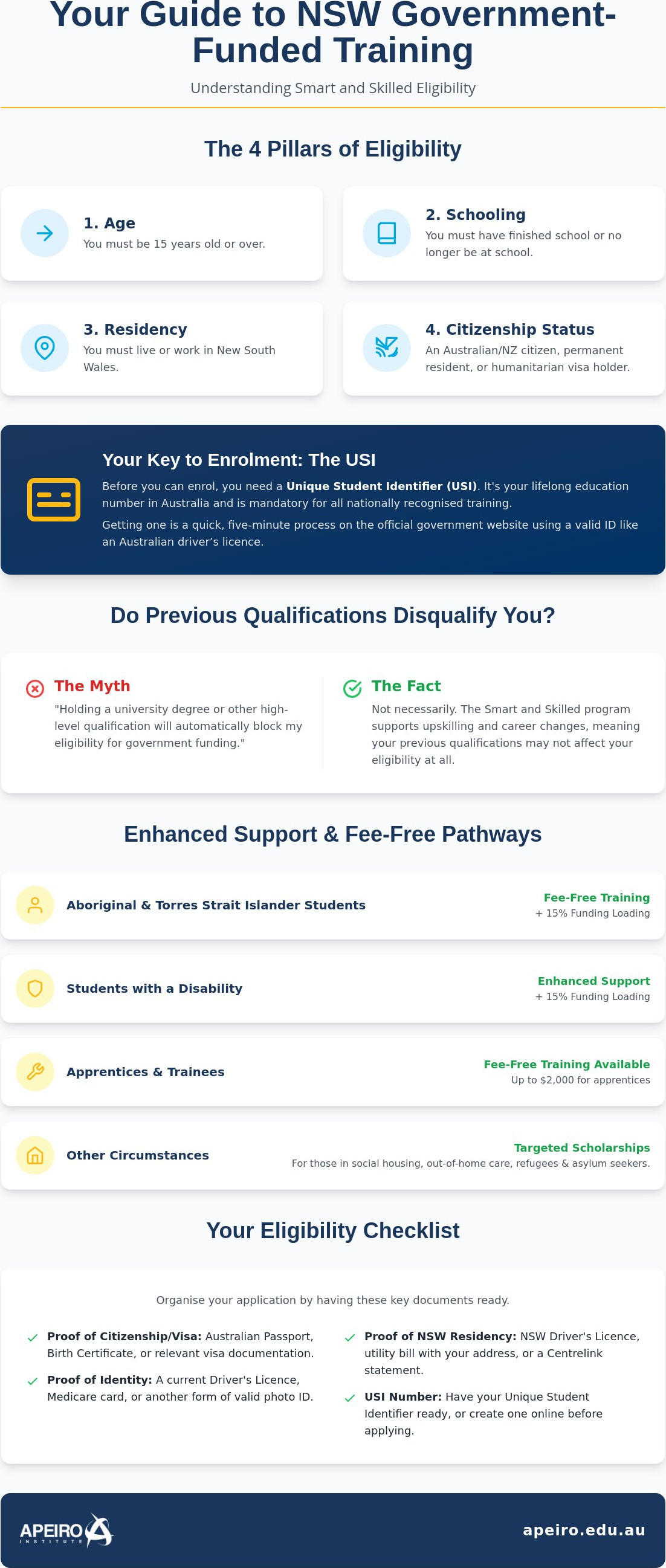
To qualify for a subsidised place, you generally need to meet four specific criteria. First, you must be at least 15 years old. This allows young people to begin their trade journey early, often through apprenticeships or traineeships. Second, you must have finished school. While there are exceptions for registered home-schooled students, the program generally targets those who have moved beyond secondary education and are ready for professional training.
Third, your residency matters. You must live or work in New South Wales. This is a common point of confusion for border residents. If you live in a town like Albury or Tweed Heads but your workplace is physically located within NSW, you are likely eligible for funding. Finally, your citizenship status is vital. You must be an Australian citizen, a permanent resident, a New Zealand citizen, or a holder of a humanitarian visa. These pillars ensure that the subsidised training supports individuals who are committed to living and working within the state’s borders.
The USI: Your Key to Funded Training
Before you can enrol in any funded course, you need a Unique Student Identifier, or USI. Think of this as your lifelong education number. It is mandatory for all students undertaking nationally recognised training in Australia. If you don't have one, creating it is a simple five minute process on the official government website. You will just need a form of identification, such as your passport or Australian driver’s licence, to get started.
If you have studied before, you probably already have one. You can use the "Find my USI" tool to recover it quickly. A USI is the permanent record of all your Australian VET achievements. Having this number ready is the first practical step toward securing your funding. It allows training providers to verify your details and ensure your records are kept accurate throughout your career. Once you have this number, the rest of the application process becomes much smoother.
Special Eligibility Categories and Fee-Free Options
Beyond the basic pillars of residency and age, the NSW government provides targeted support to ensure training is accessible for everyone. The Smart and Skilled program includes specific provisions for Aboriginal and Torres Strait Islander students, who are typically eligible for fee-free training across all levels of the skills list. To further support these learners, training providers receive a 15% funding loading. A similar 15% loading applies to students with a disability, ensuring they receive the necessary resources to succeed in their chosen course. This extra investment ensures that personal circumstances don't stand in the way of professional achievement.
For young people aged 15 to 30 who live in social housing or are in out-of-home care, fee-free scholarships are a vital resource. These scholarships remove the financial burden of student fees for Certificate I through to Certificate IV qualifications. Additionally, refugees and asylum seekers holding valid humanitarian visas have a clear path to subsidised training in 2026. This inclusive approach strengthens the Smart and Skilled student eligibility pool, welcoming diverse talents into the local workforce. It's about creating a fair go for all residents, regardless of their starting point.
Apprenticeships and Traineeships
If you're starting an apprenticeship or traineeship, the financial news is even better. Most NSW apprentices commencing their training before June 30, 2027, are eligible for fee-free training. The government pays the student fee, which can be as much as $2,000, directly to the provider. Trainees are also well-supported, with fee-free options available for many priority roles, covering fees up to $1,000. Your employer plays a key role here by confirming your employment status, which solidifies your eligibility. You can explore a wide range of Smart and Skilled funded courses NSW to see which trade pathways fit your current job role.
Support for Priority Industries
The NSW Skills List is regularly updated to target sectors with the highest demand for workers. In 2026, industries like electronics, automotive, and community services are high on the priority list. For example, courses like the Certificate III in Individual Support often attract significant subsidies because the state needs more qualified carers. Certain qualifications, including the Certificate IV in Ageing Support, are even being offered fee-free until December 2026 to address critical shortages. Choosing a course in these high-growth areas often results in lower out-of-pocket costs and better job security after graduation. If you're an experienced worker looking to formalise your skills in these fields, our Trade Pathways for Experienced Workers program can help you leverage your existing expertise for a funded qualification.
Dispelling the 'Previous Qualifications' Myth
Many people hesitate to apply for funding because they believe a university degree or an old certificate from a decade ago makes them ineligible. This is a common misunderstanding that prevents talented individuals from pursuing new trade careers. Under the current rules, Smart and Skilled student eligibility is focused on your future potential rather than your academic history. Having a higher-level qualification does not automatically disqualify you from accessing a subsidised place in a Certificate III course on the NSW Skills List. It's a system designed to help you pivot when your career needs a change of direction.
The NSW Government has transitioned toward a model that encourages lifelong learning and rapid upskilling. This means you have an entitlement to government-subsidised training for your first post-school qualification at the Certificate III level. Even if you already hold a Bachelor’s degree, you can still access this entitlement to gain practical trade skills in high-demand sectors. If you have specific questions about how your past study impacts your final fee, checking the FAQs about your eligibility is a great way to get clarity before you start your application. This policy ensures that your past choices don't limit your future opportunities.
Upskilling into Higher Level Qualifications
Once you have secured a foundational role, the pathway to leadership remains open through continued funding. You can progress from a Certificate III to a Certificate IV or a Diploma in priority areas without losing government support. For instance, moving into a management role in the care sector is highly encouraged to meet the state's growing needs. You can learn more about these advanced pathways and career outcomes in our comprehensive guide to the Diploma of Community Services Australia. This progression allows you to build a long-term career with the security of subsidised training at every major milestone.
Career Changes for Experienced Workers
Industry veterans often worry that their years of experience or previous certifications will block them from retraining in a completely different field. However, the 2026 policy shift specifically removed the 'higher-level qualification' barrier to ensure the workforce remains flexible and responsive to industry needs. This 'Second Chance' approach is perfect for mature-age students who want to move from an office environment into a hands-on trade. If you are already working in a trade but lack the formal papers, our Trade Pathways for Experienced Workers program allows you to use your existing knowledge to fast-track your qualification. It is a supportive way to formalise your expertise while benefiting from government subsidies, ensuring your experience is finally recognised and rewarded.
How to Prove Your Eligibility: A Step-by-Step Checklist
Gathering the right paperwork might feel like a chore, but it's the most important step in securing your funding. When you apply for a subsidised place, you are essentially asking the government to invest in your career. To do this, you need to provide clear, verifiable evidence that you meet the Smart and Skilled student eligibility criteria. Having these documents ready before you start your enrolment will save you time and prevent unnecessary delays in your training journey.
The Essential Document Toolkit
Your evidence usually falls into three main categories: who you are, where you live, and your current status. To verify your identity and residency, you'll typically need to provide a combination of the following:
- Personal Identification: A current Australian Driver’s Licence or a NSW Photo Card is the most common choice.
- Proof of Residency: If your licence doesn't show a NSW address, you can use a utility bill or a bank statement from the last six months.
- Work Evidence: For those living in border towns but working in NSW, a recent payslip or a letter from your employer on company letterhead is sufficient.
- Citizenship Status: An Australian birth certificate, a current passport, or a green Medicare card usually works. For visa holders, a VEVO check will be required to confirm your permanent residency or humanitarian status.
It's vital that your name matches exactly across all these documents and your USI account. If you've changed your name through marriage or deed poll, have those certificates ready too. If you are claiming a concession fee or have a disability, you'll also need to provide your current Healthcare Card, Pensioner Concession Card, or relevant medical documentation to ensure you receive the correct fee reduction.
The Enrolment Interview Process
Once your documents are in order, you'll participate in an enrolment interview with our team. This isn't a high-pressure test. It's a supportive conversation where we review your evidence and ensure the course aligns with your career goals. During this stage, you'll sign a few declarations. These are standard government forms where you confirm your residency and disclose any previous qualifications you hold. We'll use this information to calculate your final student fee based on the latest Version 17.0 fee schedule.
At Apeiro Institute, we take the stress out of this verification stage. Our experts guide you through every form, ensuring your Smart and Skilled student eligibility is confirmed quickly so you can focus on your studies. If you're unsure about a specific document or your visa status, we're here to help you find the right proof. You can get started by checking our Trade Pathways for Experienced Workers page to see how your existing skills can be verified alongside your funding application.
Next Steps: Choosing Your Funded Pathway with Apeiro
Once you have confirmed your Smart and Skilled student eligibility, the real excitement begins. You are no longer just looking at a list of requirements; you are looking at your future career. Choosing the right training provider is just as important as picking the right course. At Apeiro Institute, we specialise in high-demand industries like electronics, automotive, and community services. This focus means our trainers aren't just teachers. They are industry experts who understand the current job market in New South Wales and can help you bridge the gap between learning and employment.
Trade Pathways for Experienced Workers (TPEW)
If you've been working in your trade for years but never got around to finishing your papers, you don't have to start from scratch. Our TPEW program is designed specifically for skilled labourers who want to formalise their expertise. By combining Recognition of Prior Learning (RPL) with government subsidies, you can significantly reduce your time in the classroom. This synergy allows you to leverage your Smart and Skilled student eligibility to cover the costs of the gap training needed to finally secure your trade licence. It is often the fastest and most cost-effective route for experienced workers to gain the qualifications they need to run their own business or take on a supervisory role.
Apeiro's Funded Course Highlights
We offer a range of qualifications that align perfectly with the 2026 NSW Skills List priorities. For those with a passion for the automotive industry, the Certificate III in Light Vehicle Mechanical Technology provides the hands-on training required to become a qualified mechanic. If you're more interested in the future of technology, the UEE30920 Certificate III in Electronics and Communications opens doors to telecommunications, security systems, and electronic repair. These fields are growing rapidly, and having a subsidised qualification makes you a highly attractive candidate for local employers.
Community services also remains a top choice for those looking for a rewarding career change. Whether you are moving into aged care or disability support, these roles offer incredible job security and the chance to make a genuine difference in your local area. From your initial eligibility check to your first day in the workshop or classroom, our team is here to support you. We believe that starting your journey toward a nationally recognised qualification should be an empowering moment. We are ready to help you take that first step with confidence and clarity.
Start Your Career Transformation in NSW
Securing a subsidised place is often much simpler than many students imagine. We've seen that your academic history won't hold you back, and the 2026 residency rules are designed to support anyone living or working in NSW. Navigating Smart and Skilled student eligibility is the first step toward gaining a nationally recognised qualification that employers trust. It's about opening doors to new opportunities in high-demand sectors like automotive, electronics, and community services.
As specialists in trade pathways and Recognition of Prior Learning (RPL), we provide expert guidance through the NSW funding maze. We help you gather the right documents and choose the course that matches your professional goals. Check your Smart and Skilled eligibility with the Apeiro team today and take the stress out of your enrolment. Your new career is closer than you think, and we're ready to help you every step of the way.
Frequently Asked Questions
Can I get Smart and Skilled funding if I already have a university degree?
Yes, you can. Holding a university degree or a high-level qualification does not automatically disqualify you from accessing a subsidised place. The current policy encourages lifelong learning, meaning you can still access funding for courses on the NSW Skills List to gain practical trade skills. This is a great way to pivot your career into a new industry without the burden of paying full tuition fees.
What documents do I need to prove I work in New South Wales?
You will need to provide a recent payslip or a formal letter from your employer on official company letterhead. This document must clearly show the physical address of your workplace within New South Wales. It is a critical requirement for border residents who live in towns like Albury or Tweed Heads but contribute to the NSW economy through their daily work and professional commitments.
Is there an upper age limit for Smart and Skilled student eligibility?
There is no upper age limit for Smart and Skilled student eligibility. As long as you are at least 15 years old and meet the residency and citizenship criteria, you are welcome to apply. This inclusivity ensures that mature-age workers can formalise their years of experience or retrain in high-demand sectors like community services or automotive technology at any stage of their working life.
Can I study more than one subsidised course at the same time?
Generally, you are only permitted to enrol in one government-subsidised course at any given time. This rule ensures that government resources are spread across as many students as possible and that you can give your full attention to your current studies. Once you have successfully completed your qualification, you can then explore further funded pathways to advance your career and skills even further.
What happens to my eligibility if I move out of NSW during my course?
Your eligibility is locked in at the point of your enrolment. If you move out of NSW after your course has officially commenced, your funding will typically remain in place until you finish that specific qualification. It is important to keep your training provider informed of any changes to your contact details or residency status to ensure your student records and future funding applications remain accurate.
Are international students on a student visa eligible for Smart and Skilled?
International students on a subclass 500 student visa are not eligible for Smart and Skilled funding. This program is reserved for Australian citizens, permanent residents, New Zealand citizens, and certain humanitarian visa holders. While we offer a range of international student vocational programs, these are managed under different fee structures and do not attract the same government subsidies as local enrolments.
Do I have to pay anything if I am eligible for fee-free training?
If you are eligible for fee-free training, the NSW Government covers the entirety of the student fee by paying the provider directly. This means you won't face upfront tuition costs for your qualification. However, it's a good idea to check if there are small incidental costs for specific tools, protective equipment, or specialised textbooks that might be required for your particular trade or workshop sessions.
How do I find out if the specific course I want is subsidised in 2026?
You can find this information by reviewing the latest NSW Skills List, which identifies all qualifications currently receiving government support. The list is reviewed annually to ensure it meets the state's changing economic needs. Our team can also help you determine if your chosen course, such as electronics or automotive diagnosis, falls under the Smart and Skilled student eligibility criteria for the current 2026 intake.

Disclaimer
The information provided on this blog is for general informational and educational purposes only. While every effort is made to ensure the accuracy and reliability of the content, the author makes no representations or warranties of any kind, express or implied, about the completeness, accuracy, suitability, or availability of the information contained on this blog.
The views and opinions expressed in blog posts are those of the individual author and do not necessarily reflect the official policy or position of any organization, company, or employer.
This blog may contain links to external websites or third-party content. These links are provided for convenience only, and the author has no control over and assumes no responsibility for the content, privacy policies, or practices of any third-party sites.
Nothing on this blog constitutes professional advice (legal, financial, medical, or otherwise). Readers are encouraged to seek appropriate professional guidance before making any decisions based on the information provided here.
By using this blog, you acknowledge that any reliance on the information is at your own risk.


