
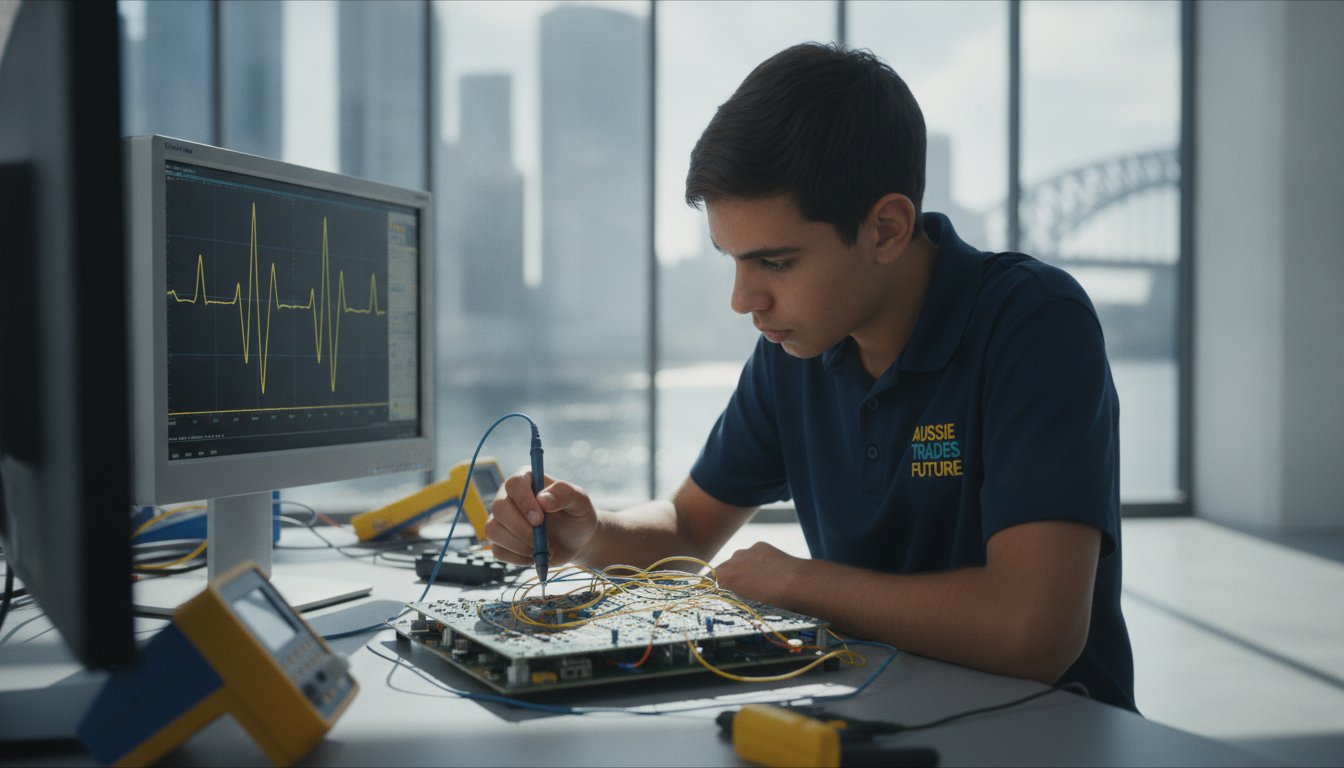
What if the most valuable trade in Australia's $100 billion tech sector isn't about wiring houses, but about mastering the "brains" inside the machines? It's completely normal to feel uncertain when you're looking at trade qualifications. You might worry about whether the units in the UEE30920 Certificate III in Electronics and Communications are actually relevant to today's jobs, or perhaps you're confused about the difference between being an electrician and an electronics technician. It's a big decision, and you want to ensure the path you choose leads to a real career.
We've put together this 2026 guide to help you discover how to launch a future-proof career in Australia's booming tech sector with a nationally recognised qualification. You'll learn exactly what to expect from the course, from mastering circuit repair and digital systems to understanding your long-term growth options. We'll also look at how this study serves as a perfect stepping stone toward specialised study like a Certificate IV, ensuring your skills stay in high demand for years to come.
Key Takeaways
- Learn the distinct differences between electronics and electrical trades to make an informed decision about your future career direction.
- Discover how the UEE30920 Certificate III in Electronics and Communications serves as a nationally recognised entry point into Australia's $100 billion tech sector.
- Identify diverse career pathways in high-demand fields like medical equipment maintenance, aviation electronics, and communications technology.
- Find out how to potentially shorten your study time by using Recognition of Prior Learning (RPL) to acknowledge your existing industry skills.
- Understand the benefits of training within a supportive, multicultural community that prioritises your personal and professional development.
What is the UEE30920 Certificate III in Electronics and Communications?
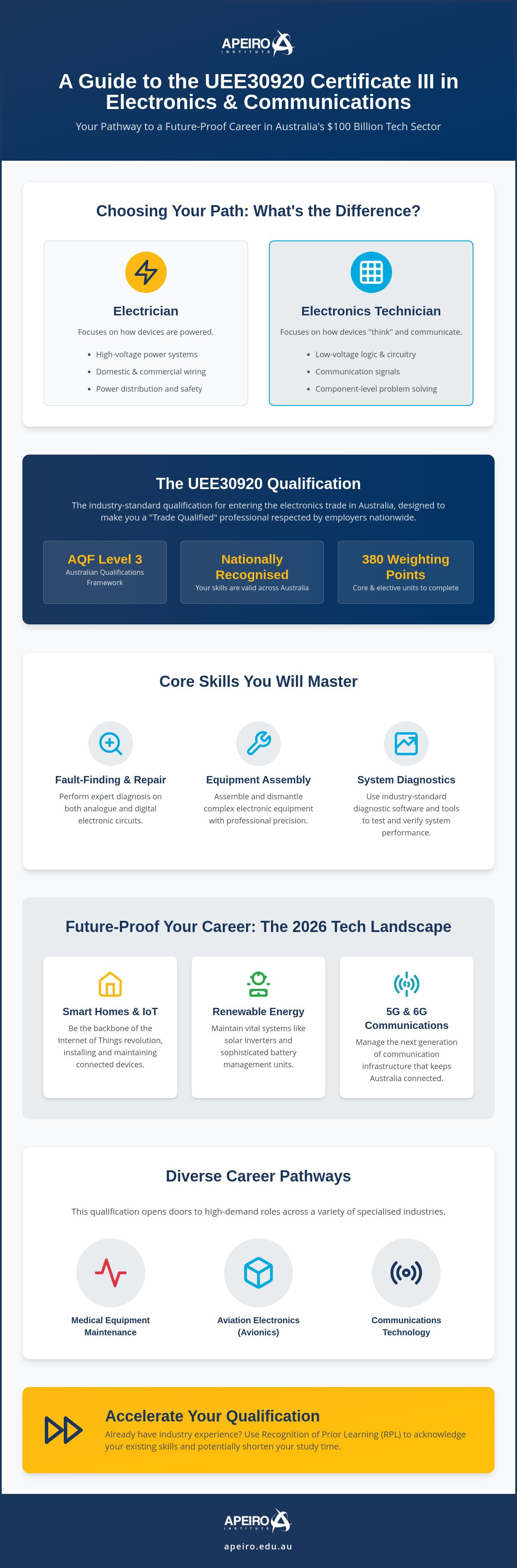
The UEE30920 Certificate III in Electronics and Communications is the industry-standard qualification for anyone looking to enter the electronics trade in Australia. It sits within the Australian Qualifications Framework (AQF) as a level 3 certificate, providing a clear, nationally recognised pathway into a professional career. Unlike general short courses, this qualification is designed to transform you into a fully "Trade Qualified" professional. It's the essential starting point for those who want their skills to be respected by employers nationwide.
Many people confuse "Electronics" with "Electrical" work, but the two fields are quite different. While an electrician focuses on high-voltage power systems and domestic wiring, an electronics specialist works with low-voltage logic, intricate circuitry, and communication signals. If you're fascinated by how devices "think" and communicate rather than just how they're powered, this is the right path for you. It's a field that requires precision, patience, and a genuine love for problem-solving.
Achieving this qualification means you've met the rigorous standards required to work as a professional Electronics Technician. It's often considered the "brain" of the trade. You'll move beyond simply replacing parts to understanding exactly how individual components interact to create complex, functional systems. This deep knowledge is what makes you an asset in a workshop or on a job site.
Core Skills You Will Master
You'll gain practical, hands-on experience that goes far beyond theory. During your studies, you will learn to:
- Perform expert fault-finding and repair on both analogue and digital electronic circuits.
- Assemble and dismantle complex electronic equipment, including advanced communications systems.
- Use industry-standard diagnostic software and tools to test and verify system performance.
The 2026 Tech Landscape
The world of electronics is evolving rapidly. In 2026, electronics technicians are the backbone of the Smart Home revolution and the Internet of Things (IoT). Your skills will be vital for maintaining renewable energy systems, such as solar inverters and sophisticated battery management systems. As Australia moves deeper into a 5G and 6G connected world, the "Communications" units of the UEE30920 Certificate III in Electronics and Communications ensure you're ready to manage the infrastructure that keeps our communities connected. It's about being prepared for the technology of tomorrow, not just today.
Course Structure: Key Units and Learning Outcomes
Starting a trade qualification can feel overwhelming if you're just looking at a list of unit codes. The UEE30920 Certificate III in Electronics and Communications is carefully balanced to ensure you gain a rock-solid foundation before you start specialising. You'll need to complete a mix of core and elective units to reach a total of 380 weighting points. This structure ensures every graduate has the same high level of fundamental skill while allowing room for personal career interests.
Safety is the first thing you'll master. In an electronics environment, Occupational Health and Safety (WHS) isn't just about wearing boots. It involves understanding electrostatic discharge (ESD), chemical safety for soldering, and working safely with extra-low voltage systems. Our practical workshops are designed to simulate real-world repair and assembly scenarios. You won't just be reading about circuits. You'll be using oscilloscopes and logic analysers to find real faults in complex equipment.
If you've already spent years working in the field without a formal piece of paper, you might find that Trade Pathways for Experienced Workers offer a faster way to get recognised.
Essential Core Units
These units are the non-negotiables of the trade. They provide the technical literacy you need to succeed in any electronics workshop. You will focus on:
- Solving problems in d.c. circuits and extra-low voltage a.c. circuits to understand power flow.
- Fabricating, assembling and dismantling utilities industry components with precision.
- Documenting occupational activities and maintaining system integrity to meet Australian standards.
This foundation ensures you understand the logic behind every repair, not just the physical process of fixing a device.
Specialisation and Electives
Once you have the basics down, you can tailor your learning to your career goals. You might choose electives that focus on computer systems or consumer electronics. If you're interested in the telecommunications industry, the "Communications" units are incredibly valuable for understanding data transmission. Choosing the right electives now can actually "pre-load" your skills. This makes it much easier to transition into a higher-level qualification later in your career.
By 2026, the curriculum has shifted to include a stronger focus on Sustainable Energy. You'll find units that touch on energy storage systems and renewable energy foundations. This reflects the industry's move toward greener technology. It ensures your skills remain relevant in a changing market where electronic systems drive environmental solutions.
Career Pathways: Where Can a Cert III in Electronics Take You?
Earning your UEE30920 Certificate III in Electronics and Communications isn't just about finishing a course; it's your entry ticket to a sector that powers almost every aspect of modern life. In Australia, the information and communication technology industry is a $100 billion powerhouse. This means your skills as a technician are in high demand. Whether you want to work in a local workshop or for a global tech firm, the opportunities are vast and varied.
Primary roles for graduates usually include becoming an Electronics Tradesperson, a Communications Technician, or a Service Technician. These professionals are the backbone of our digital world. However, there are also "hidden" industries where your skills are desperately needed. You might find yourself in medical equipment maintenance, ensuring life-saving diagnostic machines stay calibrated. Alternatively, you could enter the world of aviation electronics (avionics), maintaining the complex navigation systems that keep aircraft safe. These specialised fields often offer unique challenges and rewarding career longevity.
Salary expectations in Australia are generally strong for trade-qualified technicians. Entry-level roles provide a solid starting point, while experienced technicians who specialise in niche areas or move into supervisory positions often see significant increases. Because the UEE30920 Certificate III in Electronics and Communications qualification details are so comprehensive, you'll have the versatility to move between different industries as the market shifts.
Immediate Job Outcomes
You can expect to find work right away in consumer electronics repair, where you'll fix everything from high-end audio systems to smart home appliances. Many graduates also find rewarding roles in security system installation, setting up the complex digital networks that protect homes and businesses. If you enjoy the manufacturing side, there's plenty of work in the assembly of specialised electronic boards used in industrial machinery and robotics.
Advancing Your Career
This certificate is an excellent foundation, but it's often just the beginning of a much larger journey. It acts as a direct prerequisite for the Certificate IV in Electronics and Communications, which allows you to move into more technical, design-based roles. Many technicians eventually transition into engineering support or project management. For international students, this qualification offers a structured pathway to gain genuine Australian industry experience while building a professional network in a supportive, multicultural environment.
Accelerating Your Qualification: RPL and Trade Pathways
You don't always need to start from scratch if you've already spent years on a workshop floor or fixing devices in a professional capacity. Many experienced technicians have the skills but lack the official "piece of paper" that proves it to Australian employers. This is where Recognition of Prior Learning (RPL) becomes a game changer. It allows us to assess your existing expertise and map it directly against the units of the UEE30920 Certificate III in Electronics and Communications. It's a respectful, efficient way to acknowledge that you've already done the hard yards.
Formalising your experience is about more than just pride. In the electronics industry, having a nationally recognised qualification is often the key to unlocking higher pay grades and meeting specific licensing requirements. Employers in sectors like telecommunications or medical equipment maintenance look for the assurance that your skills meet current Australian standards. By choosing Trade Pathways for Experienced Workers (TPEW), you can save significant time and money by avoiding redundant training in areas where you are already competent.
To start this journey, you'll need to gather evidence of your career so far. This usually includes detailed work logs, references from previous employers, and even photographs or videos of your work. This documentation helps our assessors understand the depth of your practical knowledge. If you're ready to take the next step in your career, you can check your eligibility for a trade pathway today.
Is RPL Right for You?
Assessing if your informal work experience matches the UEE30920 units is the first step. If you've been assembling circuit boards, fault-finding digital systems, or managing communications infrastructure without a formal certificate, RPL is likely a great fit. This process is especially beneficial for international workers who have extensive experience from overseas but need to align their skills with the Australian Qualifications Framework. It provides a bridge between your past achievements and your future goals in the local market.
The RPL Assessment Process
The journey follows a clear, supportive path designed to keep you informed at every stage:
- Step 1: Initial skill review. We look at your resume and experience to see which units you might already master.
- Step 2: Competency conversation. You'll have a practical discussion with an assessor to demonstrate your understanding. If there are any small gaps in your knowledge, we can provide targeted gap training.
- Step 3: Certification. Once all requirements are met, you receive your nationally recognised qualification, opening doors to new professional opportunities.
Why Study Electronics at Apeiro Institute?
Choosing where to study is just as critical as the qualification you're pursuing. At Apeiro Institute, we pride ourselves on being a student-centred Registered Training Organisation (RTO) that acts as a genuine partner in your success. We don't just deliver a curriculum; we provide a bridge between your current skills and your future career goals. Our trainers are industry veterans who bring years of real-world experience into the classroom. They understand the practical challenges you'll face on the job and teach you the troubleshooting "tricks of the trade" that you won't find in a standard textbook.
Our community is one of our greatest assets. We are proud to host a multicultural student body representing more than 38 nationalities. This creates a vibrant, inclusive environment where you can learn alongside peers from all over the world. This global perspective is invaluable in the modern tech sector. For those joining us from abroad, we offer extensive support for vocational courses for international students in Australia. We understand the unique journey of moving to a new country and are committed to making your transition as smooth and rewarding as possible.
Completing the UEE30920 Certificate III in Electronics and Communications at Apeiro means you're part of a supportive network that values personal growth as much as technical mastery. We focus on building your confidence so that you feel secure in your abilities from the moment you graduate.
A Supportive Learning Environment
We keep our class sizes small to ensure you receive personalised attention from our expert mentors. This allows for a more conversational style of learning where you can ask questions and get immediate, practical answers. Our modern facilities are designed to mimic current industry workshops. This ensures the tools and equipment you use during your training are exactly what you'll encounter in a professional setting. We also offer flexible training options to suit different learner needs, acknowledging that many of our students balance study with work or family commitments.
Ready to Start Your Journey?
Your first step is checking your eligibility for enrolment. If you've already spent time working in the industry, we highly recommend looking into our Trade Pathways for Experienced Workers to see if you can fast-track your qualification through RPL. There may also be funded training options or Smart and Skilled opportunities available to help make your study more accessible. When you're ready, book a consultation with our team. We'll help you map out a clear, achievable pathway to a successful career in the electronics and communications trade.
Take the Next Step Toward Your Future in Tech
The path to becoming a trade-qualified technician in Australia is clearer and more rewarding than ever. By choosing the UEE30920 Certificate III in Electronics and Communications, you are investing in a career that spans across vital industries like telecommunications, aviation, and medical technology. You've seen how this qualification provides the practical skills needed to thrive in 2026, whether you're starting fresh or accelerating your progress through Recognition of Prior Learning. It's about turning your passion for technology into a stable, high-demand profession.
Apeiro Institute (RTO Code 45394, CRICOS Provider 03703M) is here to guide you every step of the way. As specialists in Trade Pathways for Experienced Workers, we ensure your existing expertise is respected and formalised. You don't have to navigate this journey alone. Our supportive mentors and vibrant, multicultural community are ready to help you reach your professional goals with confidence and clarity. We focus on your personal growth, ensuring you feel secure in your new skills.
Start your electronics career with Apeiro Institute today and secure your place in Australia's growing digital economy. Your new journey starts with a single conversation, and we're excited to help you take that first step toward success.
Frequently Asked Questions
What is the difference between an Electrician and an Electronics Technician?
An electrician primarily focuses on high-voltage power systems and domestic or industrial wiring, whereas an electronics technician handles low-voltage logic and intricate circuitry. While electricians ensure a building has power, electronics specialists maintain the "brains" inside devices. You'll spend more time with breadboards, microprocessors, and signal testing rather than pulling heavy cables through wall cavities or installing power points.
Can I get a Certificate III in Electronics and Communications through RPL?
Yes, you can definitely achieve the UEE30920 Certificate III in Electronics and Communications through Recognition of Prior Learning (RPL) if you have existing industry experience. This process acknowledges your current skills, which can significantly reduce your time in the classroom. You'll need to provide evidence like work logs, employer references, and photos of your work to prove your competency in the required units.
How long does it take to complete the UEE30920 course?
Completion times vary depending on your study mode, but for international students, a full-time course typically takes approximately 69 weeks. If you are undertaking the qualification as part of an apprenticeship, your training is usually spread over three to four years of on-the-job learning. We can help you determine the most efficient timeline based on your specific circumstances and previous experience in the field.
Are there any entry requirements for the Cert III in Electronics?
There are no formal national entry requirements for this qualification under the official training standards. However, most providers will conduct a Pre-Training Review to ensure you have the basic computer literacy and numeracy skills needed for technical calculations. If you're a mature-age student, some institutions might look for at least two years of relevant work experience before you begin your enrolment.
Is electronics a high-demand trade in Australia for 2026?
Electronics is absolutely a high-demand trade as Australia's information and communication technology sector is currently valued at over $100 billion. The rapid growth of renewable energy systems and IoT infrastructure has created a shortage of skilled workers who understand complex circuitry. This makes the UEE30920 Certificate III in Electronics and Communications a secure choice for anyone looking for long-term career stability.
Can international students study the Certificate III in Electronics and Communications?
Yes, international students can enrol in this course through CRICOS-registered providers across Australia. It's a popular choice for vocational students who want to gain practical, hands-on skills that are recognised globally. You'll need to meet specific student visa requirements and demonstrate your English language proficiency. Our team is always available to help you navigate the application process and settle into our multicultural community.
What kind of equipment will I learn to use during the course?
You'll gain hands-on experience with a wide range of industry-standard diagnostic and repair tools. This includes using oscilloscopes to view signal voltages, logic analysers for digital circuits, and high-precision soldering stations for delicate component replacement. You'll also learn to navigate specialised software for system testing and fault-finding. Mastering this equipment ensures you're ready to step straight into a modern, professional electronics workshop.
Does this qualification allow me to work on telecommunications towers?
This certificate provides the foundational electronics and communications knowledge needed for telecommunications work, but physically working on towers requires additional specialised certifications. You'll understand the signals and circuitry involved in data transmission, which is essential for the role. However, to climb towers, you'll generally need extra high-risk work licences and "work at heights" training to comply with Australian safety regulations.

Disclaimer
The information provided on this blog is for general informational and educational purposes only. While every effort is made to ensure the accuracy and reliability of the content, the author makes no representations or warranties of any kind, express or implied, about the completeness, accuracy, suitability, or availability of the information contained on this blog.
The views and opinions expressed in blog posts are those of the individual author and do not necessarily reflect the official policy or position of any organization, company, or employer.
This blog may contain links to external websites or third-party content. These links are provided for convenience only, and the author has no control over and assumes no responsibility for the content, privacy policies, or practices of any third-party sites.
Nothing on this blog constitutes professional advice (legal, financial, medical, or otherwise). Readers are encouraged to seek appropriate professional guidance before making any decisions based on the information provided here.
By using this blog, you acknowledge that any reliance on the information is at your own risk.


