

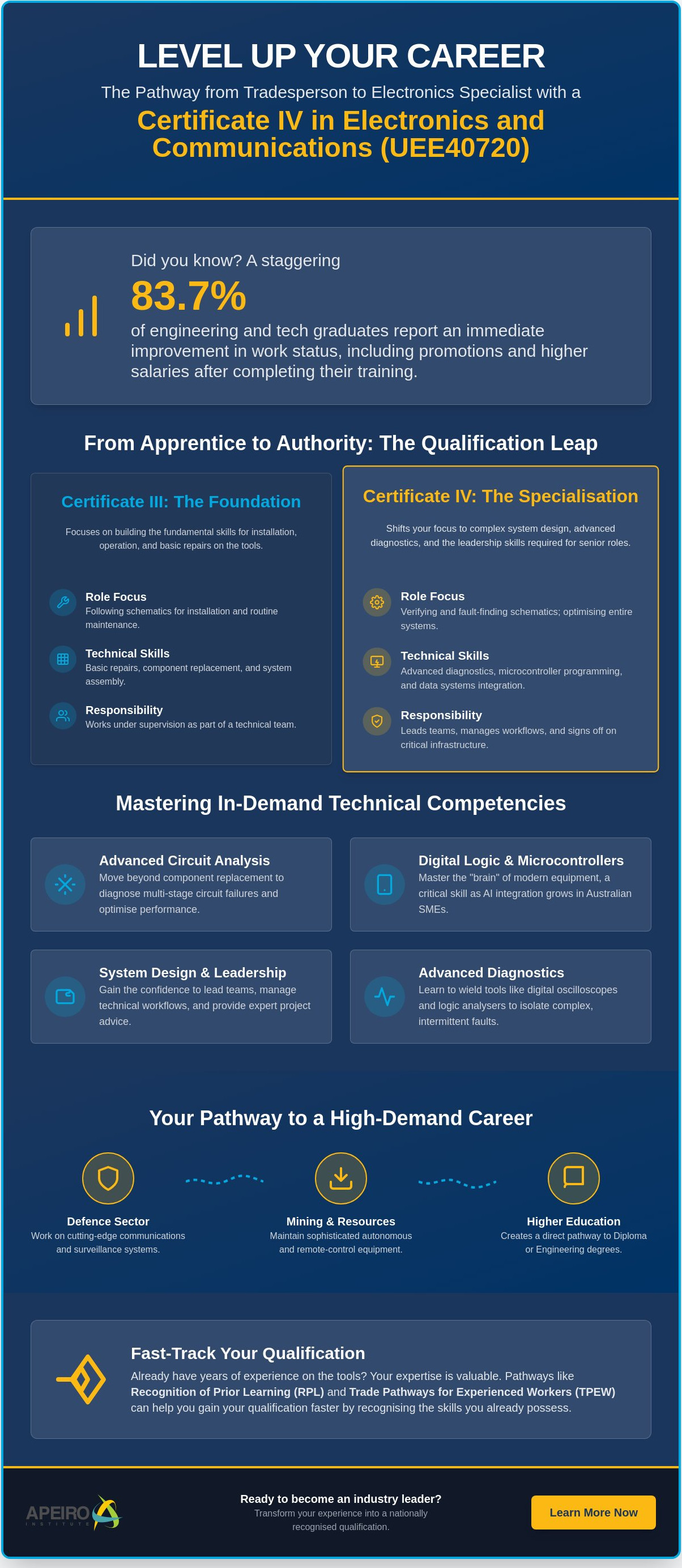
Did you know that 83.7% of graduates in engineering and related technologies report an immediate improvement in their work status, often through a promotion or a higher salary, after finishing their training? It’s a powerful reminder that while your experience is vital, formal recognition is what often tips the scale. You’ve likely spent years on the tools, yet you might still feel stuck in entry-level roles without a clear way to move up. It’s frustrating when your deep on-the-job knowledge isn't reflected in your official credentials or your weekly pay packet. Understanding the jump from a trade level to a Certificate IV electronics and communications (UEE40720) can feel confusing, especially when you’re already working full-time.
We’re here to help you clear up that confusion and map out a path to the next level of your career. This guide explores how this qualification elevates your technical expertise, allowing you to sign off on complex communications systems and take on leadership responsibilities. You’ll discover the specific differences between Cert III and Cert IV, the impact of 5G-Advanced technology on the Australian market, and how this course creates a direct pathway to engineering or diploma-level success.
Key Takeaways
- Discover how the UEE40720 qualification shifts your focus from basic repairs to the complex system design and troubleshooting required for senior roles.
- Compare the salary potential and leadership opportunities of a Certificate IV electronics and communications against entry-level trade certificates.
- Identify the specific technical skills in digital logic and microcontrollers that will be most valuable in Australia’s 2026 job market.
- Explore how high-growth sectors like Defence and Mining are prioritising technicians with advanced electronic credentials.
- Learn how Recognition of Prior Learning (RPL) and Trade Pathways can help you gain your qualification faster by recognising your existing expertise.
Understanding the UEE40720 Certificate IV in Electronics and Communications
The UEE40720 is more than just a piece of paper; it's a nationally recognised qualification designed to turn skilled technicians into industry leaders. While a trade certificate gets you on the job site, the Certificate IV electronics and communications prepares you for the high-stakes world of senior technical roles. The 2026 update to the Electrotechnology Training Package has refined these standards to meet the demands of a changing industry. This isn't just about fixing a broken circuit anymore. It's about understanding why it failed and how to optimise the entire system for future performance.
This qualification is specifically built for experienced tradespeople and Cert III graduates who want to move beyond routine tasks. It bridges the gap between manual labour and technical management. If you're looking to step into a role that requires more than just a pair of pliers and a multimeter, this is your next logical step. For professionals at established firms like Inlightec Electrical Solutions, it's about gaining the confidence to lead projects and provide expert advice in a rapidly evolving sector.
What Makes the Certificate IV Different?
The biggest shift you'll notice is the move from "doing" to "diagnosing and designing." In a Certificate III, the focus is often on installation and basic repair. At the Certificate IV level, you'll dive deeper into complex circuit analysis and advanced mathematical applications. You aren't just following a schematic; you're often the one verifying it or finding faults that others missed. This requires a higher level of critical thinking and a better grasp of how digital logic interacts with hardware.
This level also introduces supervisory responsibilities. You'll learn how to lead a team in a workshop or field environment, ensuring safety standards are met while managing technical workflows. It's the bridge between being a technician and becoming a specialist who can sign off on critical communications infrastructure. You'll move from following orders to making informed technical decisions.
Entry Requirements and Prerequisites
Getting started requires a solid foundation. Most students enter this program after completing a Certificate III in Electronics and Communications or a similar trade qualification. If you've been in the industry for years but lack the formal papers, you might be eligible for Trade Pathways for Experienced Workers (TPEW). This pathway recognises your on-the-job expertise and helps you reach your goals faster.
Because this is a higher-level qualification, there are clear standards for language, literacy, and numeracy (LLN). You'll need to be comfortable with technical reports and complex calculations. While many choose to study through Technical and further education (TAFE) or private providers, having a current background in the electrical or communications sector is essential for your success.
Core Competencies: Mastering Advanced Circuitry and Data Systems
Mastering the technical heart of the industry requires a shift in how you view hardware. While the Certificate III builds your foundation, the UEE40720 Certificate IV in Electronics and Communications takes you into the engine room of modern technology. You'll move beyond simple component replacement to master the intricate relationship between microcontrollers and digital logic. In a world where 40% of Australian SMEs have already integrated AI into their operations, understanding the digital "brain" of equipment is no longer optional. It's the standard for senior technicians in 2026.
This level of study demands a deeper dive into how data flows through a system. You aren't just looking at a single device; you're analysing how computer network hardware and data cabling integrate with traditional electronic components. This holistic view is essential for maintaining the sophisticated equipment used in modern medical, industrial, and telecommunications settings.
Troubleshooting and Fault-Finding
Isolating a fault in a multi-stage electronic circuit is like solving a high-stakes puzzle. You need a methodical approach to trace signals through complex pathways. Instead of guessing, you'll learn to use advanced diagnostic tools like digital oscilloscopes and logic analysers to see what's actually happening inside the silicon. Systemic fault diagnosis is the ability to predict failure points before they occur. This proactive mindset is what separates a senior technician from the rest of the pack. You'll learn to analyze how heat, voltage fluctuations, and signal noise impact long-term reliability in critical systems.
Communications and Data Systems
Modern communication relies on a seamless blend of radio, satellite, and fibre optic systems. You'll develop the skills to install and maintain these high-speed links while strictly adhering to the Australian Communications and Media Authority (ACMA) cabling provider rules. This ensures that every connection is safe, legal, and efficient. If you're an overseas professional looking to enter the Australian industry, exploring vocational courses for international students in Australia can provide the perfect starting point for your journey.
Safety remains paramount throughout this technical work. High-level electronics involve specific WHS/OHS protocols, particularly when dealing with high-frequency signals or sensitive data environments. Understanding these risks protects both you and the systems you manage. If you're ready to turn your current on-the-job skills into a formal Certificate IV electronics and communications, it might be time to look into trade pathways for experienced workers to fast-track your progress and gain the recognition you deserve.
Evaluating Your Learning Path: Certificate III vs. Certificate IV
Deciding between these two levels often comes down to where you see yourself in five years. A Certificate III is the "bread and butter" of the industry. It focuses heavily on the practical, hands-on skills needed to install, maintain, and repair electronic equipment. In contrast, the Certificate IV electronics and communications builds on that foundation by introducing advanced theoretical concepts and system-wide analysis. While a Cert III technician might be tasked with fixing a specific component, a Cert IV holder is often the one determining how that component fits into a larger, more complex infrastructure. You can find the official UEE40720 qualification details on the national register to see exactly how these units stack up.
The differences extend to your career trajectory and earning potential. Entry-level technicians with a Cert III typically start with salaries around $80,923. However, senior technicians or those with a Cert IV can see their pay rise to $126,859 as they take on more responsibility. This qualification also serves as a much stronger bridge to a Diploma of Engineering. It prepares you for the rigorous mathematical and design-heavy coursework you'll encounter at that higher level. Regarding time, a Cert III is often tied to a multi-year apprenticeship, whereas a Cert IV can typically be completed in six months to two years, depending on your study mode and prior experience.
The Skills Gap: Moving Beyond the Basics
One of the most significant shifts at this level is the inclusion of "Environmental and Sustainable Energy" units. These units teach you how to design and maintain systems that are energy-efficient, a critical skill as Australian industries move toward greener operations. You'll also tackle leadership units that focus on managing a small team and organising work programmes. This move into management is a natural progression if you've already completed your UEE30920 Certificate III in Electronics and Communications and are looking for more autonomy in your daily work. It’s about learning to lead, not just follow.
Career Longevity and Specialisation
In 2026, the Certificate IV electronics and communications is increasingly viewed as the minimum requirement for senior technical roles. The industry is becoming more specialised, and having this credential opens doors to niche fields like medical electronics, where you maintain life-saving equipment, or avionics, focusing on aircraft communication systems. These roles require a level of precision and theoretical knowledge that goes beyond basic trade training. If you've already spent years in the field and want to skip the Cert III, you might find that Trade Pathways for Experienced Workers Australia is the most efficient way to get your expertise recognised and move straight into advanced study.
Industry Demand and Career Outcomes in 2026
The Australian electronics landscape is undergoing a massive shift. It's no longer just about maintaining legacy systems; it's about leading the charge into a digital-first future. With the average gross salary for an electronic technician in Australia now reaching approximately $112,170 per year, the financial incentives for upskilling have never been clearer. Senior roles can even command up to $126,859. This growth is fuelled by a significant skills shortage across the country, particularly in high-stakes sectors that rely on precision and advanced fault-finding.
Graduates of the Certificate IV electronics and communications are finding themselves in high demand within the Defence, Mining, and Telecommunications sectors. In Mining, the move toward remote operations and autonomous machinery requires technicians who can manage complex, interconnected systems from afar. Similarly, the Defence sector relies on advanced electronics for secure communications and surveillance. Even the "Green Energy" transition is creating new roles. As Australia builds out its smart grids and renewable energy storage, the need for technicians who understand power conversion and sustainable energy units is skyrocketing. Getting ahead means being future-proof. By securing advanced certifications now, you ensure your skills remain relevant as technology continues to leap forward.
The Rise of Smart Technology and IoT
Smart home and industrial automation are no longer niche markets. They're the new standard. Your Certificate IV skills allow you to bridge the gap between physical hardware and the software that controls it. This hybrid expertise is exactly what modern employers are looking for. Research shows that 40% of Australian SMEs have already integrated AI technology into their operations, and this trend is only accelerating. As we move through 2026, some industry analysts suggest that over 60% of new electronics roles will demand specific IoT integration skills. This makes the leap from hardware-only to hardware-software hybrid expertise essential for any senior technician.
Telecommunications and NBN Infrastructure
Australia’s digital backbone is constantly evolving. The ongoing maintenance of the NBN and the rapid rollout of 5G and 5.5G networks require a highly skilled workforce. You'll need more than just basic cabling skills to thrive here. To work at this level, you often need to be a registered cabler with specialised endorsements in areas like fibre optics or structured cabling. If you're more interested in the large-scale infrastructure and planning side of these projects, you might also want to explore an Advanced Diploma of Civil Construction Design to see how electronics fits into the bigger picture of urban development.
The demand is there, and the pathways are ready. If you've already spent years in the industry, you don't have to start from scratch. You can use our Trade Pathways for Experienced Workers (TPEW) to have your current expertise recognised, helping you move into these high-paying senior roles much faster than you might think.
Fast-Tracking Your Qualification: RPL and Trade Pathways
Spending years on the tools gives you a level of expertise that a textbook simply cannot replicate. If you're already performing high-level technical work, sitting through an introductory classroom session feels like a poor use of your time. Recognition of Prior Learning (RPL) offers a practical solution for busy professionals. It's a process that assesses your existing skills and knowledge to grant credit toward a formal Certificate IV electronics and communications. This means you don't have to relearn what you already do every day. By choosing this path, you can significantly reduce your study load and save on tuition costs, allowing you to gain your credentials while staying on the job.
Apeiro Institute’s Trade Pathways for Experienced Workers (TPEW) simplifies this journey. We understand that your experience is your greatest asset. Instead of starting from scratch, we help you map your career history against the national training standards. You'll need to provide solid evidence of your competence, such as detailed work samples, references from previous employers, and photos of complex projects you've completed. This evidence-based approach ensures that your qualification carries the same weight and authority as one earned through traditional study, but in a fraction of the time.
The RPL Assessment Process Step-by-Step
Navigating the RPL process is straightforward when you have the right support. We've broken it down into three manageable stages to keep you moving forward without the stress.
- Step 1: Initial Consultation. You'll start with a self-assessment and a one-on-one chat with an Apeiro mentor to see if your experience aligns with the UEE40720 requirements.
- Step 2: Evidence Collection. This is where you build your portfolio. You'll gather documents, work logs, and site photos that prove you've mastered advanced circuitry and data systems.
- Step 3: Technical Review. An assessor will conduct a practical observation or a technical interview. This is your chance to demonstrate your fault-finding methodology and technical logic in person.
Why Choose Apeiro Institute for Your Electronics Training?
We pride ourselves on being more than just a training provider; we're your partner in professional growth. Our trainers are industry experts who understand the nuances of the Australian electronics market and the specific challenges you face on site. We foster a supportive, inclusive community where every student’s background is valued. Whether you're a local tradie looking to step into management or an international professional seeking Australian recognition, we provide the guidance you need to succeed. Our focus is always on practical outcomes that lead to better pay and higher-level responsibilities. Ready to take the next step? Enrol in the Certificate IV in Electronics and Communications today and start your journey toward a senior technical career.
Take the Lead in Australia’s Evolving Tech Sector
The Australian electronics industry is moving fast, and staying relevant means choosing a path that recognises your existing expertise while preparing you for the future. This qualification transforms your career from routine maintenance to the high-level system design and troubleshooting required by top-tier employers. With sectors like Defence and Mining actively seeking senior technicians, there’s never been a better time to step up. You’ve put in the years on the tools; now it’s time to get the formal recognition and salary growth you've earned through a Certificate IV electronics and communications.
Apeiro Institute (RTO 45394) provides Nationally Recognised Training tailored for busy professionals. We specialise in Trade Pathways for Experienced Workers, offering industry-led training within a vibrant, global student community. Our expert mentors guide you through the RPL process, ensuring your transition to a senior role is smooth and efficient. Don't let your career plateau when the next level of technical leadership is within reach.
Upgrade your career with the Certificate IV in Electronics and Communications at Apeiro Institute. We’re ready to help you unlock new opportunities and build your professional future today.
Frequently Asked Questions
Can I get a Certificate IV in Electronics if I don’t have a Certificate III?
Yes, you can certainly enrol without a prior trade certificate if you have enough industry experience. Our Trade Pathways for Experienced Workers (TPEW) program is specifically designed to recognise the skills you've built on the job. We'll assess your current expertise and help you bridge any gaps, allowing you to move straight into the Certificate IV electronics and communications without starting from scratch.
How long does it take to complete the UEE40720 qualification via RPL?
The timeline for Recognition of Prior Learning (RPL) is usually much faster than traditional classroom study. While a standard course might take up to two years, an RPL assessment can often be wrapped up in a few months. It really depends on how quickly you can gather your evidence, such as work logs and project photos, for our assessors to review.
What kind of jobs can I get with a Certificate IV in Electronics and Communications?
This qualification opens doors to senior technical and leadership roles across Australia. You’ll be qualified for positions such as Senior Electronics Technician, Communications Officer, or Technical Lead. These roles are vital in sectors like defence, where you might maintain secure systems, or in the medical field, where you'll look after sophisticated diagnostic equipment.
Is the Certificate IV in Electronics and Communications nationally recognised?
Yes, the UEE40720 is a fully nationally recognised qualification. Because it's part of the official Electrotechnology Training Package, your skills will be respected by employers in every state and territory. This gives you the freedom to move your career wherever the best opportunities are, knowing your credentials meet Australian industry standards.
Do I need an electrical licence to study electronics in Australia?
No, you don't need a formal electrical licence to work in the electronics field. Most electronics work involves extra-low voltage systems, which are regulated differently than the high-voltage work performed by electricians. If your specific role requires data or telecommunications cabling, you may need an ACMA registration, which this course helps you work toward.
What is the difference between electronics and electrotechnology?
Electrotechnology is the broad "umbrella" industry that includes everything from electrical wiring and refrigeration to instrumentation. Electronics and communications is a specialised branch within that field. While an electrician focuses on power distribution, an electronics technician focuses on the circuits, microcontrollers, and data systems that make modern devices and networks function.
Can international students enrol in the Certificate IV electronics course?
Yes, international students can definitely enrol in our vocational programs. We provide a supportive learning environment that helps you gain Australian-standard skills while connecting with a global community. It’s an excellent way to gain a qualification that is highly regarded both locally and internationally, helping you build a successful career in the technical sector.
Are there government subsidies or funding available for this course in 2026?
Government funding is often available for eligible students through state-specific programs. In 2026, initiatives like Smart & Skilled in NSW or various fee-free programs in Western Australia can help reduce your training costs. We suggest chatting with our team to see which subsidies you might be eligible for based on your location and circumstances.

Disclaimer
The information provided on this blog is for general informational and educational purposes only. While every effort is made to ensure the accuracy and reliability of the content, the author makes no representations or warranties of any kind, express or implied, about the completeness, accuracy, suitability, or availability of the information contained on this blog.
The views and opinions expressed in blog posts are those of the individual author and do not necessarily reflect the official policy or position of any organization, company, or employer.
This blog may contain links to external websites or third-party content. These links are provided for convenience only, and the author has no control over and assumes no responsibility for the content, privacy policies, or practices of any third-party sites.
Nothing on this blog constitutes professional advice (legal, financial, medical, or otherwise). Readers are encouraged to seek appropriate professional guidance before making any decisions based on the information provided here.
By using this blog, you acknowledge that any reliance on the information is at your own risk.


