

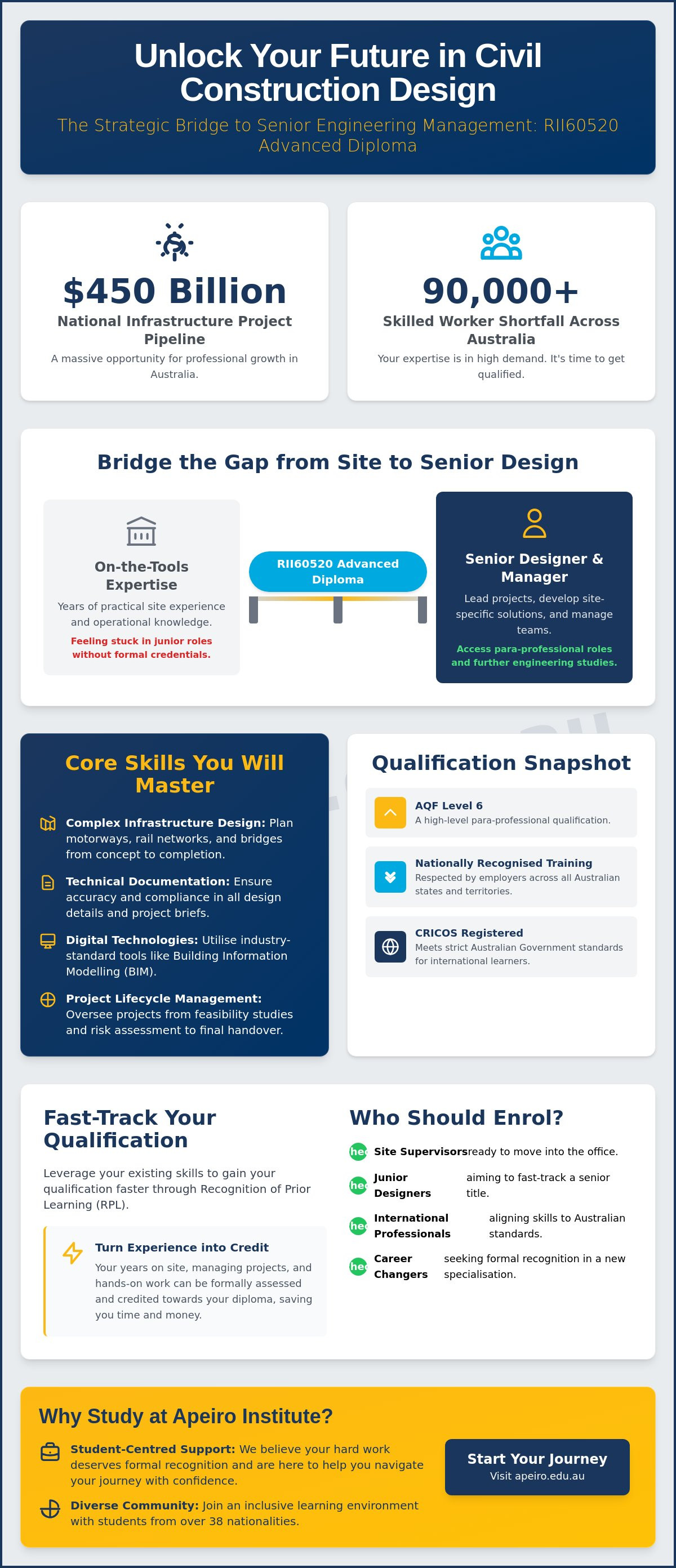
With a $450 billion project pipeline and a shortfall of 90,000 workers across the country, Australia’s infrastructure boom is more than just a news headline; it’s a massive opportunity for your professional growth. If you’ve spent years on the tools or managing site operations, you likely feel that your practical knowledge far outweighs your formal credentials. It’s frustrating to feel stuck in junior roles when you have the experience but lack the specific paper to back it up. The Advanced Diploma Civil Construction Design (RII60520) is the strategic bridge you need to move from site technicality into senior engineering management.
We believe that your years of hard work deserve formal recognition, and we’re here to help you navigate that journey with confidence. This guide will show you exactly how to elevate your civil engineering career by securing a nationally recognised qualification that opens doors to para-professional designer roles. We’ll cover everything from the technical design units and digital technology trends to the Recognition of Prior Learning (RPL) pathways that value your existing expertise. You’ll also find clear answers on CRICOS requirements for international learners and how this diploma creates a direct pathway to further engineering studies in 2026.
Key Takeaways
- Understand how the RII60520 acts as a high-level, para-professional qualification that bridges the gap between field work and senior design.
- Master complex infrastructure projects, like roads and bridges, while using the Advanced Diploma Civil Construction Design to sharpen your technical documentation.
- Fast-track your qualification by turning site experience into formal credit through Recognition of Prior Learning (RPL) and Trade Pathways for Experienced Workers (TPEW).
- Discover how you'll move from junior roles into senior designer positions with a clear pathway to further engineering studies.
- Find out how Apeiro’s student-centred support and diverse community of over 38 nationalities create an inclusive environment for your professional growth.
What is the RII60520 Advanced Diploma of Civil Construction Design?
The RII60520 is a high-level, nationally recognised qualification designed for those who want to lead in the civil works sector. It's more than just a technical course; it's a badge of expertise for senior design roles. In 2026, Australia’s infrastructure project pipeline has reached a staggering $450 billion, making this the perfect time to upgrade your credentials. This qualification is officially classified as a "para-professional" level. This means you'll work directly alongside professional engineers, providing the critical technical support and design leadership needed for large-scale projects. For a broader look at how this fits into the industry, you can check out this Construction Engineering Overview to see the discipline's core activities.
You might wonder how this differs from a standard diploma. While a Diploma of Civil Construction Design focuses on the technical execution of plans, the Advanced Diploma Civil Construction Design prepares you for the initiation and management of site-specific solutions. It's the difference between following a design brief and being the person who develops it from the ground up. You'll move beyond basic drafting into the complex world of project management, business negotiation, and advanced technical design.
Who should enrol in this qualification?
This course is ideal for site supervisors who are ready to transition from the field into a senior design or management office. It’s also a powerful choice for junior designers looking to fast-track their way to a senior title. We often see international students with existing technical backgrounds enrol to align their skills with Australian standards. If you're moving from general construction into a specialised design role, this "career changer" pathway provides the formal recognition you need. Success at this level requires more than just technical skill; you need a "mentality for management" and a passion for solving complex infrastructure puzzles before the first shovel hits the dirt.
Nationally Recognised Training and CRICOS status
Your resume deserves a qualification that carries weight. Because this is delivered by a Registered Training Organisation (RTO), your certificate is respected by employers across every state and territory. It sits at Level 6 of the Australian Qualifications Framework (AQF), which is a significant step up in the vocational hierarchy. For our international learners, the CRICOS status is a non-negotiable requirement. It ensures the course meets the strict Australian government standards for quality and compliance, which is essential for maintaining your student visa. Choosing a CRICOS-registered Advanced Diploma Civil Construction Design means you're investing in a future that is both globally aware and locally grounded.
Core Skills: What You Will Master in Civil Construction Design
Mastering the technical side of civil works is about more than just drawing lines on a screen. It’s about understanding how those lines translate into safe, durable infrastructure that serves the community for decades. When you undertake the Advanced Diploma Civil Construction Design, you move into the driver’s seat of project initiation. You'll learn to develop site-specific solutions for complex projects like motorways, rail networks, and bridges. This involves a deep dive into technical documentation where you'll be responsible for the accuracy and compliance of every design detail before construction even begins.
Technical Design and Infrastructure Planning
This qualification focuses heavily on the methodology behind structural designs, pavement layouts, and drainage systems. You won't just learn the "what"; you'll master the "how" using industry-standard digital technologies. With Australian firms increasingly adopting Building Information Modelling (BIM) and digital twins, your ability to navigate these tools is vital. The course teaches a "cradle-to-grave" project management approach. This means you'll oversee a project from the initial feasibility study and risk assessment through to the final handover. While local regulations are your primary guide, looking at global standards from organisations like the American Society of Civil Engineers (ASCE) can provide a broader perspective on the professional excellence expected at this level.
Risk management is a massive component of large-scale civil works. You'll learn to identify potential geological or environmental hazards early, saving millions in potential rework. If you're ready to start mastering these technical systems, you can explore our course structure to see how we balance theory with practical design tasks.
Management and Leadership Competencies
As you progress into senior roles, your ability to lead people becomes just as important as your ability to read a blueprint. This course prepares you to manage a diverse workforce, including tradespeople, technicians, and junior designers. You'll become the primary point of contact for stakeholder engagement, translating complex technical requirements into clear site instructions for clients and contractors. A para-professional acts as the vital link between site execution and engineering theory. It’s a role that requires grit, precision, and the confidence to make high-stakes decisions under pressure.
Finally, you'll gain a thorough understanding of the legal and environmental frameworks that govern Australian construction. From WHS legislation to environmental protection protocols, you'll ensure that every project isn't just efficient, but also fully compliant with state and federal laws. This comprehensive skill set ensures you're not just a designer, but a future leader in the industry.
Fast-Track Your Career: RPL and Trade Pathways
You've likely spent years on major Australian worksites, solving problems that would baffle a university graduate. You know the soil, the machinery, and the safety protocols like the back of your hand. Yet, when a senior design or management role opens up, you're often overlooked because you lack the formal Advanced Diploma Civil Construction Design. It’s a common frustration. We believe your site-hardened expertise is your greatest asset. That’s why we offer Trade Pathways for Experienced Workers (TPEW). This initiative is specifically designed to bridge the gap between your practical skills and a nationally recognised qualification.
Instead of spending years in a classroom learning things you already do daily, TPEW and Recognition of Prior Learning (RPL) allow you to prove what you know for your Advanced Diploma Civil Construction Design. You'll provide evidence of your competency through work samples, site photos, and technical interviews. While the RII60520 is an Australian standard, it aligns with global Professional Engineering Standards, ensuring your skills meet international benchmarks for excellence. This process respects your time and acknowledges that learning happens just as much in the field as it does in a textbook.
The RPL Assessment Process Explained
Getting started is simpler than you might think. It begins with a candid self-assessment where you identify which units of the RII60520 match your current job tasks. If you've been a Site Foreman or a Civil Technician, you've likely already mastered project initiation and workforce management. Once we've identified these overlaps, the team at Apeiro Institute supports you through the documentation phase. We help you gather references and project logs that prove your proficiency. After a successful technical interview with a qualified assessor, you can receive your qualification without the need for redundant study.
Benefits of Formalising Your Trade Experience
The most immediate benefit is the impact on your career trajectory. Holding an advanced diploma makes you eligible for senior government contracts and high-level private sector roles that require formal certification. There's also a significant boost in earning potential. Beyond the money, there’s a powerful psychological benefit to finally "levelling up" your professional status. It validates your hard work and gives you the confidence to lead at the highest levels. Recognition of Prior Learning can turn 10 years of site experience into a nationally recognised qualification in just a few months. It's the ultimate way to respect your past while securing your future.
Career Outcomes: Life After the Advanced Diploma
Completing your Advanced Diploma Civil Construction Design transforms your professional identity. You’re no longer just following instructions; you’re the one creating the technical blueprints that shape our cities. This qualification positions you as a para-professional engineer. It’s the vital bridge that connects site-level technical execution with high-level engineering theory. While some might only focus on entry-level drafting roles, this advanced level qualifies you for senior positions such as Senior Civil Works Designer, Project Manager, or Site-specific Design Consultant. To see how these roles function within a professional consultancy, you can discover ML Traffic Engineers Australia and their specialised work in transport planning. You’ll have the authority to sign off on complex documentation and lead teams with confidence.
Bridging the Gap to Professional Engineering
For many, this diploma serves as a critical stepping stone toward a full Engineering degree. If you didn't follow a traditional Year 12 path into university, this qualification provides a practical and accessible entry point. You’ll gain "practical engineering" knowledge that is highly valued in design offices. Many graduates find that their vocational background gives them a distinct advantage over university-only students because they understand how designs actually work on the ground. This level of study is also recognised by professional bodies like Engineers Australia at the associate level, giving you formal standing and a sense of belonging within the broader engineering community.
Projected Industry Demand and Stability
The timing for this career move is exceptional. Australia’s 2024-25 budget alone allocated over $120 billion for transport infrastructure projects. With a total project pipeline currently valued at $450 billion, the demand for skilled designers is at an all-time high. The Master Builders Association estimates that the industry needs an additional 90,000 workers by 2026. This isn’t just a job; it’s a future-proof career path that offers long-term stability.
Over a five-year period, a typical graduate might move from a design assistant to a lead project consultant or senior manager. Your skills are also highly transferable across the country. Whether you’re contributing to a major bridge project or a vital rail network expansion, your expertise is highly valued across all Australian states and territories. If you’re ready to secure your place in this booming industry, enrol in the RII60520 Advanced Diploma today and take the next step in your professional journey.
Why Study Civil Construction Design at Apeiro Institute?
Choosing where to complete your Advanced Diploma Civil Construction Design is a significant decision for your career. At Apeiro Institute, we don't just see you as another student enrolment. We see you as a future leader in Australia's infrastructure boom. Our training delivery is built around your personal and professional success, combining industry authority with a warm, supportive environment. You'll join a vibrant community representing more than 38 nationalities. This diversity is a major asset; it allows you to build a global network while staying grounded in local Australian industry standards and practices.
We understand that life is busy and your time is valuable. That's why our programs are designed with flexibility in mind. Whether you're an international student navigating specific visa requirements or a local professional balancing a full-time job with study, we provide the structure you need. Our deep expertise in Recognition of Prior Learning (RPL) and Trade Pathways for Experienced Workers (TPEW) means we know how to value your existing site skills. We don't make you repeat what you've already mastered in the field. Instead, we help you fill the technical gaps and reach your senior qualification faster.
The Apeiro Advantage: Supportive and Practical
Our trainers aren't just lecturers; they're industry mentors. They've spent years in the civil sector and understand the real-world pressures of a design office. They'll guide you through complex units, from structural design to workforce management, ensuring you feel confident at every step. You'll have access to industry-aligned facilities and the latest digital design software used by top firms across the country. Our commitment is to help you achieve practical vocational outcomes that make you immediately employable in senior, high-responsibility roles.
Getting Started with Your Enrolment
Taking the first step toward your new career is simple. We've streamlined our enrolment process to be as clear and stress-free as possible. First, you'll check the entry requirements to ensure you're ready for the RII60520 level. Next, our team will guide you through the application and any RPL assessments you may be eligible for. Before you know it, you'll be attending your first day of class and preparing for a senior role in the industry. For eligible learners in New South Wales, we also offer access to Smart and Skilled funding, which can help reduce the financial barrier to your education.
Build Australia’s Future with a Senior Design Career
Australia’s construction landscape is evolving rapidly. With a massive $450 billion pipeline of projects across the country, the industry needs leaders who can design and manage complex infrastructure. By securing your Advanced Diploma Civil Construction Design, you're not just getting a qualification; you're gaining the technical authority to lead senior projects and bridge the gap to professional engineering. We've seen how technical mastery of roads and bridges, combined with leadership skills, creates a stable and future-proof career path.
At Apeiro Institute (RTO Code 45394; CRICOS Provider 03703M), we are specialists in Trade Pathways for Experienced Workers. We believe your site knowledge is your greatest asset. Whether you're an international learner or a local site foreman, our supportive mentors are ready to help you turn that experience into a nationally recognised qualification. You don't have to stay stuck in a junior role when the next level of your career is within reach.
Start your journey toward a senior design career with Apeiro Institute today. We're here to support you every step of the way as you build a career that truly reflects your expertise and hard work.
Frequently Asked Questions
What are the entry requirements for the Advanced Diploma of Civil Construction Design?
You'll typically need to have completed Year 12 or possess equivalent industry experience to enrol in this advanced level qualification. Since it sits at Level 6 of the Australian Qualifications Framework, having a background in civil works or holding a previous diploma is highly beneficial. We'll assess your technical history and literacy levels to ensure you're ready for the complex design and management units.
How long does it take to complete the RII60520 qualification?
Completion times vary depending on your study mode and whether you have existing industry experience. A full-time student might take between one and two years to finish the course through traditional delivery. However, if you're an experienced professional using Recognition of Prior Learning (RPL), you could secure your qualification in a much shorter timeframe by proving your current competencies.
Can I get a trade qualification based on my work experience (RPL)?
Yes, you can use your years of site experience to fast-track your Advanced Diploma Civil Construction Design. Through the RPL process, you'll provide evidence such as project logs, site photos, and references to prove your technical proficiency. This is a practical solution for those who already have the skills but lack the formal paper to move into senior design or management roles.
Is the Advanced Diploma of Civil Construction Design open to international students?
The RII60520 is open to international learners provided the training organisation is CRICOS-registered. This registration ensures the course meets strict Australian government standards for quality and compliance. It's a popular choice for international students who want to align their technical backgrounds with Australian infrastructure regulations while studying in a diverse, inclusive community.
What is the difference between a Diploma and an Advanced Diploma in construction?
The primary difference lies in the level of responsibility and the complexity of the tasks. A Diploma (AQF Level 5) focuses on technical drafting and following established design briefs. The Advanced Diploma (AQF Level 6) moves you into project initiation, where you'll manage site-specific solutions and lead diverse teams. It effectively transitions you from a technician to a para-professional designer.
What kind of jobs can I get with an Advanced Diploma of Civil Construction Design?
Graduates are qualified for senior roles such as Senior Civil Works Designer, Project Manager, or Site-specific Design Consultant. You'll have the technical authority to oversee the design of major infrastructure like roads, railways, and bridges. Your ability to act as the vital link between site execution and engineering theory makes you a high-value asset in both private design firms and government agencies.
Does this course provide a pathway to a University Engineering degree?
Yes, the Advanced Diploma Civil Construction Design serves as an excellent stepping stone to higher education. Many Australian universities recognise this Level 6 qualification and may offer credit or advanced standing toward a Bachelor of Engineering (Civil). It’s a strategic way to reduce your future university study time while you're already working in the industry as a para-professional.
Are there government-funded options like Smart and Skilled for this course?
Government-funded places are available for eligible learners in specific regions. In New South Wales, the Smart and Skilled program offers subsidised training for certain qualifications to help address the state's skills shortages in the construction sector. You should check your specific eligibility based on your residency, employment status, and previous training to see if you can access these subsidised options.

Disclaimer
The information provided on this blog is for general informational and educational purposes only. While every effort is made to ensure the accuracy and reliability of the content, the author makes no representations or warranties of any kind, express or implied, about the completeness, accuracy, suitability, or availability of the information contained on this blog.
The views and opinions expressed in blog posts are those of the individual author and do not necessarily reflect the official policy or position of any organization, company, or employer.
This blog may contain links to external websites or third-party content. These links are provided for convenience only, and the author has no control over and assumes no responsibility for the content, privacy policies, or practices of any third-party sites.
Nothing on this blog constitutes professional advice (legal, financial, medical, or otherwise). Readers are encouraged to seek appropriate professional guidance before making any decisions based on the information provided here.
By using this blog, you acknowledge that any reliance on the information is at your own risk.


