
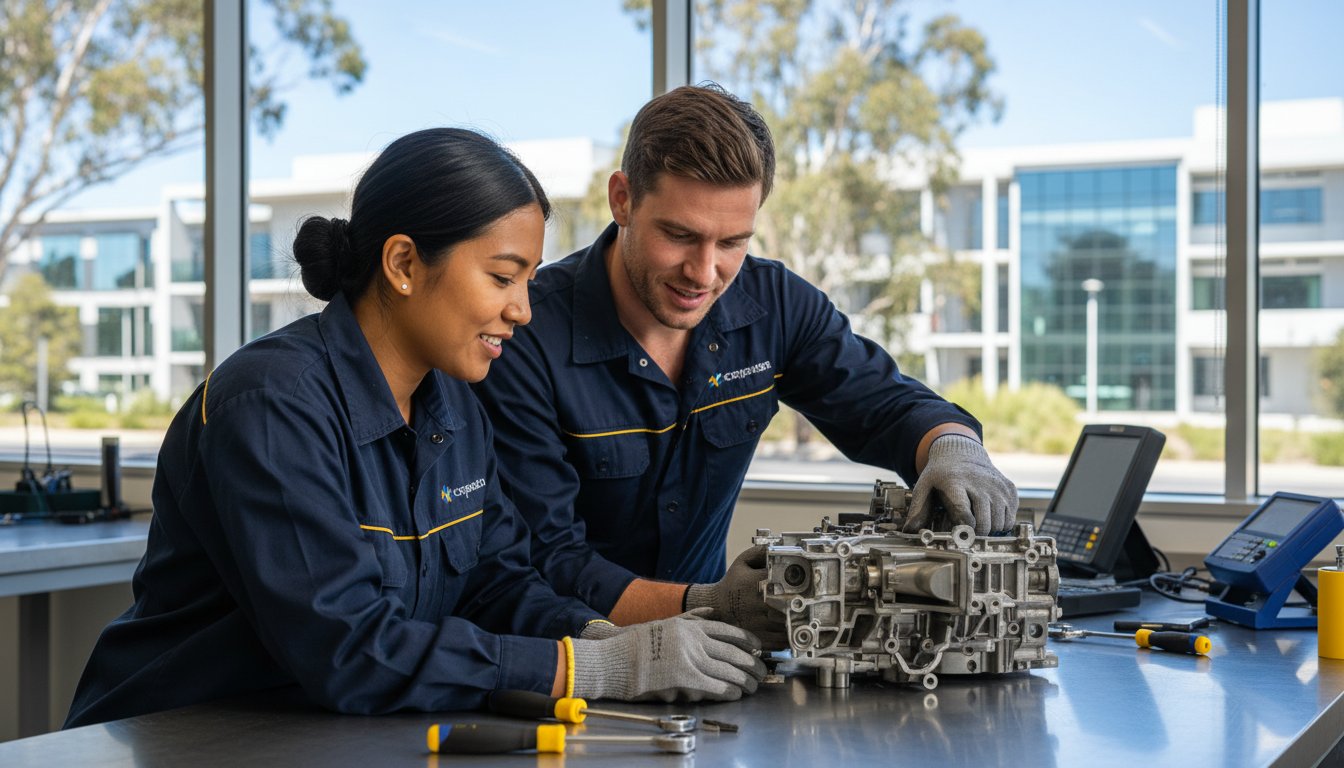
What if your years of on-site experience or office management were already worth a formal qualification? It is frustrating to feel like your hard-earned skills are invisible just because you lack a specific piece of paper. You might be feeling confused about the difference between TAFE and private providers, or perhaps you are worried about keeping your visa compliant while you study. Finding the right vocational college Australia has to offer shouldn't feel like a second job.
We understand that you want a clear path to career progression without wasting time on things you already know. This guide will show you how to navigate the Australian VET system to gain nationally recognised qualifications through either structured study or Recognition of Prior Learning. We will break down the latest 2026 loan caps, explain the May 2026 RPL policy updates, and help you choose a pathway that meets strict industry certification requirements for your next big promotion.
Key Takeaways
- Learn how a vocational college Australia can bridge the gap between your current skills and a nationally recognised qualification through practical, industry-led training.
- Understand the Australian Qualifications Framework (AQF) and why a Certificate III remains the essential starting point for most Australian trades.
- Discover how Recognition of Prior Learning (RPL) can fast-track your career by converting your existing work experience into a formal diploma or certificate.
- Get practical tips on checking RTO and CRICOS registrations to ensure your chosen provider meets the highest national standards for quality and compliance.
- Explore how a student-centred approach and industry-expert trainers can support your professional growth within a diverse, global learning community.
What is a Vocational College in Australia? Understanding the VET Sector
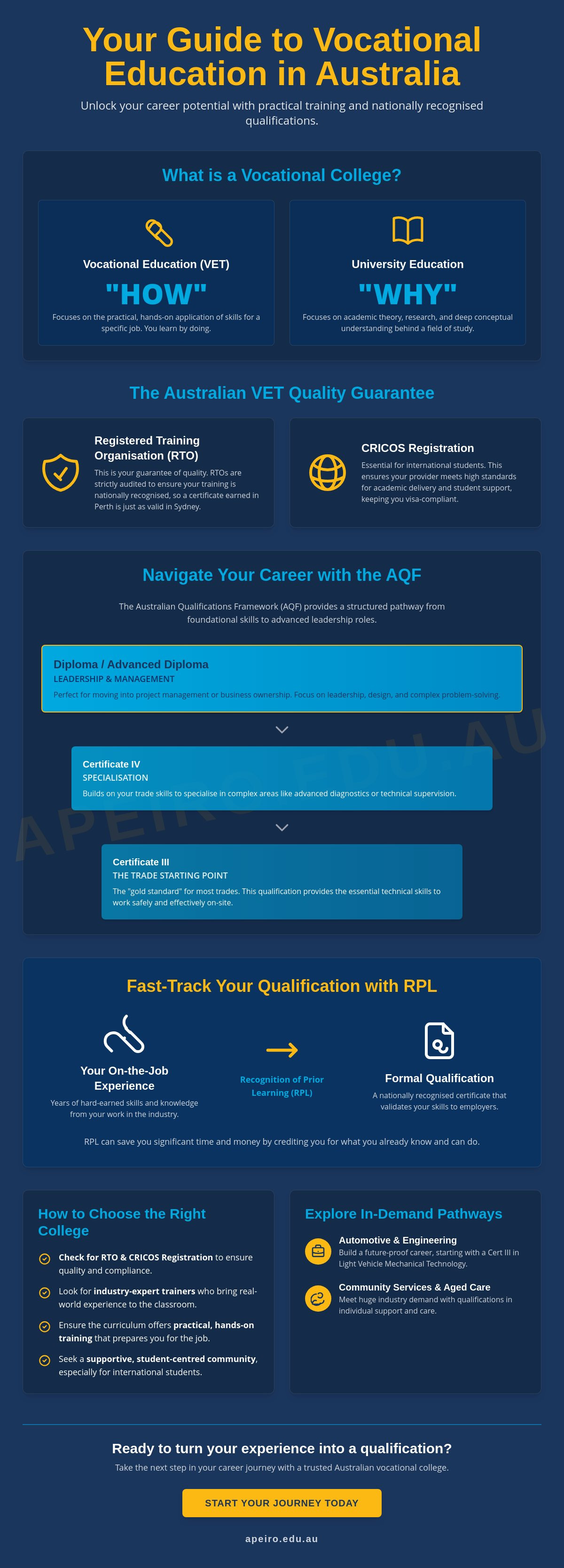
A vocational college Australia is a hub for practical, industry-led training. Unlike universities that often focus on academic theory and deep research, these colleges specialise in Vocational Education and Training (VET). The goal is straightforward: to give you the specific technical skills needed for a particular job. Universities tend to focus on "why" something works, whereas VET focuses on "how" to do it. This practical approach is why graduates often enter the workforce with high levels of confidence and job-ready expertise.
While some government-funded vocational training institutions exist, many students choose private vocational colleges for their smaller class sizes, flexible intakes, and specialised support. Both government-funded and private institutions are part of a world-renowned VET system. Australia’s VET sector is famous for its rigorous quality standards, ensuring that every graduate meets the high expectations of local employers. It’s about bridging the gap between a textbook and the "on-the-tool" reality of a modern workplace.
The Role of Registered Training Organisations (RTOs)
To deliver these courses, a vocational college must be a Registered Training Organisation (RTO). This isn't just a label; it's a guarantee of quality. RTOs are strictly audited to ensure they meet the Standards for RTOs 2025. This means your training is nationally recognised, so a certificate earned in Perth is just as valid in Sydney or Brisbane. Choosing an RTO that understands the local Australian workforce ensures your training aligns with what bosses are actually looking for right now. It provides a level of security for your investment in your future career.
CRICOS: Essential Information for International Students
If you are coming from overseas, you'll need to look for the CRICOS code. The Commonwealth Register of Institutions and Courses for Overseas Students (CRICOS) is mandatory for any college teaching international student visa holders. It ensures the education provider meets high standards of care and academic delivery. A good vocational college Australia creates a supportive environment for its global student community. You'll find a balance between hands-on practical training and the specific requirements of your international study programme, helping you stay compliant while you build your future in a new country.
Australian Qualifications Framework (AQF): Certs, Diplomas, and Beyond
Understanding the Australian Qualifications Framework (AQF) is the first step toward a successful career. This national policy regulates all qualifications in Australian education, ensuring your certificate or diploma is respected by employers nationwide. When you enrol in a vocational college Australia, you aren't just taking a class; you're moving through a structured hierarchy designed to build your expertise. This system allows you to start with foundational skills and progress all the way to high-level management roles without losing credit for what you've already achieved.
For most trades, a Certificate III is the "gold standard" for entry. It provides the essential technical skills required to work safely and effectively on-site. As your career matures, you might consider a Diploma or Advanced Diploma. These higher levels focus on leadership, design, and complex problem-solving. They are perfect for those ready to move off the tools and into project management or business ownership. Choosing the right level depends on your current experience and where you want to be in five years.
Automotive and Engineering Pathways
The automotive industry is evolving rapidly, making formal qualifications more important than ever. Aspiring mechanics should start with the AUR30620 Certificate III in Light Vehicle Mechanical Technology. It's the foundational requirement for anyone serious about the trade. Once you've mastered the basics, you can specialize in diagnostics with a Certificate IV. For those looking toward the infrastructure sector, engineering and electronics courses provide the technical depth needed for modern Australian projects. If you're unsure which path fits your goals, our team can help you map out your journey.
Community Services and Aged Care
There is a massive, growing demand for skilled workers in individual support and aged care across Australia. These roles require a unique blend of empathy and technical knowledge. A Certificate III in Individual Support is the typical starting point, but moving into a Diploma of Community Services is how you prepare for leadership in the not-for-profit sector. These courses aren't just about classroom learning. They involve mandatory work placement hours, ensuring you have real-world experience before you graduate. It's a practical way to ensure you're ready for the challenges of a rewarding career in care.
Fast-Tracking Your Career: Recognition of Prior Learning (RPL)
"I’ve been doing this for 10 years, why do I need to go back to school?" This is the most common question we hear from experienced workers. If you already have the skills, sitting in a classroom for months feels like a redundant use of your time. This is where a vocational college Australia offers a smarter alternative. Recognition of Prior Learning (RPL) acknowledges that learning happens everywhere, not just behind a desk in a traditional classroom setting.
RPL is about turning your "on-the-job" experience into a formal, nationally recognised qualification. This pathway is a critical part of Understanding the VET Sector in Australia. Initiatives like Trade Pathways for Experienced Workers (TPEW) specifically target those who have the "know-how" but lack the "paper." With the new RPL policy update that came into effect on 1 May 2026, the process is now more streamlined. By using RPL, you can cut months or even years off your time at a vocational college Australia, allowing you to get back to work with the credentials you deserve.
The RPL Assessment Process
You start the process by collecting evidence of your existing expertise. This includes photos of your work, videos of you performing technical tasks, references from previous employers, and detailed work logs. Next, you'll have a competency conversation with an industry expert to demonstrate your knowledge. If you are missing a small piece of the puzzle, you only need to complete "gap training" for those specific units rather than the entire course.
Benefits for Skilled Tradespeople
For skilled tradespeople, an RPL certificate is often the final step needed to apply for a formal trade licence in your state. It also significantly increases your earning potential by making you "paper-qualified" for government contracts or senior roles. Simply put, Recognition of Prior Learning is a formal assessment of your existing skills and knowledge, regardless of where or how they were originally learned.
How to Choose the Best Vocational College for Your Career
Selecting the right vocational college Australia is about more than just finding a convenient location. It is a decision that shapes your professional future. Your first step should always be a compliance check. Ensure the provider is a Registered Training Organisation (RTO) by searching training.gov.au. If you are an international student, the college must also have a valid CRICOS registration. These are the baseline requirements that guarantee your qualification will be recognised by employers and regulatory bodies across the country.
Once you've confirmed their registration, look closer at the people who will be teaching you. The best trainers are former "tradeys" or industry professionals who have spent years on-site or in the field. They bring a level of practical "know-how" that a textbook simply cannot provide. You should also evaluate the learning environment. Modern facilities and a diverse student community, representing dozens of different nationalities, create a more inclusive and global perspective. Flexibility is also vital. Whether you prefer campus-based learning, online modules, or workplace-based training, your college should offer a delivery mode that fits your current life and work schedule.
Evaluating Industry Connections
A college is only as good as its industry links. Institutions that maintain strong ties with local businesses often provide better job outcomes for their graduates. Ask potential providers about their work placement partners and employer networks. Industry standards in Australia change rapidly. For instance, in the automotive sector, it is essential that trainers are updated on electric vehicle (EV) technology and modern diagnostic tools. A college that stays ahead of these trends ensures you aren't learning outdated methods that won't apply to a modern workshop.
In the same vein, the scientific and laboratory sectors require a commitment to precision and quality; many professionals in these fields explore Research Peptides from Peptide Research AU to ensure their projects meet rigorous Australian standards.
Understanding Government Funding and Fees
Navigating the cost of education can feel overwhelming, but there are many pathways to make it more affordable. Depending on your location and eligibility, you might have access to state-funded initiatives like NSW Smart and Skilled. It's important to distinguish between fee-for-service courses and government-subsidised training, as the latter can significantly reduce your personal investment. Many apprentices and trainees may even find "fee-free" opportunities for certain high-demand certificates. If you need help figuring out which financial pathway is right for you, speak with our student support team today.
Apeiro Institute: Your Partner in Australian Vocational Excellence
At Apeiro Institute, we believe your education should be as unique as your career goals. Choosing the right vocational college Australia is a significant step, and we are here to act as your empowering mentor throughout the process. As a nationally recognised Registered Training Organisation (RTO 45394) and a registered CRICOS provider (03703M), we maintain the highest standards of academic integrity and student care. Our community is a vibrant, global hub where students from over 38 different nationalities come together to learn, grow, and build their futures in Australia.
We provide practical, industry-focused training across several high-demand sectors, including Automotive, Business, Civil Construction, and Community Services. Whether you are looking to start an apprenticeship or you are interested in our specialist Trade Pathways for Experienced Workers (TPEW), our programmes are designed to meet real-world needs. We don't just teach from a textbook. We ensure our graduates possess the tangible skills that Australian employers value most. Our student-centred approach means we are deeply invested in your personal growth and professional success from the moment you first enquire.
Why Students Across Australia Choose Apeiro
Our trainers are the backbone of our institute. They aren't just educators; they are industry veterans who bring years of real-world experience directly into the classroom. This ensures that the "on-the-tool" reality we discuss in our workshops is current and relevant to modern Australian standards. We offer flexible pathways that suit everyone from young learners starting their first Certificate III to seasoned professionals looking to formalise their expertise through Recognition of Prior Learning (RPL). We treat every student as a future industry leader, providing a supportive environment where you can build confidence and secure your career progression.
Start Your Journey Today
Taking the first step toward a nationally recognised qualification is easier than you might think. If you are worried about how your existing experience fits into the Australian system, we can help. You can enquire about our current course intakes or request a preliminary RPL assessment to see how much time you could save. Our team is ready to guide you through the enrolment process, explain your funding options, and help you choose the course that aligns with your ambitions. It is time to turn your hard work into a qualification that opens doors. Speak to an Apeiro mentor about your career goals today and discover how we can help you succeed in the Australian workforce.
Take the Next Step in Your Professional Journey
The Australian vocational education system is designed to reward your hard work; whether that learning happened in a classroom or on a busy job site. By understanding the AQF levels and leveraging pathways like Recognition of Prior Learning, you can secure the credentials you need without repeating what you already know. Finding the right vocational college Australia is about choosing a partner that values your background and focuses on your tangible career outcomes.
Apeiro Institute is proud to be that partner. As a nationally recognised RTO (45394) and CRICOS provider (03703M), we support a diverse community representing over 38 nationalities. We are specialists in Trade Pathways and RPL, ensuring your existing experience is never wasted. Whether you are looking to enter a new trade or move into senior management, our expert mentors are here to guide you every step of the way.
Explore Nationally Recognised Courses at Apeiro Institute and start building the career you deserve today. Your professional future is within reach, and we are ready to help you achieve it.
Frequently Asked Questions
What is the difference between a vocational college and a university in Australia?
Vocational colleges focus on practical, hands-on skills and technical training designed to get you straight into the workforce. While universities prioritise academic theory and research, a vocational college Australia provides industry-led instruction for specific roles. VET courses are generally shorter and more affordable, making them an excellent choice for those wanting job-ready expertise in trades or services.
Can I get a trade qualification based on my work experience without studying?
Yes, you can achieve this through a process called Recognition of Prior Learning (RPL). If you have significant experience in a trade like automotive or construction, you can provide evidence of your skills to an assessor. This evidence can include work logs, photos, and references. If you meet the national standards, you can receive a formal qualification without attending full-time classes.
Are vocational courses in Australia recognised internationally?
Australian vocational qualifications are highly regarded across the globe due to the strict standards of the Australian Qualifications Framework (AQF). Many countries recognise these certificates and diplomas because they know the training is rigorous and practical. This global reputation makes it easier for graduates to find work or continue their education in various international markets.
How long does a typical vocational course take to complete?
The duration varies depending on the qualification level and your study mode. A Certificate III usually takes between six and twelve months, while a Diploma or Advanced Diploma can take up to two years. If you use Recognition of Prior Learning, you can often finish much faster by skipping the units you already know through your previous work experience.
What is a CRICOS provider and why does it matter for international students?
CRICOS stands for the Commonwealth Register of Institutions and Courses for Overseas Students. It is a mandatory registration for any provider that offers courses to international student visa holders. Choosing a CRICOS-registered vocational college Australia ensures that the institution meets national quality standards and that your enrolment is legally compliant with your visa requirements.
Can I work while studying at a vocational college in Australia?
Most students choose to work while completing their studies to gain extra experience and support themselves. International students on a student visa typically have work rights, though they must adhere to the specific hour limits set by the Department of Home Affairs. Domestic students do not have these restrictions and often balance their training with full-time or part-time employment.
What industries have the highest demand for vocational graduates in 2026?
Construction, healthcare, and the automotive sector continue to see the highest demand for skilled workers this year. With Australia’s focus on infrastructure and an ageing population, there is a massive need for civil designers, aged care workers, and mechanical technicians. Gaining a qualification in these fields often leads to faster career progression and greater job security due to ongoing skill shortages.
How do I know if a vocational college is legitimate?
You can verify any provider's legitimacy by checking the national register at training.gov.au. Every legal vocational college must be a Registered Training Organisation (RTO) and have a unique RTO code. If they are not listed as "current" on this government database, they are not authorised to issue nationally recognised Australian qualifications. Always check this before paying any fees.

Disclaimer
The information provided on this blog is for general informational and educational purposes only. While every effort is made to ensure the accuracy and reliability of the content, the author makes no representations or warranties of any kind, express or implied, about the completeness, accuracy, suitability, or availability of the information contained on this blog.
The views and opinions expressed in blog posts are those of the individual author and do not necessarily reflect the official policy or position of any organization, company, or employer.
This blog may contain links to external websites or third-party content. These links are provided for convenience only, and the author has no control over and assumes no responsibility for the content, privacy policies, or practices of any third-party sites.
Nothing on this blog constitutes professional advice (legal, financial, medical, or otherwise). Readers are encouraged to seek appropriate professional guidance before making any decisions based on the information provided here.
By using this blog, you acknowledge that any reliance on the information is at your own risk.


