

What if the only thing standing between you and a leadership role is a shift in perspective? Many dedicated carers feel trapped in the physical demands of entry-level work, wondering if they can sustain this pace for the long term. You've likely mastered the day-to-day tasks, yet the path to a coordination role often feels blocked by confusing paperwork or a lack of clear direction. Completing a Certificate IV ageing support (CHC43015) is the most effective way to turn that hands-on experience into a professional leadership career.
We recognise that your time is valuable and you shouldn't have to start from scratch when you already have years of industry knowledge. This 2026 checklist provides a clear roadmap to help you transition from support worker to team leader while navigating the latest regulatory standards. We'll break down the Recognition of Prior Learning (RPL) process, explain the impact of the new Aged Care Act, and show you how to secure the specialised skills required for a higher salary in Australia's evolving aged care sector.
Key Takeaways
- Understand how the Certificate IV ageing support shifts your focus from delivering daily care to coordinating services and leading teams.
- Identify the core competencies required for leadership, including the ability to facilitate person-centred planning and navigate the latest regulatory standards.
- Discover how to use Recognition of Prior Learning (RPL) to acknowledge your current industry experience and potentially shorten your study journey.
- Map out your career progression toward high-demand roles such as Care Service Team Leader, Supervisor, or Case Management Assistant.
- Learn the specific criteria for selecting a quality training provider that offers the flexibility needed to balance your study with existing work commitments.
What is the Certificate IV in Ageing Support (CHC43015)?
The Certificate IV ageing support (CHC43015) is widely recognised as the professional benchmark for workers ready to move into supervisory or coordination roles within the Australian aged care sector. While entry-level roles focus on the immediate physical needs of clients, this qualification prepares you for a higher level of responsibility and autonomous service delivery. In 2026, the industry is no longer just looking for carers; it's looking for skilled professionals who can navigate complex regulatory environments while maintaining a high standard of Elderly care. It's a qualification designed for those who want to be more than just a pair of hands. It's for those who want to be the brains behind the care plan.
This course represents a fundamental shift in your daily work. Instead of only "doing" the tasks, you'll learn how to facilitate, monitor, and review individualised care plans. This means you'll be the one ensuring that services actually meet the client's goals and comply with the latest national standards. You'll gain the confidence to lead teams and make decisions that directly impact the quality of life for older Australians.
The Core Differences: Certificate III vs Certificate IV
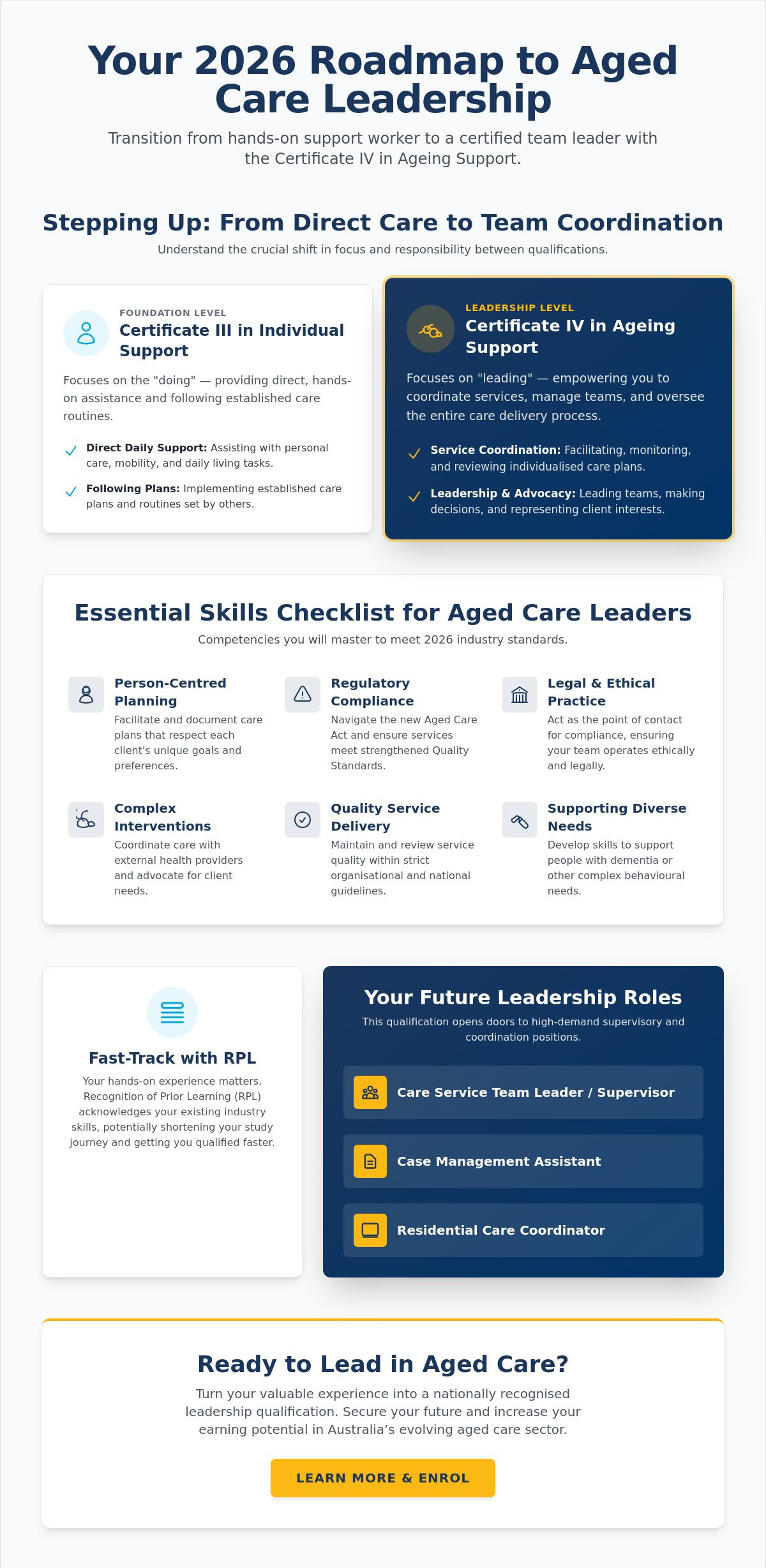
Understanding the transition between these two levels is essential for your career planning. The jump from an assistant to a supervisor involves more than just a new title; it requires a new set of cognitive and leadership skills.
- Certificate III focuses on direct daily living support, personal care, and following established routines.
- Certificate IV introduces leadership, advocacy, and the coordination of complex interventions.
- While a Certificate III in Individual Support teaches you how to assist a client, the Certificate IV empowers you to manage the entire service delivery process as a supervisor.
Why the Industry Needs Qualified Leaders in 2026
Australia's aged care landscape changed significantly with the commencement of the new Aged Care Act and strengthened Quality Standards in late 2025. These reforms created a massive demand for leaders who understand a rights-based model of care. Providers now face stricter oversight and higher transparency requirements, meaning they need coordinators who can document compliance and lead teams through these changes. Skilled leaders are the glue holding these new systems together.
The role of the Support Coordinator has also become vital as the aged care and NDIS sectors continue to overlap. If you're interested in how these sectors are evolving together, you can read more about the future of disability support and current training trends. In this new era of care, having a qualification that proves you can lead a team isn't just an advantage; it's a necessity for career longevity and security.
The Essential Skills Checklist for Aspiring Aged Care Leaders
Moving into a leadership role requires a specific toolkit. It isn't just about working harder; it's about working differently. To succeed in a Certificate IV ageing support, you need to bridge the gap between providing daily care and managing the systems that deliver it. This transition involves mastering several high-level competencies that are now critical under the 2025 regulatory reforms. You're no longer just a member of the team. You're the one ensuring the team functions at its best.
The ability to facilitate person-centred service planning is the cornerstone of modern care. You'll be responsible for ensuring that every client's unique preferences are documented and respected. Advocacy is another major pillar. You must be prepared to represent the interests of those in your care, especially when coordinating complex interventions with external health providers. Leading a small team in a residential setting also means you are the primary point of contact for legal and ethical compliance. You can find the official CHC43015 qualification details to see how these units are structured to build your supervisory authority.
Technical Competencies: What You Will Master
You'll learn to develop and review individualised service plans that respect the rights of diverse clients. This includes maintaining quality delivery within strict organisational guidelines and the new Aged Care Quality Standards. Supporting people with dementia or complex behavioural needs is a core part of this mastery. It requires a deep understanding of non-pharmacological interventions and person-first approaches. This technical mastery within a Certificate IV ageing support programme ensures you can handle the shift from task-based care to outcome-based coordination.
Soft Skills for Senior Support Workers
Senior workers often face the challenge of being the link between different groups. You'll need to master conflict resolution to handle high-pressure situations with empathy and clarity. This is especially true when communicating with families or medical staff. Empowering your colleagues through mentoring is just as important as the clinical side of the job. You'll help junior staff manage their own workloads while improving their practical skills. Without strong prioritisation, the physical demands of care can quickly overwhelm your administrative duties. If you feel you need to strengthen your foundational knowledge before taking this step, reviewing the core units in a Certificate III in Individual Support is a practical way to prepare for the jump in responsibility.
Entry Requirements and the RPL Pathways Checklist
Entering a higher-level qualification requires a solid foundation. Most training providers look for basic Language, Literacy, and Numeracy (LLN) skills to ensure you can handle the reporting and coordination tasks expected of a leader. While not always a strict prerequisite, having a Certificate III in Individual Support is the most common and effective starting point. It provides the clinical base you'll build upon during your Certificate IV ageing support journey. If you're already working in the sector, you likely have many of the foundational skills needed to succeed at this next level.
If you've been in the industry for years, you shouldn't have to repeat what you already know. Recognition of Prior Learning (RPL) is a formal process that assesses your existing skills against the course units. This can significantly reduce your study time and let you focus on new leadership concepts. At Apeiro Institute, we specialise in Trade Pathways for Experienced Workers (TPEW), helping seasoned carers get the formal qualification that matches their actual workplace prowess. It's a practical way to respect your history in the sector while accelerating your future.
The Recognition of Prior Learning (RPL) Checklist
To determine if you're a candidate for an accelerated pathway, use this quick self-assessment. If you can tick these boxes, you may be able to fast-track your qualification:
- Do you have at least 2 years of recent industry experience in an Australian aged care setting?
- Can you provide third-party reports or references from a current or previous supervisor?
- Do you have documented evidence of leading care plan reviews or coordinating team tasks?
- Have you maintained up-to-date records of professional development or internal training?
For a deeper dive into how this process works, check out our guide on Trade Pathways for Experienced Workers Australia. This resource explains how to gather your evidence and what to expect during the assessment.
Work Placement Requirements
Vocational placement is where theory meets the real world. For the CHC43015 qualification, you must complete a mandatory 120 hours of work placement in a registered aged care facility. This is a non-negotiable requirement to ensure you can apply supervisory skills in a live environment. Many students worry about balancing these hours with their current jobs. Often, if you're already working in a suitable facility, your training provider can approve your current workplace as your placement site. This allows you to gain your qualification while you continue to earn. Educational institutions like the University of Wollongong also highlight this practical requirement as a key step in professional development. We'll guide you through the documentation needed to verify these hours and ensure the site meets national standards.
Career Outcomes: Where Can a Certificate IV Take You?
Completing your qualification opens doors that remain closed to those with only foundational training. In the 2026 Australian market, the demand for senior staff has reached an all-time high due to the recent Support at Home program reforms. You aren't just looking at a job title change; you're looking at a significant shift in your earning potential and daily influence. As of June 2026, the average annual salary for workers in this sector ranges between $80,000 and $90,000. For those stepping into Team Leader positions, you can expect an hourly rate between $38.00 and $40.00, reflecting the increased responsibility of the role.
Your career trajectory with a Certificate IV ageing support can lead to several specialised paths. You might choose to stay close to clinical settings or move toward the administrative side of care coordination. Common roles include:
- Care Service Team Leader or Supervisor: You'll manage daily operations and lead a team of support workers to ensure high-quality care delivery.
- Case Management Assistant or Support Coordinator: This role involves liaising between clients, families, and medical professionals to manage complex care requirements.
- Community Program Coordinator: You'll design and implement social and recreational programs that promote wellbeing and independence for older Australians.
Stepping into Management
For many, this qualification acts as the essential bridge to higher-level management. It facilitates the transition from hands-on physical labour to administrative and strategic oversight. Once you've mastered the Certificate IV, you're perfectly positioned to progress into a Diploma of Community Services. This pathway allows you to move into senior management roles where you influence policy and organisational strategy. This qualification provides the long-term career value needed to stay relevant in an industry that is increasingly professionalised and regulated.
Specialising in Home and Community Care
The Australian aged care strategy has shifted heavily toward home-based care. With the Support at Home program fully operational as of late 2025, there is a massive need for coordinators who can manage mobile teams. You'll spend your time coordinating remote service delivery and advocating for client rights within their own homes. This role requires a high level of autonomy and the ability to make quick, ethical decisions on the go. If you're ready to move beyond entry-level tasks and lead the future of Australian care, you can enrol in our Certificate IV ageing support program today and start your journey toward a leadership role.
Selecting Your Training Provider: The Quality RTO Checklist
Choosing the right Registered Training Organisation (RTO) is the final, most critical step in your leadership journey. You need a provider that doesn't just teach from textbooks but actively integrates the latest operational standards into their curriculum. A quality provider acts as your mentor, ensuring you're ready for the current workforce expectations. Before you commit, use this checklist to evaluate your options and ensure your Certificate IV ageing support delivers the professional value you deserve.
- CRICOS Registration: Verify if the provider is a CRICOS-registered RTO. This registration ensures they meet high national standards for quality and accountability, providing peace of mind for both local and international students.
- Flexible Learning: Look for flexibility. Most aspiring leaders are already working full-time; you need a programme that offers blended or evening options to suit your roster.
- Industry Alignment: Practicality is non-negotiable. Ensure the training includes hands-on components that mirror real-world coordination and supervisory tasks.
- Student Support: Check their support systems. You should have access to dedicated mentors and student advisors who understand the unique challenges of the Australian aged care sector.
The Apeiro Institute Advantage
At Apeiro Institute, we take pride in delivering nationally recognised training that feels personal and inclusive. Our instructors are industry experts who have navigated the same career shifts you're currently facing. We place a heavy emphasis on student-centred support, ensuring you never feel overwhelmed by the transition to supervisory work. One of our key strengths is our expertise in Trade Pathways for Experienced Workers (TPEW). We recognise the immense value of your existing hands-on experience and work tirelessly to ensure it's formalised through a streamlined RPL process. This approach respects your history while accelerating your move into management.
Enrolment Steps and Next Actions
Ready to take the next step? Your first move should be requesting a free RPL assessment. This simple action helps you understand how much of your current experience counts toward your Certificate IV ageing support, potentially saving you months of study. You should also explore your funding options. Depending on your location and eligibility, you may be able to access government-subsidised training or flexible payment plans designed for working professionals. We recommend booking a consultation with one of our student advisors. They can help you map out a clear career path and ensure you're choosing the right elective units to meet your specific goals in coordination. Your leadership career is waiting; let's get started.
Take Charge of Your Professional Growth
Stepping into a supervisory role is about more than just a new job title; it's about gaining the authority to shape the future of care for older Australians. We've explored how the Certificate IV ageing support provides the technical mastery and leadership skills needed to thrive in a rights-based care environment. By utilising our expert RPL assessment for experienced workers, you can turn your years of hands-on dedication into a nationally recognised qualification faster than you might think. This transition allows you to move away from the physical strain of entry-level work and into a rewarding career in coordination and management.
Apeiro Institute is proud to offer Nationally Recognised Training (RTO 45394) and serves as a CRICOS Provider for international students. This ensures every learner receives the professional guidance and support they need to succeed in Australia's booming aged care sector. Whether you're aiming for a team leader position or moving into complex case management, the roadmap is now in your hands. You already have the passion and the experience; now it's time to get the credentials that match your expertise.
Take the next step in your aged care career, Enquire about the Certificate IV in Ageing Support today. We're here to help you navigate your enrolment and support your journey toward becoming a leader in the industry.
Frequently Asked Questions
Is the Certificate IV in Ageing Support hard if I already have a Cert III?
It isn't necessarily harder in terms of physical labour, but it does require a different mindset and more administrative focus. While the Certificate III focuses on direct care tasks, the Certificate IV ageing support introduces more complex documentation, leadership, and service coordination. You'll move from following care plans to reviewing and adjusting them. If you're already comfortable with the basics of individual support, you'll find this a natural and manageable progression.
Can I get a Certificate IV in Ageing Support through RPL?
Yes, you can certainly use Recognition of Prior Learning (RPL) if you have significant industry experience. Most providers look for at least two years of recent experience in an Australian aged care setting to qualify. By providing evidence like third-party reports and workplace documentation, you can bypass units you've already mastered. This is a practical way to fast-track your qualification and focus only on the new leadership skills you need to advance.
How much more can I earn with a Certificate IV compared to a Certificate III?
Stepping up to a Certificate IV can significantly increase your hourly rate as you move into supervisory roles. In the 2026 market, a Team Leader can expect to earn between $38.00 and $40.00 per hour. This is a noticeable jump from the standard support worker rate, which typically ranges from $31.00 to $38.00. These figures reflect the 4.75% increase for modern award wages implemented by the Fair Work Commission in July 2026.
What is the duration of the CHC43015 course in 2026?
The duration typically ranges from six to twelve months depending on your study mode and existing experience. If you're studying full-time, you might complete the theory and placement components within six months. Part-time students or those balancing work often take closer to a year to finish. If you're eligible for RPL, your study time could be reduced even further as you won't need to complete every single unit from scratch.
Do I need to find my own work placement for the Certificate IV?
You don't always have to find your own placement, as many RTOs have established partnerships with aged care facilities to help students. However, if you're already employed in the sector, your current workplace can often be approved for your mandatory 120 hours of vocational placement. This allows you to meet the course requirements while continuing to work with the residents you already know. Your training provider will guide you through the necessary documentation to verify these hours.
Can international students study the Certificate IV in Ageing Support?
Yes, international students can enrol in this course through CRICOS-registered providers in Australia. These programs are specifically designed to meet visa requirements while providing the same nationally recognised training as domestic courses. It's a popular choice for those looking to build a career in Australia's essential services. You'll gain practical skills that are in high demand across the country, ensuring your training remains relevant and valuable in the global market.
What jobs can I get with a Certificate IV in Ageing Support?
This qualification prepares you for several leadership and coordination roles within residential or community settings. You could work as a Care Service Team Leader, a Support Coordinator, or a Community Program Coordinator. These roles involve managing small teams, advocating for client rights, and ensuring services meet the new Aged Care Quality Standards. It's the standard entry point for anyone looking to move beyond direct care and into professional management.
Is there government funding available for aged care courses in Australia?
Yes, there are several funding pathways available depending on your state and individual eligibility. In New South Wales, the Smart and Skilled program offers fee-free places for eligible students, while Victoria provides "Free TAFE" options for this specific qualification. These subsidies are designed to address the critical shortage of skilled workers in the sector. It's a great time to check your eligibility and reduce the out-of-pocket costs of your professional development.

Disclaimer
The information provided on this blog is for general informational and educational purposes only. While every effort is made to ensure the accuracy and reliability of the content, the author makes no representations or warranties of any kind, express or implied, about the completeness, accuracy, suitability, or availability of the information contained on this blog.
The views and opinions expressed in blog posts are those of the individual author and do not necessarily reflect the official policy or position of any organization, company, or employer.
This blog may contain links to external websites or third-party content. These links are provided for convenience only, and the author has no control over and assumes no responsibility for the content, privacy policies, or practices of any third-party sites.
Nothing on this blog constitutes professional advice (legal, financial, medical, or otherwise). Readers are encouraged to seek appropriate professional guidance before making any decisions based on the information provided here.
By using this blog, you acknowledge that any reliance on the information is at your own risk.


