

By 2050, Australia is projected to face a shortfall of over 400,000 direct-care workers in the aged care sector. This immense demand makes the Certificate III individual support ageing disability one of the most secure and meaningful qualifications you can hold today. You might feel a bit overwhelmed by confusing course codes or worry if you have the right personality for such a heart-centred role. It's completely normal to want certainty before you start your journey.
This guide provides a clear, supportive roadmap for obtaining the CHC33021 qualification in 2026. We'll break down the 120-hour work placement requirement, explain the differences between the ageing and disability streams, and show you how this certificate leads to immediate employment. Our goal is to help you turn your natural empathy into a professional career. Stable work. Purposeful outcomes. Let's get you started on a path where your skills are always in demand and your contribution truly matters in your local community.
Key Takeaways
- Understand why the CHC33021 is the gold standard foundational qualification for anyone starting a professional career in Australia’s care and support sectors.
- Explore the core units and the mandatory 120-hour work placement that ensure you're fully prepared for the practical, day-to-day demands of the role.
- Learn how to choose between ageing and disability streams, or how to combine both in your Certificate III individual support ageing disability for maximum career flexibility.
- Identify the essential entry requirements and clearances, such as LLN assessments and National Police Checks, needed to begin your enrolment smoothly.
- Discover how studying with a supportive RTO like Apeiro Institute can help you transition from the classroom to a rewarding job in residential care or community support.
Understanding the CHC33021 Certificate III in Individual Support
The Certificate III individual support ageing disability serves as the foundational qualification for anyone seeking a meaningful career in Australia’s care sector. It is more than just a training program; it is a nationally recognised credential under the Australian Qualifications Framework (AQF). This ensures that the skills you develop meet rigorous industry standards and are valued by employers in every state and territory. This qualification specifically prepares you to provide person-centred support to individuals who require assistance due to ageing, disability, or other functional limitations.
At the heart of this course is a philosophy of empowerment. The "Individual Support" framework teaches you to look beyond a person’s physical or cognitive limitations and focus on their unique strengths and preferences. You will learn how to help clients maintain their independence while respecting their dignity, privacy, and cultural background. As Australia’s population continues to age, the need for qualified workers has never been higher. Total government recurrent expenditure on disability services alone reached $51.1 billion in 2024-25, which highlights the massive scale and importance of the industry you are about to enter. To see how these principles are applied by community organisations, check out Crescent Care.
The Role of an Individual Support Worker
A support worker’s daily tasks are incredibly varied and rewarding. You might find yourself assisting a client with personal hygiene and dressing in the morning, then transitioning to domestic assistance such as meal preparation or light cleaning. However, the role goes much deeper than physical tasks. It is about social inclusion and emotional wellbeing. You act as a vital link, helping clients stay connected to their communities and participate in activities they enjoy. The Australian care sector has shifted toward consumer-directed care, which gives clients more control over the services they receive. Whether you are working within the NDIS or providing Aged Care in Australia, your role is to facilitate the client's choices and help them live life on their own terms.
Why 2026 is the Best Time to Start
There has never been a more strategic time to enter this field. Workforce shortages are a significant challenge, with projections indicating a shortfall of over 211,000 full-time equivalent positions by 2049-50. This high demand translates to excellent job security and diverse career paths for new graduates. You could find employment in residential facilities, community centres, or even in clients' private homes. By enrolling in the CHC33021 Certificate III in Individual Support (Ageing and Disability) in 2026, you position yourself at the forefront of a vital industry. The Certificate III individual support ageing disability provides a direct route into a resilient job market where your contribution provides a lifeline to some of the most vulnerable members of our society.
How the Qualification Works: Units, Streams, and Practical Experience
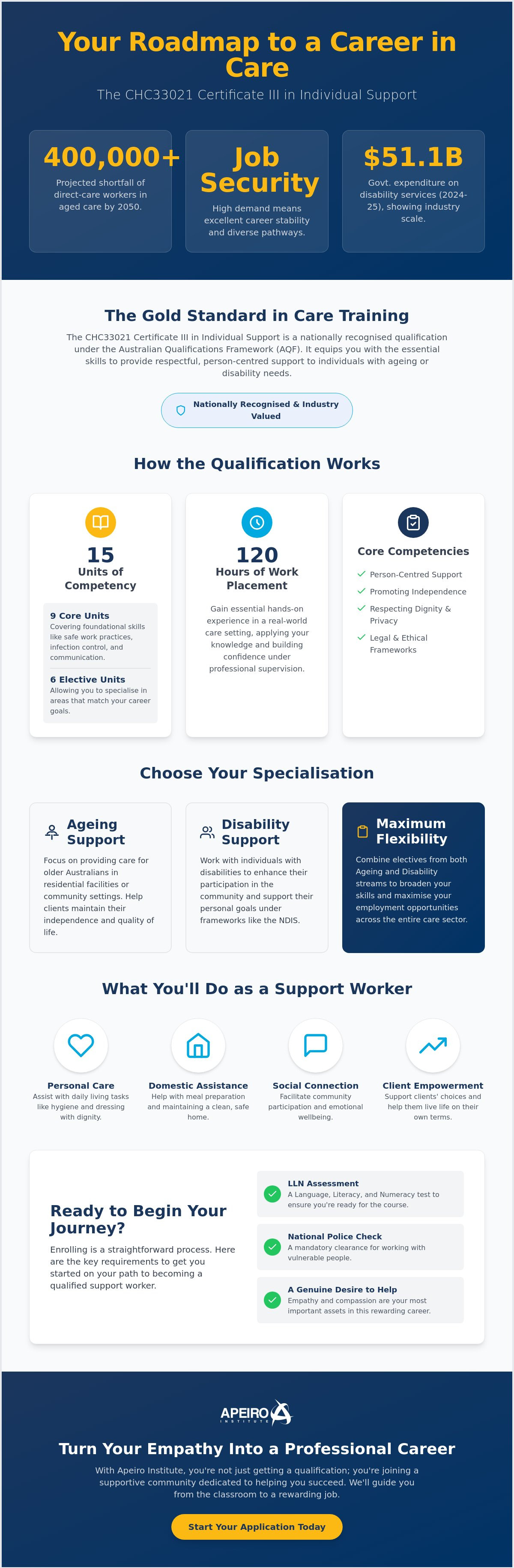
To become a qualified support worker, you need a mix of classroom knowledge and hands-on experience. The CHC33021 Certificate III in Individual Support is designed to provide exactly that. This qualification consists of 15 units of competency, including 9 core units and 6 elective units. You'll dive into essential topics like following safe work practices for direct client care and complying with infection prevention and control policies. Understanding how healthy body systems function is also a priority. These units provide the legal and ethical framework you'll need to work safely within the Australian care sector.
Beyond the core, you choose electives that define your specialisation. The Certificate III individual support ageing disability allows you to focus on the Ageing stream, the Disability stream, or a combination of both. Some students also look at Home and Community electives if they prefer working in a client's private residence rather than a residential facility. This flexibility ensures your training aligns with your personal career goals and the specific needs of your local community.
The Importance of the 120-Hour Work Placement
Placement is where your training truly comes to life. You are required to complete at least 120 hours of supervised work in a relevant care setting. This is your chance to move from textbooks to real-life interactions. During this time, you'll work in a residential facility or community centre under the guidance of experienced professionals. To make the most of it, treat every shift like a long job interview. Show initiative, ask questions, and build rapport with both staff and residents. Many students find that their placement host offers them a permanent role before they've even finished their studies.
Core Competencies You Will Master
Person-centred care is the industry gold standard where the individual's needs, preferences, and rights are the primary focus of all support activities. You'll learn how to empower people with disabilities by supporting their independence and helping them achieve personal goals. Similarly, you will master techniques for facilitating the empowerment of older people; this ensures they maintain a sense of agency and purpose in their daily lives.
Your progress isn't just measured by exams. Assessments are practical and varied. You'll build a portfolio of evidence, complete written tasks, and participate in direct observations where an assessor watches you perform tasks in a real or simulated work environment. If you're ready to start building these skills, you can explore the full unit list for the Certificate III in Individual Support (Ageing and Disability) to see which stream suits you best.
Choosing Your Specialisation: Ageing vs. Disability Support
Choosing between ageing and disability support is often the biggest hurdle for new students. While both paths focus on empowerment, the day-to-day reality can look quite different. In residential aged care, you'll likely work within a structured facility alongside a team of nurses and other carers. Conversely, disability support under the NDIS often involves one-on-one community access or providing support in a group home setting. Each environment offers unique rewards, whether it is the steady pace of a residential centre or the dynamic nature of community-based support.
To see how person-centred support is delivered in practice, learn more about Im with you, an Australian NDIS provider recognised for its high standard of quality care.
Many students find that the best approach is to complete a dual specialisation. Obtaining your Certificate III individual support ageing disability with both streams significantly boosts your employability. It makes you a versatile worker who can switch between sectors as job openings or your personal interests change. The CHC33021 Certificate III in Individual Support is specifically designed to allow for these elective choices; this ensures you aren't locked into just one career path from the start.
A common worry for prospective students is the physical demand of the role. While the work is active, modern healthcare has evolved. You aren't expected to lift clients manually. Instead, you'll be trained to use mechanical hoists, slide sheets, and standing aids. These safety protocols protect both you and the client. Emotionally, the requirements vary too. Ageing support often involves companionship and palliative care, while disability support might focus more on skill-building and social integration. New skills. Greater opportunities.
The Future of Disability Support
The NDIS has revolutionised how we think about disability support in Australia. It has shifted the power to the individual, creating a massive surge in demand for workers who can provide tailored, one-on-one care. You might help a client attend a local footy match or manage their weekly grocery shop. If you're curious about where this sector is heading, check out our guide on The Future of Disability Support: Trends and Courses in Australia for 2026. This shift toward individual choice means your role is more about partnership than just assistance.
The Evolving Landscape of Aged Care
Aged care is undergoing a major transformation following the Royal Commission. There is now a mandate for increased care minutes, meaning more staff are needed to ensure residents receive high-quality attention. This sector offers specialised paths in dementia support and palliative care. Once you've found your feet, you might even consider moving into a leadership role. Take a look at our Your Career Advancement Checklist for the Certificate IV in Ageing Support (CHC43015) to see how your career can grow beyond the basics.
How to Enrol and Prepare for Your Career in Care
Once you've decided on your specialisation, the next step is moving from research to action. Enrolling in a Certificate III individual support ageing disability is a straightforward process, but it requires some preparation to ensure you hit the ground running. Before you start, you'll need to complete a Language, Literacy, and Numeracy (LLN) assessment. Don't let this intimidate you. This isn't a "pass or fail" entrance exam; it's a supportive tool used by RTOs to identify if you need any extra help with your studies. It ensures you have the foundational skills to manage the course documentation and communicate effectively with clients.
Choosing the right provider is just as vital as the course itself. Look for an RTO that offers robust student support and, most importantly, placement assistance. Since the 120-hour work placement is a mandatory requirement, having a provider that helps you find a reputable host facility can save you a lot of stress. You want a learning environment that feels like a partnership, where mentors are available to guide you through both the theory and the practical realities of the care sector.
Step-by-Step Enrolment Process
The journey begins with your formal application. Most providers will invite you for an initial interview to discuss your career goals and ensure the course matches your expectations. This is the perfect time to ask about flexible study options. You should also confirm your eligibility for government subsidies. Depending on your state, programs like New South Wales’ "Smart & Skilled" or Western Australia’s "Fee-Free Training" may significantly reduce your out-of-pocket costs in 2026. Once accepted, you'll attend an orientation session to familiarise yourself with the online learning portal and meet your trainers.
Essential Clearances and Compliance
Safety is the top priority in the care industry. Before you can step foot in a facility for your placement, you must organise several mandatory clearances. A National Police Check is standard, and if you plan on working with younger clients, a Working with Children Check is also required. For those focused on the disability stream, an NDIS Worker Screening Check is now a vital requirement across Australia. You'll also need to provide evidence of specific vaccinations, including flu and COVID-19 shots, as required by current health regulations. Keeping these documents organised in a digital folder will make your transition to employment much smoother. Ready to take the first step? You can apply for the Certificate III in Individual Support (Ageing and Disability) today and begin your career in this essential sector.
Advancing Your Career with Apeiro Institute
Completing your Certificate III individual support ageing disability is a significant milestone, but it is often just the beginning of a much larger professional journey. At Apeiro Institute, we're committed to more than just helping you pass a course. We focus on industry-aligned training that translates directly into workplace success. Our approach values global perspectives and local reliability, creating an inclusive community where students from all backgrounds feel empowered to grow. We understand that starting a new educational path can feel like a big leap, so we act as your partner in every step of the process.
If you already have experience in other industries or have developed transferable skills through informal work, we can help you navigate the transition. Apeiro Institute has extensive expertise in helping individuals move into new roles through programs like Trade Pathways for Experienced Workers (TPEW). While this specific program often serves technical trades, it reflects our broader institutional commitment to recognising the value of your existing expertise. We believe your previous life and work experiences are assets that can enhance your care career, especially when combined with our nationally recognised training.
Pathways to Case Management and Leadership
Your journey doesn't have to stop at an entry-level position. The skills you master in the Certificate III individual support ageing disability provide a natural bridge to higher-level responsibilities. Many of our graduates choose to advance their expertise by enrolling in the Diploma of Community Services. This pathway opens doors to roles in case management, coordination, and leadership within residential facilities. If you've been working in the sector for a while, you might also be eligible for Recognition of Prior Learning (RPL). This process acknowledges your hands-on experience, potentially shortening the time it takes to gain advanced qualifications. Career growth. Professional recognition.
Why Choose Apeiro Institute?
Choosing where to study is a decision that impacts your future confidence. At Apeiro, our trainers are industry experts who bring real-world Australian care experience into the classroom. They don't just teach from a book; they share practical insights that prepare you for the nuances of daily care work. Our learning environment is designed to be supportive and student-centered, ensuring you never feel like just another number in a system. We provide the expert guidance you need to turn your passion for helping others into a stable, rewarding career that employers across Australia trust. Your future starts here, and we're ready to help you reach it.
Launch Your Career in Australia’s Essential Care Sector
The journey to becoming a qualified support worker is both practical and deeply rewarding. By choosing a Certificate III individual support ageing disability, you aren't just earning a qualification; you're building a foundation for a career that offers genuine job security and the chance to make a daily difference. We've explored how the CHC33021 course structure prepares you through core units and hands-on experience, and why dual specialisation is the smartest move for your future employability.
Now is the time to turn your natural empathy into a professional skillset. Apeiro Institute provides Nationally Recognised Training (RTO 45394) led by expert trainers with real-world industry experience. You'll receive dedicated placement support to ensure you gain the confidence needed for the workplace. Don't let uncertainty hold you back from a career where your skills are always in demand. Enrol in the CHC33021 Certificate III in Individual Support at Apeiro Institute today and take the first step toward a purposeful professional life. Your contribution to our community is vital, and we're ready to help you succeed.
Frequently Asked Questions
How long does it take to complete the Certificate III in Individual Support?
It typically takes between six to twelve months to complete your Certificate III individual support ageing disability. The exact duration depends on whether you choose to study full-time or part-time and how quickly you complete the required 120 hours of work placement. Some students prefer an intensive approach to enter the workforce faster, while others balance their training with existing family or work commitments. This flexibility makes it an ideal choice for career changers.
Can I work in aged care while I am still studying?
Yes, you can often find employment in the care sector while you're still completing your qualification. Many aged care facilities and disability service providers hire students as personal care assistants once they've finished their core units and initial work placement. This is a fantastic way to gain hands-on experience and start earning a wage while you finish your studies. It also helps you build valuable industry connections before you even graduate.
What is the difference between CHC33015 and CHC33021?
The CHC33021 is the current, nationally recognised qualification that has replaced the older CHC33015 version. This updated course reflects current industry standards and places a stronger emphasis on person-centred care and empowerment. It was designed to better align with the findings of the Royal Commission into Aged Care Quality and Safety. This ensures that graduates are equipped with the most up-to-date skills required by modern employers in Australia’s evolving care landscape.
Are there any prerequisites for enrolling in this course?
There are no formal academic prerequisites like a Year 12 certificate required for enrolment. However, you will need to complete a Language, Literacy, and Numeracy (LLN) assessment to ensure you can manage the course materials effectively. You must also be able to obtain essential clearances, such as a National Police Check and an NDIS Worker Screening Check, before you can begin your mandatory 120-hour supervised work placement. These steps ensure the safety of all clients.
How much do individual support workers earn in Australia?
Earnings for support workers in Australia vary based on your experience, the specific setting you work in, and the relevant industry award. Most workers are covered by the Social, Community, Home Care and Disability Services (SCHADS) Industry Award. Your income can also be influenced by shift work, weekend loadings, and whether you are employed on a permanent or casual basis. It's a field with steady growth and reliable income opportunities for qualified professionals.
Is the work placement paid or unpaid?
Work placement is generally unpaid as it forms a mandatory part of your vocational training and assessment. It's designed to give you a safe environment to practice your skills under professional supervision without the pressure of a standard employee role. Think of it as a valuable investment in your future career. Many students find that their placement leads directly to a paid job offer once they've demonstrated their skills and reliability to the host facility.
Can I complete the Certificate III in Individual Support online?
You can complete the theoretical components of your Certificate III individual support ageing disability through online or blended learning. This provides great flexibility if you need to study around other responsibilities. However, the 120 hours of work placement must be completed in person at a registered care facility or community setting. This ensures you master the practical, hands-on skills that are essential for providing high-quality support to your future clients in a real-world environment.
What happens if I already have experience in the care sector?
If you have significant experience in the care sector, you may be eligible for Recognition of Prior Learning (RPL). This process involves assessing your existing skills and knowledge against the course requirements. It can potentially reduce the number of units you need to study, allowing you to gain your qualification faster. You'll need to provide evidence of your experience, such as workplace documents, references, and proof of previous training or informal care work you've performed.

Disclaimer
The information provided on this blog is for general informational and educational purposes only. While every effort is made to ensure the accuracy and reliability of the content, the author makes no representations or warranties of any kind, express or implied, about the completeness, accuracy, suitability, or availability of the information contained on this blog.
The views and opinions expressed in blog posts are those of the individual author and do not necessarily reflect the official policy or position of any organization, company, or employer.
This blog may contain links to external websites or third-party content. These links are provided for convenience only, and the author has no control over and assumes no responsibility for the content, privacy policies, or practices of any third-party sites.
Nothing on this blog constitutes professional advice (legal, financial, medical, or otherwise). Readers are encouraged to seek appropriate professional guidance before making any decisions based on the information provided here.
By using this blog, you acknowledge that any reliance on the information is at your own risk.


