

A Light Vehicle Mechanical Technology apprenticeship typically takes four years to complete. It combines paid work with formal training towards the Certificate III in Light Vehicle Mechanical Technology, offering a practical pathway into the trade through trusted providers like Apeiro Institute.
An apprenticeship is a significant commitment, so it helps to understand what the training involves and how to get started. This guide outlines how apprenticeship training works, the entry requirements and the experience you can gain along the way. You’ll also learn how the qualification can support further study and possible career directions in the automotive industry, helping you decide whether this pathway suits your plans.
Key Takeaways
- Plan for an apprenticeship that typically takes four years and combines paid work with formal training.
- Understand how the Certificate III builds practical skills through tasks such as servicing, inspections and fault diagnosis.
- Explore the entry requirements and consider how prior experience may shape your training pathway.
- Use the apprenticeship as a foundation for further study, including the Certificate IV in Automotive Mechanical Diagnosis.
- Compare the training structure and qualification options to identify the next step that fits your automotive career goals.
How long is a light vehicle mechanic apprenticeship?
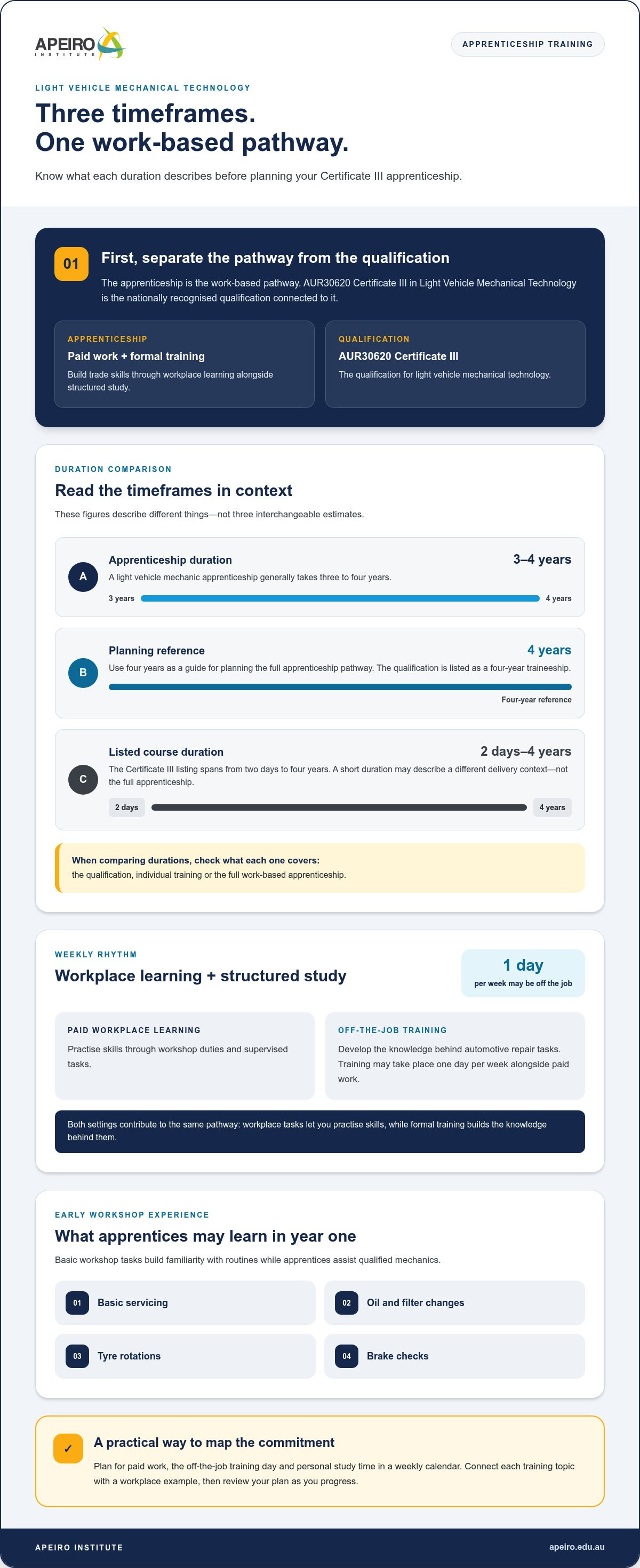
A light vehicle mechanic apprenticeship in NSW generally takes three to four years. The relevant qualification is AUR30620 Certificate III in Light Vehicle Mechanical Technology. For planning, use four years as a reference: the qualification is listed as a four-year traineeship. The apprenticeship combines workplace experience with formal training, building skills for light vehicle mechanical work.
The apprenticeship and the qualification describe connected, but different, parts of training. The apprenticeship is the work-based pathway; AUR30620 is the nationally recognised Certificate III. Off-the-job training may be delivered one day per week alongside paid work. Your training plan connects both settings, helping you develop practical capability and the knowledge behind automotive repair tasks.
In NSW, qualification requirements depend on the motor vehicle repair class. Under section 4 of the Motor Dealers and Repairers Act 2013, qualification requirements for each class are approved by the Commissioner for Fair Trading. AUR30620 is for light vehicle mechanical technology. It doesn’t automatically cover every motor vehicle repair class, so match the qualification to the work you plan to perform.
Heavy commercial vehicle work is a separate pathway. If you want to repair heavy vehicles, identify the qualification approved for that repair class rather than assuming the light vehicle Certificate III applies. If you’re choosing between passenger vehicles and heavy commercial vehicles, first decide which type of work interests you, then align your training with that class.
AUR30620 develops skills across servicing, inspections, testing, fault diagnosis and repair. It also covers battery charging and part replacement. A learner might inspect a vehicle, assess test results and follow a repair process under qualified supervision. These connected tasks help explain how formal learning relates to workshop practice.
Workshop work can involve hazards, so safe work practices matter. In NSW, you must complete your apprenticeship before applying for a motor vehicle tradesperson certificate. Keep track of your training progress and the repair class your qualification relates to.
If you’re unsure whether you’ve completed your apprenticeship, Training Services NSW can be contacted on 13 28 11. To plan your pathway, identify your intended vehicle class, then match it to the relevant qualification. For light vehicle mechanical work, AUR30620 Certificate III in Light Vehicle Mechanical Technology is the qualification to consider.
Apprenticeship duration and training
Plan for a pathway that combines paid workplace learning with formal training. The duration depends on whether you mean the apprenticeship or the qualification’s listed course duration.
Apprenticeship duration
A light vehicle mechanic apprenticeship generally takes three to four years to complete, with four years a useful guide for planning the full pathway. You build trade skills while working, rather than completing all your learning in a classroom.
Off-the-job training may take place one day per week alongside paid work. Your routine can therefore include both workshop duties and structured study. When planning, consider how the training day fits around your work responsibilities and how you’ll keep track of learning in each setting.
The two parts complement each other: workplace tasks let you practise skills, while off-the-job training develops the knowledge behind them. Think about how you’ll organise study time around work, and keep a record of the tasks and training you complete. A clear routine can make a long apprenticeship easier to manage.
Course duration
The listed duration for the Certificate III in Light Vehicle Mechanical Technology ranges from 2 days to 4 years. That range makes it important to distinguish a course-duration listing from the time needed to finish an apprenticeship. A short duration may refer to a different delivery context, rather than the full apprenticeship pathway.
For a realistic plan, focus on the qualification and training arrangement for your pathway. The apprenticeship generally takes three to four years, while the Certificate III traineeship is listed as four years. When comparing these durations, clarify what each covers: the qualification, individual training or the full work-based apprenticeship.
In the first year, apprentices may learn basic servicing, oil and filter changes, tyre rotations and brake checks, while assisting qualified mechanics. These tasks build familiarity with workshop routines before you move on to more involved learning. Keep notes on what you practise, the training that supports it and the skills you want to develop further.
A practical way to organise your progress is to connect each training topic with a workplace example. For instance, link servicing theory with a supervised service task, then record the steps you practised. This helps you see how study and paid work contribute to the same qualification. The Certificate III in Light Vehicle Mechanical Technology is the qualification to explore when mapping out this training pathway.
Before starting, map your expected work and training commitments in a weekly calendar. Include the off-the-job training day, workplace learning and time for personal study. Review the plan as you progress. This helps you understand the commitment and stay organised throughout the apprenticeship.
Entry requirements and prior experience
The Certificate III in Light Vehicle Mechanical Technology has no formal academic entry requirements, so a particular school qualification is not a formal prerequisite. Start by considering the training pathway and the practical demands of learning in an automotive workshop.
Although there’s no formal academic prerequisite, preparation can still help. Consider how you follow instructions, take measurements and approach written tasks. For example, practising how to follow a workshop procedure step by step may help you feel more prepared for structured training. These are useful starting skills, not extra entry requirements.
Previous experience can give you useful context, whether it comes from employment, personal projects or helping maintain a vehicle. List the tasks you’ve done and what you learned. For example, note whether you’ve followed a service checklist, used tools safely or helped identify a vehicle problem. This record can help you explain your interests and pinpoint skills you’d like to develop.
Distinguish familiarity from demonstrated trade competence. Working on your own car may introduce you to vehicle components and workshop routines, but it is not the same as completing assessed training. A Certificate III develops skills against the qualification’s requirements. Treat informal experience as a foundation for learning, not as a replacement for formal assessment or the qualification.
A useful preparation plan is simple:
- List automotive tasks you’ve completed and describe your role in each one.
- Note tools, equipment or procedures you’ve encountered, without overstating your ability.
- Identify topics you want to understand, such as vehicle systems or fault-finding.
- Set aside regular time for learning and recording new skills.
For example, if you’ve helped with basic vehicle maintenance, record what you observed, the instructions you followed and what you’d like to learn next. If you have no workshop experience, note your interest in automotive work and prepare to learn from the beginning. Neither situation changes the stated academic entry requirement.
When comparing training pathways, focus on the qualification, learning structure and how practical skills are assessed. Consider whether you’re ready to combine study with hands-on learning, and which routines help you stay organised. These questions clarify your next steps without turning personal experience into an assumed entry condition.
If you have relevant work experience, organise evidence of your tasks and responsibilities before discussing your training pathway. If you’re new to the trade, start with an honest list of your interests and learning goals. Either approach gives you a clearer starting point for building automotive skills through formal training.
Further study pathways
After an automotive apprenticeship, further study can build on your trade skills. The next step depends on the technical tasks or career direction you want to pursue.
Further study options
The Certificate IV in Automotive Mechanical Diagnosis is an option for further study after an apprenticeship and can extend your learning towards diagnostic work. Consider which tasks you want to develop, such as investigating faults, testing systems or interpreting diagnostic results. Compare those goals with the course content to find a relevant next qualification.
Think of progression as a sequence: complete your apprenticeship, review which work you enjoy, then identify the skills you want to strengthen. If fault-finding interests you, for example, diagnosis-focused study may suit that direction. If you prefer broader technical development, compare the subjects and outcomes of further automotive qualifications before choosing.
Decide whether you want deeper technical expertise or a change in direction. List the tasks you want to perform more confidently, then match them to a qualification’s learning outcomes. This connects your next step to your experience, rather than choosing a course simply because it follows the Certificate III.
Prior learning can also shape your approach to further training. Keep examples of workplace tasks, training records and assessments from your apprenticeship. Use them to identify what you already understand and what you want to learn next. A clear skills record makes it easier to compare study options with your goals.
Study modes
Automotive apprenticeship training combines paid workplace learning with off-the-job study, which may be delivered one day per week alongside work. This format connects course learning with workshop practice. Consider how a regular training day fits into your employment and study routine.
Before choosing further study, compare how each option delivers learning and assessment. Look at the balance of practical tasks, theory and workplace-based components. If you’re managing workshop shifts, for example, plan your study around work commitments. A weekly timetable can show where training, revision and assessment preparation fit.
Study mode affects how you organise your learning, even when qualifications cover related skills. Compare the course structure, scheduled learning and assessment tasks with your work responsibilities. Note which activities require workshop practice and which involve independent study. This helps you plan without assuming every automotive course has the same delivery format.
Set a goal before comparing courses. You might aim to improve your diagnostic skills or build knowledge for a particular type of workshop work. Then review the qualification’s learning outcomes and delivery structure. This connects your apprenticeship experience to a deliberate study choice and keeps your career development focused.
Certificate III in Light Vehicle Mechanical Technology
AUR30620 Certificate III in Light Vehicle Mechanical Technology is the trade qualification for light vehicle mechanical work. Its value lies in connecting practical workshop tasks with the knowledge needed to inspect, test, diagnose and repair vehicles. This makes it more than a course title: it gives learners a structured way to build skills across core automotive work. Understanding its scope helps you judge whether it matches the role you want.
The qualification covers several connected areas. Mechanical inspections help identify a vehicle’s condition, while testing supports fault-finding. Diagnosis involves interpreting the results of those checks and selecting appropriate repair work. The qualification also covers servicing, battery charging and part replacement. These skills relate to common workshop activities, but each task calls for care, a clear process and sound technical judgement.
Work placements under qualified supervision provide a practical setting for learning. For example, you may observe an inspection, practise relevant steps under supervision, then connect that experience with your training. Linking workplace practice with course learning can make technical concepts easier to apply. It also helps you become familiar with workshop procedures as you develop the skills covered by the certificate.
- Inspection: check vehicle condition and identify areas requiring attention.
- Testing: use test results to help investigate vehicle concerns.
- Diagnosis: interpret findings and determine the fault to address.
- Repair and servicing: complete relevant work, including battery charging and part replacement.
These areas work together. A vehicle concern may start with an inspection, move to testing, then require diagnosis before repair. For instance, you might examine a vehicle, gather test information and discuss the findings with a qualified supervisor. This sequence shows how the certificate links methodical thinking with hands-on automotive tasks.
When considering this qualification, compare its coverage with the work you want to do. Look for the connection between classroom learning, supervised placement and workshop tasks. AUR30620 focuses on light vehicle mechanical technology, so its scope is relevant to people aiming for that trade. It also provides a foundation for considering further automotive study, such as diagnostic training, as your career develops.
Review the qualification’s practical focus and consider whether its inspection, testing and repair skills fit your goals. A clear match between the training and your intended work gives you a useful basis for planning your next step.
Explore the Certificate III in Light Vehicle Mechanical Technology
Apeiro Institute: UEE30920 Certificate III in Electronics and Communications
Apeiro Institute offers AUR30620 Certificate III in Light Vehicle Mechanical Technology for learners pursuing light vehicle mechanic training. Its Apprenticeships and Traineeships offering is relevant if you’re looking for a structured work-and-study pathway. The UEE30920 Certificate III in Electronics and Communications is another vocational qualification, focused on a different industry. Choose according to the work you want to prepare for: vehicle servicing and repair, or electronics and communications.
If you’re planning an automotive career, compare the AUR30620 qualification with your goals and the training pathway you’re considering. If electronics and communications better matches your interests, explore UEE30920 instead. Understanding the difference helps you focus on a suitable next step, rather than choosing by certificate title alone.
Take the next step towards your automotive career
Choosing a Light Vehicle Mechanical Technology apprenticeship in NSW can turn your interest in vehicles into practical trade skills. Before moving forward, consider what you want from your training: a pathway into light vehicle work, a way to build on existing experience or study in another technical field. This decision can help you focus your next conversation and compare options with confidence.
Apeiro Institute offers Apprenticeships and Traineeships, and Trade Pathways for Experienced Workers (TPEW) for people bringing relevant experience. If electronics and communications better match your interests, Apeiro Institute also offers UEE30920 Certificate III in Electronics and Communications. Choose the option that best fits your goals and background.
Your career starts with a considered next step. Keep building towards work that suits your interests and strengths.
Frequently Asked Questions
What are my training options?
You can pursue AUR30620 Certificate III in Light Vehicle Mechanical Technology through an apprenticeship or traineeship pathway. If you already have relevant automotive skills, Recognition of Prior Learning may help assess existing competency against qualification requirements. Trade Pathways for Experienced Workers applies to UEE30920 Certificate III in Electronics and Communications, not automotive training. Choose the pathway that matches your intended trade and experience, then consider how workplace learning fits your plans.
What happens next?
Start by deciding whether you want to work on light vehicles, then identify AUR30620 as the relevant qualification to explore. Next, consider how you’ll combine workplace learning with formal training and organise the time required for both. If you have previous automotive experience, make a record of tasks and training you’ve completed. That gives you a clearer basis for discussing your pathway and any skills you may want assessed.
What skills do I need?
You don’t need to begin with every mechanical skill already developed. Useful habits include following instructions carefully, working methodically and explaining what you’ve observed. If a vehicle has a fault, for example, note the symptoms before jumping to a conclusion. Practical training builds technical ability over time, while clear communication helps you describe completed work and raise questions that arise during a task.
What will I learn?
You’ll develop skills in inspecting, testing, servicing and repairing light vehicles. For example, you might trace a concern from an initial inspection through testing and fault diagnosis, then identify suitable repair work. The qualification also covers battery charging and part replacement. Supervised practical activities connect these tasks with technical learning, helping you practise a process and understand why each step matters.
What qualification does a Light Vehicle Mechanical Technology apprenticeship in NSW lead to?
The apprenticeship pathway leads to AUR30620 Certificate III in Light Vehicle Mechanical Technology. In NSW, completing the apprenticeship is required before applying for a motor vehicle tradesperson certificate. The qualification relevant to a repair class depends on that class’s approved requirements. For light vehicle mechanical work, AUR30620 is the specific Certificate III to consider. Keep records of training and workplace progress as you work towards completion.
What are the entry requirements for a light vehicle mechanic apprenticeship in NSW?
The Certificate III in Light Vehicle Mechanical Technology has no formal academic entry requirements. Previous workshop experience can provide useful context, but familiarity with vehicle maintenance is different from assessed trade competence. For example, write down any servicing tasks you’ve helped with and what you learned. This can help you identify your strengths and learning goals without treating informal experience as a substitute for the qualification.
How long does a light vehicle mechanical apprenticeship take in NSW?
A light vehicle mechanic apprenticeship generally takes three to four years. Industry training providers list the Certificate III in Light Vehicle Mechanical Technology as a four-year traineeship. The pathway combines workplace learning with formal training, so plan for both study and work commitments. A weekly calendar can help you track training days, workplace tasks and time to review what you’ve learned.
What are the current apprentice pay rates in NSW by year and age?
Apprentice pay rates vary according to the apprentice’s year and age, so there isn’t one rate for everyone. To understand your pay, identify your apprenticeship year and age category, then compare them with the applicable wage table for your employment arrangement. Check that your payslip reflects the correct category and hours worked. Pay is separate from course duration and qualification requirements, so consider each when planning your apprenticeship.

Disclaimer
The information provided on this blog is for general informational and educational purposes only. While every effort is made to ensure the accuracy and reliability of the content, the author makes no representations or warranties of any kind, express or implied, about the completeness, accuracy, suitability, or availability of the information contained on this blog.
The views and opinions expressed in blog posts are those of the individual author and do not necessarily reflect the official policy or position of any organization, company, or employer.
This blog may contain links to external websites or third-party content. These links are provided for convenience only, and the author has no control over and assumes no responsibility for the content, privacy policies, or practices of any third-party sites.
Nothing on this blog constitutes professional advice (legal, financial, medical, or otherwise). Readers are encouraged to seek appropriate professional guidance before making any decisions based on the information provided here.
By using this blog, you acknowledge that any reliance on the information is at your own risk.


