

The pathway’s label matters: in NSW, telecommunications training is classified as an apprenticeship, not a traineeship. A telecommunications apprenticeship runs for 36 months, or 30 months if you already hold the Certificate II in Telecommunications Technology. For data and voice communications, the apprenticeship typically takes four years.
If you’re weighing up where to start, you’ll want clear information about the training, time involved and potential earnings. This guide explains how apprenticeship and traineeship pathways differ, outlines relevant qualifications and summarises indicative apprentice wage rates. It also shows how communications training relates to broader electrotechnology careers, helping you assess which pathway suits your goals.
Key Takeaways
- Understand why telecommunications training is classified as an apprenticeship in NSW, while the terminology can differ elsewhere in Australia.
- Explore how communications training can connect with broader electrotechnology pathways, and compare options by their qualification and work focus.
- See how apprentice wage rates vary with factors such as age and Year 12 completion, then use those details to make a more informed decision.
- Learn which data and voice communications qualification appears on the Australian Apprenticeships Priority List and what that may mean for eligible apprentices.
- Find out how apprenticeships, traineeships and training pathways for experienced workers can support different starting points.
Career pathways in telecommunications and adjacent industries
Telecommunications apprenticeships can lead to work in communications cabling, rail telecommunications or related electrical fields. The right pathway depends on the systems you want to work with and the environment where you want to build your skills.
Electrical and telecommunications apprenticeships
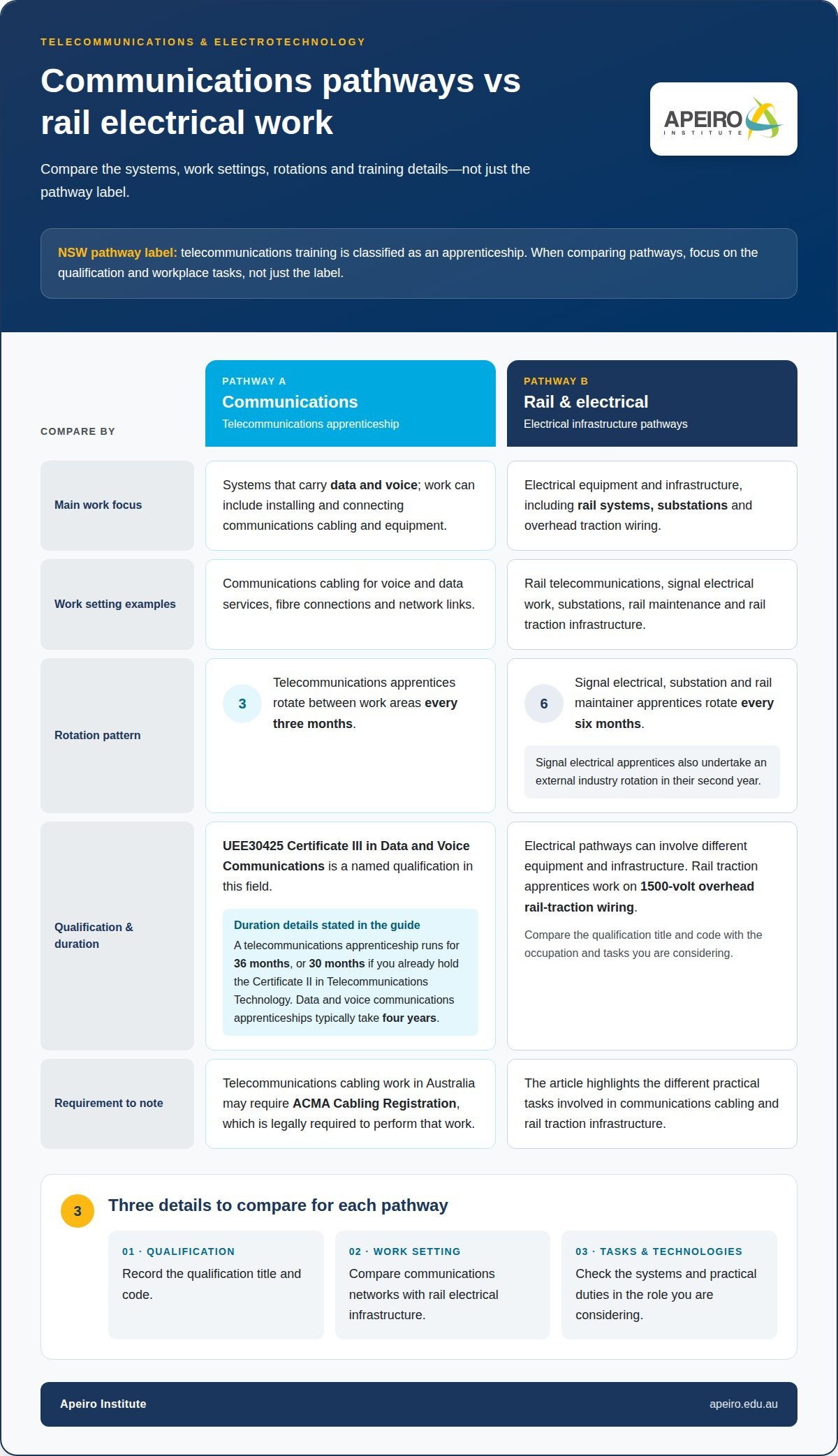
In NSW, telecommunications training is classified as an apprenticeship, while some other Australian jurisdictions classify it as a traineeship. When comparing career pathways, focus on the qualification and workplace tasks, not just the label.
Communications apprentices learn about systems that carry data and voice. Electrical apprenticeships can focus on different equipment and infrastructure, including rail systems, substations and overhead traction wiring.
Rail apprenticeships show how much work settings can vary. Telecommunications apprentices rotate every three months, while signal electrical, substation and rail maintainer apprentices rotate every six months.
Signal electrical apprentices also undertake an external industry rotation in their second year. Rail traction apprentices work on 1500-volt overhead rail-traction wiring, illustrating how electrical pathways can differ from communications work.
Cabling and fibre work
Telecommunications cabling work can involve installing and connecting infrastructure for voice and data services. Fibre work is another area to explore, with tasks involving fibre connections and network links.
Compare the systems and sites involved. A communications role may focus on data and voice cabling, while other telecommunications work supports infrastructure across broader networks.
Cabling work has an important requirement: telecommunications cabling work in Australia may require ACMA Cabling Registration, which is legally required to perform that work. Consider this requirement when comparing training pathways and potential job duties.
For example, connecting communications cabling involves different practical tasks from working on rail traction infrastructure in an electrical role. The work environment can help you decide which pathway interests you.
Telecommunications apprentice duties
Apprentice duties develop through workplace training and the systems an employer works with. In a communications setting, examples can include helping install cabling, connecting equipment and supporting checks on data or voice connections.
Rail telecommunications offers a different work setting. Apprentices may rotate between work areas every three months, while signal electrical apprentices have six-month rotations and an external industry rotation during their second year.
These examples show why it helps to look beyond the word “apprentice”. Consider whether you’re interested in network connections, rail communications or electrical infrastructure, then compare the qualification and workplace tasks.
Telecommunications also connects with adjacent industries. Gas supply pathways include formally recognised qualifications from Certificate II to Diploma, offering another vocational direction for people interested in technical infrastructure.
Industry demand is another consideration: telecommunications is expected to experience strong growth over the next 5 years. Matching your interests to a specific work setting can help you choose a practical career pathway.
Electrotechnology career pathways and qualifications
Electrotechnology includes technical work across communications and other electrical industries. In Australia, comparing the qualification, work setting and technologies involved can help you choose a pathway that matches your career goals.
Start with the work you want to do. Data and voice communications roles focus on communications systems, while rail electrical work can involve infrastructure such as overhead traction wiring. These roles require different workplace skills, so let the job focus guide your qualification research.
Next, compare the qualification title and code with the occupation you’re considering. The UEE30425 Certificate III in Data and Voice Communications is one named qualification for this field. A qualification’s title can help identify its subject area, while its training content indicates the skills it is designed to develop.
Next, consider how training connects with practical work. An apprenticeship combines vocational learning with workplace experience, allowing learners to apply technical knowledge to real tasks. Ask yourself whether you want to work with communications connections, electrical infrastructure or another technical system. Each points to a different set of technologies and duties.
Electrotechnology can offer progression beyond an initial trade qualification. Skill shortages at trade and post-trade technical levels in the electrotechnology industry are expected to worsen over the next five years. If you’re planning a long-term career, consider how further technical learning could build on your initial qualification.
A practical way to compare pathways is to write down three details for each option:
- The qualification title and code, such as UEE30425 for data and voice communications.
- The work setting, such as communications networks or rail electrical infrastructure.
- The technologies and tasks that appear in the role you want to pursue.
This comparison helps distinguish a communications pathway from related electrical careers without relying on the job title alone. It also gives you a clearer basis for discussing training with an employer or training organisation.
If you’re mapping a technical career around existing skills, explore vocational pathway options as part of your qualification research.
NSW apprenticeship duration
Plan around the qualification, not just the broad telecommunications label. A NSW telecommunications apprenticeship runs for 36 months, while data and voice communications apprenticeships in Australia typically take four years. These are distinct pathways, so identify the qualification attached to the role before estimating your study and work commitment.
A different term applies to some telecommunications apprentices. In NSW, the apprenticeship duration is 30 months for an apprentice who already holds the Certificate II in Telecommunications Technology. That is a specific pathway variation, not a general reduction for every applicant with previous work experience or another certificate.
These durations provide a starting point when discussing a position with an employer. Ask which qualification the role leads to, whether it is the telecommunications apprenticeship or data and voice communications pathway, and whether the existing Certificate II applies. This will help you compare the expected commitment without treating different training routes as equivalent.
Duration also shapes how you plan your work and learning. A four-year data and voice apprenticeship calls for a longer commitment than the 36-month telecommunications pathway. The 30-month term applies only to eligible telecommunications apprentices who already hold the specified Certificate II. Each pathway develops skills over time through training and workplace experience.
Use these steps to make the timeline clearer:
- Identify the qualification. Match the role to its named training pathway before comparing durations.
- Check the relevant starting point. For the 30-month telecommunications term, the specified prior qualification is Certificate II in Telecommunications Technology.
- Plan around the full term. Consider how the apprenticeship fits your employment, study and personal commitments.
- Keep the pathway in view. Connect the expected duration with the work and skills you want to develop.
A certificate can affect the length of a pathway only where the relevant term recognises it. The Certificate II example is precise: it relates to a telecommunications apprentice in NSW and changes the term to 30 months. It should not be assumed to shorten the four-year data and voice apprenticeship, because that is a separate pathway.
Before you commit, write down the qualification title, stated duration and any entry qualification that affects the term. For example, compare a 36-month telecommunications apprenticeship with the 30-month option only if you already hold the specified Certificate II. Keep the four-year data and voice pathway separate in your planning. That simple comparison makes the time commitment easier to understand and helps you discuss a recognised training route with clarity.
Apprentice wage rates
Weekly pay depends on the apprentice category and training year. As at 1 July 2026, the indicative first-to-fourth-year Award wage range differs for junior apprentices who completed Year 12, junior apprentices who didn’t, and adult apprentices aged 21 years and over. These figures provide a practical comparison for planning an apprenticeship budget.
| Apprentice category | Indicative weekly range, first to fourth year |
|---|---|
| Junior, didn’t complete Year 12 | |
| Junior, completed Year 12 | |
| Adult, aged 21 years and over |
The junior ranges show why Year 12 completion matters when comparing indicative rates.
Adult apprentices aged 21 years and over have a separate range: per week across the first to fourth years. Don’t compare this adult range with a junior figure without noting the age category. The apprenticeship year and the apprentice’s category are both essential context.
These figures are ranges, not a complete year-by-year pay table, and don’t show the exact rate for each individual year. Use them to understand the reported lower and upper figures, then identify which category applies to your situation. This avoids assuming there is a single first-year rate for every apprentice.
For budgeting, compare the weekly wage with your regular commitments. Keep the period consistent: these figures are weekly, not annual. Don’t convert them into an annual income estimate without accounting for your actual pay arrangements and time worked.
- Identify your category: junior without Year 12, junior with Year 12, or adult aged 21 years and over.
- Note the date: the listed ranges apply as at 1 July 2026.
- Keep the unit clear: every figure above is an indicative weekly Award wage.
Pay is only one factor when choosing a communications apprenticeship. Consider the wage alongside the training pathway, workplace experience and skills you could build for future work across a network. Knowing the applicable category and planning around weekly pay can help you assess how the apprenticeship fits your plans.
Are NSW electrical communications apprenticeships subsidised or eligible for government incentives?
There are government incentive pathways linked to data and voice communications apprenticeships. The UEE30425 Certificate III in Data and Voice Communications appears on the Australian Apprenticeships Priority List, making eligible apprentices able to access financial incentives. Additional support payments are available for data and voice communications apprentices working in Australia’s new energy sector.
These incentives differ from a general course subsidy. The Priority List connection relates to a named qualification and eligible apprentices. New energy support relates to data and voice communications apprentices working in that sector. Keep these distinctions in mind when assessing what support may apply to your apprenticeship.
Start by identifying the qualification attached to the role. For example, UEE30425 is the qualification named in the Priority List information. Then consider whether the work is in Australia’s new energy sector, because that is the context specified for additional support payments. The qualification and work context provide a more useful starting point than the broad label “electrical communications”.
Keep the two potential forms of support separate in your planning:
- Priority List incentives: UEE30425 Certificate III in Data and Voice Communications appears on the Australian Apprenticeships Priority List, enabling eligible apprentices to access financial incentives.
- New energy support: additional support payments are available for data and voice communications apprentices working in Australia’s new energy sector.
This distinction helps you frame useful questions when planning an apprenticeship. A position linked to data and voice communications may fit the qualification pathway, while the new energy sector is a separate factor for additional support. Don’t assume that every communications apprenticeship has the same incentive eligibility just because the job titles sound similar.
It’s useful to distinguish training support from apprentice incentives. An incentive relates to eligible apprentices under the named pathway, while funded training concerns course funding arrangements. The facts here establish the Priority List status and new energy support context, but do not specify payment amounts or guarantee a funding outcome. Avoid budgeting on the assumption that you’ll receive a payment.
For a practical planning sequence, record the qualification title, identify the work sector, then consider which incentive pathway those details relate to. For example, note whether the apprenticeship is connected with UEE30425 and whether the role is in the new energy sector. This gives you a clear basis for understanding the available support categories without mixing separate criteria.
Apprenticeship planning is clearer when you identify the qualification and work setting from the outset. Use these details to connect the training pathway with the relevant incentive category and your employment plans.
Apeiro Institute: Apprenticeships and Traineeships
Apeiro Institute offers Apprenticeships and Traineeships for learners considering a practical vocational pathway. For communications training, the UEE30920 Certificate III in Electronics and Communications provides a relevant qualification to explore alongside the work you want to do.
If you already have industry experience, Apeiro Institute’s Trade Pathways for Experienced Workers (TPEW) may suit your next step. Smart & Skilled Funded Courses are another option to explore. These pathways can help you compare a structured apprenticeship with training designed around existing experience or funded study.
Before choosing, match the qualification and pathway to your career goals, experience and preferred work setting. Contact Apeiro Institute to discuss a training pathway that fits your plans.
Choose a pathway that fits your next step
Your next step is to connect the qualification with the work you want to do. If you’re considering an electrical communications apprenticeship in NSW, think about whether you’re entering the industry or building on experience you already have. This distinction can help narrow down a suitable training pathway and make your next conversation more focused.
Apeiro Institute offers Apprenticeships and Traineeships, the UEE30920 Certificate III in Electronics and Communications, and Trade Pathways for Experienced Workers (TPEW). These options provide different starting points for people exploring communications training or progressing from existing skills. Consider which best reflects your circumstances and career direction.
You don’t need every detail settled before taking the next step. A clear sense of your experience, interests and preferred work can guide a discussion about training options.
With a pathway in view, you can take your next career step with greater clarity and confidence.
Frequently Asked Questions
Apprenticeship or Traineeship?
In NSW, telecommunications training is classified as an apprenticeship. The label can differ across Australia, so focus on the qualification and type of work rather than the title alone. For example, data and voice communications training has its own apprenticeship pathway. Before deciding if it suits your career direction, compare the qualification linked to the role with the practical work you want to learn.
What Does a Telecommunications Apprentice Do?
A telecommunications apprentice builds practical skills by supporting communications work under workplace supervision. Depending on the employer and role, tasks may involve installing cabling, connecting equipment and assisting with data or voice systems. A role focused on network connections, for example, differs from rail telecommunications work. Cabling tasks may also have registration requirements, so consider the specific work scope when assessing the duties.
What qualification do you need to be a telecommunications technician?
The qualification depends on the technician’s specialisation. For data and voice communications, UEE30425 Certificate III in Data and Voice Communications is a named qualification associated with the apprenticeship pathway. Other electronics and communications training may relate to different work or qualification outcomes. Start by matching the qualification title to the role’s duties, such as data and voice connections, rather than assuming every telecommunications technician follows the same training route.
What electrical communications apprenticeships are available in NSW?
NSW pathways include telecommunications apprenticeships and data and voice communications apprenticeships. Related electrical roles can focus on rail signalling, substations, rail maintenance or traction systems, each with a different workplace emphasis. For example, Sydney Trains telecommunications apprentices and signal electrical apprentices have different rotation patterns. Compare the qualification, employer and work setting to see whether a pathway centres on communications networks or electrical infrastructure.
What qualifications and entry requirements are needed for an electrical communications apprenticeship in NSW?
Entry requirements depend on the employer and qualification. Most employers and registered training organisations expect data and voice communications apprenticeship candidates to have completed Year 12, with passes in English and Maths. That is a common expectation, not a universal entry rule. Check the specific role’s stated criteria and identify the qualification it leads to. Existing Certificate II in Telecommunications Technology is relevant to the shortened NSW telecommunications apprenticeship term.
What is the difference between an electrical apprenticeship and a telecommunications or communications apprenticeship in NSW?
An electrical apprenticeship may focus on electrical infrastructure, while a telecommunications apprenticeship centres on communications systems and connections. Examples include rail traction wiring in electrical work and data or voice networks in communications. Some roles share infrastructure, but their duties and training focus can differ. Compare the daily tasks and qualification for each role to identify the technical skills you want to develop.
How long does an electrical communications apprenticeship take in NSW?
Duration depends on the specific pathway. A NSW telecommunications apprenticeship runs for 36 months, or 30 months if the apprentice already holds Certificate II in Telecommunications Technology. A data and voice communications apprenticeship in Australia typically takes four years. These terms apply to different pathways, so identify the qualification before planning around a completion date or comparing apprenticeship commitments.
What are apprentice wages and pay rates for electrical and communications apprentices in NSW?
Indicative weekly Award wage ranges vary by apprentice category and year. As at 1 July 2026, junior data and voice apprentices who didn’t complete Year 12 have a first-to-fourth-year range of . For juniors who completed Year 12, the range is . Adult apprentices aged 21 years and over have a range of weekly.

Disclaimer
The information provided on this blog is for general informational and educational purposes only. While every effort is made to ensure the accuracy and reliability of the content, the author makes no representations or warranties of any kind, express or implied, about the completeness, accuracy, suitability, or availability of the information contained on this blog.
The views and opinions expressed in blog posts are those of the individual author and do not necessarily reflect the official policy or position of any organization, company, or employer.
This blog may contain links to external websites or third-party content. These links are provided for convenience only, and the author has no control over and assumes no responsibility for the content, privacy policies, or practices of any third-party sites.
Nothing on this blog constitutes professional advice (legal, financial, medical, or otherwise). Readers are encouraged to seek appropriate professional guidance before making any decisions based on the information provided here.
By using this blog, you acknowledge that any reliance on the information is at your own risk.


