

Your workshop experience may count towards an Australian-recognised qualification through recognition of prior learning for mechanics in Australia. The assessment fee depends on factors such as the qualification, assessment workload, location and your relevant experience, with the amount provided after a quote request. If your skills are assessed as meeting the requirements, the resulting qualification is nationally recognised.
It’s understandable to want a clear idea of the cost before you begin, especially when you’ve already built practical skills on the job. Knowing what evidence to gather and how RPL differs from credit transfer can also make the process feel more straightforward.
This guide explains what can affect the cost, the kinds of work and training evidence you can prepare, and what national recognition means for your qualification. You’ll also see when RPL may suit your experience and when credit transfer, which recognises previous study, is the more relevant pathway.
Key Takeaways
- RPL costs depend on the qualification, assessment workload, location and your work experience, so prepare to discuss these factors when requesting a quote.
- Gather evidence of your practical skills, such as work references, job descriptions, training records and examples of completed work.
- An Australian-recognised qualification awarded through RPL has the same national recognition as one issued by a TAFE or another Registered Training Organisation.
- Use RPL to have relevant work experience assessed; credit transfer is for previous study that may count towards another qualification.
- Sort your evidence by the skills and tasks it demonstrates to make your experience easier to assess against the qualification requirements.
Is my qualification nationally recognized?
A qualification gained through Recognition of Prior Learning (RPL) is issued under the Australian Qualifications Framework (AQF) and is nationally recognized. RPL assesses skills and knowledge developed through work and other experience, rather than requiring you to repeat learning you can already demonstrate.
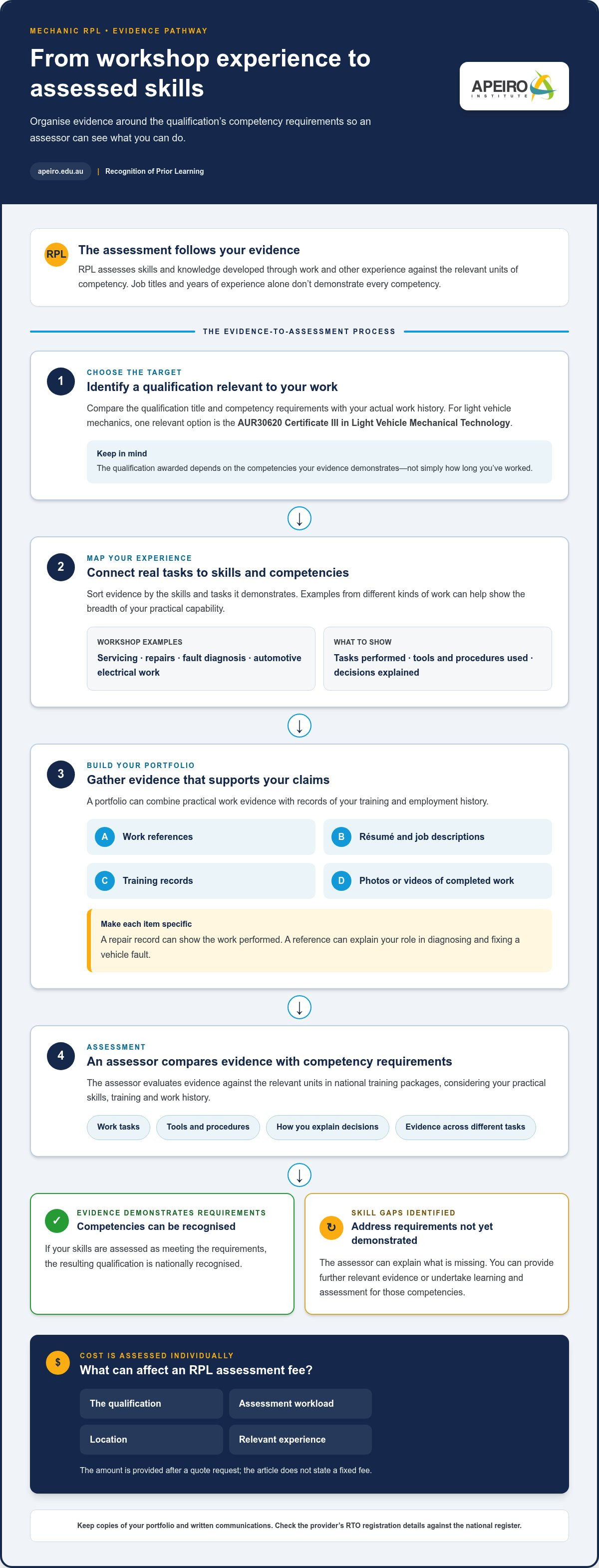
For a mechanic, RPL connects practical experience to the requirements of a formal automotive qualification. An assessor considers your evidence against the relevant units of competency. Experience diagnosing faults, servicing vehicles or repairing components may help demonstrate those skills. The qualification awarded depends on the competencies your evidence demonstrates, not simply the number of years you've worked.
Certificate III is a trade-level qualification at AQF Level 3. The AUR30620 Certificate III in Light Vehicle Mechanical Technology is one automotive qualification relevant to light vehicle mechanics. Its title identifies the qualification; RPL assesses whether your previous skills match its requirements. You can explore the Certificate III in Light Vehicle Mechanical Technology as a qualification pathway with Apeiro Institute.
Available options depend on the type of automotive work and skills being assessed. One automotive RPL listing presents 13 qualifications currently available to apply for, while a broader Australian listing includes 49 automotive qualifications. These figures describe different listings, not a single universal menu. Compare the qualification's title and competency requirements with your actual work history before preparing an application.
Overseas qualifications and work experience aren't automatically accepted by every Australian employer. An Australian-recognized qualification gained through RPL or credit transfer can document your skills in a format employers understand. It doesn't guarantee acceptance for every job or replace a separate occupational licence where one is required.
Australia has specific national pathways for overseas-trained tradespeople. According to Australian Government Trades Recognition Australia, overseas trade skills can be assessed for recognition nationwide. A person with an overseas qualification can also apply to have it recognized across all states and territories. For candidates planning study or training pathways from abroad, educational consultancies like AusPak International can provide guidance on course selection and institutional requirements. Identify whether you need an assessment of trade skills or recognition of an existing qualification to get started.
RPL may suit experienced mechanics without formal qualifications, migrants with overseas experience, and tradespeople who learned on the job. Start by identifying the qualification that matches your work, then map your previous tasks to its competencies. This gives you a practical basis for organizing evidence and understanding how your experience relates to a nationally recognized automotive qualification.
What evidence is required for RPL?
For mechanic RPL, evidence needs to show how your experience matches the qualification’s units of competency. An assessor considers practical skills, training and work history, not just job titles.
RPL Assessment and Evidence
In Australia’s vocational education and training system, an RPL assessor evaluates evidence against relevant units in national training packages. Mechanics can demonstrate skills gained on the job through workplace experience, rather than relearning them in a classroom. Build a portfolio that connects each item to a task or skill, making your experience easier to understand and assess.
Useful evidence includes work references, a résumé, job descriptions, training records, and photos or videos of completed work. For example, a repair record can show the work performed, while a reference can explain your role in diagnosing and fixing a vehicle fault. Include evidence from different tasks to show the breadth of your experience.
Assessing Skills and Experience
Assessors compare your evidence with the competencies required for the qualification. They may consider the tasks you perform, the tools and procedures you use, and how you explain your decisions. Examples from servicing, repairs, fault diagnosis or automotive electrical work can help demonstrate your practical capability.
Experience alone doesn’t demonstrate every competency. If an assessment identifies skill gaps, the assessor can explain which requirements your evidence hasn’t yet demonstrated. You can then provide further relevant evidence or undertake learning and assessment for those competencies.
What experience and evidence do mechanics need to apply for RPL? Mechanics need relevant work experience and evidence showing the skills they’ve gained. Prepare references, job descriptions, training records and examples of completed work, then organise them around the qualification’s competency requirements.
Registered training organisations (RTOs) assess RPL against nationally recognised training requirements. Australian RTOs are required to provide RPL services. For migration or skills-assessment purposes, a Diploma or Certificate qualification may be required, but an RPL qualification alone doesn’t establish a migration or skills-assessment outcome.
How can applicants check that an RPL provider is legitimate and avoid scams? Check the provider’s RTO registration details against the national register, and compare the qualification code with the course information. Be cautious of claims promising a qualification without reviewing evidence or assessing your skills.
Before submitting documents, keep copies of your portfolio and written communications. Look for a clear explanation of the assessment steps, evidence requirements and how skill gaps are handled. These details help you understand the process and distinguish an evidence-based assessment from a promise of a certificate without assessment.
How is RPL different from a credit transfer?
RPL and credit transfer recognise different kinds of previous learning. RPL assesses skills and experience gained through work; credit transfer applies previous education towards another course. For an automotive mechanic, the distinction affects which documents to gather and how to organise an application. Start by identifying whether your evidence comes mainly from workshop practice or completed study.
For RPL, an assessor considers evidence against the relevant qualification requirements. An application may include academic records, course information, employer references, a résumé and payslips. Work references can describe your duties, while a résumé maps your career history. Payslips can support employment details, and course information can explain earlier training. Together, these records help show where your skills and experience came from.
Practical examples can make a mechanic’s evidence clearer. A job description might show responsibility for servicing or repair work. A reference could explain the tasks you performed, while photos or videos may show completed work. Training records can document formal learning. Arrange each item beside the competency or task it supports, rather than sending a collection without explanation.
Previous study is central to a credit transfer application. A provider assesses whether completed training is relevant to the new course. Evidence may include a statement of academic achievement, academic records and information about the earlier course. For example, a unit completed during a previous automotive course may be considered against a corresponding unit in a Certificate III pathway.
For a Victorian credit transfer application, previous study or training can count towards another qualification when the provider assesses its relevance. Applicants should establish which study records demonstrate the learning completed. This differs from RPL, where an assessor evaluates work experience and other evidence against competency requirements. A work reference alone doesn’t show that you completed an equivalent unit of study.
Use this simple sorting step before applying:
- Put workshop references, job descriptions, payslips and work examples in your RPL evidence group.
- Put academic records, course details and achievement statements in your credit transfer group.
- Match each document to the experience or previous study it supports.
If your goal is a Certificate III in Light Vehicle Mechanical Technology, first decide whether your strongest evidence is hands-on work experience or completed automotive study. That distinction helps you prepare the right application and explain how your previous learning relates to the qualification. Keep copies of submitted records so you can track which evidence supports each part of your career pathway.
Difference between RPL and credit transfer
Recognition of Prior Learning (RPL) and credit transfer assess different kinds of previous learning. RPL assesses existing skills gained through work experience, while credit transfer applies previous education towards another course. For a vehicle mechanic, workshop experience repairing engines or electrical systems points towards RPL. Completed study in mechanical technology may instead support a credit transfer application.
With RPL, an assessor compares your skills and experience with the requirements of a qualification. Evidence can include employer references, a résumé, payslips and examples of work. The focus is what you can demonstrate, not simply the course you attended. This pathway may suit tradespeople who learned on the job or overseas workers whose experience hasn’t resulted in an Australian-recognised qualification.
Credit transfer starts with completed study. A registered training provider considers whether previous units or training are relevant to the new course. For example, a learner who completed automotive units may submit their academic record and course information when seeking credit towards another vehicle qualification. A statement of academic achievement can also show which subjects or units were completed.
The distinction matters if your aim is a Certificate III in Light Vehicle Mechanical Technology. A mechanic with substantial workshop experience but no formal automotive study may consider RPL. Someone who has completed relevant training may seek credit transfer for matching study. If your background includes both, work evidence and academic records can support different parts of an application.
Credit transfer can also apply between vocational study and higher education. An Australian AQF Level 5 Diploma can typically provide up to one year of advanced standing towards a relevant bachelor’s degree. An AQF Level 6 Advanced Diploma can provide up to 1.5 years of university credit towards a relevant bachelor’s degree. The receiving institution determines how previous study applies.
These university examples describe credit for prior education, not recognition of mechanic work experience. An experienced mechanic’s practical skills don’t become university credit through RPL alone. Instead, RPL assesses those skills against a vocational qualification. This difference is useful when planning a career step, whether you want a trade qualification or further study.
Overseas qualifications and work experience may not be accepted by an Australian employer in their original form. RPL or credit transfer may help someone gain an Australian-recognised qualification, depending on whether their strongest evidence is practical experience or previous study. Sort your documents into those two groups first, then match each item to the course or qualification requirements.
Use this quick guide: choose RPL when you want existing skills assessed; consider credit transfer when you have completed relevant education. If you’re unsure which evidence best reflects your mechanical, vehicle or electrical background, list your work tasks separately from your completed courses before preparing an application.
Potential time and cost savings
RPL can recognise relevant skills you’ve already gained, rather than requiring you to repeat learning. The time and cost depend on your evidence, the qualification and the assessment requirements.
Potential Time Savings
An RPL process in Australia can typically take between 2 and 8 weeks, depending on how quickly applicants gather and submit evidence. A complete portfolio can help keep the assessment moving by making your experience easier to evaluate against qualification requirements.
Candidates with a complete RPL evidence portfolio commonly receive their qualification within 4 to 6 weeks from RTO assessment. These periods describe separate stages: gathering and submitting evidence, then assessment by a Registered Training Organisation. Organise work records and references before applying to reduce avoidable delays.
Time savings depend on what your portfolio demonstrates. A mechanic with clear records of relevant repair and diagnostic work may have evidence ready to map against competencies. Missing dates, unclear job duties or gaps in supporting records can mean more work assembling the application. Sort documents by task, then identify which skills each example demonstrates.
RPL can reduce repeated learning when your existing skills meet course requirements. If assessment identifies a gap, you may need further learning or assessment for that competency. Plan around the skills being assessed, rather than assuming every unit will be recognised through RPL.
RPL Costs and Payment Plans
The price depends on your circumstances and is provided after a quote request. RPL assessment costs vary according to the assessment location, qualification sought, assessment workload and your relevant work experience. These factors shape how much evidence needs review and how the assessment is conducted.
For budgeting, separate the assessment fee from any payment arrangements available for your study. Build your budget around the quoted cost and payment timing, and consider these alongside the assessment steps involved. A payment arrangement doesn’t change the evidence or assessment required.
Before requesting a quote, identify the qualification you want and organise your evidence. A résumé, work references, training records and examples of completed tasks can help describe your experience. Clear information helps show the scope of assessment required and the work history relevant to your application.
RPL may save time when your evidence already demonstrates the required competencies. It doesn’t remove the assessment itself. The assessor still needs to evaluate your skills against qualification requirements, and any gaps may call for additional learning. Employers may value a nationally recognised qualification, but RPL doesn’t guarantee a job or a particular salary.
Use your quote to understand the cost factors and assessment scope together. Check that the qualification matches your trade goals, then prepare evidence that reflects your actual work. An organised portfolio can make the assessment process clearer and help you decide whether RPL suits your experience.
Apeiro Institute: UEE30920 Certificate III in Electronics and Communications
Apeiro Institute offers the UEE30920 Certificate III in Electronics and Communications for learners seeking a nationally recognised qualification in this field. It’s an electronics and communications pathway, not an automotive mechanic qualification, so consider it when your career goals include communications or electronics skills.
For experienced workers exploring vocational pathways, Trade Pathways for Experienced Workers (TPEW) may also be relevant. Apeiro Institute offers Apprenticeships and Traineeships, as well as Smart & Skilled Funded Courses. The right option depends on your intended qualification and learning pathway. If your goal is automotive trade recognition, focus on the relevant automotive qualification and RPL assessment rather than an electronics certificate.
Turn your workshop experience into a clear next step
Your next move is to connect the work you’ve done with the qualification you want to achieve. Recognition of prior learning for mechanics in Australia can provide a pathway for assessing practical skills, while a clear career goal helps you decide which training option fits. Organise your evidence around the tasks you perform, then consider how those skills relate to your intended qualification.
Apeiro Institute offers Recognition of Prior Learning and Trade Pathways for Experienced Workers (TPEW), alongside Apprenticeships and Traineeships. It also offers UEE30920 Certificate III in Electronics and Communications, a separate pathway for learners interested in electronics and communications. These options support different goals, so focus on the course or assessment route that aligns with your experience.
Taking a considered next step can help make your existing skills part of a more formal career plan. Your experience is a useful starting point.
Keep building on what you know, one practical step at a time.
Frequently Asked Questions
How much does the RPL cost?
RPL assessment costs depend on the qualification, assessment location, workload and your relevant work experience. The price is provided after a quote request, rather than being one standard amount for every mechanic. Before requesting a quote, identify your intended qualification and outline your work history. This gives a clearer picture of the assessment scope and the factors that influence the cost, without assuming every application requires the same assessment work.
Who is eligible for RPL?
RPL may suit experienced workers without formal qualifications, migrants with overseas experience, and tradespeople who learned on the job. The key is having relevant skills and evidence that relate to the qualification you’re seeking. For example, a mechanic could document vehicle servicing, fault diagnosis or repair tasks. Assessment considers whether your experience and evidence meet the qualification’s requirements, not simply your job title.
How long does the RPL process take?
An RPL process can typically take between 2 and 8 weeks, depending on how quickly applicants gather and submit their evidence. Candidates with a complete portfolio commonly receive their qualification within 4 to 6 weeks from RTO assessment. These are separate stages, so prepare references, work records and training documents early. Missing or unclear evidence can add work to your application and affect how smoothly the assessment progresses.
How much experience do you need for RPL?
Most RPL qualifications require applicants to demonstrate at least 2 to 3 years of relevant work experience. The experience should relate to the qualification and show practical skills gained through your work. For a mechanic, examples could include servicing vehicles, diagnosing faults or carrying out repairs. Prepare a clear work history that identifies your roles, tasks and supporting evidence, rather than relying on years of employment alone.
What is RPL and how does it work?
Recognition of Prior Learning assesses skills and knowledge gained through work, training and other experience against a qualification’s requirements. For example, a mechanic may provide records of repair work, references or training documents to demonstrate relevant capabilities. An assessor evaluates the evidence against units of competency. If the evidence doesn’t demonstrate every required skill, further evidence, learning or assessment may be needed for those competencies.
Can you get AUR30620 through RPL?
Yes, AUR30620 Certificate III in Light Vehicle Mechanical Technology can be pursued through RPL when your evidence demonstrates the relevant competencies. Examples might include records of light vehicle servicing, diagnostic work and repairs. Make sure your evidence shows your own responsibilities and skills, rather than only describing work completed by the workshop. The assessment considers how your demonstrated capabilities align with the qualification requirements.
What is recognition of prior learning (RPL) for mechanics in Australia?
Recognition of prior learning for mechanics in Australia is an assessment pathway for having existing automotive skills considered towards a vocational qualification. It may suit people who gained trade experience through employment, overseas work or informal learning. You provide relevant evidence, such as work records or references, and an assessor compares it with the qualification’s competency requirements. This process assesses demonstrated skills, rather than awarding a qualification solely for time spent working.
Which Australian mechanic qualifications can be obtained through RPL?
Australian automotive RPL listings include 49 qualifications, with options varying by qualification and assessment pathway. Examples include AUR30620 Certificate III in Light Vehicle Mechanical Technology, AUR40216 Certificate IV in Automotive Mechanical Diagnosis and AUR50216 Diploma of Automotive Technology. To identify a suitable pathway, consider your current automotive duties and career aims. Then compare your skills and experience with the requirements of the qualification you want to pursue.

Disclaimer
The information provided on this blog is for general informational and educational purposes only. While every effort is made to ensure the accuracy and reliability of the content, the author makes no representations or warranties of any kind, express or implied, about the completeness, accuracy, suitability, or availability of the information contained on this blog.
The views and opinions expressed in blog posts are those of the individual author and do not necessarily reflect the official policy or position of any organization, company, or employer.
This blog may contain links to external websites or third-party content. These links are provided for convenience only, and the author has no control over and assumes no responsibility for the content, privacy policies, or practices of any third-party sites.
Nothing on this blog constitutes professional advice (legal, financial, medical, or otherwise). Readers are encouraged to seek appropriate professional guidance before making any decisions based on the information provided here.
By using this blog, you acknowledge that any reliance on the information is at your own risk.


