

The timeframe for an automotive apprenticeship in NSW depends on the qualification and training arrangement, so there is no single duration for every pathway. An apprenticeship combines practical experience with an employer and formal training through a Registered Training Organisation (RTO). Your chosen specialisation also shapes what you learn.
If you’re wondering how long an apprenticeship takes, that’s a sensible place to start. You’ll also want to understand the training, how it fits around work and which pathway best matches your goals.
This guide explains the main automotive specialisations, how Certificate III training connects classroom learning with workshop experience, and what to consider when exploring vacancies across Sydney and NSW. You’ll come away with a clearer sense of the options and the next steps towards building your skills in the automotive industry.
Key Takeaways
- Match your apprenticeship pathway to the type of automotive work you want to do, such as servicing and repairing light vehicles.
- Expect to build skills through a combination of formal training with a Registered Training Organisation and practical experience with an employer.
- Look for a workplace where you can learn through guidance, clear communication and regular feedback as you develop your trade skills.
- When comparing vacancies, weigh up location and specialisation alongside the training and support involved.
- Choose a Certificate III pathway that fits your interests, local job prospects and longer-term career goals.
How long is an automotive apprenticeship?
The duration depends on the qualification, its training requirements and your progress. The work setting matters too: light vehicle apprentices focus on cars and similar vehicles, rather than trucks and buses.
Light vehicle apprenticeship options
Light vehicle mechanic and technician apprenticeships prepare you for maintenance and repairs on cars and other light vehicles. Job listings use different titles, so compare the actual duties and specialisation, not just the role name. Check whether the listing describes workshop tasks, practical training and a formal qualification. These details show what the apprenticeship is designed to teach.
Light vehicle training
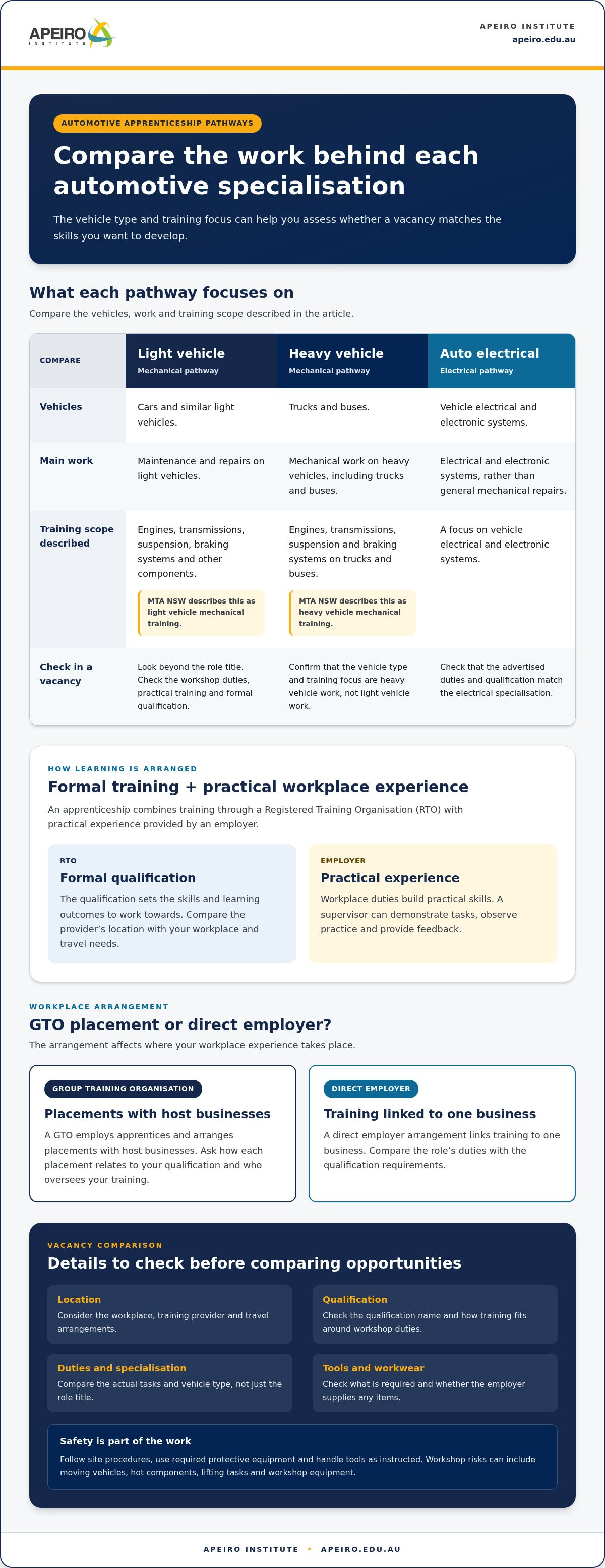
MTA NSW describes light vehicle mechanical training as covering maintenance and repair of engines, transmissions, suspension, braking systems and other components. Use that scope to assess whether the training matches your interests. For example, vehicle servicing and repairs differ from heavy vehicle work on trucks and buses. Compare each listing’s training focus with its described duties.
There is no single duration for every light vehicle apprenticeship. Completion depends on the qualification requirements, formal training and practical experience involved. When comparing opportunities, look for the qualification name and how training fits around workshop duties. Consider whether the advertised tasks help you develop the mechanical skills you want. A clear link between the qualification and daily work makes the pathway easier to assess.
Workplace safety involves following site procedures, using required protective equipment and handling tools as instructed. Common risks include moving vehicles, hot components, lifting tasks and workshop equipment. Learn the correct process before starting each task.
Tool and equipment costs depend on the role, workplace requirements and tasks. Before accepting a listing, find out which tools and workwear are required and whether the employer supplies any items. This helps you understand potential personal costs without assuming every workshop has the same arrangement.
Some advertised opportunities include financial support, but the details vary between listings. Treat support as a feature of that specific opportunity, not a standard inclusion across light vehicle apprenticeships.
When reviewing light vehicle apprenticeship listings, note the location, qualification, training provider and duties. Compare these with your preferred work and travel arrangements. MTA NSW describes heavy vehicle mechanical training as covering trucks and buses, including their engines, transmissions, suspension and braking systems. This distinction can help you decide whether light vehicle work suits your goals.
On-the-job training, mentoring and qualifications
An apprenticeship combines workplace learning with formal training through a Registered Training Organisation (RTO). Your employer provides practical experience, while the qualification sets the skills and learning outcomes to work towards.
Training provider and location
Apprentices complete a formal qualification through an RTO while gaining practical experience with an employer. Compare the provider’s location with your workplace and travel needs. MTA NSW recommends considering provider location and opportunities in your preferred specialisation. A training location that fits your weekly routine can make formal sessions easier to organise.
Light vehicle training covers cars and similar vehicles, while heavy vehicle training covers trucks and buses. Auto electrical apprenticeships focus on vehicle electrical and electronic systems rather than general mechanical repairs.
Apprenticeship types and registration
An apprenticeship combines paid workplace learning with a formal qualification, while a traineeship is another workplace-based training pathway. The right option depends on the occupation and qualification. Compare the role’s duties with the qualification title before committing. School leavers and career changers can both build job skills through structured work and study.
To register in NSW, coordinate the employer and RTO details, then follow the apprenticeship registration process through Training Services NSW. Keep the training plan and contact details together so everyone can follow the qualification and workplace arrangements.
Some apprentices work through a Group Training Organisation (GTO), which employs apprentices and arranges placements with host businesses. This can provide experience across workplaces. Ask how each placement relates to your qualification and who oversees your training. A GTO arrangement may suit someone seeking supported workplace experience, while a direct employer arrangement links training to one business.
Changes to an apprenticeship
If an apprenticeship is cancelled or the employer changes, contact Training Services NSW and your RTO promptly. Explain what has changed and discuss how to record completed training and practical experience. Clear records can help the next employer and training team understand your progress.
Before a new arrangement begins, gather your qualification details, training plan and assessment records. Discuss remaining learning with the RTO, then establish how workplace duties will support it. A new employer may provide a different setting for practical learning, so compare the role’s tasks with your qualification requirements.
Mentoring makes day-to-day learning practical. A supervisor can demonstrate a repair, explain the steps and observe you applying the skill. For example, after watching a brake inspection, practise the task under supervision and discuss what to improve. Bring questions from formal training into the workshop, and use feedback to identify what to practise next.
Before starting, clarify who supervises your work, how you’ll receive feedback and how workplace learning connects with RTO assessments. This helps you know where to turn for guidance, whether you’re learning a repair or preparing evidence of your skills.
Employer, mentoring and workplace support
An employer connects formal learning with practical workshop experience. Your daily tasks, supervisor’s guidance and training plan should support the skills required for your qualification. This link between study and work helps apprentices build trade skills in a real workplace. Look for clear communication between the employer, training provider and apprentice.
Host employer partnerships in NSW
An apprenticeship involves an employer and a Registered Training Organisation (RTO). The employer provides practical experience, while the RTO delivers the formal qualification. Before accepting a role, compare its workshop duties with the training you’ll complete. For example, a light vehicle apprentice should understand how routine servicing and repairs fit into the workplace learning plan.
Ask how your supervisor will introduce unfamiliar tasks. A useful sequence is to watch a demonstration, practise under supervision and discuss feedback. For a vehicle inspection, observe the checks first, complete them with guidance, then review any missed steps. This gives you a clear way to turn instructions into practical skills.
MTA NSW advises apprentices to consider the training provider’s location and opportunities in their preferred specialisation. Use these factors when comparing an employer and training arrangement. A workshop near your training location may make travel easier to organise. The role itself matters too: compare its duties with your interests, such as mechanical servicing or another automotive trade.
Mentoring and workplace support
Good mentoring makes it easier to ask questions before a task becomes confusing. Agree on who to approach for help, how feedback will be shared and when you can review progress. After learning a repair procedure, for example, ask your supervisor to identify a skill to practise next. Keep notes about the task and feedback to support your next discussion.
Workplace support also means knowing the correct process for a new task. Before using unfamiliar equipment, ask for an explanation and demonstration. If workshop instructions differ from your formal training, raise the difference with your supervisor and RTO. Clear communication connects workplace practice with qualification learning.
Employer contact details
Use the contact details in each vacancy listing to make a focused enquiry. Note the employer’s name, contact person, phone number or email, and advertised role. In your message, say which apprenticeship interests you, when you’re available to talk and give one relevant example, such as school workshop experience or an interest in vehicle repairs.
Before contacting an employer, prepare focused questions about supervision, training arrangements and the workshop’s main duties. For instance, ask who will guide your practical learning and how the role connects with the RTO qualification. Record the answers so you can compare opportunities consistently.
Support works best when everyone understands their role. The employer guides workplace learning, the RTO delivers formal training, and you raise questions or difficulties early. This structure gives you practical steps for developing skills and progressing in automotive trades.
Automotive apprenticeship vacancies across Sydney and NSW
Vacancies vary by location, workshop and specialisation, so read each listing closely. Treat its specific details as features of that role, not standard inclusions across state apprenticeship programs.
Start with the work itself. One listing might focus on light vehicle servicing and repairs, while another centres on a different automotive trade. Check the position title, daily duties and named qualification. These details show whether the role fits your interests and the skills you want to develop.
Location matters for both work and training. Compare the workshop location with your usual travel routes and the training provider’s location. Industry bodies advise prospective apprentices to consider provider location and opportunities in their preferred specialisation. A vacancy may suit your chosen trade but involve a longer journey to training.
Read the full advertisement for practical details before applying. Note the employer’s contact method, application instructions, listed duties, workwear and any stated support. Separate confirmed listing details from assumptions. If an advertisement names an incentive, treat it as specific to that opportunity, not a benefit every apprentice receives.
Use a simple comparison when reviewing openings across different locations and areas:
- Role: identify the automotive specialisation and workshop tasks.
- Location: note the workplace area and training location.
- Qualification: record the formal program named in the listing.
- Support: note any stated workwear or government incentives.
- Application: follow the employer’s listed steps and contact method.
This comparison helps you assess the whole apprenticeship, not just its title. Two light vehicle listings, for example, may differ in location, duties or stated support. Note each role’s details, then prioritise the options that match your preferred specialisation, travel needs and training arrangements.
When you’re ready to apply, tailor your application to the advertised work. Mention a relevant example, such as school workshop experience, an interest in vehicle repairs or a practical skill you’ve developed. Use the employer’s contact details in the listing, name the role as advertised and include the requested information.
Vacancy details can change as employers recruit, so organise your search around the requirements rather than relying on one advertisement. Keep your shortlist current, record application dates and note any responses. This makes comparisons clearer without treating one listing as a standard across every region.
For each opening, connect three things: the employer’s work, the training program and your career direction. A vacancy is a stronger fit when its duties match your preferred specialisation and its location works for both employment and training. That gives you a practical basis for choosing which opportunity to pursue.
Automotive apprenticeship pathways and Certificate III qualifications
Your chosen specialisation shapes the skills you practise and the qualification you work towards. For light vehicle work, compare the apprenticeship’s duties with its training outcomes and your longer-term career direction.
There is no upper age limit for starting an Australian apprenticeship. Entry requirements can vary by employer, role and qualification, so read the vacancy and qualification information together. Focus on whether the work and training match your experience and career goals.
MTA NSW advises prospective apprentices to consider their interests, job prospects, location and long-term goals when choosing a specialisation. It also recommends researching which areas of the automotive industry are in demand. Someone drawn to mechanical diagnosis, for example, may choose a different pathway from someone interested in vehicle body repairs.
Compare specialisations by the work they cover. MTA NSW describes light vehicle mechanical training as covering maintenance and repair of engines, transmissions, suspension, braking systems and other components. Heavy vehicle mechanical training covers trucks and buses, including their engines, transmissions, suspension and braking systems. Paint and panel training focuses on repairing damaged body panels, preparing surfaces, matching paint and finishing.
Automotive sales and administration is another pathway, with training in customer service, vehicle sales, finance and insurance, inventory management and administrative support. MTA NSW also says students learn workplace health and safety, communication and teamwork. Choose the field whose daily tasks match your interests and intended career.
A Certificate III qualification connects formal learning with practical work. The AUR30620 Certificate III in Light Vehicle Mechanical Technology is a relevant qualification to consider for light vehicle mechanical training. Compare its title with the duties in an apprenticeship listing, then consider whether the workplace offers experience related to those skills.
Use these steps to assess a pathway:
- Identify the automotive work that interests you, such as mechanical repairs, paint and panel, or sales administration.
- Research local job prospects and demand in your preferred specialisation.
- Compare the qualification title and training focus with the vacancy’s duties.
- Consider how the specialisation supports your long-term career goals.
A qualification should make sense alongside the work you’ll do. If you want to diagnose vehicle faults, compare the pathway’s learning focus with mechanical diagnosis tasks. If you prefer body repairs, look for training aligned with panel restoration and paint finishing. Matching the work and learning gives you a clearer basis for choosing than the course title alone.
For a light vehicle pathway, explore the Certificate III in Light Vehicle Mechanical Technology.
Apeiro Institute: UEE30920 Certificate III in Electronics and Communications
Apeiro Institute offers the UEE30920 Certificate III in Electronics and Communications for learners interested in communications and electronics skills. It’s a different qualification from light vehicle mechanical training, so choose it if your career interests extend towards electronics and communications rather than workshop repairs.
If you’re already experienced in a trade, Trade Pathways for Experienced Workers (TPEW) may suit your next training step. Apprenticeships and Traineeships and Smart & Skilled Funded Courses provide other study pathways to explore. Consider which qualification aligns with your experience and career direction before deciding.
Contact Apeiro Institute to discuss a suitable training pathway.
Take your next step towards an automotive career
Choosing an automotive apprenticeship in NSW is a practical way to shape your working life around the skills and trade that interest you. Turn that interest into a focused plan: identify the direction you want to pursue, consider the training that supports it and decide what experience you can build on.
Apeiro Institute offers Apprenticeships and Traineeships, alongside Trade Pathways for Experienced Workers (TPEW) for people with existing trade experience. Its UEE30920 Certificate III in Electronics and Communications suits a different career direction from light vehicle mechanical training, so consider which area best fits your goals.
You don’t need every career decision mapped out before taking a step. Start with a pathway that reflects your interests and experience, then explore how its training can support your development.
Your automotive career can begin with a considered choice. Keep building towards the work that motivates you.
Frequently Asked Questions
How much does an apprentice mechanic earn?
An apprentice mechanic’s earnings depend on the applicable pay arrangements for their employment and apprenticeship. There isn’t one amount that applies to every automotive apprentice. The relevant minimum rates are updated annually, with new rates applying from the first full pay period on or after 1 July. To understand an advertised role, distinguish its stated pay from the minimum rate that applies to your circumstances.
What automotive apprenticeship qualifications are available in NSW?
For light vehicle mechanical work, AUR30620 Certificate III in Light Vehicle Mechanical Technology is a relevant qualification. Automotive study can also include AUR40216 Certificate IV in Automotive Mechanical Diagnosis and AUR50216 Diploma of Automotive Technology. These qualifications cover different levels and areas of automotive learning, so compare their titles and focus with the work you want to do. The qualification attached to an apprenticeship should align with its workplace duties.
How long does an automotive apprenticeship take in NSW?
The time needed to finish depends on the qualification’s training requirements and your progress through formal learning and workplace experience. For an automotive apprenticeship in NSW, use the qualification and training plan to understand what you need to complete, rather than relying on a general estimate. Your progress through assessments and practical skill development shapes the pathway. Track completed learning and discuss outstanding requirements with your training team.
What is the apprentice pay rate for automotive apprentices in NSW?
Automotive apprentice award minimums are updated each year from the first full pay period on or after 1 July. This means the applicable minimum can change when the annual update takes effect. A pay rate in an advertisement may describe that particular role, so don’t assume it represents the minimum for every apprentice. Consider the listed employment terms alongside the applicable apprentice pay arrangements.
Which registered training organisations offer automotive apprenticeship training in NSW?
Apeiro Institute is a Registered Training Organisation (RTO 45394) offering AUR30620 Certificate III in Light Vehicle Mechanical Technology and Apprenticeships and Traineeships. It also offers Smart & Skilled Funded Courses for eligible learners. When comparing training pathways, focus on whether the qualification matches your automotive specialisation and how the training fits your workplace arrangements. This helps connect the formal course with the skills you need in your role.
What government incentives or financial support are available to automotive apprentices in NSW?
Treat these as details of that specific opportunity, not standard inclusions for all apprenticeships.
What are the entry requirements for an automotive apprenticeship in NSW?
School leavers and career changers can both pursue apprenticeships, and there is no upper age limit. To register in NSW, coordinate the employer and RTO details through the apprenticeship registration process.

Disclaimer
The information provided on this blog is for general informational and educational purposes only. While every effort is made to ensure the accuracy and reliability of the content, the author makes no representations or warranties of any kind, express or implied, about the completeness, accuracy, suitability, or availability of the information contained on this blog.
The views and opinions expressed in blog posts are those of the individual author and do not necessarily reflect the official policy or position of any organization, company, or employer.
This blog may contain links to external websites or third-party content. These links are provided for convenience only, and the author has no control over and assumes no responsibility for the content, privacy policies, or practices of any third-party sites.
Nothing on this blog constitutes professional advice (legal, financial, medical, or otherwise). Readers are encouraged to seek appropriate professional guidance before making any decisions based on the information provided here.
By using this blog, you acknowledge that any reliance on the information is at your own risk.


