

Your workshop experience is only one part of embarking on a motor mechanic apprenticeship in Australia. The apprenticeship typically takes four years and combines hands-on work with formal training towards the AUR30620 Certificate III in Light Vehicle Mechanical Technology with providers like Apeiro Institute. If you’re already part-way through, understanding how to approach the next stage can help you keep moving towards your trade qualification.
It’s natural to have questions about day-to-day duties, which automotive specialisation suits you and whether you need a driver’s licence to get started. This guide explains apprentice mechanic duties, the training pathway and key eligibility considerations, so you can weigh up your options.
You’ll also learn what the Certificate III covers, how to compare specialisations and what to consider when applying part-way through an apprenticeship. With a clearer picture of the work, study and practical steps involved, you can plan your next move with confidence.
Key Takeaways
- A light vehicle mechanic apprenticeship typically takes four years, combining practical workplace experience with formal training towards a nationally recognised qualification.
- The AUR30620 Certificate III in Light Vehicle Mechanical Technology develops skills for maintaining and repairing vehicle systems and components.
- When weighing automotive specialisations, consider your interests and research job demand to help choose a direction that suits your goals.
- Apprenticeship eligibility includes being an Australian citizen or permanent resident; understand the licence requirements that apply to your intended work.
- If you’re already part-way through an apprenticeship, explore how your previous training and experience may fit into your next steps.
What do you do as an Automotive Light Vehicle Mechanic Apprentice?
An automotive light vehicle mechanic apprentice develops trade skills through workplace experience and formal training. The work focuses on maintaining and repairing vehicle systems and components. A motor mechanic apprenticeship in NSW combines practical workshop learning with structured education, allowing apprentices to apply their training to real tasks.
Apprenticeship Duration and Workplace Training
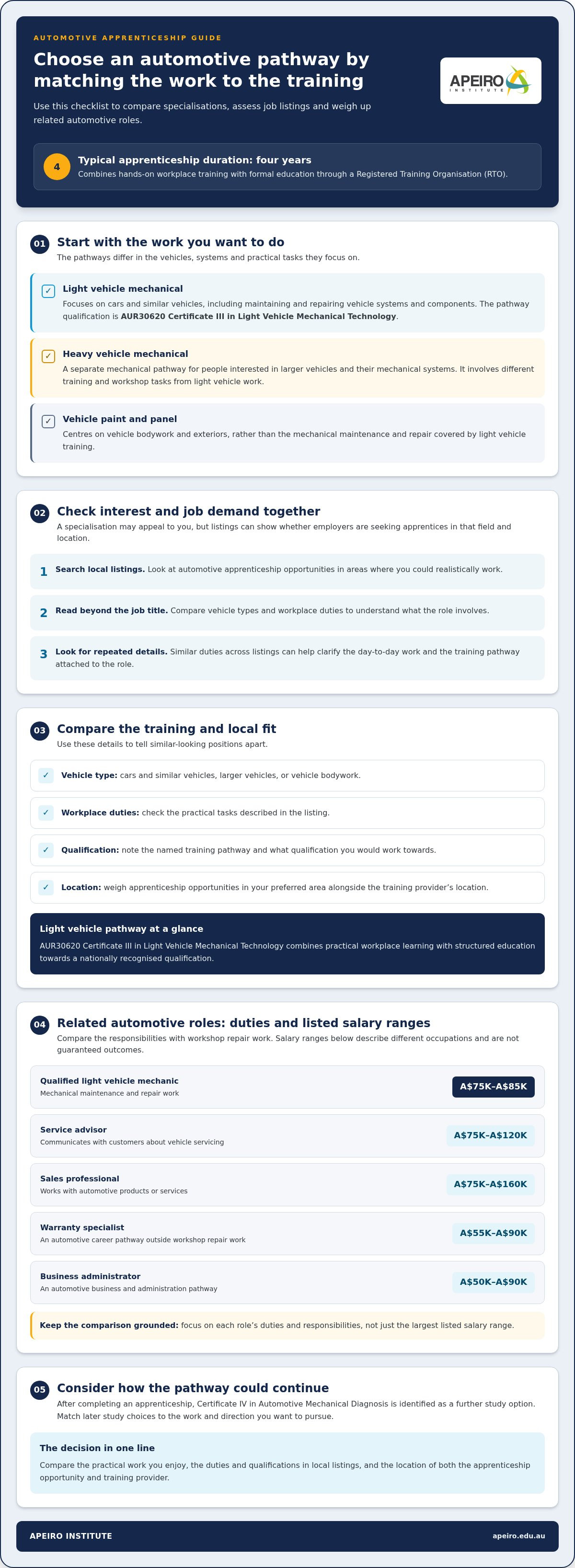
A light vehicle mechanical apprenticeship typically takes four years to complete. It combines hands-on workplace training with formal education delivered by a Registered Training Organisation (RTO). Apprentices gain practical work experience while working towards a nationally recognised qualification in their chosen trade.
Workplace tasks connect practical experience with the knowledge needed to understand vehicle systems. For example, an apprentice might practise a maintenance task, then study the related concepts through formal training. When considering a motor mechanic apprenticeship in NSW, compare the training provider’s location with apprenticeship opportunities in your preferred area. MTA NSW advises applicants to consider both, as location can affect how well a training pathway fits their circumstances.
Vehicle Mechanical Training
Light vehicle mechanical training develops the practical skills and theoretical knowledge needed to maintain and repair vehicle systems and components. MTA NSW describes both as parts of the training. Apprentices learn to connect workshop procedures with how vehicle parts and systems operate, rather than treating each task in isolation.
Heavy vehicle mechanical training is a separate pathway for people interested in working on larger vehicles. Consider the vehicles you want to work with before choosing a training direction. Light vehicle training focuses on cars and similar vehicles, while heavy vehicle training covers larger vehicles and their mechanical systems. The pathways involve different training and workshop tasks.
Vehicle paint and panel training offers another direction in automotive work. It focuses on vehicle bodywork, rather than the mechanical maintenance and repair covered in light vehicle training. If you enjoy working with vehicle exteriors, compare this pathway with mechanical training and consider which practical skills you want to develop.
For light vehicle apprentices, the AUR30620 Certificate III in Light Vehicle Mechanical Technology is the qualification for this training pathway. Compare its focus with the workshop work you want to pursue, then weigh training location and local apprenticeship opportunities together. This gives you a practical basis for choosing a direction that aligns with your interests and circumstances.
Choosing an automotive apprenticeship specialisation
Your specialisation shapes the vehicles, systems and workshop tasks you learn to handle. For a motor mechanic apprenticeship in NSW, compare your interests with the work described in job listings and the training pathway attached to each role.
MTA NSW advises applicants to consider their interests when choosing an automotive specialisation and to research job demand before deciding. Use both checks: an area might appeal to you, but job listings can show whether employers are seeking apprentices in that field and location.
Start by searching for automotive apprenticeship listings in areas where you could realistically work. Read beyond the job title and compare vehicle types, workplace duties, the named qualification and training location. A light vehicle listing, for example, may focus on cars and similar vehicles, while a heavy vehicle role involves larger vehicles. Paint and panel work takes a different direction, focusing on vehicle bodywork.
Look for recurring details across listings. Similar duties can help clarify what a role involves, while the stated training pathway indicates the qualification you would work towards. MTA NSW also advises considering apprenticeship opportunities in your preferred area alongside the training provider’s location. This can help distinguish between positions that otherwise seem similar.
Consider related automotive roles
Mechanical training supports a trade pathway, while automotive sales and administration involve different work. A service advisor communicates with customers about vehicle servicing, while a sales professional works with automotive products or services. Warranty specialists and business administrators are other roles in automotive career pathways. Compare their daily responsibilities with workshop repair work before choosing your direction.
Salary ranges listed for these roles vary: a qualified light vehicle mechanic is A$75K-A$85K; a service advisor, A$75K-A$120K; a sales professional, A$75K-A$160K; a warranty specialist, A$55K-A$90K; and a business administrator, A$50K-A$90K. These figures describe different occupations, not guaranteed outcomes. The relevant comparison is the role and its duties, rather than the largest range alone.
Map the next career step
Consider how your first qualification could connect with later study. Certificate IV in Automotive Mechanical Diagnosis is identified as a further study option after completing an apprenticeship. If light vehicle work matches your goals, explore the light vehicle mechanical technology qualification as one way to understand that training pathway.
Job prospects depend on the specialisation and location you’re considering. Compare current job listings, note which roles appear, and weigh their duties against your interests. This gives you a practical basis for choosing an automotive apprenticeship focus and identifying the career options it may support.
Driver’s licence and eligibility requirements
For a motor mechanic apprenticeship in NSW, applicants must be Australian citizens or permanent residents. A driver’s licence is a separate consideration, so check the specific position’s stated requirements.
Separate these two points when reviewing an apprenticeship advertisement. First, confirm that your residency status meets the eligibility criterion. Then read the duties for driving tasks, vehicle movements or travel between work locations. A workshop role focused on repairs, for example, may involve different tasks from a position that includes vehicle collection or delivery.
A job listing is the best place to identify what an employer expects for that role. Look for explicit references to a driver’s licence, vehicle movements, customer pick-ups or travel, and note the exact wording. A general mention of workshop work doesn’t specify which driving tasks the job involves.
Before applying, organise the details that explain your situation: your Australian citizenship or permanent residency status, any current licence and relevant driving experience. Keep each item distinct. If an advertisement mentions collecting customer vehicles, for example, state your licence status accurately rather than assuming the task has the same requirements as workshop servicing.
- Eligibility: identify whether you are an Australian citizen or permanent resident.
- Licence: record the licence you currently hold, if any.
- Role duties: mark any advertised driving, delivery or travel tasks.
- Application: answer licence questions accurately and relate your experience to the stated duties.
This approach also helps when comparing NSW opportunities. One advertisement may focus on workshop repairs, while another describes customer-facing duties or vehicle movements. Use the written duties to understand each role, rather than assuming all apprenticeships involve the same driving tasks.
If you don’t hold a licence, don’t present that as a substitute for the eligibility rule. State your actual status and read each position’s requirements carefully. If you do hold a licence, include its current class only when requested, and don’t overstate your experience.
Keep your application clear and factual: establish your eligibility, describe your licence status accurately, then connect your experience to the listed duties. This gives an employer a straightforward picture of your circumstances and the work you’re prepared to undertake.
What are the employer and apprentice obligations under NSW apprenticeship rules?
A NSW apprenticeship brings together workplace learning, formal training and progress towards a nationally accredited qualification. The arrangement works best when the employer, apprentice and Registered Training Organisation (RTO) understand their roles and communicate about training progress. For a light vehicle apprentice, that means connecting workshop experience with the formal learning required for the trade.
The employer provides the workplace setting for practical experience. In a motor workshop, this could include supervised opportunities to practise maintenance tasks, become familiar with vehicle systems and develop safe work habits. Tasks should relate to the apprentice’s training pathway, rather than being treated as unrelated labour. Apprentices need to take part in assigned learning, follow workplace instructions and ask questions when a task is unfamiliar.
An RTO delivers formal education as part of the apprenticeship. Practical work experience and a nationally recognised qualification are connected parts of the pathway. The employer and apprentice can strengthen that connection by discussing upcoming workplace tasks alongside the topics being studied. For example, a learner studying vehicle systems can ask how a workshop task relates to that training.
Keep training progress visible
Use a simple routine to keep training and workshop activity aligned. Record completed learning tasks, note areas that need more practice and discuss upcoming training with the relevant people. If an apprentice hasn’t had the opportunity to practise a skill, raising the gap early makes it easier to plan suitable workplace experience. Clear notes also help both sides discuss progress with specific examples.
- Employer: plan relevant workplace tasks and explain instructions before work begins.
- Apprentice: attend to assigned training, ask questions and communicate when support is needed.
- RTO: deliver the formal education component and assess learning towards the qualification.
- Both: discuss progress and identify practical experience that supports training goals.
These are practical ways to keep an apprenticeship on track, but they don’t replace the terms of an individual apprenticeship arrangement. Read the written agreement carefully, note the training pathway and keep copies of relevant training communications. If circumstances change, such as duties or training arrangements, document what has changed and discuss its effect on learning progress.
If you’re already part-way through an apprenticeship, record your completed training, workplace experience and any outstanding learning. This gives the employer and RTO a clearer basis for planning the next stage. A motor mechanic apprenticeship depends on coordinated work and study, so regular communication helps connect daily workshop tasks with progress towards the qualification.
What safety risks and licensing requirements apply to motor mechanics in NSW?
Workshop safety and licence requirements are separate considerations when planning a motor mechanic apprenticeship in NSW. Applicants must be Australian citizens or permanent residents. For licence questions, read the duties for each position and identify whether they involve driving, moving vehicles or other tasks requiring specific authorisation.
Begin a safety review with the task at hand. For a vehicle inspection, identify the equipment, vehicle system and procedure involved. Before starting, clarify the instructions, training required and who will supervise the work. If a procedure is unfamiliar, pause and ask for guidance. This is a practical approach to new workshop tasks during a motor mechanic apprenticeship in NSW.
Use a consistent routine for each new workshop task:
- Identify the work: name the vehicle, system and task, such as inspecting a braking system.
- Clarify the method: review instructions and ask about unfamiliar steps or equipment.
- Confirm your preparation: establish which training and supervision apply to that task.
- Review the outcome: record what you completed and any skills needing further practice.
These steps connect hands-on learning with formal training. The AUR30620 Certificate III in Light Vehicle Mechanical Technology is the qualification associated with the light vehicle pathway. Its training covers practical skills and theoretical knowledge for maintaining and repairing vehicle systems and components. Treat each new procedure as a learning task, with instructions and supervision suited to your experience.
Separate trade training from driving duties
A workshop role may include driving-related duties, so read each advertisement carefully. Look for vehicle collection, delivery, road testing or travel between work locations. Note any named licence conditions and compare them with your current licence status. Don’t assume every motor mechanic position has the same driving tasks or licence requirements.
Moving a vehicle within a workshop and completing a road-related task are different activities. Clarify the task, required authorisation and supervision before proceeding. If an advertisement asks for a particular licence, address that requirement accurately in your application. Keep the apprenticeship eligibility criterion separate from any driving conditions attached to the role.
As your training progresses, record completed learning and tasks you’re ready to practise with guidance. This makes it easier to discuss your capabilities with your employer and connect workshop duties to qualification progress. The light vehicle mechanical technology qualification provides a structured training pathway for this work.
Explore light vehicle mechanical training
Apeiro Institute: UEE30920 Certificate III in Electronics and Communications
Apeiro Institute offers the UEE30920 Certificate III in Electronics and Communications for learners interested in developing skills in that field. It is a separate qualification from the AUR30620 Certificate III in Light Vehicle Mechanical Technology, so it isn’t the motor mechanic apprenticeship qualification discussed above.
If your goal is automotive training, focus on the qualification and apprenticeship pathway that match the workshop role you’re pursuing. Apeiro Institute offers Apprenticeships and Traineeships, Trade Pathways for Experienced Workers (TPEW) and Smart & Skilled Funded Courses. These options can help you explore vocational training pathways.
Contact Apeiro Institute to discuss the training direction that aligns with your career goals.
Take the next step towards your automotive career
Choosing a motor mechanic apprenticeship in NSW is a starting point for building a trade pathway that fits your interests and experience. Identify the training direction you want, then consider how your existing skills and workplace learning can support it. If you’re already working in a trade, Trade Pathways for Experienced Workers (TPEW) may help you explore how your experience connects with vocational training.
Apeiro Institute offers Apprenticeships and Traineeships, as well as the UEE30920 Certificate III in Electronics and Communications. These are distinct pathways, so focus on the qualification that matches your intended work. If you’re weighing your options or considering a change in direction, Apeiro Institute can help you explore its training offerings and decide what to investigate next.
Keep your goals in view, choose a next step that suits your circumstances and build towards a future you can be proud of.
Frequently Asked Questions
Do you accept applicants' part-way through a current apprenticeship?
Apeiro Institute offers Apprenticeships and Traineeships. If you’re already part-way through, prepare your training record, results for completed units and details of your current workplace training. These documents show what you’ve studied and the experience you’ve gained. Recognition of Prior Learning may also be relevant if you have skills or experience to be assessed towards a qualification. Share clear records when discussing your next training step.
Do you need a driver's licence to be able to start an apprenticeship?
A driver’s licence requirement depends on the duties attached to the apprenticeship. Read the advertisement for tasks such as moving vehicles, customer collections or road testing, and note any licence conditions it names. If the listing asks about your licence, describe your current status accurately. For example, distinguish between holding a licence and having experience driving customer vehicles. This keeps your application relevant to the role.
What are my training options?
For light vehicle mechanical training, the relevant qualification is the AUR30620 Certificate III in Light Vehicle Mechanical Technology. Apprenticeships and Traineeships combine workplace learning with formal vocational training. Eligible NSW apprentices and trainees may access fee-free training through NSW Smart & Skilled. Apeiro Institute also offers Trade Pathways for Experienced Workers and other vocational qualifications, so choose an option that matches your trade and experience rather than treating every course as an apprenticeship.
What are the essential criteria I must meet to apply?
To be eligible for an apprenticeship, applicants must be Australian citizens or permanent residents. An employer’s advertisement may also set requirements related to the specific job, such as particular duties or licence conditions. Read each listing carefully and prepare accurate details about your eligibility, training history and work experience. If you’ve already completed units, include the results so your application reflects your progress.
What happens next?
Start by choosing the automotive pathway and qualification that fit the work you want to pursue. Then review apprenticeship listings, note their location and duties, and prepare your application details. If you’re already studying, gather your training records and completed unit results. With a clear view of your preferred direction, you can explore the relevant training option and take your next step with useful information ready.
What is the typical recruitment timeline?
There isn’t one fixed recruitment timeline for every apprenticeship. The process depends on when an employer is recruiting, how applications are reviewed and whether interviews or other selection steps are involved. Stay organised by preparing your résumé, eligibility details and training records before applying. Track the dates and instructions in each listing, then respond promptly to employer communications.
What skills do I need?
Curiosity about how vehicles work, careful attention to instructions and a willingness to learn are useful foundations. Workshop tasks also call for clear communication: apprentices need to understand directions and ask questions about unfamiliar procedures. For example, describing what you observed during a vehicle inspection can help clarify the next task. Structured training and workplace experience help you develop trade-specific practical skills as you progress.
What qualifications can you gain from a motor mechanic apprenticeship in NSW?
A light vehicle mechanical apprenticeship leads towards the AUR30620 Certificate III in Light Vehicle Mechanical Technology, a nationally accredited qualification in the chosen trade. The training develops practical and theoretical knowledge for maintaining and repairing vehicle systems and components. Further study may be an option after completing an apprenticeship. Your pathway depends on the trade and qualification attached to your training arrangement.

Disclaimer
The information provided on this blog is for general informational and educational purposes only. While every effort is made to ensure the accuracy and reliability of the content, the author makes no representations or warranties of any kind, express or implied, about the completeness, accuracy, suitability, or availability of the information contained on this blog.
The views and opinions expressed in blog posts are those of the individual author and do not necessarily reflect the official policy or position of any organization, company, or employer.
This blog may contain links to external websites or third-party content. These links are provided for convenience only, and the author has no control over and assumes no responsibility for the content, privacy policies, or practices of any third-party sites.
Nothing on this blog constitutes professional advice (legal, financial, medical, or otherwise). Readers are encouraged to seek appropriate professional guidance before making any decisions based on the information provided here.
By using this blog, you acknowledge that any reliance on the information is at your own risk.


