

An automotive apprenticeship combines hands-on work with formal training, not just time in a workshop. A vehicle mechanic apprenticeship in NSW typically takes four years, although an apprentice may finish earlier by completing all required competencies sooner. Apprentices build workplace experience while studying through a Registered Training Organisation.
As a light vehicle mechanic apprentice, you’ll learn to service, repair and diagnose faults in vehicles, including their engines, transmissions, suspension and braking systems. You’ll develop practical skills alongside the theory behind the work, with experienced mechanics guiding you as your confidence grows.
This guide explains what the role involves, where apprenticeships and training are available across NSW, and how to explore pathways that fit your interests. You’ll also learn about the skills you can develop and the career directions that may follow, so you can take your next step with a clearer picture of the trade.
Key Takeaways
- Plan your entry by securing an apprenticeship placement, then consider how formal training fits alongside workshop experience.
- Explore the practical skills involved, from routine servicing to diagnosing faults across key vehicle systems.
- Compare opportunities across NSW and weigh how the training location may affect access to your preferred specialisation.
- Use your interests and long-term goals to guide your next steps, including further automotive qualifications and potential career pathways.
Training provider and apprenticeship locations
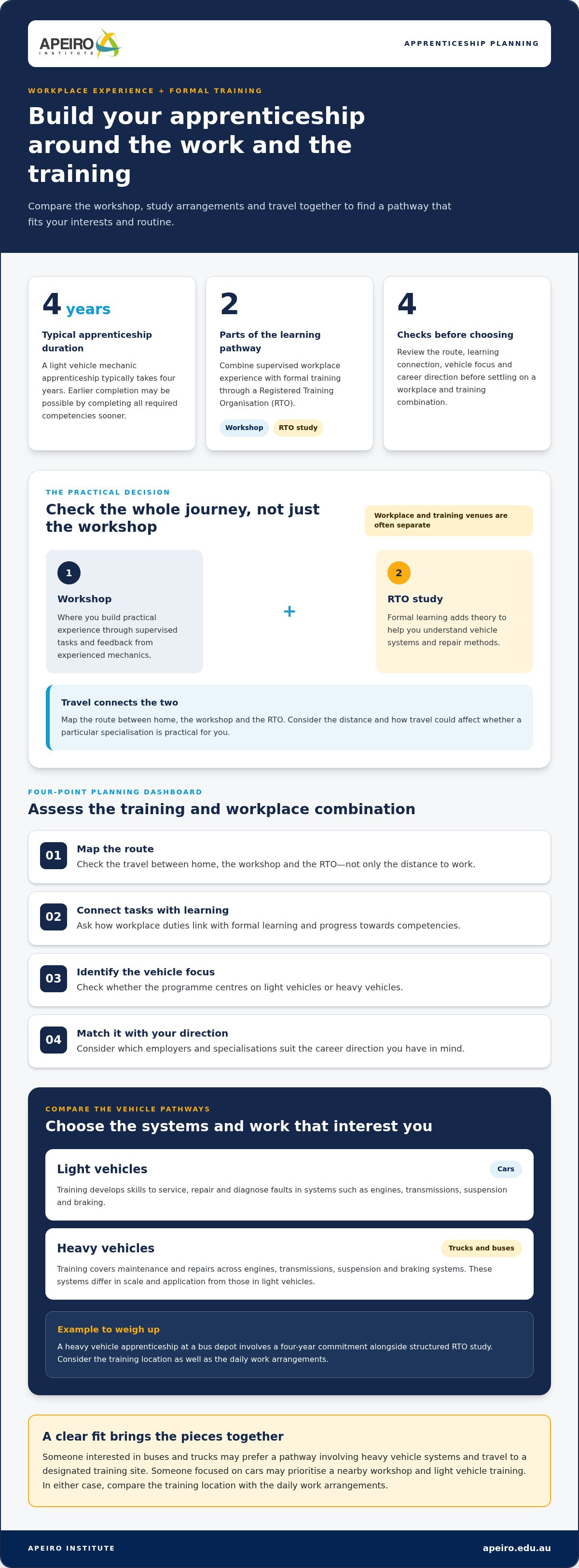
A light vehicle mechanic apprenticeship typically takes four years in Australia, though an apprentice may finish sooner by completing all required competencies early. Training combines workshop experience with formal education delivered by a Registered Training Organisation (RTO). Before choosing an opportunity, consider how you’ll manage the distance between work and training. A long commute can affect whether a particular specialisation is practical for you.
Apprenticeships combine hands-on work with formal training, and the training provider’s location can shape the available program. Consider the workplace and study arrangements together, including any travel between them. For example, a heavy vehicle apprenticeship at a bus depot requires a four-year commitment alongside structured RTO study. Because the workplace and training venue are often separate, you should factor both into your decision.
Heavy vehicle training combines practical skills with theory. Apprentices learn to maintain and repair vehicles such as trucks and buses, including their engines, transmissions, suspension and braking systems. These systems differ in scale and application from those in light vehicles, so consider which work interests you. The training location can also shape the specialisation available and the jobs you can pursue.
On the job, apprentices develop skills through supervised tasks and feedback from experienced mechanics. A typical progression might start with preparing a vehicle and tools, then move to servicing components and helping diagnose faults. A supervisor can explain the order of a task and review the work. At Apeiro Institute, formal learning adds the theory needed to understand vehicle systems and repair methods.
Employment arrangements and safe workshop practices address apprentice entitlements, supervision and workplace safety. Before starting, clarify who will supervise you, how formal training fits your work schedule, and how to report hazards or unsafe tasks. These questions help you understand expectations while ensuring an apprentice is not treated as a substitute for a qualified mechanic.
Use these steps to assess a training and workplace combination:
- Map the route between home, the workshop and the RTO.
- Ask how workplace tasks connect with formal learning and competency progress.
- Identify whether the program focuses on light or heavy vehicles.
- Consider which employers and specialisations suit your career direction.
For example, someone interested in buses and trucks may prefer a pathway involving heavy vehicle systems and travel to a designated training site. Someone focused on cars may prioritise a nearby workshop and light vehicle training. In either case, compare the training location with the daily work arrangements. This practical check can help you choose an apprenticeship that fits your interests and routine.
What do you do as an Automotive Light Vehicle Mechanic Apprentice?
An apprentice learns through practical workshop tasks and formal training, developing the skills to inspect, service, repair and diagnose light vehicles. For example, you might help prepare a car for servicing, follow a repair procedure, then discuss the results with a supervising mechanic. Each task builds your understanding of how vehicle systems work together.
A light vehicle mechanic apprenticeship in Australia has no formal entrance requirements, but you need an apprenticeship placement. Securing an employer is therefore a key step before starting the workplace pathway. Employers assess applicants’ suitability for the role, while training develops automotive knowledge and practical skills. Be ready to explain your interest in mechanical work and give examples of how you follow instructions and solve problems.
A driver licence is separate from the apprenticeship’s formal entry requirements. It may be relevant if a job involves moving vehicles around a workplace, but that is different from learning mechanical skills. Before accepting a position, understand which tasks involve driving and which involve repairs or servicing. Inspecting a vehicle in a workshop, for example, does not itself mean driving it on public roads.
Truck licences are also separate from apprenticeship entry requirements. A light vehicle mechanic apprentice learns about light vehicles, while heavy vehicle work involves vehicles such as trucks and buses. Repair training and permission to drive are distinct. If a role involves moving heavy vehicles, clarify how that task fits the workplace duties and training plan. Learning to repair a vehicle does not automatically authorise you to drive it.
For vocational study, organise your Unique Student Identifier (USI) details with your enrolment information. Keep the identifier accessible alongside your personal details and training records. This helps you manage course administration as you move between workplace learning and formal education. Use consistent personal details across enrolment documents so your records can be matched correctly.
To prepare for applications, take these practical steps:
- Secure an apprenticeship placement with an employer.
- Ask what vehicle types and workshop duties the position covers.
- Discuss how workplace tasks connect with formal training.
- Prepare your enrolment details, including your USI information.
- Clarify whether driving forms part of the role’s daily duties.
These questions help distinguish the training pathway from a job’s specific duties. One workshop may focus on passenger cars, while another role involves different vehicle types, shaping the practical experience you gain. Look for a placement where the work and training align with the mechanical skills you want to develop.
If you’re comparing formal study options for light vehicle work, explore the AUR30620 Certificate III in Light Vehicle Mechanical Technology as a relevant qualification pathway.
Mechanical servicing, repairs and fault-finding
Light vehicle mechanic training covers the practical skills and theory needed to maintain and repair vehicle systems, including engines, transmissions, suspension, braking systems and other components. Apprentices learn what each system does before assessing faults. For example, unusual braking performance points to the braking system, while a transmission concern involves a different set of components.
Servicing follows a methodical sequence. First, understand the reported concern and the vehicle’s condition. Next, inspect relevant components and follow the required service or repair procedure. Then record your findings and explain what work was completed. This approach connects hands-on tasks with the reasoning behind them and helps distinguish routine maintenance from repairs addressing a specific fault.
Fault-finding means assessing evidence rather than guessing. An apprentice might note the driver’s description, inspect the related system and compare observations with expected operation. A concern about suspension focuses the inspection on suspension components; an engine concern shifts attention to engine operation. Describing the issue clearly helps a supervising mechanic decide what to do next.
- Engines: Learn how engine components fit within light vehicle maintenance and repairs.
- Transmissions: Understand their role, then connect reported concerns with the relevant system.
- Suspension: Study components and their function when inspecting suspension-related issues.
- Braking systems: Build knowledge of braking components through practical training and theory.
- Other components: Apply the same careful approach to additional vehicle systems.
Vehicle body repair and refinishing is a related but distinct area. Training can cover repairing damaged body panels, preparing surfaces, applying and matching paint, and finishing the repaired area. A damaged panel, for example, may need repair before surface preparation and paint application. Matching the finish is part of the process, not a substitute for sound panel preparation.
Consider which work interests you. Mechanical training centres on vehicle systems such as engines, transmissions, suspension and brakes. Body repair focuses on damaged panels and refinishing. Both involve practical skills, but they develop different capabilities. This distinction can help you explain your interests when considering training and workplace tasks.
A useful way to reflect on workshop learning is to connect each task with its purpose:
- Identify the system involved in the servicing or repair task.
- Describe the concern using clear observations.
- Follow the relevant procedure under supervision.
- Review the findings and the completed work.
These steps build a foundation for vehicle maintenance and a methodical approach to repairs. As training progresses, apprentices gain experience connecting practical tasks with the theory behind each vehicle system.
Apprenticeship employers and locations across NSW
Apprenticeship opportunities span different parts of NSW and different vehicle settings. A workshop, bus depot or plant maintenance workplace can expose apprentices to different vehicles and components. The right location depends on the work you want to learn, the employer’s training arrangements and the distance to formal study. Compare the workplace and training venue, especially when they are in separate towns.
Randwick is one example of a heavy vehicle apprenticeship setting. A bus-depot apprenticeship there requires a four-year commitment and TAFE study at Wetherill Park. This illustrates why it’s useful to consider both the job location and where training takes place.
Regional opportunities can have different daily arrangements. A heavy vehicle mechanic apprentice job in Gunnedah lists a Monday-to-Friday schedule, from 7am to 3pm, alongside TAFE attendance. That example gives a concrete picture of how work hours and study may fit together. Before pursuing a role, map the commute and consider how the training location affects your routine.
Other listings illustrate the range of mechanical work. Plant mechanics work with equipment rather than the light vehicles common in automotive workshops. The advertised pay applies to the specific listed job, not necessarily to every apprenticeship.
Use each listing to understand the role rather than assuming all apprenticeships offer the same work or conditions. Check the vehicle type, workplace tasks, training location, schedule and stated pay. For example, a bus-depot role in Randwick differs from plant mechanic work in Rydalmere. These details help you assess whether a position suits your interests and travel needs.
When comparing employers across NSW, consider the vehicles and components you want to work with. A light vehicle workshop suits learners focused on cars, while a bus depot offers experience with heavy vehicles. Plant maintenance provides another direction. The training provider’s location can affect which specialisations and job prospects are accessible in your preferred area. Start with the work, then compare practical locations.
Make a shortlist of opportunities using a few practical criteria:
- Vehicle focus: Identify whether the role covers light vehicles, buses, trucks or plant.
- Location: Compare the workplace with the formal training venue.
- Routine: Note listed work hours and how TAFE attendance fits.
- Advertised conditions: Read pay information in the context of the specific job listing.
For example, an applicant interested in buses could compare the Randwick depot example with the Gunnedah schedule. Someone drawn to plant equipment might explore the Rydalmere example instead. Matching the role, location and training arrangements helps you focus on opportunities that fit your goals.
Career prospects and related qualifications
A light vehicle apprenticeship can build skills for several automotive career directions. More than 100,000 people are employed in Australia’s automotive industry. Your next steps can depend on the systems you enjoy, the experience you gain and the work available in your preferred area. Consider those factors before choosing a specialisation or further qualification.
After a light vehicle apprenticeship, you can pursue Certificate IV in Automotive Mechanical Diagnosis. This qualification builds on mechanical foundations and develops a focus on diagnosing vehicle faults. Further automotive study can deepen your technical knowledge or prepare you for responsibilities beyond workshop repairs. Match your next qualification to the work you want to do.
Career options can also extend beyond hands-on mechanical work. A qualified light vehicle mechanic may progress towards workshop or service management. Other possible directions include service advising, warranty work, skills training, sales, business administration, franchise ownership or engineering. Each path calls for different strengths, such as customer communication, technical expertise, business planning or supporting other learners.
Estimated salary ranges listed for these roles provide a broad comparison, not a guaranteed outcome:
- Qualified light vehicle mechanic: A$75,000-A$85,000.
- Workshop manager: A$80,000-A$165,000.
- Service manager: A$95,000-A$165,000.
- Service advisor: A$75,000-A$120,000.
- Warranty specialist: A$55,000-A$90,000.
- Skills trainer: A$85,000-A$100,000.
- Sales professional: A$75,000-A$160,000.
- Business administrator: A$50,000-A$90,000.
- Franchise owner: A$100,000-A$180,000.
- Engineer: A$90,000-A$190,000.
Use these estimates as context when comparing career directions. Figures vary between roles, and the listed ranges do not establish what an individual will earn. Focus first on the work itself: a service advisor supports customer interactions, while a workshop manager oversees workshop operations. A mechanic interested in diagnosis may prefer further technical study.
To plan your next move, identify the tasks you want to do more often. If fault-finding interests you, explore diagnostic study after your apprenticeship. If you enjoy guiding a team, build experience with workshop responsibilities. If customer service or business appeals, consider how automotive knowledge could support those roles. Choosing a qualification that matches your goal makes further learning purposeful and connects your apprenticeship skills with a longer-term career plan.
Apeiro Institute: UEE30920 Certificate III in Electronics and Communications
Apeiro Institute offers the UEE30920 Certificate III in Electronics and Communications, alongside automotive training for learners pursuing light vehicle work. If your goal is a mechanic apprenticeship, the AUR30620 Certificate III in Light Vehicle Mechanical Technology is the more directly relevant qualification. Apprenticeships and Traineeships and Smart & Skilled Funded Courses may also suit learners exploring vocational training options. The electronics qualification is a separate pathway for those interested in electronics and communications, rather than a replacement for automotive mechanic training. Consider which direction best matches your career plans and the skills you want to develop. For information about training pathways, contact Apeiro Institute or visit apeiro.edu.au.
Take your next step towards the trade
Choose a direction that reflects your starting point. If you’re new to the trade, explore apprenticeship and traineeship pathways and consider the workplace experience you want to build. If you already have relevant experience, Trade Pathways for Experienced Workers (TPEW) may help you formalise skills gained on the job. Your next step towards a vehicle mechanic apprenticeship in NSW can begin with a clear conversation about your goals and suitable training.
Apeiro Institute also offers the UEE30920 Certificate III in Electronics and Communications, a separate option for learners interested in electronics and communications. Consider whether that area complements your longer-term interests, or whether automotive training is your priority.
Keep moving towards work that interests you. With a clear goal and a practical learning pathway, you can start building confidence for your future in the trade.
Frequently Asked Questions
What are my training options?
You can combine paid workplace learning with formal vocational study through an RTO. In NSW, eligible apprentices and trainees may access fee-free NSW Smart & Skilled funded training. Choose training that matches your intended work, such as light vehicle mechanics or automotive diagnosis. If you already have trade experience, Trade Pathways for Experienced Workers may help formalise your existing skills. Apeiro Institute acknowledges Traditional Owners throughout Australia.
What happens next?
Start by securing an apprenticeship placement with an employer, as workplace learning is part of the pathway. Then discuss how formal training will fit alongside your job, including the provider, study arrangements and competency assessment. If your employer mainly works on passenger vehicles, for example, ask how your training connects with that experience. Keep your enrolment details and training records organised as you progress.
What skills do I need?
You’ll need a willingness to learn practical tasks, follow instructions and work carefully with vehicle components. Curiosity helps when investigating a fault, while clear communication supports discussions with supervisors and customers. For example, describe a vehicle concern accurately before beginning an inspection. You’ll develop trade skills during training, so you don’t need to start as an experienced mechanic. Reliability and an interest in problem-solving can help you engage with workshop learning.
What will I learn?
You’ll develop knowledge of light vehicle systems and how to approach servicing, maintenance and repairs. Training connects practical activities with the theory behind components such as engines, transmissions, suspension and braking systems. You’ll also learn to observe symptoms, follow repair procedures and communicate findings. A reported braking concern, for example, calls for careful attention to the relevant system rather than a guess about the cause.
What vehicle mechanic apprenticeship qualifications are available in NSW?
Relevant automotive qualifications include AUR30620 Certificate III in Light Vehicle Mechanical Technology, AUR40216 Certificate IV in Automotive Mechanical Diagnosis and AUR50216 Diploma of Automotive Technology. The Certificate III aligns with light vehicle mechanic training, while the Certificate IV focuses on diagnosis. The Diploma is a further automotive study option. Consider your current experience and intended work when deciding which qualification best fits your next step.
What are the entry requirements for a light vehicle mechanic apprenticeship in NSW?
There are no formal entrance requirements for a light vehicle mechanic apprenticeship, but you need to secure an apprenticeship placement. Applicants must be Australian citizens or permanent residents to qualify for an apprenticeship. A driver licence is separate from formal entry requirements; whether driving is part of a particular job depends on its duties. Focus first on finding an employer placement and understanding the work involved.
What is the NSW apprenticeship registration and training process?
The practical pathway starts with an employer placement, followed by workplace learning alongside formal RTO training. The employer and training arrangements connect your job tasks with the qualification’s required competencies. Ask how training is organised, how progress is assessed and how workplace experience contributes to learning. For example, discuss how servicing tasks at work relate to topics in your formal study.
How long does a vehicle mechanic apprenticeship take in NSW?
A light vehicle mechanic apprenticeship typically takes four years to complete in Australia. An apprentice may finish sooner by achieving all required competencies early. Progress depends on completing the training requirements and demonstrating the necessary skills through workplace and formal learning. Discuss how your competency progress is tracked so you know what remains as you move through the apprenticeship.

Disclaimer
The information provided on this blog is for general informational and educational purposes only. While every effort is made to ensure the accuracy and reliability of the content, the author makes no representations or warranties of any kind, express or implied, about the completeness, accuracy, suitability, or availability of the information contained on this blog.
The views and opinions expressed in blog posts are those of the individual author and do not necessarily reflect the official policy or position of any organization, company, or employer.
This blog may contain links to external websites or third-party content. These links are provided for convenience only, and the author has no control over and assumes no responsibility for the content, privacy policies, or practices of any third-party sites.
Nothing on this blog constitutes professional advice (legal, financial, medical, or otherwise). Readers are encouraged to seek appropriate professional guidance before making any decisions based on the information provided here.
By using this blog, you acknowledge that any reliance on the information is at your own risk.


