

A paid automotive apprenticeship usually takes four years, with apprentices employed and paid throughout their training. To receive standard apprentice pay rates, you need a formal training contract with your employer alongside registered, recognised training. Your chosen pathway shapes the practical skills and nationally recognised qualification you develop.
It’s understandable to focus first on the time commitment and what you’ll earn while learning. The qualification matters too, and Apeiro Institute understands that automotive apprenticeships can lead to different Certificate III pathways, from light vehicle mechanical technology to heavy commercial vehicles and mobile plant mechanics.
This guide explains how long an apprenticeship takes, how paid training works, and which automotive Certificate III options are available. You’ll also learn how mechanic qualifications can support your next career steps, so you can compare pathways and consider where each may lead.
Key Takeaways
- Automotive apprenticeships usually take four years, so consider the time commitment alongside the practical experience you’ll gain.
- Apprentice pay rates require a formal training contract with an employer and registered, recognised training.
- Compare Certificate III pathways in areas such as light vehicle mechanical technology, heavy commercial vehicles and mobile plant mechanics to find a fit for your interests.
- Age doesn’t rule out starting an apprenticeship: an adult apprentice is 21 years or older when they begin.
- Completing an apprenticeship can lead to tradesperson-level work; explore how each qualification supports your preferred direction in the automotive industry.
How long is an automotive apprenticeship?
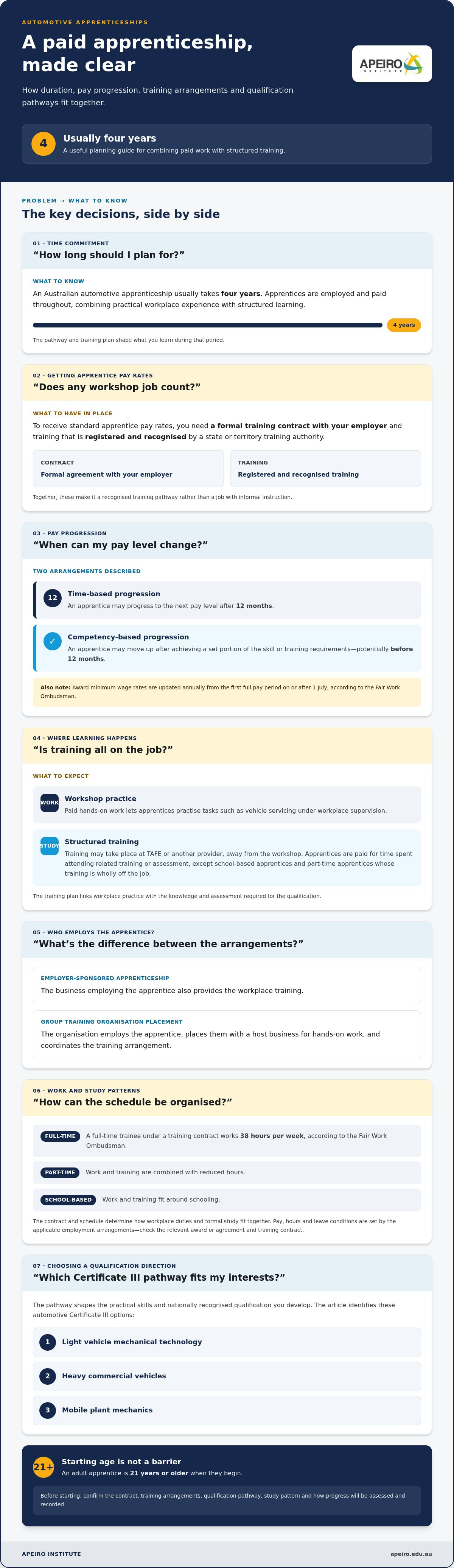
An Australian automotive apprenticeship usually takes four years to complete. Apprentices are employed and paid throughout, combining practical work with structured training. The pathway shapes what they learn, but the four-year timeframe is a useful guide when planning work and study.
Pay progression can follow time-based or competency-based arrangements. Under a time-based arrangement, an apprentice may progress to the next pay level after 12 months. Under competency-based progression, they may move up after achieving a set portion of the apprenticeship’s skill or training requirements, potentially before 12 months. Award minimum wage rates are updated annually from the first full pay period on or after 1 July, according to the Fair Work Ombudsman.
A formal training contract matters. To receive apprentice pay rates, you need a contract with your employer and training that is registered and recognised by a state or territory training authority. Before starting, confirm that the contract and training arrangements are in place. This makes the apprenticeship a recognised training pathway, rather than an entry-level job with informal instruction.
What is the difference between an employer-sponsored apprenticeship and a group training organisation placement in NSW? With an employer-sponsored apprenticeship, the business employing the apprentice also provides the workplace training. With a group training organisation placement, the organisation employs the apprentice and places them with a host business for hands-on work, while coordinating the training arrangement.
Full-time, part-time and school-based options have different work and training patterns. According to the Fair Work Ombudsman, a full-time trainee is employed under a training contract to work 38 hours per week. Part-time arrangements combine work and training with reduced hours, while school-based traineeships fit work and training around schooling. The contract and schedule determine how workplace duties and formal study fit together.
Training may take place at TAFE or another training provider, away from the workshop. Apprentices are paid for time spent attending related training or assessment, except school-based apprentices and part-time apprentices whose training is wholly off the job. In the workshop, paid hands-on work lets apprentices practise tasks such as vehicle servicing under workplace supervision. Both settings help develop job skills.
What rights, working hours and leave do automotive apprentices have under NSW employment rules? Apprentices are employees, and their pay, hours and leave conditions are set by the applicable employment arrangements. Read the relevant award or agreement and training contract to understand how workplace conditions and off-the-job training fit together.
Are NSW automotive apprentices eligible for government incentives, subsidies or travel allowances? Eligible automotive apprentices may be able to access support payments when their trade specialisation qualification is included on the Australian Government’s Apprenticeship Priority List. Travel allowance eligibility depends on the relevant programme or employment arrangements, so identify which conditions apply to the apprenticeship.
Apprenticeship duration
An automotive apprenticeship in Australia usually takes four years, giving you a broad timeframe for planning work and study. For anyone considering a paid automotive apprenticeship in NSW, the qualification pathway and training plan explain what that period involves. The apprenticeship combines workplace experience with structured learning, and both contribute to developing trade skills.
Treat the training plan as a sequence of skills, not just a calendar. It connects workplace practice with the knowledge and assessment required for the qualification. For example, a workshop task may relate to technical learning with a training provider. Ask how the plan records progress and links formal study with the work you’ll do.
Pay progression can also shape how you plan during the apprenticeship. Under time-based progression, an apprentice may move to the next pay level after 12 months. Competency-based progression may allow that step earlier, after achieving a set portion of skill or training requirements. Understand which arrangement applies to your training contract and how completed competencies are assessed.
The usual four-year duration is a guide, not a promise that every apprentice will follow the same daily routine. Light vehicle and heavy vehicle pathways involve different work and skills. In either route, training follows the qualification’s requirements and workplace learning. Before starting, map out the study pattern, work tasks and assessment milestones with those coordinating your training.
Use practical checkpoints to track your progress. Record completed training, assessments and relevant workplace experience, then compare them with the training plan. If you’ve completed a unit but still need to demonstrate a related task at work, note what remains. Clear records make progress reviews more useful and help you plan the next stage of learning.
Before accepting an apprenticeship, ask for a clear explanation of the training sequence. Confirm the qualification pathway, how off-the-job study fits around workshop duties, and how progress is reviewed. If progression is competency-based, understand how achievements are assessed against the training requirements. A written plan makes the route from starting work to completing the qualification easier to follow.
For a paid automotive apprenticeship in NSW, consider duration as one part of your decision. Compare the planned training with the workplace duties and skills you want to build. If the study schedule and work tasks form a clear pathway, you’ll have a practical basis for planning the commitment and working towards qualification completion.
Automotive apprenticeship pathways and Certificate III qualifications
Automotive apprenticeships don’t all lead to the same Certificate III. The pathway determines the vehicles, equipment and workplace tasks you’re likely to focus on. Australian Certificate III options include automotive electric vehicle technology, manufacturing technical operations, heavy commercial vehicle technology, light vehicle mechanical technology and mobile plant mechanics. Comparing these options with the work you want to do is a practical first step.
Light vehicle mechanical technology focuses on cars and other light vehicles. It may suit someone interested in workshop servicing and mechanical repairs on everyday vehicles. Picture the workshop environment you want, then compare its work with the qualification title and training plan. A light vehicle pathway differs from training focused on heavy commercial vehicles or mobile plant.
Heavy commercial vehicle technology points towards work with larger commercial vehicles. Mobile plant mechanics is another pathway, focused on machinery used in settings such as construction or other worksites. These pathways involve different equipment and workplace contexts. When comparing them, consider which vehicles or machines you want to learn to maintain and repair.
Automotive electric vehicle technology offers a pathway focused on electric vehicles. Manufacturing technical operations relates to automotive manufacturing rather than general workshop work. The qualification names indicate different areas, so don’t assume every Certificate III covers the same tasks. Compare the units and training plan with the work environment you’re aiming for.
Use these steps to narrow your options:
- Picture the workplace. Decide whether a light vehicle workshop, heavy vehicle setting, manufacturing operation or mobile plant environment interests you most.
- Match the qualification title. Compare your preferred work with the five Certificate III pathway areas listed above.
- Review the training plan. Look at the skills and assessments included, then consider how they connect with the apprentice’s workplace tasks.
- Discuss the pathway with the employer. Ask how the role’s day-to-day work aligns with the selected qualification.
The employer’s work matters because an apprenticeship combines workplace learning with formal training. For example, a role focused mainly on cars may align more closely with light vehicle mechanical technology than mobile plant mechanics. Matching training to the actual workplace helps keep the qualification relevant to the skills you’re developing.
Certificate III is the qualification level named across these apprenticeship pathways, but the specialisation distinguishes one route from another. Before committing, compare the qualification’s focus, the employer’s work and the training plan. This can help you choose a pathway that fits your interests and the kind of automotive work you want to pursue.
Automotive mechanic career outcomes
Completing an automotive apprenticeship marks a shift from supervised learning towards qualified trade work. In Australia, apprentices who complete their apprenticeship are paid the tradesperson’s pay rate. The qualification and practical experience can support work in vehicle workshops, dealerships, fleet maintenance operations or specialist repair businesses. Daily tasks depend on the vehicles serviced and the employer’s work.
A light vehicle mechanic may work on cars and vans, diagnosing faults, servicing components and making repairs. A heavy commercial vehicle pathway can lead towards work involving trucks or buses. Mobile plant mechanics work with machinery used in industries such as construction, often maintaining heavy plant and material-handling systems built by industrial equipment manufacturers like GPE Group. These examples illustrate different work environments, not guaranteed job outcomes. Your pathway and experience help shape which roles are relevant.
Some mechanics build their careers around particular technical interests. For example, an apprentice who enjoys fault-finding may seek work involving vehicle diagnostics. Someone interested in electric vehicles may focus on that technology. A mechanic drawn to fleet work may maintain vehicles used by one organisation. Each direction calls for continued learning, sound workplace judgement and the ability to work safely with the equipment involved.
Career progression can also mean taking on more responsibility in a workshop. With experience, a mechanic may help organise repair tasks, support less experienced team members or contribute to diagnosing complex faults. These are possible development paths, not automatic steps after qualification. Opportunities depend on the workplace, the mechanic’s skills and the responsibilities available in the role.
To explore a career direction, use these practical steps:
- Identify the work you enjoy. Compare hands-on servicing, diagnosis and repairs across different vehicle types.
- Notice the workplace setting. Consider whether a workshop, dealership, fleet operation or construction site suits you.
- Build evidence of your skills. Keep track of tasks completed, equipment used and training achieved during your apprenticeship.
- Discuss development goals. Use examples from your work to talk with a supervisor about skills to strengthen next.
A qualification is a foundation for future learning, not a limit. As technology and vehicle systems develop, mechanics can build knowledge through workplace experience and relevant training. For example, someone interested in diagnosis may explore advanced technical learning after developing core trade skills, while others may eventually pursue formal engineering degrees overseas with guidance from a university admissions consultant UK. Consider the learning requirements, the work you want to do and how further study fits your career plan.
When comparing roles, look beyond the job title. Check the vehicle types, typical tasks, diagnostic equipment and level of customer interaction. A workshop mechanic and a fleet mechanic may both service vehicles, but their daily routines can differ. Matching these details to your interests helps you plan a practical next step after your apprenticeship.
Which NSW TAFE or registered training providers deliver automotive apprenticeships?
In NSW, a paid automotive apprenticeship NSW pathway may involve Apeiro Institute or another registered training organisation (RTO). The employer provides the workplace, while the training provider delivers formal learning linked to the qualification. The provider and course need to match the apprentice’s chosen automotive pathway. For example, light vehicle mechanical training differs from training focused on heavy commercial vehicles.
Don’t choose by provider name alone. First, identify the qualification that matches the work, such as AUR30620 Certificate III in Light Vehicle Mechanical Technology. Then compare the provider’s course information with the employer’s workplace tasks. This helps establish whether the classroom or workshop training relates to the vehicles and skills involved in the apprenticeship.
Delivery arrangements can differ. One provider may schedule training in blocks, while another may arrange regular sessions alongside workplace learning. The course and training plan explain the pattern. Before choosing an option, compare the proposed study schedule with work commitments, travel and the apprentice’s responsibilities. A clear schedule makes attendance and assessment easier to plan.
Use these steps to compare an Apeiro Institute or RTO option:
- Match the qualification. Check that the course title and pathway fit the intended automotive work.
- Compare delivery. Review how formal study and workplace learning fit together.
- Consider practical logistics. Look at the training location, session pattern and travel involved.
- Understand assessment. Identify how course learning and practical skills are assessed.
For a light vehicle role, compare the training plan with tasks such as servicing and mechanical repairs. In a heavy vehicle workplace, check whether the qualification aligns with that vehicle type. The qualification title is a starting point, not a substitute for reading the course details. Employer duties and formal training should support the same pathway.
Provider choice also affects the rhythm of the apprenticeship. A block of off-the-job training may need different planning from regular study sessions. Apprentices and employers can use the training calendar to organise workshop tasks around formal learning. Keep assessment dates and completed training records together so progress stays visible throughout the course.
When comparing Apeiro Institute and RTO delivery, focus on how the qualification, training plan and worksite fit together. These details matter more than the provider label alone. A light vehicle apprentice should be able to see how the selected course supports the skills needed in the workplace. Use that alignment to make an informed choice.
Explore light vehicle mechanical training
Training may be delivered by Apeiro Institute or another registered training organisation (RTO); the suitable provider depends on the qualification and automotive pathway.
Apeiro Institute: UEE30920 Certificate III in Electronics and Communications
Apeiro Institute offers UEE30920 Certificate III in Electronics and Communications for learners interested in communications and electronics, rather than a mechanic qualification. If your goal is automotive work, use the pathway information above to focus on an automotive apprenticeship and its relevant training. If you’re drawn to electronics, this certificate may better match your direction.
Apeiro Institute offers Apprenticeships and Traineeships, Trade Pathways for Experienced Workers (TPEW) and Smart & Skilled Funded Courses. These options support different training needs, including structured workplace learning and pathways for experienced workers. Consider your current skills and intended trade when deciding which route aligns with your goals.
Contact Apeiro Institute to discuss your training direction.
Take your next step towards automotive training
Choosing a paid automotive apprenticeship in NSW is the starting point for shaping your working life, not just selecting a course. Think about the vehicles and tasks that interest you, then use those preferences to guide conversations about your training pathway. A clear sense of direction can help you make choices that fit your goals.
Apeiro Institute offers Apprenticeships and Traineeships, as well as Trade Pathways for Experienced Workers (TPEW) for people building on existing trade experience. Its UEE30920 Certificate III in Electronics and Communications is a different pathway for learners drawn to electronics and communications. Consider which area best matches the work you want to pursue.
Every career path starts with a practical next step. Keep exploring the training route that fits your interests and move forward with confidence.
Frequently Asked Questions
How much does an apprentice mechanic earn?
An apprentice mechanic’s pay depends on the applicable award or agreement and apprenticeship arrangements. Rates can vary with factors such as age, apprenticeship stage and whether progression is time-based or competency-based. Compare the employment documents with the role’s classification and pay conditions. For example, a new apprentice and someone who has completed training may have different applicable rates.
How much do automotive apprentices earn in NSW by year and age?
There isn’t one pay figure for every year and age group: the applicable rate depends on the award or agreement and the apprentice’s circumstances. An adult apprentice is 21 years or older when starting, according to the Fair Work Ombudsman. Check how the employment documents classify the role and set progression. Competency-based progression may affect when an apprentice reaches a higher pay level.
What are the NSW minimum apprentice wages and allowances in 2026?
The applicable minimum depends on the relevant award or agreement, classification and apprenticeship stage. Australian award minimum wage rates are updated annually from the first full pay period on or after 1 July, according to the Fair Work Ombudsman. Allowances also depend on the applicable employment instrument and the circumstances they cover. Check the relevant pay conditions against the apprentice’s actual duties and work arrangements.
What qualifications and entry requirements do NSW automotive apprenticeships have?
Entry requirements depend on the apprenticeship pathway and employer. Start by identifying the automotive work you want to learn, such as light vehicle mechanical work, then match it to the relevant qualification. Discuss the role’s duties and training arrangements with the employer. Apprentice pay rates require a formal training contract and registered, recognised training, so include these arrangements in your decision.
How long does an automotive apprenticeship take in NSW, and what training is involved?
An automotive apprenticeship usually takes four years. Training combines workplace experience with formal learning and assessment through a training provider. For example, an apprentice may practise skills for their chosen vehicle pathway at work, then complete related off-the-job study. Review the training plan to see how workplace duties, study sessions and assessments connect to the qualification.
What should I check in an automotive apprenticeship contract before signing?
Before signing, read the contract for the employer’s details, qualification pathway, work arrangements and pay conditions. Check that the training provider and study plan match the automotive work you’ll do. Look for how progress and assessments will be recorded, and clarify the training review process. Keep a copy of the signed contract and training plan so you can refer to both.
What rights, working hours and leave do automotive apprentices have under NSW employment rules?
Automotive apprentices are employees, and their pay, hours and leave are set by the applicable employment arrangements. Check the relevant award or agreement and training contract; a full-time trainee under a training contract works 38 hours per week.

Disclaimer
The information provided on this blog is for general informational and educational purposes only. While every effort is made to ensure the accuracy and reliability of the content, the author makes no representations or warranties of any kind, express or implied, about the completeness, accuracy, suitability, or availability of the information contained on this blog.
The views and opinions expressed in blog posts are those of the individual author and do not necessarily reflect the official policy or position of any organization, company, or employer.
This blog may contain links to external websites or third-party content. These links are provided for convenience only, and the author has no control over and assumes no responsibility for the content, privacy policies, or practices of any third-party sites.
Nothing on this blog constitutes professional advice (legal, financial, medical, or otherwise). Readers are encouraged to seek appropriate professional guidance before making any decisions based on the information provided here.
By using this blog, you acknowledge that any reliance on the information is at your own risk.


