

What if you could secure a nationally recognised qualification and launch a high-demand career without the stress of a massive student debt? For many aspiring tradies and professionals in New South Wales, the high cost of education feels like a brick wall that's difficult to climb. It's frustrating to feel stuck in a job you've outgrown simply because you can't afford the training to move up. If you've been feeling overwhelmed by complex eligibility rules or confused about which path to take, you aren't alone.
The good news is that the NSW Government has prioritised vocational training, making it more accessible than ever. This guide explains how to navigate Smart & Skilled Funding for Traineeship & Apprenticeship programs so you can focus on building your skills rather than worrying about the bill. You'll discover how to secure government-subsidised training that can lead to zero or very low out-of-pocket costs. We'll walk you through the current eligibility criteria, explain how the fee-free initiatives work through to 2025 and 2026, and help you choose the right path for your professional future.
Key Takeaways
- Learn how Smart & Skilled Funding for Traineeship & Apprenticeship programs can help you gain a qualification with little to no up-front costs.
- Identify the specific age and residency requirements you need to meet to access government-subsidised training in NSW.
- Compare the duration and focus of apprenticeships versus traineeships to find the right fit for your professional development.
- Find out how to fast-track your career through Trade Pathways for Experienced Workers (TPEW) if you already have industry experience.
- Follow a simple, supportive process to enrol in your preferred course and secure your subsidised place.
What is Smart and Skilled Funding and How Does it Work?
Smart and Skilled is a NSW Government initiative that makes it much easier to get the training you need for a successful career. It's built on the idea of an "entitlement" to government-subsidised training for eligible students. By focusing on the NSW Skills List, the program ensures that funding goes toward qualifications that actually lead to jobs in high-demand industries. This includes a wide range of study levels, from a Certificate II right through to an Advanced Diploma. When you look into Smart & Skilled Funding for Traineeship & Apprenticeship programs, you're looking at a system designed to put you in control of your own professional growth without the heavy price tag.
The program is a cornerstone of the Australian Technical and Further Education (TAFE) and vocational training landscape. It ensures that "priority" skills, which are reviewed twice a year by industry experts, remain affordable and accessible. The latest NSW Skills List (Version 17.0), which commences on 1 July 2026, reflects the state's most urgent workforce needs. Instead of paying the full market rate for a course, the government pays the lion’s share. This leaves you with a much smaller investment or, in many cases, no cost at all, making high-quality education a reality for everyone.
The Goal of Subsidised Training in 2026
As we move into 2026, the focus is sharper than ever on critical industries that keep NSW running. There's a massive demand for electronics technicians and mechanical specialists who can handle modern technology and complex systems. For example, those pursuing a Certificate III in Light Vehicle Mechanical Technology are entering a field where their skills are desperately needed. By subsidising these specific paths, the government helps local businesses find the qualified staff they need while helping you build a secure, long-term future. It's about ensuring our workforce stays competitive and capable as technology evolves.
Fee-Free vs. Subsidised: Understanding the Costs
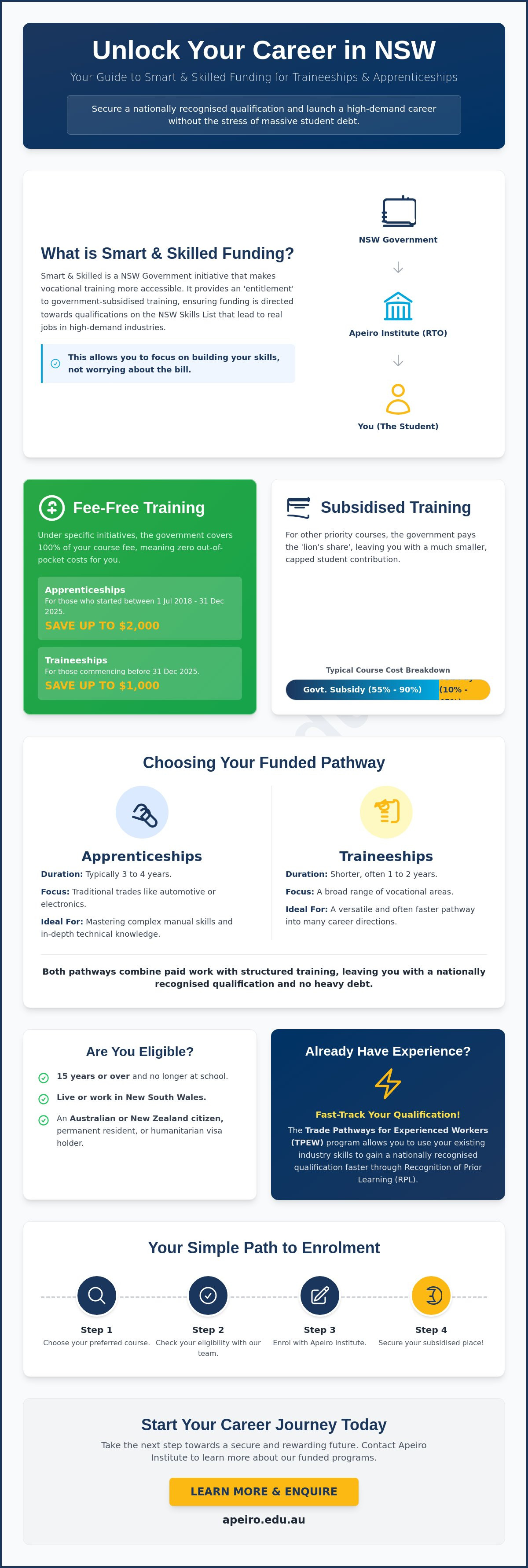
It's helpful to know the difference between "fee-free" and "subsidised" training so you can plan your budget. Under the Fee-free Traineeship Initiative, NSW trainees who commence their training before 31 December 2025 are eligible for fee-free training. This means the up-front course fee is entirely covered by the government. Similarly, the Fee-free Apprenticeship Initiative provides free training for apprentices who started their subsidised training between 1 July 2018 and 31 December 2025. These initiatives can save apprentices and trainees up to $2,000 and $1,000 respectively in up-front costs.
For other priority qualifications that aren't fully fee-free, the NSW Fee Free program is scheduled to run until 31 December 2026. In these cases, you'll pay a subsidised rate. This is a capped student contribution, typically between 10% and 45% of the total course cost. When you're comparing your options, remember that Smart & Skilled Funding for Traineeship & Apprenticeship programs is designed to be accessible. Whether you're just starting out or looking to formalise your years of experience on the tools, these subsidies make the transition possible.
Apprenticeships vs. Traineeships: Choosing Your Funded Pathway
Deciding between an apprenticeship and a traineeship is often the first hurdle for students. While both pathways offer a fantastic way to learn while you earn, they serve different career goals and industry needs. Apprenticeships are usually the long-haul option, typically lasting three to four years. They focus on traditional "trades" like automotive or electronics, where mastering complex manual skills and technical knowledge takes time. Traineeships, by contrast, are generally shorter, often wrapping up within one to two years. They cover a broader range of vocational areas, making them a versatile choice for many different career directions.
Both pathways combine paid work with structured training at a Registered Training Organisation (RTO) like Apeiro Institute. This dual approach ensures you aren't just reading about your job in a textbook; you're actually doing it. Smart & Skilled Funding for Traineeship & Apprenticeship programs applies to both models, though the specific "entitlement" rules can vary depending on the qualification level and the industry's current demand. Regardless of which you choose, the goal is the same: to leave you with a nationally recognised qualification and no heavy debt.
The Apprentice Journey
If you've always wanted to become a qualified Light Vehicle Mechanic, the apprentice journey is likely your best bet. This path requires a formal training contract between you, your employer, and the NSW Government. It's a serious commitment. However, it leads to a trade certificate that is recognised all over Australia, giving you incredible job security and mobility. Because these roles are often in high-demand fields, funding is frequently available to help cover the costs of your off-the-job training.
The Trainee Pathway
For those looking at careers in community services or healthcare, the trainee pathway offers a faster route to professional certification. It's a perfect fit for roles like Individual Support, where you can gain essential skills and on-the-job experience simultaneously. Businesses often prefer this model because it allows them to upskill their staff quickly to meet local community needs. It's a flexible, supportive way to get into the workforce and start making a difference sooner without the four-year wait for a trade certificate.
Choosing the right path depends on your long-term goals and how quickly you want to be fully qualified. Both options are designed to bridge the gap between where you are now and where you want to be in your career. If you're unsure which path fits your current skill set, you might want to chat with our team about trade pathways to see which funded option aligns with your experience.
Eligibility Criteria: Who Can Access Funded Training?
Understanding whether you qualify for financial support is the first step toward your new career. The NSW Government has made the process straightforward to encourage more people to enter high-demand trades. To access Smart & Skilled Funding for Traineeship & Apprenticeship programs, you generally need to meet a few basic requirements. First, you must be an Australian citizen, a permanent resident, a New Zealand citizen, or a humanitarian visa holder. You also need to be at least 15 years old and no longer attending school, although school-based apprenticeships are a notable exception to this rule.
Location is another key factor. You must either live or work in New South Wales to be eligible for this specific funding pool. One of the most common misconceptions is that having a previous qualification shuts the door on future funding. Under the "Second Chance" rule, you can often still receive funding for a Certificate III qualification even if you already hold a higher degree from a university. This policy acknowledges that career paths aren't always linear and that the state needs skilled tradespeople regardless of their academic background.
Special Eligibility for Apprentices and Trainees
If you are a registered apprentice or trainee in NSW, your path to funding is even smoother. Most people in these roles find that their eligibility is validated automatically once their training contract is formally registered and approved by Training Services NSW. This status often grants you access to "fee-free" training or, at the very least, a significantly capped student fee. Even if you already hold a prior Master’s degree, you are still eligible for a funded apprenticeship under the current Smart and Skilled guidelines. This ensures that career changers aren't penalised for their previous education when moving into a critical trade area.
Documentation You Will Need to Organise
To make your enrolment as easy as possible, it's a good idea to get your paperwork ready early. Having these items on hand will speed up the process with your training provider. You will typically need to provide:
- Proof of Identity: A current Australian Birth Certificate, Passport, or Citizenship Certificate.
- Evidence of Residency: Documents like a driver’s licence or a utility bill that show you live or work in NSW.
- Unique Student Identifier (USI): This is a mandatory requirement for all vocational education in Australia. If you don't have one, it's free and easy to create online.
By gathering these documents now, you'll be ready to secure your spot in a funded program and start your journey toward a nationally recognised qualification. If you're an experienced worker looking to formalise your skills, you can also explore how Trade Pathways (TPEW) might work alongside these eligibility rules to get you qualified faster.
Trade Pathways for Experienced Workers: Fast-Tracking Your Cert
You've already done the hard yards. For many workers in the automotive and electronics sectors, years of hands-on experience have provided a level of expertise that matches any textbook. However, without a formal qualification, you might find yourself hitting a glass ceiling when it comes to pay rises or supervisory roles. This is where Trade Pathways (TPEW) becomes a game changer. It's a specific initiative designed to help experienced workers get qualified faster by recognising the skills they've already mastered on the job.
The best part is that Smart & Skilled Funding for Traineeship & Apprenticeship programs often extends to these pathways. Instead of starting from scratch, the government can subsidise the cost of assessing your existing skills. This process, known as Recognition of Prior Learning (RPL), identifies what you already know so you don't have to repeat units. If there are any "gaps" in your knowledge, you only need to complete those specific units to earn your full certificate. It's a respectful and efficient way to honour your career history while moving you forward.
How TPEW Works with Funding
Getting started with the TPEW pathway is a methodical process. First, we help you identify your years of experience in trades like electronics or light vehicle mechanics. From there, you'll undergo a professional assessment to see which units of a qualification you've already mastered through your daily work. Once your existing skills are mapped out, we use government subsidies to cover the remaining training required for your full certification. This ensures you spend less time in a classroom and more time advancing your career. It's a practical solution that respects your time and your budget.
Benefits of Formalising Your Skills
Holding a nationally recognised qualification is about more than just having a piece of paper on the wall. It's about security and growth. Once you're officially qualified, your earning potential typically increases, as you meet the industry standards for higher pay grades. You'll also gain the ability to supervise others and take on more responsibility within your workshop or firm. Perhaps most importantly, a formal qualification allows you to apply for the specific trade licences required for certain types of high-level work in NSW. It's the final step in turning a job into a lifelong, protected career.
Don't let your years of hard work go unrecognised. If you're ready to take the next step, enquire about our Trade Pathways for Experienced Workers and find out how Smart and Skilled funding can fast-track your path to a trade certificate.
How to Enrol in a Funded Program with Apeiro Institute
Starting your journey toward a new career is an exciting step, and we've designed our enrolment process to be as smooth as possible. We understand that paperwork can feel daunting, but our team is here to guide you through every stage. By following a clear, methodical path, you can secure your place in a subsidised course and focus on what really matters: gaining the skills you need for the future. We're here to act as your partner in this transition, ensuring you feel supported from day one.
The first step is to choose the right qualification for your goals. Whether you're interested in the Certificate III in Electronics and Communications or perhaps a path in community services, selecting your course sets the foundation. Once you've decided, the next move is to contact us. We'll sit down with you to discuss your specific eligibility and provide a clear Smart and Skilled fee estimate. This ensures you know exactly where you stand before you commit to anything, giving you total peace of mind regarding your financial commitment.
After confirming your eligibility, we move on to the formal "Notification of Enrolment" process. Our student support team handles the heavy lifting here, ensuring all your documentation is correctly filed with the NSW Government. This is a vital step in locking in your Smart & Skilled Funding for Traineeship & Apprenticeship programs. Once this is complete, you're ready to start your training journey. You'll be learning from industry-expert trainers who are as invested in your success as you are, providing a learning environment that is both professional and encouraging.
Our Support for Apprentices and Employers
We know that a successful apprenticeship or traineeship is a team effort. That's why we act as a bridge between the student, the employer, and the Australian Apprenticeship Support Network (AASN). We help coordinate the training plan to ensure it meets everyone's needs and stays compliant with government standards. Our flexible delivery options are designed to fit around a busy work schedule, so you don't have to choose between earning a wage and getting qualified. Throughout your studies, we provide ongoing mentoring to keep you motivated and on track for your 2026 graduation.
Ready to Get Started?
There's never been a better time to invest in yourself. With the support of Smart & Skilled Funding for Traineeship & Apprenticeship programs, the financial barriers to education are lower than they've ever been. Don't let the fear of costs or complex rules hold you back from a rewarding trade career. Our team are experts at navigating government funding and will work hard to find the best possible result for your situation.
Take the first step toward your new future today. Apply for a Smart and Skilled Funded Place Today and let us help you reach your professional goals with confidence and expert guidance.
Your Path to a Recognised Qualification Starts Here
Securing a brighter future through vocational education is now within reach for everyone in New South Wales. Whether you're a school leaver or an experienced hand on the tools, the government's commitment to priority skills makes the transition affordable. You've seen how the "Second Chance" rule keeps doors open and how fee-free initiatives can eliminate up-front costs for many. By choosing the right pathway, you're building long-term job security in an industry that desperately needs your expertise.
Navigating Smart & Skilled Funding for Traineeship & Apprenticeship programs doesn't have to be a solo journey. Apeiro Institute offers Nationally Recognised Training (RTO 45394) with flexible workplace-based models designed to fit your busy life. If you already have years of experience, our expert Trade Pathways for Experienced Workers can help you formalise your skills and fast-track your certification.
Check your eligibility for Smart and Skilled funding with Apeiro Institute today. We're here to help you turn your professional goals into a reality with the expert guidance and support you deserve.
Frequently Asked Questions
Is Smart and Skilled funding available for all courses?
No, funding is specifically reserved for qualifications listed on the NSW Skills List. This list is reviewed twice a year to ensure it aligns with the state's most urgent workforce needs. Version 17.0 of the list, which commences on 1 July 2026, prioritises high-demand areas like electronics and mechanical technology. If your chosen course isn't on this list, you won't be able to access the government subsidy for that specific program.
Can I get a fee-free apprenticeship if I already have a qualification?
Yes, you can often access fee-free training even if you already hold a degree or diploma. The "Second Chance" rule is designed to help people transition into trade careers where there are critical skill shortages. For apprentices who started their subsidised training between 1 July 2018 and 31 December 2025, the NSW Government covers the full cost of the training regardless of your previous academic history.
What is the difference between a traineeship and an apprenticeship in Australia?
The primary difference lies in the duration of the program and the industry focus. Apprenticeships generally last three to four years and are tailored for traditional trades like automotive or electronics. Traineeships are typically shorter, often taking one to two years, and cover a wider range of vocational areas. Both pathways are supported by Smart & Skilled Funding for Traineeship & Apprenticeship programs to ensure you gain practical, workplace-based experience.
How much will I have to pay if I am not eligible for fee-free training?
If you don't qualify for a fee-free place, you'll typically pay a student contribution between 10% and 45% of the total course cost. The NSW Government subsidises the remaining balance to keep education affordable. This fee is determined by a standard "Provider Calculator," which means the cost for a specific qualification is consistent across all approved training providers. This ensures fairness and transparency for every student in the state.
How long does the Smart and Skilled enrolment process take?
The initial eligibility check and fee estimate can often be completed during your first consultation with our team. Once we have your proof of identity and residency, the formal "Notification of Enrolment" process moves quite quickly. The total time depends largely on how fast your training contract is validated by the relevant authorities. We work closely with you to ensure all paperwork is correct from the start to avoid unnecessary delays.
Do I need to find an employer before I can get funding?
Yes, for both apprenticeships and traineeships, having a formal training contract with an employer is a mandatory requirement for funding. The Smart and Skilled program is built around a workplace-based model where you learn on the job. If you haven't secured an employer yet, you can still explore other subsidised courses on the NSW Skills List that don't require a training contract but still offer excellent career prospects.
Can international students access Smart and Skilled funding?
Generally, Smart and Skilled funding is reserved for Australian citizens, permanent residents, New Zealand citizens, or humanitarian visa holders. International students usually enrol in vocational programs under different fee structures. While the funding isn't available, international students still receive the same high-quality, nationally recognised training and support. Our team can help you understand the best enrolment options available for your specific visa status and career goals.
What happens if I lose my job during my funded apprenticeship?
You can often continue your training for a short period while you look for a new employer to take over your training contract. It's vital to notify your RTO and your Australian Apprenticeship Support Network (AASN) provider as soon as your employment status changes. Maintaining your place in Smart & Skilled Funding for Traineeship & Apprenticeship programs depends on finding a new workplace where you can complete your practical, on-the-job units.

Disclaimer
The information provided on this blog is for general informational and educational purposes only. While every effort is made to ensure the accuracy and reliability of the content, the author makes no representations or warranties of any kind, express or implied, about the completeness, accuracy, suitability, or availability of the information contained on this blog.
The views and opinions expressed in blog posts are those of the individual author and do not necessarily reflect the official policy or position of any organization, company, or employer.
This blog may contain links to external websites or third-party content. These links are provided for convenience only, and the author has no control over and assumes no responsibility for the content, privacy policies, or practices of any third-party sites.
Nothing on this blog constitutes professional advice (legal, financial, medical, or otherwise). Readers are encouraged to seek appropriate professional guidance before making any decisions based on the information provided here.
By using this blog, you acknowledge that any reliance on the information is at your own risk.


