

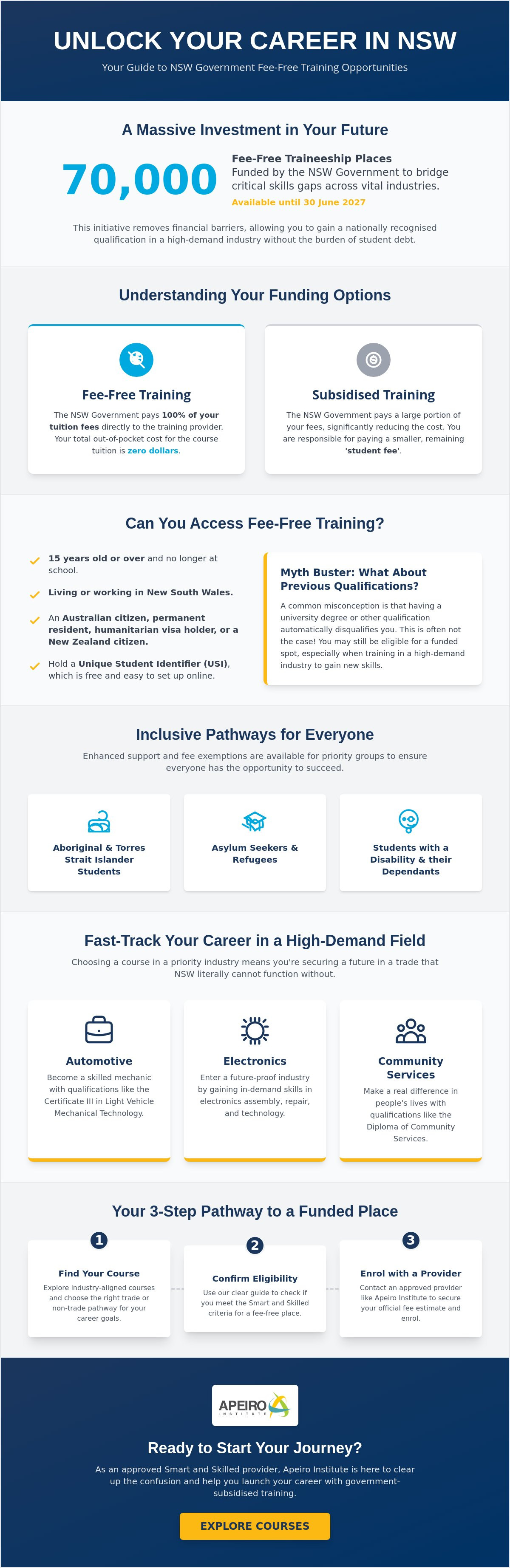
Did you know the NSW Government is funding 70,000 Smart and Skilled fee-free traineeship places until 30 June 2027? It's a massive investment designed to bridge the skills gap in our most vital industries. If you've been putting off your education because you're worried about the cost, this could be the exact opportunity you need to get ahead without the financial burden.
We know that trying to make sense of government eligibility rules often feels overwhelming. You might be anxious about the financial commitment or worried about choosing a qualification that doesn't lead to a real job. At Apeiro Institute, we're here to clear up that confusion. We'll show you how to fast-track your career using NSW government-subsidised training and fee-free apprenticeship opportunities.
This article explains the specific differences between fee-free and subsidised training, clarifies eligibility for scholarships, and outlines how to launch a career in high-demand fields like electronics, automotive, or community services. We'll break down the 1 January 2020 commencement rules and help you secure a spot in a programme that fits your professional goals.
Key Takeaways
- Understand how the NSW Government is addressing critical labour shortages by funding thousands of vocational training places.
- Confirm if you meet the core criteria for Smart and Skilled fee-free training, including exceptions for those who already hold a degree.
- Learn the difference between trade apprenticeships and non-trade traineeships to find the right career pathway for your goals.
- Follow our clear guide to finding an approved provider and securing your official fee estimate for 2026.
- Explore industry-aligned courses in automotive, electronics, and community services that can fast-track your professional growth.
Unlocking Your Career: What is Smart and Skilled Fee-Free Training?
Smart and Skilled is the NSW Government's flagship initiative designed to help people get the skills they need for the jobs they want. Think of it as a bridge. It connects you to the vocational education and training system, making high-quality courses more accessible for everyone. In 2026, the focus has sharpened significantly on Smart and Skilled fee-free positions. This shift isn't just about saving you money. It's a strategic move to fill critical labour shortages across the state. By removing the financial barrier, the government is inviting you to train in industries that are crying out for qualified workers.
Taking this step means you can earn a nationally recognised qualification without the burden of a mounting student debt. These qualifications are the gold standard for employers across Australia, proving you have the practical skills required to hit the ground running. Whether you're looking to change industries or start your very first job, this program provides a clear, supported pathway to professional success.
The Difference Between Subsidies and Fee-Free Scholarships
It's easy to get tangled in the terminology when you're looking at course costs. A government subsidy means the state pays a portion of your training, leaving you with a smaller "student fee" to cover yourself. However, a fee-free place means exactly that: zero dollars out of your pocket for the tuition. The NSW Government pays the entire balance directly to your training provider. Specific fee-free scholarships are also available for those who need them most. This includes young people aged 15 to 30 who are in out-of-home care or individuals with a recommendation from a domestic and family violence service. These pathways ensure that your personal circumstances don't stand in the way of your potential.
Why the NSW Government Invests in Your Skills
The government isn't just being generous; they're investing in the future of the NSW economy. There is a high demand for skilled professionals in priority areas like electronics, automotive repairs, and community services. When you choose a course like the Certificate III in Light Vehicle Mechanical Technology or a Diploma of Community Services, you're entering a sector with a documented skills gap. This program helps bridge the gap between where you are now and a stable, rewarding career. Choosing a high-demand path means you aren't just getting a certificate. You're securing a future in a trade that the state literally cannot function without.
Eligibility Check: Can You Access Fee-Free Training in NSW?
Starting a new career path shouldn't feel like a guessing game. While the rules might seem complex at first glance, the basic Smart and Skilled eligibility criteria are actually quite broad. To qualify for Smart and Skilled fee-free training, you generally need to meet four foundational requirements. You must be 15 years old or over, no longer at school, and living or working in New South Wales. Finally, you need to be an Australian citizen, permanent resident, humanitarian visa holder, or a New Zealand citizen.
One common misconception is that having a previous qualification, like a university degree, automatically disqualifies you from government support. That's not the case. Even if you've studied before, you may still be eligible for a funded spot, especially if you're looking to gain skills in a high-demand industry. You'll also need a Unique Student Identifier (USI). This is a reference number that creates a secure online record of your Australian training and qualifications. It's free, easy to set up, and essential for your enrolment process.
Special Eligibility for Priority Groups
The NSW Government is committed to making education inclusive. Aboriginal and Torres Strait Islander students often have access to Smart and Skilled fee-free training across a wider range of courses. Similarly, students living with a disability, along with their dependants, can access significant fee exemptions to help them enter the workforce. Asylum seekers and refugees also have specific pathways to funded places, ensuring that those building a new life in NSW have the tools to succeed. If you're an experienced worker looking to formalise your skills, you can check your eligibility for trade pathways to see how your professional history counts toward a new qualification.
The "No Longer at School" Requirement
This rule is straightforward for most, but it can be tricky for some. If you're home-schooled or enrolled in an alternative education programme, you're generally considered "no longer at school" once you've officially completed your secondary education requirements. It's a different story for school-based apprenticeships. These are funded through separate streams because they're integrated into the HSC. If you're currently in Year 10, 11, or 12 and dreaming of a trade, it's best to speak with your careers advisor about the specific transition programmes available. Our goal is to help you move from the classroom to the workshop with total confidence and clarity.
Fee-Free Apprenticeships and Traineeships: Choosing Your Pathway
Choosing between an apprenticeship and a traineeship is the first step toward your new career. Under the Smart and Skilled program, both pathways offer incredible value, but they serve different professional goals. Apprenticeships generally focus on traditional trades like automotive or electronics. Traineeships, on the other hand, usually cover non-trade vocations such as community services or business. Accessing a Smart and Skilled fee-free place means you can focus on your work and study without the stress of tuition costs.
The best part for 2026? The NSW Government has committed to providing fee-free apprenticeships for all new starters. If you're just beginning your journey, this means your training costs are fully covered. You get to earn while you learn, receiving a legal wage from your employer while working toward a nationally recognised qualification at Apeiro Institute. This model allows you to build practical experience and theoretical knowledge simultaneously, making you highly employable from day one.
Your employer is a vital partner in this process. They don't just provide the work; they also help initiate the Smart and Skilled application. Together, you'll sign a training contract that outlines the commitment to your education and on-the-job training. It's a partnership that ensures you have the support needed to complete your course successfully.
Spotlight on Electronics and Communications (UEE30920)
The Certificate III in Electronics and Communications is a high-priority trade. With the 2026 job market shifting toward smart infrastructure and advanced communications, electronics technicians are in high demand. You can attain this qualification through a Smart and Skilled fee-free apprenticeship, setting yourself up for a career in a field that isn't just growing; it's essential. Career outcomes include working with telecommunications, security systems, and complex electronic equipment, providing a stable and technically rewarding future.
Trade Pathways for Experienced Workers (TPEW)
For those who have been in the industry for years but lack the formal paperwork, the Trade Pathways for Experienced Workers (TPEW) program is a game changer. It's designed to recognise the skills you've already built on the tools through previous experience. If there are gaps in your knowledge, Smart and Skilled funding can often assist with the necessary gap training. This allows you to formalise your expertise and increase your earning potential without starting from scratch. It's a respectful, efficient way to get the credentials you've already earned through hard work.
How to Enrol and Secure Your Funded Place for 2026
Securing a Smart and Skilled fee-free place is a structured process, but you don't have to do it alone. The journey from interest to enrolment involves four clear steps. First, you must find an approved Smart and Skilled provider like Apeiro Institute that offers the specific course you need. Once you've found your match, the second step is to confirm your eligibility. Your provider will help you generate a "Fee Estimate". This is an official document from the NSW Government that confirms exactly how much of your course is subsidised. If you qualify for a fee-free spot, this estimate will show a zero balance for the student fee.
The third step involves gathering your supporting evidence. You'll need your Unique Student Identifier (USI) and proof of your residency or citizenship status. Finally, once all your documents are verified, you'll complete the enrolment process. Because places for certain high-demand courses can fill up quickly, it's wise to start this process as early as possible. Getting your paperwork sorted now ensures you're ready to start your training when the next intake begins.
Gathering Your Proof of Eligibility
You'll need a few key documents to prove you meet the criteria. A current Medicare card, Australian driver’s licence, or citizenship papers are the standard requirements. If you live near the NSW border but work within the state, you can still access funding. In this case, you'll need to provide evidence of your employment in NSW, such as a recent payslip or an official letter from your employer. For students living with a disability, providing a letter from a medical practitioner or a disability support pension card can help secure additional fee exemptions or support services. Having these files ready in a digital format makes the online application much faster.
The Role of the RTO in Your Application
At Apeiro Institute, we see ourselves as your mentor through the entire paperwork process. We understand that government forms can feel daunting, so we provide a pre-enrolment consultation. This chat ensures the course you've chosen actually aligns with your long-term career goals. It's also important to remember that the student fee for a specific course is the same across all Smart and Skilled providers. This means your choice should be based on the quality of training and the level of support the provider offers. If you're ready to take the next step toward a rewarding career in care, you can check your eligibility for individual support training today. We're here to help you navigate the Smart and Skilled fee-free requirements so you can focus on learning.
Start Your Journey with Apeiro Institute
Choosing the right Registered Training Organisation (RTO) is just as vital as choosing the right career path. At Apeiro Institute, we don't just provide lessons. We act as a partner in your professional growth. We understand that starting a new qualification can feel like a big leap, especially when you're trying to balance work, family, and study. Our goal is to make that transition as smooth as possible by offering a supportive, student-centred environment that prioritises your practical outcomes. By specialising in industries with high demand, we ensure that your Smart and Skilled fee-free training leads to real-world opportunities.
We take pride in our inclusive community. Our campus is a vibrant hub where students from over 38 different nationalities come together to learn and grow. This diversity enriches the learning experience, providing you with a global perspective while you gain locally recognised skills. Whether you're looking to get your hands dirty in a workshop or provide essential care in the community, we have the facilities and the expertise to help you succeed.
Our Commitment to Your Career Success
Our training facilities are designed to mirror the environments you'll encounter in the workforce. We believe that hands-on experience is the best way to build confidence. Our expert trainers bring years of industry experience into the classroom, ensuring you learn the latest techniques and standards. The Certificate III in Light Vehicle Mechanical Technology remains one of our most popular funded options. It's a perfect choice for those who want to turn a passion for cars into a stable, high-demand trade. We're here to mentor you from your first day on campus through to the moment you receive your qualification, helping you navigate every challenge along the way.
Community and Individual Support Pathways
If your passion lies in helping others, our community services programs offer a rewarding way to make a difference. The Certificate III in Individual Support is a fantastic entry point for anyone looking to start a career in the rapidly growing aged care and disability sectors. For those ready to take more advanced steps in their professional journey, the Diploma of Community Services provides the skills needed for case management and coordination roles. These pathways are often available as Smart and Skilled fee-free options for eligible students. If you aren't sure where you fit, we invite you to contact our team for a personalised eligibility check. We'll help you find the right funded course to launch your new career with confidence.
Secure Your Future with Funded Training
Accessing a Smart and Skilled fee-free qualification is one of the most effective ways to pivot your career or formalise the skills you've spent years building on the tools. We've seen how government subsidies remove the financial barrier to education, allowing you to focus on mastering your trade rather than worrying about student debt. Whether you're entering the automotive industry, exploring electronics, or moving into community services, the path to a nationally recognised qualification is clearer than ever before. You don't have to navigate the eligibility rules or paperwork on your own.
As an approved NSW Smart and Skilled provider and specialists in Trade Pathways for Experienced Workers, Apeiro Institute (RTO 45394) acts as your mentor. We provide the nationally recognised training needed to thrive in the 2026 job market. Our team is ready to help you find the right course and secure your funded spot. Check your eligibility for a fee-free course with Apeiro Institute today and start your journey with confidence. Your professional goals are within reach, and we're here to help you achieve them.
Frequently Asked Questions
Is Smart and Skilled training really fee-free?
Yes, it is. For eligible students in priority areas, the NSW Government pays the student fee directly to the training provider. This means you don't pay anything for the tuition of a Smart and Skilled fee-free course. It's a strategic initiative designed to help you enter high-demand industries without the pressure of upfront costs or mounting student debt. You'll just need to meet the eligibility criteria to secure your spot.
What happens if I have already completed a Certificate III?
You may still be eligible for funded training. While the program often focuses on your first post-school qualification, the rules have been relaxed for many priority industries. If you're looking to retrain in a sector with a critical skills shortage, like electronics or aged care, you can often access a subsidised place regardless of your previous study. We can check your specific situation to confirm your eligibility.
Can I access fee-free training if I live in a border town like Albury or Tweed Heads?
Absolutely. The criteria state that you must either live or work in New South Wales. If you reside in a border town like Albury or Tweed Heads but your place of employment is across the border in NSW, you're generally eligible for the program. You'll just need to provide evidence of your employment, such as a recent payslip or a letter from your employer, during the enrolment process.
How do I find out if a specific course is on the NSW Skills List?
You can check the full list on the official Training Services NSW website. The NSW Skills List is updated regularly to reflect the needs of the economy. Alternatively, you can speak with our team at Apeiro Institute. We can quickly confirm if your preferred qualification is currently attracting government funding and help you understand what that means for your specific career goals and potential out-of-pocket costs.
Do I have to pay for my own textbooks and equipment in a fee-free course?
Generally, yes. The funding covers your tuition fees, but it doesn't usually cover incidental costs. This includes things like specialised tools, safety gear (PPE), or specific textbooks required for your units. While the government takes care of the educational cost, students are typically responsible for their own personal equipment and materials. We always provide a clear list of what you'll need before your first day of class.
What is the difference between Smart and Skilled and a VET Student Loan?
Smart and Skilled is a government subsidy where the state pays for your training, and you don't have to pay it back. A VET Student Loan is a debt you take on to cover tuition for higher-level courses, which you eventually repay through the tax system once you earn over a certain threshold. Choosing Smart and Skilled fee-free training is about removing the debt burden entirely for priority vocational paths.
Can I study a Smart and Skilled course part-time while working?
Yes, flexibility is a core part of the program. Many students balance their training with work or family commitments. We offer various delivery modes, including part-time options, to ensure you can gain your qualification at a pace that suits your lifestyle. This "earn while you learn" approach is particularly common for those in apprenticeships or traineeships who are already working within their chosen industry.
What should I do if I don’t have a Unique Student Identifier (USI)?
You'll need to create one before you can enrol in any nationally recognised training in Australia. It's a quick, free process that you can complete on the official USI website using a form of identification like your driver's licence or Medicare card. Your USI stays with you for life and keeps all your training records in one secure place. If you're having trouble, our enrolment team can guide you through the steps.

Disclaimer
The information provided on this blog is for general informational and educational purposes only. While every effort is made to ensure the accuracy and reliability of the content, the author makes no representations or warranties of any kind, express or implied, about the completeness, accuracy, suitability, or availability of the information contained on this blog.
The views and opinions expressed in blog posts are those of the individual author and do not necessarily reflect the official policy or position of any organization, company, or employer.
This blog may contain links to external websites or third-party content. These links are provided for convenience only, and the author has no control over and assumes no responsibility for the content, privacy policies, or practices of any third-party sites.
Nothing on this blog constitutes professional advice (legal, financial, medical, or otherwise). Readers are encouraged to seek appropriate professional guidance before making any decisions based on the information provided here.
By using this blog, you acknowledge that any reliance on the information is at your own risk.


