

Imagine spending thousands of dollars and months of hard work on a course, only to discover your certificate isn't actually valid when you apply for that dream promotion. It's a common worry for many Australians, and for good reason. Securing a nationally recognised qualification Australia wide is the most reliable way to future-proof your career, but the sea of acronyms like RTO, AQF, and CRICOS can make the process feel overwhelming. You want to ensure your chosen provider is reputable and that your hard-earned money is a genuine investment in your future, not a gamble.
We understand that you're looking for more than just a piece of paper; you're looking for a pathway to progress. Whether you're aiming to enter a specific trade or move into senior leadership, this 2026 buying guide provides the clarity you need. We'll walk you through the essential steps to verify any training organisation and explain how your current industry experience could actually count towards your certificate through Recognition of Prior Learning (RPL). By the end of this article, you'll have a clear roadmap to choosing a qualification that's respected by employers in every state, giving you the confidence to take that next big step in your professional journey.
Key Takeaways
- Understand how the Australian Qualifications Framework (AQF) ensures your certificate is valued equally across every state and territory.
- Learn the simple steps to verify a course so you don't waste time or money on unrecognised providers.
- Discover how to use Recognition of Prior Learning (RPL) to turn your existing work history into a formal, nationally recognised qualification Australia wide.
- Identify the key traits of a quality Registered Training Organisation (RTO), including strong employer connections and personalised student support.
- Explore specialised models like Trade Pathways for Experienced Workers (TPEW) to fast-track your career in high-demand industries.
What is a Nationally Recognised Qualification in Australia?
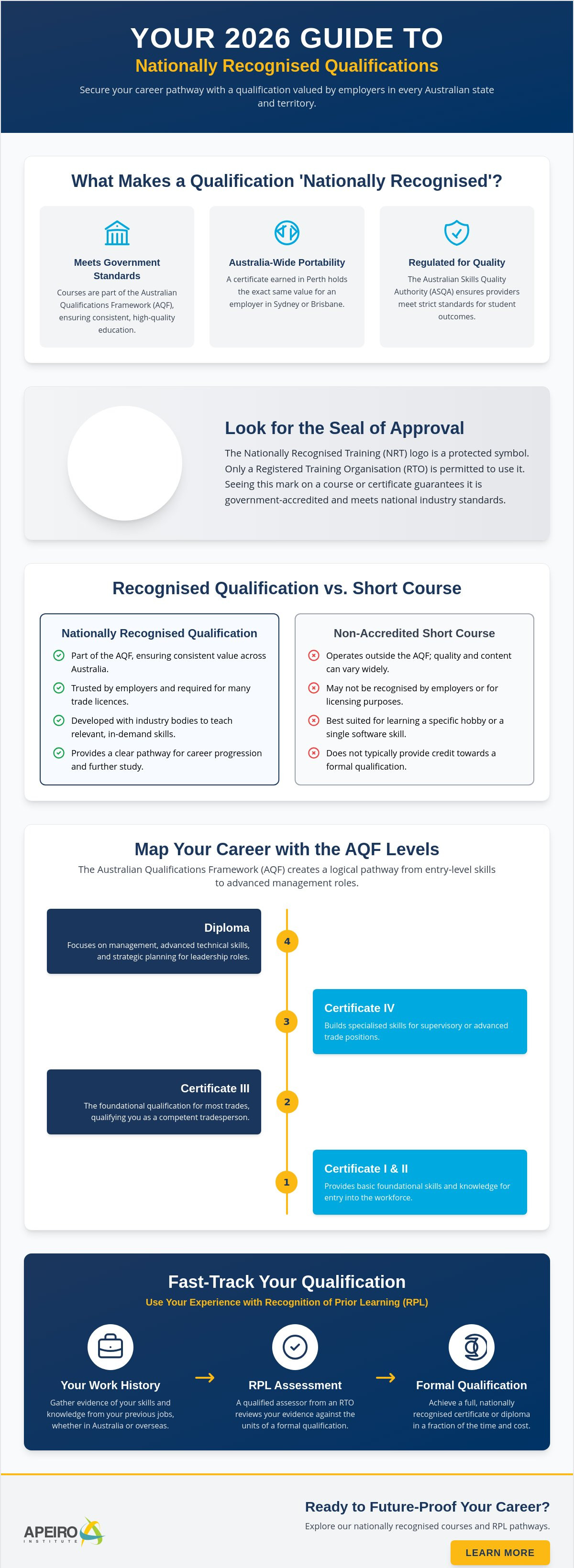
A nationally recognised qualification Australia wide is a competency-based program that meets strict government standards. Unlike a short private workshop, these courses are part of the Australian Qualifications Framework (AQF), which is the national policy for regulated qualifications in Australian education and training. This framework ensures that your education has a consistent value no matter where you study. If you earn a Certificate III in Perth, it's recognised exactly the same way by an employer in Sydney or Brisbane. This portability is a huge advantage for anyone looking to move between states for work.
The high quality of these courses isn't accidental. The Australian Skills Quality Authority (ASQA) acts as the national regulator, making sure every training provider delivers what they promise. As of 1 July 2025, new standards for Registered Training Organisations (RTOs) came into effect to focus even more on student outcomes and industry engagement. This means you can feel secure knowing your training is current, relevant, and backed by the government. There's a clear distinction between these "accredited" courses and "non-accredited" training. While a private short course might teach you a specific hobby skill, it won't give you the formal standing required for many trade licences or professional career paths.
The Nationally Recognised Training (NRT) Logo
When you're browsing course brochures or websites, look for the "upside-down house" symbol. This is the Nationally Recognised Training (NRT) logo. It's a protected mark that acts as a seal of approval. Only an RTO is allowed to display this logo. Seeing it on your certificate tells future employers that you've been assessed against national industry standards. It's a powerful addition to your resume that builds immediate trust with recruiters.
The AQF Levels: From Certificates to Graduate Diplomas
The AQF structure helps you map out your career progression logically. It ranges from Certificate I through to Doctoral Degrees. For most trade and professional entries, you'll likely look at Certificate III, Certificate IV, or Diploma levels. For example, a Certificate III in Light Vehicle Mechanical Technology provides the foundational skills for a mechanic, while a Diploma might focus on management or advanced technical design. Choosing the right level depends on your current experience and where you want to be in five years. We always suggest starting with the qualification that matches the specific entry requirements of your chosen industry.
The Tangible Benefits: Why "Recognised" Trumps "Short Course"
Choosing a nationally recognised qualification Australia wide offers a level of security that a simple private short course cannot match. While a non-accredited workshop might teach you a specific skill, it lacks the legal weight and portability required for long-term career growth. When you invest in a recognised program, you're gaining a professional currency that is respected by every employer from Hobart to Darwin. If your life takes you to a different state, your qualification moves with you without the need for reassessment or bridging courses.
Industry alignment is another significant advantage. These courses aren't designed in a vacuum; they're developed in close consultation with industry bodies to ensure the skills you learn are exactly what's needed on the tools today. In many technical fields, such as automotive repair or community services, having a Certificate III in Light Vehicle Mechanical Technology is more than just a preference. It's often a legal requirement for obtaining a trade licence. Without this formal recognition, you may be restricted from performing certain tasks or advancing to a senior role.
Employer Trust and Quality Assurance
Australian hiring managers look for the NRT code on a resume because it represents a guaranteed standard of competence. It tells them that you've been assessed against rigorous national benchmarks and have proven your ability to perform specific tasks. This trust is vital for anyone entering the workforce or changing careers. If you're interested in the specific benefits of vocational training for international students, you'll find that this formal recognition is often the first thing local recruiters check. To be absolutely sure about a provider, you can always cross-reference their details on the official national register of VET.
Value for International Students
For learners arriving from overseas, national recognition must go hand-in-hand with CRICOS registration. This dual layer of protection ensures that your course meets high educational standards while also complying with your student visa requirements. It provides a reliable pathway for professional development and helps you build a solid foundation for your future in Australia. For a detailed breakdown of how these systems work together, our Pillar Guide for International Students is an essential resource for navigating the 2026 landscape.
These qualifications also create future pathway opportunities. Many universities recognise the credits earned through a Diploma or Advanced Diploma, potentially shortening the duration of a Bachelor's degree. This makes vocational training a smart, cost-effective starting point for higher education.
How to Spot a Genuine Nationally Recognised Course
Identifying a legitimate nationally recognised qualification Australia wide is simpler than it looks once you know where to look. The ultimate source of truth is Training.gov.au (TGA). This is the national register for Vocational Education and Training (VET) in Australia. If a course or a training provider isn't listed here, it isn't nationally recognised. You can search by the provider's name or their unique RTO code to confirm they have the right to deliver the specific training you're interested in.
Don't be fooled by fancy titles. Many private companies offer a "Certificate of Completion" for short workshops, but this is not the same as a formal qualification. A genuine, accredited course results in a "Testamur". This is the official document that features the Nationally Recognised Training logo we mentioned earlier. If a provider is vague about the type of certificate you'll receive, it's a red flag. Always ask for the RTO code and verify it against the national database before you pay any fees.
Understanding Course Codes
Every accredited course has a unique national code, such as BSB50120 or AUR30620. These aren't just random strings of characters. The letters usually represent the industry (AUR stands for Automotive Retail, Service and Repair), while the first number often indicates the AQF level. The last two digits, like the "20" in AUR30620, show the year the training package was endorsed. When industry standards change, these codes are updated. Enrolling in the most current version ensures your skills are up to date with modern workplace expectations.
The RTO and CRICOS Connection
If you're an international student, there's an extra layer of verification you must perform. While every legitimate provider is an RTO, not every RTO is allowed to teach students on a study visa. To do this, the provider must also be registered on the Commonwealth Register of Institutions and Courses for Overseas Students (CRICOS). This registration ensures the provider meets additional requirements for student support and financial security. For a deeper look at how this works, read our guide on what is a CRICOS Registered Training Organisation. It's a vital step in protecting your visa status and your educational investment.
Verifying these details might take an extra ten minutes, but it's the best way to ensure your hard work leads to a real career outcome. It gives you the peace of mind that your certificate will be accepted by employers and licensing bodies across the country.
Fast-Tracking Your Career: RPL and Trade Pathways
You might have spent years on a job site or in a workshop without ever stepping foot in a traditional classroom. In the Australian VET sector, that experience holds immense value. Recognition of Prior Learning (RPL) is a formal assessment process that acknowledges the skills you've already mastered through your daily work. It allows you to earn a nationally recognised qualification Australia wide without having to repeat training for tasks you already perform at an expert level. This approach doesn't just save you time. It respects the years of hard work you've already put in.
For skilled professionals, the Trade Pathways for Experienced Workers (TPEW) model is a particularly effective route. This framework is specifically designed for individuals who need to formalise their status to apply for trade licences or move into supervisory roles. To qualify for this pathway, you generally need to demonstrate a consistent work history in your industry, typically spanning three or more years. Because this is a formal assessment, you'll need to provide a portfolio of evidence. This often includes:
- High-quality photos and videos of you performing specific technical tasks.
- Detailed references from current or previous employers and supervisors.
- Authentic workplace documents, such as job cards, logbooks, or project plans.
- Records of any previous non-accredited training or short courses you've completed.
RPL for Automotive and Electronics
In technical fields, having the right paper is often the difference between being a helper and being a lead technician. If you're an experienced mechanic, the AUR30620 Certificate III in Light Vehicle Mechanical Technology can often be achieved through the RPL process. Similarly, electronics professionals who have spent years handling site installations and communications repairs can formalise their expertise into a national certificate. This professional recognition is a vital step toward securing your trade licence and increasing your earning potential.
The Assessment Process
It's a common misconception that RPL is a shortcut. In reality, it's a rigorous validation of your expertise that must meet the same high standards as traditional study. The process begins with a self-assessment where you look at the course requirements and identify which areas match your experience. You then work with a qualified assessor who reviews your evidence and conducts a professional interview to verify your knowledge. This ensures that every graduate, regardless of their pathway, meets the national benchmarks for quality and safety. For a deeper look at how to prepare your application, our Trade Pathways for Experienced Workers Guide offers a clear roadmap for 2026.
Ready to see if your years on the tools could earn you a certificate? Explore our TPEW options and take the first step toward formalising your career today.
Choosing the Right RTO for Your Professional Journey
Selecting a Registered Training Organisation (RTO) is about more than just finding a provider that offers a nationally recognised qualification Australia wide. It's about finding a partner that understands your career goals and provides the specific environment you need to thrive. While the national code ensures the curriculum is standardised, the quality of delivery, the modernness of the equipment, and the strength of industry links can vary significantly between colleges. You should look for a provider that doesn't just tick boxes but actively prepares you for the realities of the Australian workforce.
Practicality should be your top priority when evaluating an RTO. If you're pursuing a trade qualification, such as the Certificate III in Light Vehicle Mechanical Technology, ask to see the workshop facilities. Are they equipped with industry-standard tools and diagnostic gear? Beyond the physical space, consider the level of student support. This is especially vital for international learners who may need extra guidance with local workplace culture or technical terminology. A good RTO provides a safety net of individual assistance, ensuring you never feel like just another number in a crowded classroom.
Specialist Training vs Generalist Colleges
There's a distinct advantage to choosing a specialist provider over a large, generalist college. Organisations that focus deeply on specific sectors, like Community Services or Engineering, often have much stronger ties to local employers and trade bodies. These connections can lead to better work placement opportunities and a curriculum that feels more relevant to current industry demands. When a college specialises, their trainers are usually experts who stay at the forefront of their field, offering you insights that go far beyond the standard textbook definitions.
The Apeiro Institute Advantage
At Apeiro Institute, we've built a community that spans over 38 nationalities, all united by a common goal of professional growth. We understand that starting a new educational journey can feel intimidating, which is why we act as an empowering mentor throughout the entire process. Whether you're a newcomer to the industry or an experienced professional looking to formalise your skills through our TPEW and RPL services, we provide the expert guidance needed to succeed. Our focus is on practical, industry-aligned outcomes that ensure your qualification opens real doors in the Australian job market. We don't just teach the material; we partner with you to build a secure and prosperous future.
Take the Next Step in Your Australian Career
Securing a nationally recognised qualification Australia wide is the most effective way to ensure your skills are respected by employers in every state. By verifying your provider on the national register and choosing a course aligned with the Australian Qualifications Framework, you're making a secure investment in your professional future. Whether you're starting fresh or using your years of experience to fast-track through Recognition of Prior Learning, the right certificate acts as a key to new opportunities and higher earning potential.
As specialists in Trade Pathways for Experienced Workers, Apeiro Institute (RTO 45394, CRICOS 03703M) is here to guide you. We pride ourselves on delivering industry-aligned training to a global student community representing over 38 nationalities. Our team is ready to help you navigate the enrolment process with empathy and expert advice, ensuring you feel confident and supported at every turn. You've already put in the hard work on the tools; now it's time to get the formal recognition you deserve.
Find your path to a nationally recognised qualification with Apeiro Institute and start building your future today. We're excited to partner with you on this journey toward your career goals.
Frequently Asked Questions
Is a nationally recognised qualification the same as a degree?
No, they represent different pathways within the Australian Qualifications Framework (AQF). A degree is an academic qualification typically issued by a university, whereas a nationally recognised qualification Australia wide is usually vocational and focused on practical, job-ready skills. While both are highly valued, vocational certificates and diplomas are often shorter and more directly aligned with specific trade requirements or industry standards.
How can I check if a course is nationally recognised?
You can verify any course by visiting the Training.gov.au (TGA) website, which is the official national register for Vocational Education and Training (VET). Simply enter the course code, such as AUR30620, or the name of the training provider to see their current registration status. If the provider is a Registered Training Organisation (RTO) and the course is listed as "current" on their scope, it's a legitimate, accredited qualification.
Can I get a nationally recognised qualification through work experience?
Yes, you can achieve this through a process called Recognition of Prior Learning (RPL). This pathway allows you to present evidence of your existing skills, such as photos of your work, references, and workplace documents, to a qualified assessor. If your experience meets the national standards for a specific qualification, you can receive your certificate without needing to complete traditional classroom study or attend regular lectures.
Do employers in Australia prefer nationally recognised training?
Most Australian employers prioritise nationally recognised training because it guarantees a consistent level of competence across the country. In technical fields like automotive repair or electronics, these qualifications are often a legal prerequisite for employment and trade licensing. Hiring managers trust the NRT logo because it shows the candidate has been assessed against rigorous, government-backed industry benchmarks rather than a private provider's internal standards.
What happens if my RTO closes down during my studies?
There are strong protections in place to ensure you aren't left stranded if a provider ceases operations. For international students, the Tuition Protection Service (TPS) helps you find a replacement course or provides a refund of unspent tuition fees. Domestic students are also covered by regulatory safeguards managed by the Australian Skills Quality Authority (ASQA), which are designed to maintain the integrity of the VET sector and protect your educational investment.
Are online courses nationally recognised in Australia?
Online courses can be nationally recognised as long as they are delivered by an RTO that has that specific course on their scope of registration. The mode of delivery doesn't change the accreditation status. However, for many trades and care-based qualifications, you'll still need to complete practical assessments in a workshop or clinical environment to prove you can perform the required tasks safely and effectively in a real-world setting.
How much does it cost to get a nationally recognised qualification?
Costs vary depending on the level of the course and the delivery method chosen. For example, general industry data from 2026 indicates that Recognition of Prior Learning (RPL) costs typically range from $500 for certificate levels to $5,000 for advanced diplomas in trade and construction sectors. Many students also access government subsidies or funded places, such as Smart and Skilled programs, which can significantly lower out-of-pocket expenses for eligible learners.
Is a Certificate III considered a nationally recognised qualification?
A Certificate III is a core nationally recognised qualification Australia wide, provided it's delivered by an RTO and listed on the national register. It's often the standard entry-level requirement for trades and provides the foundational skills needed for professional practice. Whether you're studying electronics or community services, a Certificate III is a vital step in the AQF hierarchy that is respected by employers and licensing bodies in every state.

Disclaimer
The information provided on this blog is for general informational and educational purposes only. While every effort is made to ensure the accuracy and reliability of the content, the author makes no representations or warranties of any kind, express or implied, about the completeness, accuracy, suitability, or availability of the information contained on this blog.
The views and opinions expressed in blog posts are those of the individual author and do not necessarily reflect the official policy or position of any organization, company, or employer.
This blog may contain links to external websites or third-party content. These links are provided for convenience only, and the author has no control over and assumes no responsibility for the content, privacy policies, or practices of any third-party sites.
Nothing on this blog constitutes professional advice (legal, financial, medical, or otherwise). Readers are encouraged to seek appropriate professional guidance before making any decisions based on the information provided here.
By using this blog, you acknowledge that any reliance on the information is at your own risk.


