

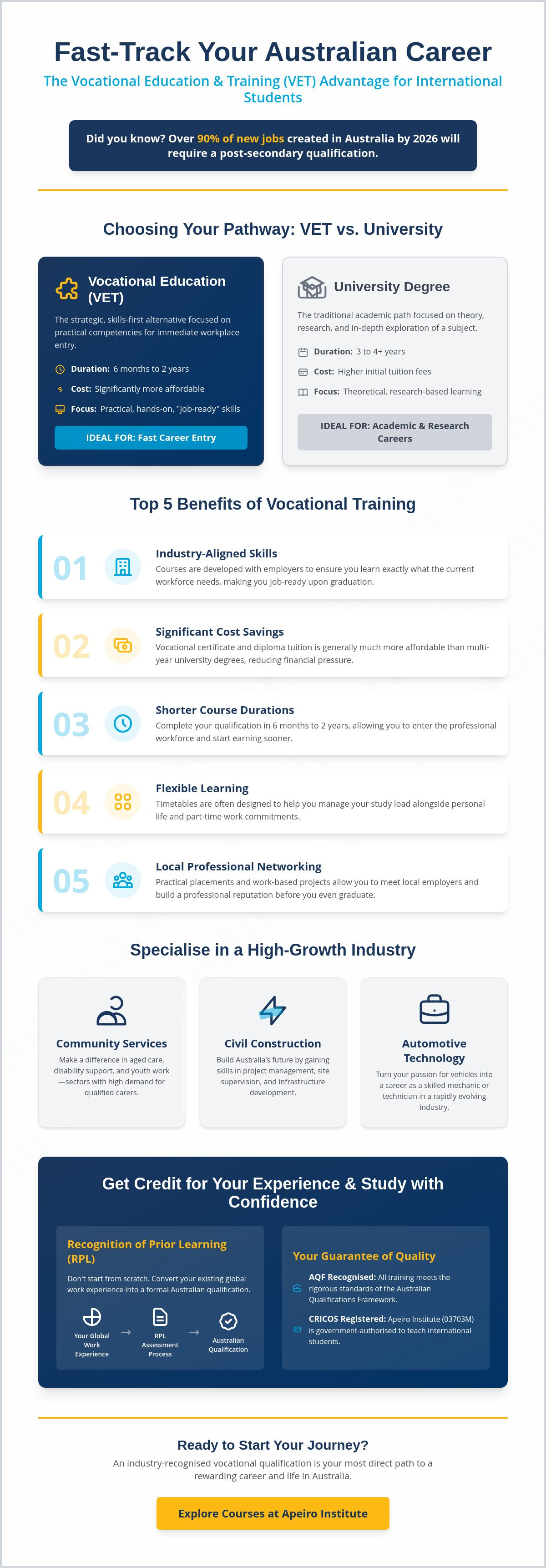
Did you know that over 90% of new jobs created in Australia by 2026 will require a post-secondary qualification? While many people assume a long university degree is the only way forward, the reality is often different for those who want to start working sooner. It's understandable to feel stressed about high tuition fees and a lack of local work experience when you first arrive. That's why understanding how vocational training benefits international students is so vital for your professional success.
We'll show you how vocational education can fast-track your Australian career through practical skills, lower costs, and industry-recognised qualifications. You'll discover why hands-on training in a trade is often the smartest move for your budget and your long-term goals. We'll break down the potential pathways to further study and show you how to meet the latest Genuine Student requirements with confidence. From community services to automotive technology, your journey to a rewarding career in Australia starts with making an informed choice today.
Key Takeaways
- Understand how the Australian Qualifications Framework (AQF) ensures your training meets national standards for quality and industry relevance.
- Explore how vocational training benefits international students by offering significantly lower tuition costs and a direct path to practical, job-ready skills.
- Learn how to use Recognition of Prior Learning (RPL) to convert your existing global work experience into a formal Australian qualification.
- Identify high-growth sectors such as community services, civil construction, and automotive technology where skilled tradespeople are in high demand.
- Discover the value of a supportive learning environment that combines professional mentorship with a diverse, inclusive student community.
Understanding Vocational Education and Training (VET) in 2026
Australia's approach to tertiary education is evolving rapidly. While university was once seen as the only prestigious path, Vocational Education and Training (VET) has emerged as a strategic, skills-first alternative. In 2026, the focus is firmly on what you can do, not just what you know. VET providers prioritise practical competencies that allow you to step straight into a workplace with confidence. This hands-on model is exactly why vocational training benefits international students who want to see a fast return on their educational investment.
All VET qualifications are governed by the Australian Qualifications Framework (AQF). This national system ensures that whether you're studying for a certificate or a diploma, your training meets rigorous standards recognised across the country. It provides a clear, reliable pathway for career progression. You can start with a foundational course and build your way up as your experience grows. This structured approach takes the guesswork out of your education and ensures your hard work is respected by local employers.
The Role of a CRICOS Registered Training Organisation
For anyone studying on a student visa, CRICOS registration is the most important detail to check. It stands for the Commonwealth Register of Institutions and Courses for Overseas Students. This registration is a legal requirement that ensures the provider is authorised to teach international learners. Apeiro Institute is a CRICOS Provider (03703M), which means our courses meet the strict quality and support standards required by the Australian Government. These regulations are designed to protect your rights and your tuition fees, giving you peace of mind while you focus on your studies.
VET vs. University: Which Suits Your Career Goals?
Choosing between VET and university depends on your personal timeline and preferred learning style. University degrees are often theory-heavy and usually require three to four years of full-time study. VET courses offer a more streamlined, "work-ready" alternative. Most vocational programmes last between six months and two years, which is a significant advantage if you're looking to enter the workforce quickly. While universities explore the "why" through academic research, VET focuses on the "how" through practical application. The Australian tertiary sector is an inclusive environment where students of all nationalities are welcomed and supported as they pursue their professional dreams.
Top 5 Benefits of Vocational Training for International Students
Choosing the right educational path is one of the most significant decisions you'll make when moving to Australia. While university degrees are a traditional choice, many learners find that vocational training benefits international students in more immediate, practical ways. The Australian job market is currently hungry for specific technical expertise, and VET courses are designed to fill these gaps directly. By focusing on five key areas, you can see how this pathway supports both your professional ambitions and your personal well-being.
- Industry-Aligned Skills: Courses are developed in consultation with employers to ensure you're learning exactly what the current workforce needs.
- Significant Cost Savings: Tuition for vocational certificates and diplomas is generally much more affordable than multi-year university degrees, reducing your initial financial pressure.
- Shorter Durations: You can often complete a qualification in six months to two years, meaning you can start your professional career much sooner.
- Flexible Learning: Timetables are often designed to help you manage your study load alongside your personal life and part-time work commitments.
- Local Networking: Practical placements allow you to meet local employers and build a professional reputation before you even graduate.
Research suggests that international students who gain valuable training and skills become highly regarded contributors to the local economy. This is because they arrive on the job with a clear understanding of Australian workplace standards and technical requirements.
Practical Skills and Hands-On Learning
In a vocational setting, the classroom often looks like a real-world job site. Simulated workshops allow you to practice your trade in a safe, supportive environment under the guidance of industry experts. Whether you're training for a Certificate III in Light Vehicle Mechanical Technology or learning the intricacies of electronics, you'll spend more time doing the work than reading about it. This "learning by doing" approach builds genuine confidence. You aren't just memorising facts; you're mastering the tools and techniques you'll use every day in your career.
Cost-Effective Pathways to Success
Budgeting is a major concern for most international learners. Vocational courses offer a high-quality alternative that won't break the bank. Beyond the lower tuition fees, many students use VET as a stepping stone. This "pathway" model allows you to earn a Diploma first, enter the workforce, and then potentially receive credit towards a university degree later if you choose to continue your studies. It's a low-risk way to secure a nationally recognised qualification in Australia while staying financially secure. If you're passionate about helping others, starting with a Certificate III in Individual Support can get you into the healthcare sector quickly and affordably.
Bypassing the Basics: Recognition of Prior Learning (RPL) for Skilled Learners
Many students arrive in Australia with a wealth of knowledge already under their belts. If you've spent years working as a mechanic, an electrician, or a community worker in your home country, you shouldn't have to start from zero. Recognition of Prior Learning (RPL) is a formal process that assesses your existing skills against Australian standards. This is where workforce and vocational training policies truly support global talent. By valuing what you already know, the system allows you to skip the basics and focus on what's new. It's a significant way that vocational training benefits international students who want to respect their professional history while building a future here.
The Trade Pathways for Experienced Workers (TPEW) programme is specifically designed for this purpose. It helps you turn years of on-the-job experience into a formal qualification without the need for redundant classroom time. This doesn't just save you money; it saves you hundreds of hours that you can spend working in your trade instead. Formalising your experience is the fastest way to gain the credentials local employers are looking for.
How RPL Works for International Professionals
The process is straightforward but requires careful documentation to be successful. Instead of sitting through lectures for things you already know, you provide evidence of your competence. This often includes:
- Detailed references from previous employers or supervisors.
- Photos or videos of you performing specific technical tasks on the job.
- Work samples, project logs, or existing certifications from your home country.
A qualified RTO assessor reviews this evidence to see if it matches the requirements of the Australian qualification. It's a collaborative process where the assessor guides you through what's needed to prove your expertise. This service is essential for those looking into trade pathways for experienced workers in Australia, ensuring your skills are correctly mapped to local industry expectations and safety standards.
From Offshore Experience to Australian Certification
There's a profound sense of relief when your global expertise is finally recognised on Australian soil. Many professionals feel frustrated when their years of hard work seem invisible in a new country. Gaining an Australian certificate through RPL changes that narrative instantly. It provides the legal and professional standing required for various licensing bodies and industry registrations. RPL can significantly shorten the path to a Certificate III or Diploma qualification by acknowledging that you are already a master of your craft. It's about giving you the credit you deserve while ensuring you meet the high standards expected in the local workforce.
High-Growth Industries: Selecting Your Vocational Specialisation
One of the standout vocational training benefits international students enjoy is the ability to align their education with Australia's most urgent skills shortages. In 2026, the job market prioritises candidates who can demonstrate specific, practical expertise in sectors that underpin the national economy. Choosing a specialisation isn't just about following an interest; it's about identifying where the long-term demand lies. Whether you're drawn to technical trades or the care economy, selecting a course with a clear professional outcome is the most effective way to secure your future.
For those with a passion for mechanics, the automotive sector remains a pillar of stability. The AUR30620 Certificate III in Light Vehicle Mechanical Technology is a perfect example of a qualification that leads directly to a vital role. As the transport industry evolves, the need for skilled technicians who understand modern vehicle systems continues to grow. This trade offers a reliable career path with opportunities for progression into diagnostic or management roles as you gain experience on the tools.
Electronics and Communications: The Digital Backbone
The Australian technology industry contributes $167 billion to the GDP, and this growth is supported by a massive infrastructure of communication systems. Studying the UEE30920 Certificate III in Electronics and Communications prepares you to maintain the digital backbone of the country. There's a constant demand for technicians who can install, repair, and manage sophisticated electronic equipment. This qualification doesn't just lead to immediate work; it serves as a robust foundation for those who might want to pursue advanced engineering roles later in their career.
Community Services and Individual Support
The "care economy" is currently Australia’s largest employer, with 2.2 million workers expected in the healthcare and social assistance sector by 2026. This growth is driven by an ageing population and an increased focus on disability support services. Starting with a CHC33021 Certificate III in Individual Support (Ageing and Disability) allows you to enter this rewarding field quickly. It's a career path that offers immense job security and a clear ladder for progression. Many students move from support roles into Case Management by completing a Diploma of Community Services, showing how vocational training supports lifelong professional growth.
Ready to turn your passion into a professional career? Explore our nationally recognised courses and start your journey today.
Why Apeiro Institute is the Ideal Choice for International Vocational Students
Finding the right training provider is about more than just picking a course. It's about finding a partner that understands your unique journey as an international learner. At Apeiro Institute, we've built a vibrant, inclusive community that represents over 38 different nationalities. This diversity creates a rich learning environment where global perspectives meet Australian industry standards. The specific vocational training benefits international students receive at Apeiro are built on a foundation of community, empathy, and real-world relevance. We understand the challenges of moving to a new country, and we're here to ensure your educational experience is as smooth and rewarding as possible.
Flexibility is at the heart of our approach. With multiple campus locations and a wide range of course levels, we make it easier for you to find a study plan that fits your lifestyle. Whether you're starting with a foundational certificate or advancing to a diploma, our programmes are designed to be accessible and manageable. We focus on practical training outcomes that matter to employers, ensuring that the time you spend in the classroom translates directly into professional success in the Australian workforce.
Student-Centred Support and Mentorship
Starting a new educational journey can feel intimidating, but it doesn't have to be. We project the personality of an empowering mentor, offering an environment where every student feels seen and supported. Our team provides personalised guidance from the moment you first reach out. If you're unsure which course suits your goals or how to start the Recognition of Prior Learning (RPL) process, our expert advisors are ready to help. We don't just teach; we invest in your personal growth. By focusing on building your confidence and providing a sense of security through expert guidance, we help you overcome the hurdles of professional transition with ease.
Nationally Recognised Training for a Global Career
Every qualification we offer is nationally recognised across Australia, ensuring your hard work is valued by employers in every state. Our diverse range of courses covers high-demand sectors including Automotive, Business, Community Services, and Engineering. This breadth of options allows you to find the perfect fit for your existing skills or your future ambitions. Our trainers are industry veterans who bring years of practical experience directly into the workshop or classroom. They ensure that every lesson has a direct application in the local workforce, giving you a competitive edge when you graduate. Your global career starts with a solid Australian foundation.
Ready to take the next step toward your professional goals? Enquire today to start your vocational journey with Apeiro Institute and join a community dedicated to your success.
Take the Next Step Toward Your Australian Career
The shift toward skills-based education in Australia offers a clear advantage for those ready to enter the workforce. By choosing a path that prioritises practical experience over years of theory, you're positioning yourself at the front of the queue for high-growth industries. We've explored how vocational training benefits international students through lower tuition costs, shorter study durations, and flexible pathways that respect your previous expertise. Whether you're interested in community services, automotive technology, or electronics, the right qualification provides the security and confidence you need to thrive in a new country.
Apeiro Institute is a Registered Training Organisation (RTO 45394) and CRICOS Provider (03703M) dedicated to your success. Our community of students from over 38 different nationalities reflects our commitment to diversity and inclusive support. As specialists in Trade Pathways for Experienced Workers (TPEW) and RPL, we help you turn your global expertise into local recognition. Your professional future in Australia is within reach, and we're here to guide you every step of the way. We can't wait to welcome you to our community and watch you achieve your goals.
Explore our CRICOS-registered vocational courses and start your Australian career today.
Frequently Asked Questions
What are the main benefits of vocational training for international students in Australia?
One of the primary vocational training benefits international students experience is the direct focus on job-ready skills that meet local industry needs. Unlike theoretical study, these courses prioritise hands-on application in workshops and simulated environments. This approach allows you to build confidence quickly while benefiting from lower tuition costs and shorter timeframes compared to many other tertiary options.
Is a vocational certificate better than a university degree for finding work?
While university degrees focus on academic theory, vocational certificates are specifically designed for immediate entry into the workforce. In sectors like automotive repair or individual support, employers often prefer candidates with VET qualifications because they have practical experience from day one. It isn't about being better in a general sense; it's about which path gets you into your chosen profession faster.
Can I get credit for work experience I gained outside of Australia?
Yes, you can formalise your global expertise through the Recognition of Prior Learning (RPL) process. This allows you to skip units of study for skills you've already mastered in your home country. By providing evidence like work references and technical samples, you can significantly reduce the time and cost required to earn your Australian qualification and start working sooner.
How long does a typical vocational course take to complete?
Most vocational courses range from six months to two years depending on the level of the qualification. For example, a Certificate III might take 12 months, while a more advanced Diploma could extend to two years. This streamlined duration is a major reason why vocational training benefits international students who want to start their Australian careers as soon as possible.
Are vocational courses in Australia recognised internationally?
Australian vocational qualifications are highly regarded globally because they are part of the Australian Qualifications Framework (AQF). This national system ensures a consistent standard of quality across all registered providers. While specific licensing requirements vary by country, the skills you gain in Australia are respected by international employers in technical and trade sectors due to their practical nature.
What is the difference between an RTO and a TAFE?
TAFE is a government-run provider, while a Registered Training Organisation (RTO) is typically a private provider. Both must meet the same national standards to offer accredited courses. Private RTOs often provide more specialised support, flexible schedules, and smaller class sizes. This makes them a popular choice for students seeking a personalised and community-focused learning environment during their studies.
Do I need a specific visa to study a vocational course at Apeiro Institute?
What industries in Australia have the most demand for vocational graduates in 2026?
High-demand sectors in 2026 include healthcare, social assistance, and the technology industry. With over 2.2 million workers needed in the care economy, roles in aged care and disability support are particularly stable. Additionally, the civil construction and automotive sectors continue to face significant skills shortages, creating excellent opportunities for graduates with specialised trade qualifications to enter the workforce quickly.

Disclaimer
The information provided on this blog is for general informational and educational purposes only. While every effort is made to ensure the accuracy and reliability of the content, the author makes no representations or warranties of any kind, express or implied, about the completeness, accuracy, suitability, or availability of the information contained on this blog.
The views and opinions expressed in blog posts are those of the individual author and do not necessarily reflect the official policy or position of any organization, company, or employer.
This blog may contain links to external websites or third-party content. These links are provided for convenience only, and the author has no control over and assumes no responsibility for the content, privacy policies, or practices of any third-party sites.
Nothing on this blog constitutes professional advice (legal, financial, medical, or otherwise). Readers are encouraged to seek appropriate professional guidance before making any decisions based on the information provided here.
By using this blog, you acknowledge that any reliance on the information is at your own risk.


