
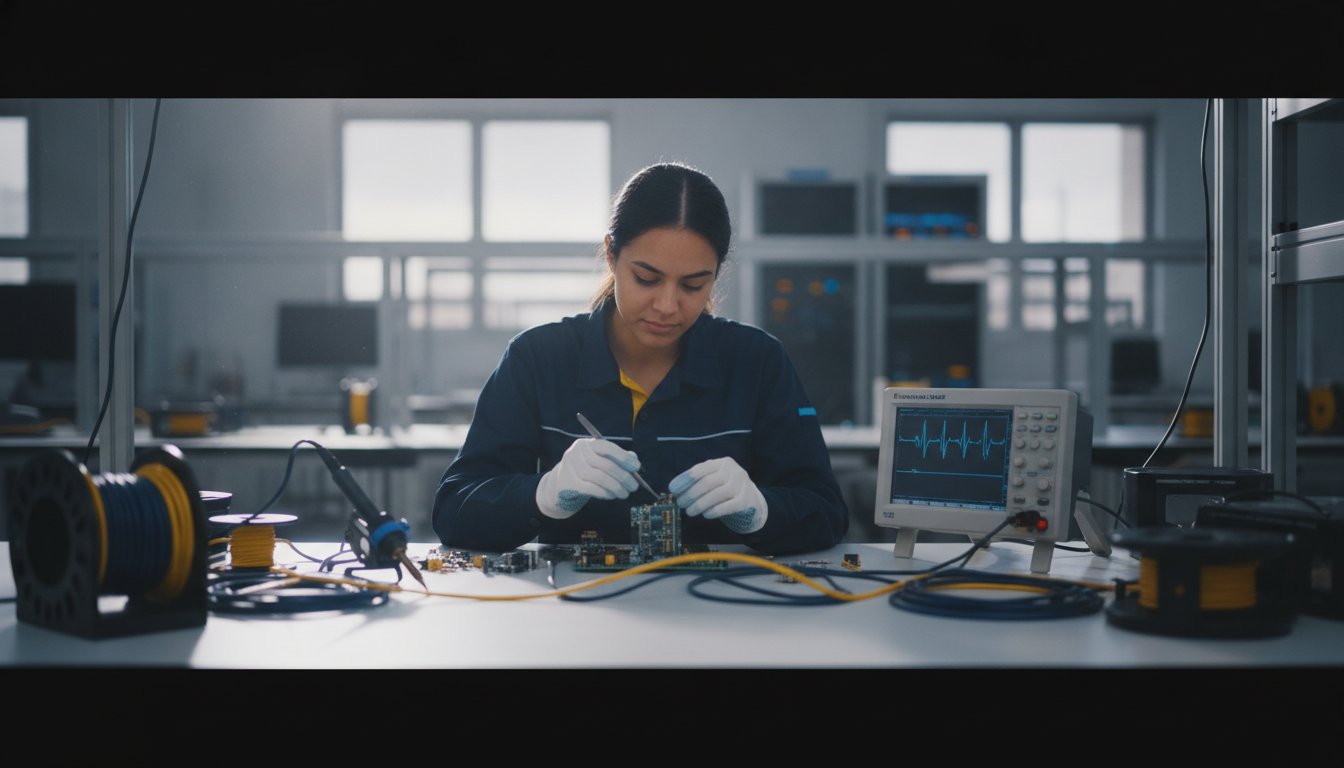
The line between traditional electrical work and high-level digital communications has officially vanished. If you're ready to step into a future-proof trade, understanding the UEE30920 course details is your first step toward becoming a qualified electronics and communications technician. It's completely normal to feel a bit stuck when you're staring at technical unit codes or trying to figure out how to fit training around your current work schedule. You want a clear path forward, not more confusion.
We've put together this 2026 guide to simplify the process for you. You'll find everything you need to know about this qualification, from a breakdown of core units like troubleshooting digital sub-systems to the diverse career outcomes waiting for you in the field. We also highlight flexible pathways for experienced workers, including how Recognition of Prior Learning (RPL) can help you get certified faster. Whether you're an apprentice starting out or a seasoned tradie looking to formalise your expertise, this overview provides the clarity and support you need to take that next professional leap.
Key Takeaways
- Discover how this nationally recognised qualification prepares you for a range of technical roles, from component-level repair to managing complex communication networks.
- Get the full breakdown of UEE30920 course details, including the 52-week duration and the 1200+ hours of comprehensive training needed for success.
- Explore the diverse career outcomes available in 2026, ensuring you're ready for the digital transformation across Australian trade industries.
- Learn how experienced workers can fast-track their journey to a trade certificate using Recognition of Prior Learning (RPL) and Trade Pathways for Experienced Workers (TPEW).
- Understand the value of a student-centred learning environment that provides the expert guidance and flexibility you need to balance study with your current job.
What is the UEE30920 Certificate III in Electronics and Communications?
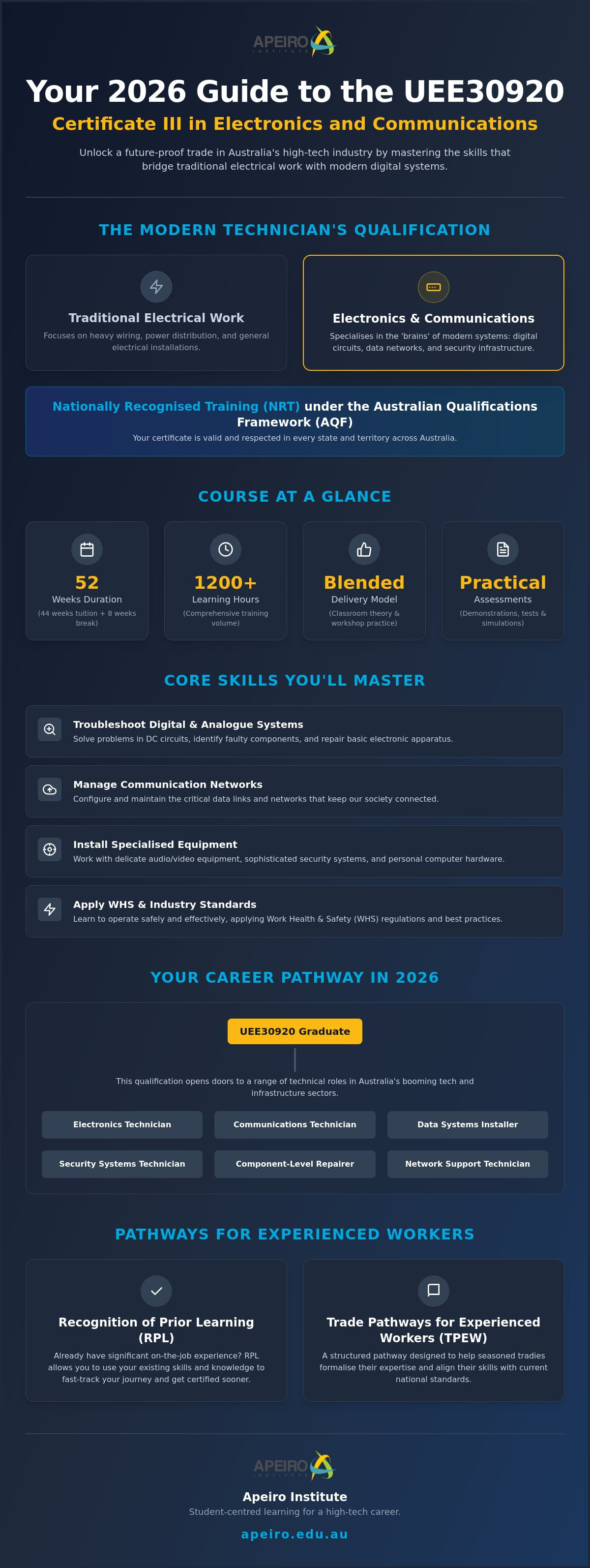
The UEE30920 Certificate III in Electronics and Communications is a nationally recognised trade qualification designed for the modern technician. Unlike general electrical roles that focus on heavy wiring and power distribution, this course dives into the precision world of electronic components and digital systems, such as the industrial weighing solutions and instrumentation provided by Zenith Sales & Calibrations Pty Ltd. If you're looking for UEE30920 course details, you'll find that it bridges the gap between traditional craftsmanship and the rapidly evolving digital sector. It covers everything from troubleshooting circuit boards to configuring large-scale communication networks.
Australia is currently experiencing a significant tech and infrastructure boom. As we move through 2026, the demand for technicians who can maintain critical data links and security systems is at an all-time high. This course is a perfect fit for school leavers wanting a future-proof career, career changers looking for a technical shift, or experienced workers seeking to formalise their years of on-the-job expertise. It provides the foundational knowledge required to work safely and effectively in a high-tech environment.
The Core Focus of Electronics and Communications
Understanding the UEE30920 course details helps you see the specific focus areas that set this trade apart. While a standard electrician might focus on power, an electronics technician specialises in the "brains" of the building. You'll learn to handle delicate audio and video equipment, install sophisticated security systems, and manage personal computer networks. It's about ensuring the infrastructure that keeps our society connected stays online. From repairing basic apparatus faults to troubleshooting resonance circuits, the skills you gain are highly practical and aligned with what employers need right now.
Qualification Standards and National Recognition
When you enrol in this course, you're entering a programme that meets the strict requirements of the Australian Qualifications Framework (AQF). Being "Nationally Recognised Training" (NRT) means your certificate is valid in every state and territory across Australia. The course is part of the Electrotechnology Training Package (UEE), ensuring that every unit you study aligns with current industry safety and quality standards. This isn't just a piece of paper; it's a guarantee to employers that you've been trained to the highest national level. For those already working in the field, exploring Trade Pathways for Experienced Workers (TPEW) can be a great way to align your existing expertise with these national standards without starting from scratch.
UEE30920 Course Details: Units, Duration, and Delivery
The structure of this qualification is designed to be thorough yet manageable for those balancing other life commitments. When looking at the UEE30920 course details, the standard duration is 52 weeks. This timeframe includes 44 weeks of intensive tuition and 8 weeks of scheduled breaks, allowing you to recharge and stay focused. With a total volume of learning approximately 1200+ hours, you'll receive comprehensive training that covers every technical base required for the modern electronics industry.
Delivery is usually a blended model. You'll spend time in the classroom mastering the theoretical side of electrotechnology before heading into the workshop for hands-on practice. It's about seeing how the physics of a circuit actually works in a real-world scenario. To ensure you're ready for the job, assessment methods include practical demonstrations, knowledge tests, and workplace simulations that mirror the challenges you'll face on site. You can find the Official UEE30920 Qualification Details on the national register for a full list of compliance requirements and packaging rules.
Core Units of Competency
The core of the programme focuses on the essential skills every technician needs to operate safely and effectively. Safety is the priority, starting with UEECD0007, which teaches you to apply work health and safety (WHS) regulations and practices in the workplace. From there, you'll move into the technical heart of the trade with UEEEC0060. This unit involves repairing basic electronic apparatus faults by identifying and replacing faulty components. You'll also spend significant time solving problems in direct current (DC) and resonance circuits, which are the building blocks of modern communications systems.
Elective Options and Specialisations
One of the best parts of this course is the ability to customise your career path based on your interests. Electives allow you to lean into specific sectors like security system installation or data communications. You might focus on fabricating, assembling, and dismantling utilities industry components, which is vital for large-scale infrastructure projects. Additionally, learning to compile and produce detailed reports for the energy sector ensures you can handle the administrative side of a technician's role. If you already have some of these skills from years on the tools, you might want to look into Trade Pathways for Experienced Workers to see if you can fast-track your progress through recognition of your existing expertise.
Career Outcomes: Where Can UEE30920 Take You?
Completing this qualification opens doors to a variety of high-growth sectors across Australia. While the UEE30920 course details focus on the technical mechanics of circuitry and signal processing, the real-world application of these skills is what defines your career. By 2026, the digital transformation of traditional trades means that nearly every physical infrastructure project requires a technician who understands complex electronic systems. You aren't just a tradie; you're a specialist in the technology that keeps our modern world running.
Opportunities are expanding rapidly in telecommunications, defence, and home automation. As Australian homes and businesses become "smarter," the need for professionals who can bridge the gap between hardware and software continues to climb. Whether you're working on high-speed data links or intricate defence equipment, your expertise ensures that critical systems remain operational and secure.
Professional Job Roles for Graduates
Graduates often find themselves in roles that require a mix of fine motor skills and high-level problem-solving. As an Electronics Tradesperson, your day might involve component-level repair or intricate sub-assembly work for manufacturing or medical equipment. If you prefer working with larger networks, becoming a Communications Technician allows you to install and maintain the data and voice networks that power our businesses. Many students also move into the security sector as a Security Systems Installer, where you'll set up advanced surveillance and digital access control systems. You can explore more about these Electronics and Communications Career Pathways through government industry data.
Industry Demand and Future Growth
The Australian job market is currently facing a significant "tradie shortage" in specialised technical roles. Unlike general construction, the electronics sector requires a specific set of competencies that are in high demand for the rollout of green energy technology. Technicians are essential for maintaining smart grids and solar inverters, making this a vital role in our transition to sustainable energy.
If you're already working in the industry but lack the formal certificate, you don't have to start from the beginning. Exploring Trade Pathways for Experienced Workers can help you turn your years of experience into a recognised qualification. For those looking even further ahead, this Certificate III serves as the perfect foundation for advanced study. You could eventually move into a Diploma of Electronics and Communications Engineering, shifting from a hands-on technician role into a design or management position. The career ladder in this field is long, and it starts with getting the right training under your belt.
Pathways for Experienced Workers: RPL and TPEW
Many technicians have spent years on the tools without formalising their skills. If you've been installing security systems or repairing circuit boards for a decade, starting a standard four year apprenticeship from scratch isn't a practical option. This is where a deep dive into the UEE30920 course details regarding Recognition of Prior Learning (RPL) becomes life changing. RPL is a formal process that acknowledges the skills you've already mastered through your career, potentially shaving months or even years off your study time. It's a respectful way to transition from an "unqualified" expert to a nationally recognised tradesperson.
Turning years of "on the job" knowledge into a formal national qualification isn't just about getting a piece of paper; it's about opening doors to higher pay grades and more senior roles. For mature age students, this pathway recognises that your time is valuable and your existing expertise has real currency in the Australian job market.
The RPL Assessment Process
Getting your experience recognised at Apeiro Institute is a methodical and supportive journey. We act as your mentor throughout the process, ensuring you know exactly what evidence is required to prove your competency. The process generally follows three clear steps:
- Step 1: Initial consultation and self assessment. We sit down with you to discuss your work history and help you map your daily tasks against the national standards.
- Step 2: Gathering evidence. You'll collect work samples, references from previous supervisors, and even photos or videos of your work to demonstrate your skills in action.
- Step 3: Competency conversation and practical assessment. You'll have a one on one chat with an Apeiro trainer to discuss your technical knowledge, followed by a practical demonstration to confirm your proficiency.
TPEW: A Faster Route to Certification
While standard apprenticeships are excellent for school leavers, our Trade Pathways for Experienced Workers (TPEW) initiative is specifically designed for those who already have a solid foundation in the industry. TPEW differs from traditional models because it focuses on filling the specific gaps in your knowledge rather than making you relearn things you do in your sleep. It significantly reduces the financial and time burden of getting qualified, making it a much more attainable goal for busy professionals with existing commitments.
Employers across Australia value TPEW graduates because they bring the maturity and work ethic of an experienced hand, backed by formal credentials. If you're ready to formalise your expertise and move your career forward, explore our Trade Pathways for Experienced Workers to see how we can help you get certified faster.
Why Choose Apeiro Institute for Your UEE30920 Course?
Choosing where to study is a significant decision that shapes your professional future. At Apeiro Institute, we act as your empowering mentor rather than just a training provider. Our expert trainers bring decades of real-world Australian industry experience into the classroom, ensuring you learn the practical skills that local employers actually value. When you examine our UEE30920 course details, you'll see a curriculum designed for the 2026 job market. Our modern workshop facilities simulate actual work environments, allowing you to master complex electronics in a safe and supportive setting.
Our campus is a vibrant, inclusive community representing over 38 nationalities. This global perspective makes for a richer learning experience and helps you build a network that spans across borders. We believe that a supportive atmosphere is essential for personal growth, and we're committed to making every student feel at home while they pursue their trade goals.
Support for Local and International Students
We offer tailored support for every learner who walks through our doors. As a CRICOS-registered provider, we are a trusted choice for international students looking to build a successful career in Australia. You can find more information about your options in our Vocational Courses for International Students in Australia guide. For local students in New South Wales, we provide expert guidance on NSW Smart and Skilled funding. If you're eligible, this government initiative can help reduce the cost of your training, making your career transition more affordable and attainable.
Start Your Electronics Journey Today
Ready to take the next step toward becoming a qualified technician? Our enrolment process is designed to be clear and stress-free. We focus on personalised attention to ensure you're on the right path from day one. Whether you're a school leaver or an experienced hand looking to formalise your skills through Trade Pathways for Experienced Workers, we provide the steady guidance you need to succeed. The Apeiro difference lies in our commitment to your career-focused outcomes and our passion for seeing you thrive in the electrotechnology sector. Don't wait to future-proof your career in this high-demand field. Enquire about UEE30920 at Apeiro Institute today and join a community that's truly invested in your professional growth.
Take the Next Step Toward Your Technical Career
The UEE30920 qualification is more than just a certificate; it's your entry point into a high-tech industry that powers Australia's digital infrastructure. By exploring the UEE30920 course details, you've seen how this training balances rigorous technical units with the practical flexibility needed for modern workers. Whether you're entering the trade as an apprentice or using Recognition of Prior Learning to formalise years of on-the-job experience, the path to becoming a qualified communications technician is clearer than ever. The demand for specialised skills in electronics is only growing, and securing your certification now ensures you're ready for the opportunities of 2026 and beyond.
At Apeiro Institute (RTO Code 45394), we're here to act as your expert guide through every step of your journey. We provide Nationally Recognised Training in a supportive environment that values your personal growth and professional ambition. As a registered CRICOS Provider (03703M), we also welcome international students looking to build a successful future in Australia. We're committed to helping you bridge the gap between your current skills and your future career goals.
View UEE30920 Course Details and Enrol Today
Your future in electronics is waiting, and we're ready to help you reach it with confidence.
Frequently Asked Questions
Is the UEE30920 Certificate III in Electronics and Communications a trade qualification?
Yes, this is a nationally recognised electrotechnology trade qualification across Australia. It is specifically designed for technicians who work with electronic components, digital systems, and complex communication networks. While it differs from a general sparky's license, it carries the same professional weight and recognition within its specialised high-tech field.
How long does it take to complete the UEE30920 course?
The standard duration for this qualification at Apeiro Institute is 52 weeks. This timeframe includes 44 weeks of active tuition combined with 8 weeks of scheduled breaks to help you manage your study and work commitments. When you look at the UEE30920 course details, you'll see it involves approximately 1200+ hours of comprehensive training to ensure you are fully job-ready.
Can I get my qualification faster if I have previous experience?
Yes, you can certainly shorten your study time by applying for Recognition of Prior Learning (RPL). If you've spent years working on the tools but don't have the formal certificate, we can assess your existing skills against national standards. This process, often part of our Trade Pathways for Experienced Workers (TPEW), allows you to skip units you've already mastered and finish sooner.
What are the entry requirements for international students?
International students need to meet specific academic and English language standards to enrol. Generally, this includes having completed Year 12 or an equivalent qualification and achieving an IELTS score of at least 5.5. As a CRICOS-registered provider, we provide a clear roadmap for international learners to ensure all visa and educational prerequisites are met before the course begins.
Is there government funding available for this course in NSW?
Yes, eligible local students in New South Wales can often access government subsidies through the Smart and Skilled programme. These funded positions are designed to get more people into high-demand trades like electronics. We suggest chatting with our support team to check your specific eligibility based on your residency and any previous qualifications you might hold.
What is the difference between an electrician and an electronics technician?
The main difference is the type of systems and voltage you'll be handling daily. Electricians typically focus on high-voltage power, lighting, and general wiring in buildings. Electronics technicians specialise in low-voltage systems, component-level repairs, and digital communication networks. The UEE30920 course details focus heavily on the "brains" of modern technology rather than just the power supply.
Does the UEE30920 course include a work placement?
This qualification is most commonly delivered through an apprenticeship or traineeship model where you are already employed in the industry. This allows you to apply your classroom learning directly to your daily job. For students not in an apprenticeship, our modern workshop facilities use realistic simulations to ensure you get the hands-on practice required to meet industry standards.
What tools or equipment do I need to start the course?
Apeiro Institute provides access to all the specialised diagnostic equipment and high-tech tools you'll need during your workshop sessions. This includes everything from soldering stations to advanced circuit testing software. While you don't need to buy a full professional kit to start, we can provide a list of basic hand tools that will be useful as you progress into the workplace. For professional projects requiring specialised gear, Zenith Rental offers a comprehensive range of electrical and power testing equipment for hire.

Disclaimer
The information provided on this blog is for general informational and educational purposes only. While every effort is made to ensure the accuracy and reliability of the content, the author makes no representations or warranties of any kind, express or implied, about the completeness, accuracy, suitability, or availability of the information contained on this blog.
The views and opinions expressed in blog posts are those of the individual author and do not necessarily reflect the official policy or position of any organization, company, or employer.
This blog may contain links to external websites or third-party content. These links are provided for convenience only, and the author has no control over and assumes no responsibility for the content, privacy policies, or practices of any third-party sites.
Nothing on this blog constitutes professional advice (legal, financial, medical, or otherwise). Readers are encouraged to seek appropriate professional guidance before making any decisions based on the information provided here.
By using this blog, you acknowledge that any reliance on the information is at your own risk.


