

What if the solution to your persistent workshop vacancies isn't finding the perfect candidate, but building one instead? Most Australian business owners know the frustration of seeing a mounting pile of work while specialised roles remain unfilled for months. Addressing skilled labour shortages with traineeships provides a practical way out of this cycle by turning your workplace into a hub of real-world learning. It's time to stop worrying about high hiring costs and start shaping the skills your team actually needs.
In this article, you'll discover how these programs provide a strategic solution to Australia's persistent skills gap while helping you build a loyal, future-ready workforce. We will walk through the benefits of nationally recognised qualifications and show you how to access government-funded training incentives. By the end, you'll have a clear roadmap for creating a sustainable, high-quality pipeline of talent that grows alongside your business.
Key Takeaways
- Understand the specific skills mismatch currently affecting technical sectors like electronics and automotive and why traditional hiring methods are falling short.
- Learn how addressing skilled labour shortages with traineeships allows businesses to create flexible, workplace-based learning pathways that reduce operational downtime.
- Discover the "earn while you learn" model's dual benefits, including lower recruitment costs for employers and clear career progression for workers.
- Identify the essential steps to partner with a Registered Training Organisation (RTO) to access government-funded training and nationally recognised qualifications.
- Explore how industry-focused mentoring helps your workforce meet 2026 standards while fostering long-term staff loyalty and expertise.
What is the Skilled Labour Shortage in Australia for 2026?
Australia's job market is currently facing a complex challenge that goes beyond a simple lack of applicants. It's a mismatch between the skills workers currently possess and the specific technical requirements of modern industry. This gap is the core of the 2026 skilled labour shortage. Addressing skilled labour shortages with traineeships allows businesses to bridge this divide by training staff directly for the roles they need to fill. Instead of waiting for the perfect candidate to appear, employers are now creating them through structured, workplace-based learning.
The Suitability vs. Retention Gap
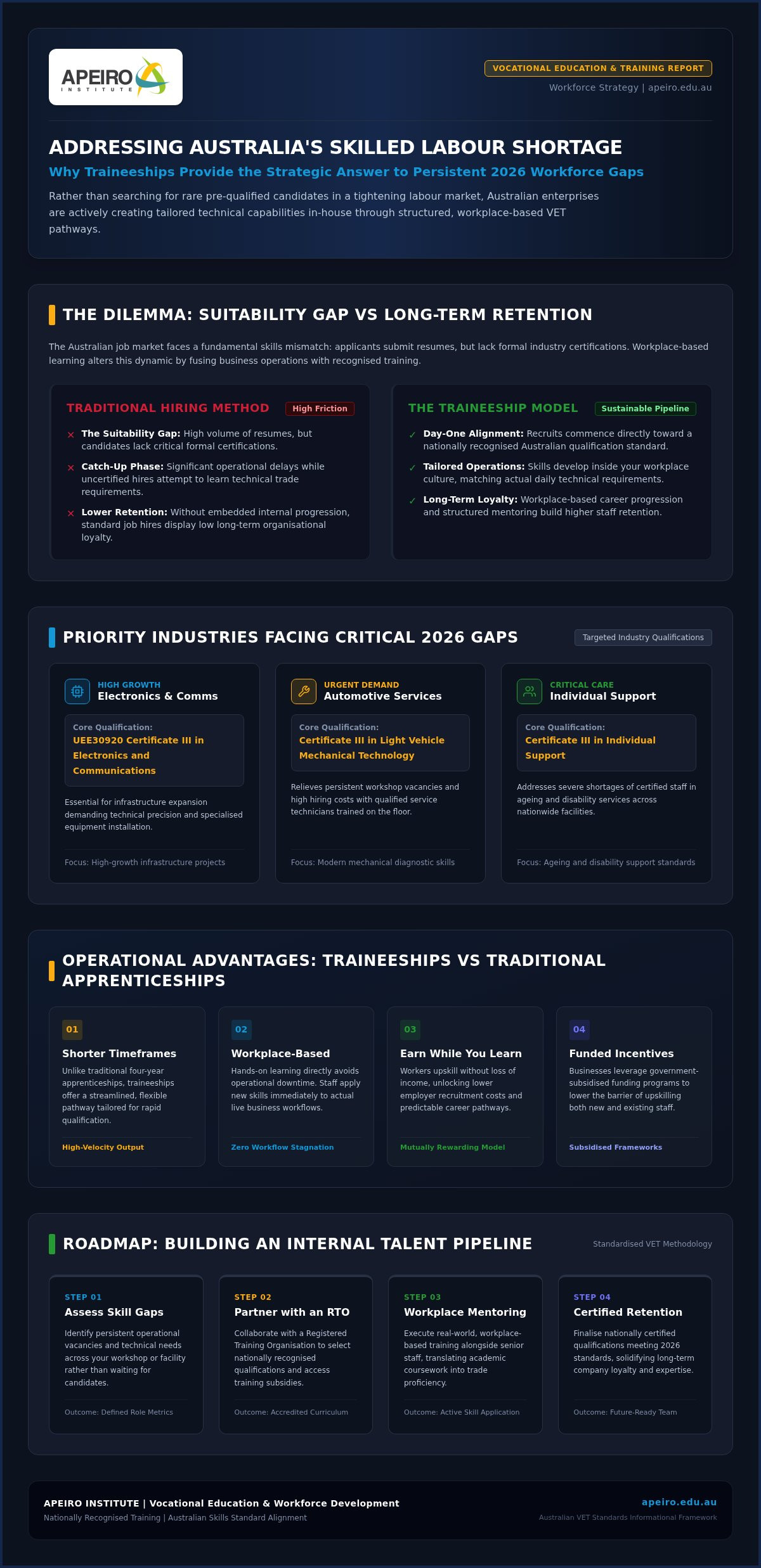
Many managers find that while they receive plenty of resumes, very few candidates hold the necessary certifications. This is often called the suitability gap. When you hire someone who lacks formal training, you're constantly playing catch-up with their technical abilities. Using the apprenticeship and traineeship model changes this dynamic entirely. It ensures that from day one, your new hire is working toward a nationally recognised standard that fits your operational needs. Because the worker is learning within your specific business culture, they are far more likely to stay long-term. Internal training pathways build a sense of loyalty that a standard job offer simply can't match.
Priority Industries Facing Critical Gaps
Several technical sectors are feeling the pinch more than others as we head toward 2026. The electronics and communications field is a primary example. High-growth infrastructure projects require the technical precision found in qualifications like the UEE30920 Certificate III in Electronics and Communications. The automotive sector is also under significant pressure. There is a constant, urgent demand for qualified staff who hold a Certificate III in Light Vehicle Mechanical Technology. Finally, the social sector requires immediate support. The Certificate III in Individual Support is essential for addressing the critical lack of qualified staff in ageing and disability services across the country.
The Vocational Education and Training (VET) sector is the engine room for fixing these gaps. It offers immediate relief by providing practical, job-ready skills rather than just abstract theory. Addressing skilled labour shortages with traineeships through a registered training organisation ensures that your team's education is relevant to the current economy. It's a direct, supportive way to turn an eager applicant into a highly skilled professional who understands your business from the inside out.
Why Traineeships are the Strategic Answer to Persistent Gaps
Recruiting fully qualified staff in a competitive market is often expensive and time-consuming. Addressing skilled labor shortages with traineeships offers a proactive alternative by letting you develop specific skills within your existing team. The "earn while you learn" model is a powerful deterrent to labour gaps. It allows workers to gain a qualification without losing their income. This setup is particularly effective for technical trades where practical experience is just as vital as classroom knowledge.
Unlike traditional four-year apprenticeships, many traineeships offer a more streamlined and flexible path to qualification. They are designed to be completed in shorter timeframes, making them ideal for fast-moving industries like community services or business administration. Because the training is workplace-based, your business doesn't suffer from significant operational disruption. Your staff learn on the job, applying new techniques to real-world tasks immediately.
Aligning Education with Industry Standards
Every trainee works toward a nationally recognised qualification that meets strict Australian standards. This consistency is crucial. According to national occupation shortage data, the demand for precision in technical roles has never been higher. Registered Training Organisations (RTOs) act as the bridge here, ensuring that theoretical knowledge translates into practical trade skills. Traineeships create a sustainable pipeline of talent by transforming motivated learners into industry-qualified professionals who are already integrated into your business operations.
Addressing the Training Gap with Funded Pathways
Financial barriers shouldn't stand in the way of progress. Many businesses can access subsidised training through programs like NSW Smart and Skilled. These subsidies lower the entry cost for both the employer and the student, making professional development much more accessible. Addressing skilled labor shortages with traineeships through these funded routes ensures your business remains competitive without overstretching the budget. Choosing a reputable RTO is the best way to ensure these pathways lead to high-quality outcomes. If you have team members with years of experience but no formal papers, exploring Trade Pathways for Experienced Workers can be a game-changer for your retention strategy.
Bridging the Gap: Benefits for Employers and Workers
Investing in a traineeship program isn't just about filling a seat; it's about building a partnership. Addressing skilled labour shortages with traineeships creates a unique environment where both the business and the individual thrive simultaneously. For employers, the most immediate advantage is the reduction in recruitment costs. Instead of paying premium rates for fully qualified staff in a thin market, you can invest in someone eager to grow. This investment pays off through increased staff loyalty. When a team member sees that you're invested in their personal growth, they're far more likely to stay for the long haul.
For workers, the benefits are equally transformative. A traineeship provides a clear, structured career pathway leading to a nationally recognised qualification. This isn't just a piece of paper; it's a ticket to long-term job security in the 2026 digital economy. As technical trades become more sophisticated, having formalised skills ensures you're ready for new industry standards. You can explore these pathways through the Australian Apprenticeships support program, which helps navigate the financial and administrative steps of getting started.
Upskilling the Existing Workforce
It's a common myth that traineeships are only for school-leavers. In reality, mature-age workers are a vital part of the solution. Many experienced staff members have years of hands-on knowledge but lack the formal papers to prove it. The Trade Pathways for Experienced Workers (TPEW) model is designed specifically for this group. By formalising these existing skills, businesses can improve their overall productivity and ensure they meet strict compliance standards. It's a respectful, efficient way to acknowledge expertise while strengthening your team's credentials.
Meeting Demand in Community Services
The social sector is currently facing some of the most persistent vacancies in the country. Traineeships in Individual Support are essential for helping facilities meet their NDIS and aged care quotas. Addressing skilled labour shortages with traineeships in this field doesn't just fill a gap; it builds a compassionate, qualified workforce for a stable sector. For those looking to take their career even further, these entry-level qualifications often serve as the perfect foundation for a Diploma of Community Services. This progression ensures that our most vulnerable community members receive care from professionals who are both empathetic and highly trained.
Navigating the Pathway: How to Commence a Traineeship
Starting a traineeship is a practical, step-by-step process that brings together the worker, the employer, and an expert training provider. It's about collaboration. Addressing skilled labour shortages with traineeships works most effectively when everyone is aligned on the training goals from the first day. Your first task is to identify the specific skill gap in your business or career. You should match these needs against the national priority lists to ensure you're moving into a high-demand area. Once you've found the right fit, you need to partner with a Registered Training Organisation (RTO) that delivers the specific qualification you require.
After selecting your RTO, the next step involves checking eligibility for government-funded training or subsidies. If you're eligible, you'll sign a training contract. This document is a formal agreement that outlines the responsibilities of the employer, the trainee, and the training provider. From here, workplace-based learning officially begins. You'll receive regular support and assessments to ensure you're meeting industry benchmarks while staying productive on the job.
The Role of Recognition of Prior Learning (RPL)
If you're an experienced worker without a certificate, RPL is an essential tool for your career. It can significantly shorten the time it takes to finish a traineeship by recognising the skills you already use every day. To make this happen, you'll need to gather evidence of your competency. This usually includes items like work samples, technical references, or photos of your completed projects. Formalising your existing knowledge is one of the fastest ways to fill qualified vacancies in your team.
Choosing the Right Qualification
Picking the right course is the key to long-term success. For those with a technical mind, the UEE30920 Certificate III in Electronics and Communications is a fantastic choice for the 2026 job market. If you're more interested in mechanical tasks, a pathway in light vehicle mechanical technology might be a better fit. Addressing skilled labour shortages with traineeships is most successful when you align your personal interests with the industries that need your help the most. Checking current shortage lists will help you decide which path offers the best stability.
Start your journey with our Trade Pathways for Experienced Workers
Empowering Your Future with Apeiro Institute
Apeiro Institute acts as more than just a training provider. We are your partner in professional growth. Addressing skilled labour shortages with traineeships requires a deep understanding of both industry needs and individual potential. Our team is dedicated to providing industry-focused training that meets 2026 standards, ensuring our students are ready for the technical demands of the future. By choosing a mentor-driven RTO with a global perspective, you're gaining access to high-level expertise delivered with a genuine, person-to-person touch. We bridge the gap between where you are now and where you want to be.
Our approach is built on the belief that education should be accessible and supportive. We avoid the cold, detached language of traditional institutions, opting instead for a voice that feels encouraging and inclusive. Whether you're entering the automotive sector or the social services field, we provide the expert guidance you need to feel secure in your learning journey. Our goal is to build your confidence while providing a clear, logical pathway to your professional objectives.
Why Industry Leaders Partner with Apeiro
Employers choose to work with us because we focus on practical, vocational outcomes that translate directly to job readiness. We understand that businesses can't afford significant downtime. Our flexible training delivery is designed to support both the student and the employer, allowing for workplace-based learning that keeps your operations running smoothly. We're proud to support a diverse community representing over 38 nationalities. This creates a rich, inclusive learning environment that reflects the modern Australian workforce. Navigating the complexities of funding and certification can be difficult, but our expertise in Smart and Skilled funded courses makes the process straightforward for our partners.
Get Started on Your Trade Pathway Today
Taking the first step toward a nationally recognised qualification is easier than you might think. Whether you're an employer looking to upskill your team or an individual ready to formalise your years of experience, we're here to help. Addressing skilled labour shortages with traineeships starts with a conversation about your specific goals. We offer personalised training assessments to help you find the most efficient route to your qualification. This includes specialised pathways for experienced workers who already have the skills but need the formal papers to prove it. Your future is within reach, and we're ready to help you grab it.
Contact Apeiro Institute to explore our traineeship and RPL options
Building Your Future-Ready Workforce Today
Traineeships are more than just a training method; they're a strategic solution for businesses and individuals ready to grow. By focusing on practical, workplace-based learning, you can close the suitability gap and ensure your team meets the technical standards of the 2026 economy. Addressing skilled labor shortages with traineeships allows you to turn existing potential into certified expertise while maintaining business productivity. It's about creating a sustainable pipeline of talent that understands your unique workplace culture from day one.
Whether you're formalising years of experience through Recognition of Prior Learning or starting a fresh career in a high-demand trade, the right support makes all the difference. As a nationally recognised training provider (RTO 45394), Apeiro Institute offers dedicated student support and industry-expert trainers to guide you every step of the way. We specialise in helping you navigate funded pathways so that professional development feels attainable rather than intimidating.
Explore Nationally Recognised Traineeships and Trade Pathways at Apeiro Institute
Your professional goals are well within reach, and we're here to act as your expert guide. Let's work together to build a more skilled and secure future for your career or your business.
Frequently Asked Questions
What is the difference between an apprenticeship and a traineeship in Australia?
Apprenticeships generally focus on traditional skilled trades like electrical or plumbing and usually take three to four years to finish. Traineeships cover a wider range of vocational areas, such as business or community services, and are often completed within one to two years. Both involve a legal agreement between the employer and the worker, combining on-the-job experience with structured learning from a registered training provider.
How do traineeships help solve the national skilled labour shortage?
Addressing skilled labour shortages with traineeships helps bridge the gap between candidate availability and actual industry requirements. It allows your business to develop a custom pipeline of talent trained specifically for your operational needs. By turning your workshop or office into a learning environment, you ensure your staff hold nationally recognised qualifications. This proactive approach reduces the high cost of hiring fully qualified staff in a competitive market.
Are there government incentives for employers hiring trainees in 2026?
The Australian Government offers several financial incentives to encourage businesses to take on trainees, particularly in priority technical sectors. These subsidies are designed to offset the costs of training and wages, making it more affordable to grow your own team. Programs like NSW Smart and Skilled provide funded training pathways that significantly lower the barrier for entry. It's always best to check the current priority lists for the latest incentive details.
Can I do a traineeship if I already have years of experience in the trade?
You certainly can, and it's a brilliant way to formalise your professional standing. Through Recognition of Prior Learning (RPL), we assess your existing technical expertise against national standards. This often means you don't have to repeat training for skills you've already mastered on the job. It significantly shortens the time needed to earn your certificate, helping you fill qualified vacancies and advance your career much faster than starting from scratch.
Which industries in Australia have the biggest skills shortages right now?
Currently, technical trades and the care sector face the most significant gaps. Electronics and communications, light vehicle mechanical technology, and community services like ageing and disability support are all high-priority areas. Addressing skilled labour shortages with traineeships in these sectors is vital for supporting Australia's infrastructure and social needs. These industries offer excellent job security and clear career progression for those who hold the right nationally recognised qualifications.
How long does it usually take to complete a traineeship?
A standard traineeship usually takes between 12 and 24 months to complete, depending on the qualification level and your industry. However, this timeframe isn't set in stone. If you have previous experience, you can use Recognition of Prior Learning (RPL) to fast-track your progress. The flexible, workplace-based nature of the training means you can balance your studies with your daily work commitments while moving toward your professional goals at a steady pace.
Is workplace-based training as effective as classroom learning?
Workplace-based training is incredibly effective because it focuses on real-world application rather than just theory. You'll learn using the actual tools and systems you use every day, which makes the information much easier to retain. This hands-on approach ensures your skills are perfectly aligned with modern industry standards. It also minimises business downtime, as the learning happens alongside your regular duties, making it a highly efficient way to gain a qualification.
Can international students participate in traineeships or trade pathways?
International students can enrol in various vocational programs designed specifically for global learners. While traditional funded traineeships are often reserved for Australian residents, international learners have access to equivalent trade pathways in automotive technology, business, and engineering. These programs allow students from over 38 nationalities to gain Australian industry certification. It's a fantastic way to acquire practical skills that are recognised globally while building a career within a supportive learning environment.

Disclaimer
The information provided on this blog is for general informational and educational purposes only. While every effort is made to ensure the accuracy and reliability of the content, the author makes no representations or warranties of any kind, express or implied, about the completeness, accuracy, suitability, or availability of the information contained on this blog.
The views and opinions expressed in blog posts are those of the individual author and do not necessarily reflect the official policy or position of any organization, company, or employer.
This blog may contain links to external websites or third-party content. These links are provided for convenience only, and the author has no control over and assumes no responsibility for the content, privacy policies, or practices of any third-party sites.
Nothing on this blog constitutes professional advice (legal, financial, medical, or otherwise). Readers are encouraged to seek appropriate professional guidance before making any decisions based on the information provided here.
By using this blog, you acknowledge that any reliance on the information is at your own risk.


