

What if your biggest overhead, the cost of training new staff, could actually become your most strategic financial asset? Finding qualified tradespeople in Australia is a constant battle, and when you do find them, the rising cost of labour can feel like a heavy burden on your bottom line. It's frustrating to see potential growth stalled by complex government paperwork or the confusion of which trades actually qualify for the best subsidies. This guide is designed to cut through that noise, showing you exactly how to leverage Priority List trade incentives for employers to reduce training costs and secure your business's future.
We'll explore the latest updates to the Australian Apprenticeship Incentive System (AAIS), identify high-priority qualifications like the Certificate III in Electronics and Communications, and explain how Trade Pathways for Experienced Workers can help certify your existing team. By the end, you'll have a clear roadmap to building a sustainable pipeline of skilled workers with Apeiro Institute as your expert partner, ensuring your staff have the skills they need to help your business thrive.
Key Takeaways
- Learn how the 2026 Priority List targets specific skills shortages in electronics and renewable energy to help you plan your future workforce.
- Discover how to access Priority List trade incentives for employers through the Australian Apprenticeship Incentive System (AAIS) to offset hiring and training costs.
- Identify which high-demand trades, such as light vehicle mechanical technology, offer the most substantial subsidies for your business.
- Understand the essential documentation and eligibility requirements needed to ensure your incentive claims are processed without delays.
- See how Trade Pathways for Experienced Workers (TPEW) allows you to formally recognise the skills of your current team and unlock further incentive opportunities.
Understanding the 2026 Australian Apprenticeships Priority List
The Australian Apprenticeships Priority List is a strategic tool developed by the federal government to identify occupations facing significant national shortages. For business owners, it acts as a guide to where the most substantial financial support is directed. By focusing on these high-demand areas, the government aims to build a resilient workforce that can meet future economic challenges. It isn't just about filling current vacancies; it's about anticipating where the Australian economy is headed.
The 2026 list reflects a major shift in our national priorities, particularly towards renewable energy and advanced electronics. As industries evolve, the demand for specialised skills in these sectors has skyrocketed. Jobs and Skills Australia plays a critical role here, using detailed labour market analysis to determine which trades receive extra funding. Hiring for a "Priority" trade is significantly more cost-effective because it allows you to access higher subsidy rates that aren't available for non-priority roles. Effectively, these Priority List trade incentives for employers help bridge the gap between rising labour costs and the need for high-quality training.
How Occupations are Selected for the List
The selection process is rigorous and data-driven. Jobs and Skills Australia examines current labour market shortages alongside future economic requirements to ensure the list remains relevant. For 2026, the impact of emerging technologies is a major factor, with a focus on trades that support digitisation and the transition to net-zero emissions. The Priority List serves as the primary driver for employer financial support by aligning government spending with industry needs. This methodical approach ensures that your business isn't just training for today, but is prepared for the technological shifts of the next decade.
The Link Between the Priority List and Training Subsidies
Being on this list is the key that unlocks the Australian Apprenticeship Incentive System (AAIS). This system provides the framework for wage subsidies and other financial benefits that help your business grow. To ensure you're eligible for these payments, your apprentices must be enrolled in a nationally recognised qualification Australia. These apprenticeship training programs provide the structured learning environment required for compliance with government standards. By choosing a trade from the priority list, you're not just training a new staff member; you're securing Priority List trade incentives for employers that directly improve your bottom line and ensure long-term operational stability.
Financial Incentives and Wage Subsidies: What Employers Can Claim
The Australian Apprenticeship Incentive System (AAIS) is the backbone of government support for businesses looking to expand. For 2026, the system focuses heavily on occupations listed as being in national shortage. These Priority List trade incentives for employers aren't just a single payment; they're a structured series of subsidies designed to make hiring more affordable. By tapping into employer financial assistance for apprenticeships, you can significantly lower the financial risk associated with bringing on new staff. This support is especially vital for offsetting the time your tradies spend away from the tools during their classroom based learning.
Businesses operating in regional or remote areas often find it harder to attract talent. To address this, the government provides additional support layers on top of standard subsidies. These payments help cover the extra costs often associated with regional operations, such as travel or higher logistics expenses. It's a national initiative aimed at ensuring every Australian business, regardless of location, has a fair shot at building a skilled workforce. This helps level the playing field for smaller workshops and larger industrial firms alike.
Hiring Incentives for New Apprentices
The most immediate benefit comes in the form of hiring incentives. These are direct financial contributions provided to your business during the first two years of a training contract. When you hire for a role on the Priority List, the total claimable amount increases, reflecting the urgent need for those specific skills in the market. To access these funds, you must maintain a valid training contract with a registered training organisation Australia. This partnership ensures that the apprentice is receiving high quality instruction that meets national standards while you receive the necessary financial backing to support their journey.
Retention and Completion Incentives
While hiring support gets the ball rolling, completion incentives ensure the journey is finished. These milestone payments are released at key stages of the apprenticeship, culminating in a final payment once the qualification is achieved. This structure encourages long term workforce stability, reducing the high cost of staff turnover. Your RTO plays a vital role here, as they must verify that the apprentice is making satisfactory progress before any claims can be processed. It's a collaborative effort that rewards businesses for investing in the long term growth of their employees. If you're ready to see how these subsidies apply to your specific industry, you can explore our funded training options to get started.
High-Demand Trades: Electronics, Automotive, and Construction
The 2026 Priority List isn't just a list of job titles. It's a strategic map for business growth. By aligning your hiring with these high-demand sectors, you ensure your business remains eligible for the highest tiers of support. Understanding how to match your operational needs to these qualifications is the most effective way to secure Priority List trade incentives for employers while addressing the skills shortage in your own workshop or office. It allows you to plan your recruitment around the trades that offer the best return on investment, both in terms of government funding and long-term productivity.
Spotlight on Electronics and Communications
Modern systems are becoming increasingly complex. From smart home integration to industrial automation, the demand for technicians who can handle advanced electronics has never been higher. This critical shortage is exactly why the UEE30920 Certificate III in Electronics and Communications remains a staple on the Priority List. By enrolling your staff in this qualification, you aren't just filling a vacancy; you're future-proofing your business against skill gaps. These technicians are the backbone of our digital infrastructure, and the government recognises this through substantial financial backing for employers who invest in their training.
Automotive and Construction Design Opportunities
The automotive sector is undergoing a massive transformation. The Certificate III in Light Vehicle Mechanical Technology has evolved on the Priority List to reflect the need for mechanics who can work with both traditional and emerging vehicle technologies. As the national fleet changes, having certified technicians who understand these systems is a competitive advantage. Similarly, Civil Construction Design is essential for the national infrastructure projects currently rolling out across Australia. These roles underpin the planning and execution of our roads, bridges, and energy networks.
Upskilling your existing workforce in these areas is a smart move. Using the Priority List to justify investment in advanced staff training allows you to build a more capable team without the full weight of the training costs. This is where Priority List trade incentives for employers become truly valuable, as they subsidise the development of high-level skills that are often difficult to find in the open market. If you have experienced staff who lack formal papers, you can explore our trade pathways for experienced workers to see how their existing expertise can be recognised and subsidised. This approach not only secures your workforce but also ensures you're meeting compliance standards for government-funded projects.
Eligibility and Compliance: Navigating the Incentive System
Navigating government systems can often feel like a maze, but the financial rewards for your business are well worth the effort. To successfully claim Priority List trade incentives for employers, you must adhere to strict eligibility and compliance standards. This isn't just about ticking boxes; it's about ensuring your training environment is safe and productive for your new apprentice. By following a structured approach, you can turn complex requirements into a streamlined part of your business operations.
Your first step is connecting with an Australian Apprenticeship Support Network (AASN) provider. They act as the bridge between your business and the government, helping you sign the training contract and identifying which specific subsidies apply to your situation. They're an essential partner in managing the administrative side of the 2026 incentive system, ensuring you don't miss out on available funding due to simple paperwork errors.
Employer Eligibility Criteria
To qualify for support, your business must provide a safe workplace that meets all national standards and have a valid training contract in place. One of the most important factors in your incentive calculation is the distinction between a "New Worker" and an "Existing Worker." Generally, a new worker is someone who's been with your business for less than three months before starting their apprenticeship. This status often unlocks higher subsidy tiers compared to upskilling a long-term staff member. Additionally, your apprentice must be enrolled in a nationally recognised qualification to ensure the training meets industry benchmarks and remains compliant with the Australian Apprenticeship Incentive System (AAIS).
The Application and Claim Process
Once the contract is signed, you'll need to register with the Apprenticeships Data Management System (ADMS). This is the online portal where all your claims are lodged and tracked. Understanding the timing of your claims is essential for your business cash flow. Most incentives are tied to specific milestones, such as the six-month and twelve-month marks of the training contract. Missing these windows can result in lost funding, so it's vital to stay on top of your system notifications. Accurate record-keeping is the key to successful incentive recovery. This includes maintaining up-to-date payroll data and ensuring your training partner has confirmed your apprentice's progress at each stage.
Common compliance pitfalls in 2026 often include failing to update the ADMS portal when an apprentice's circumstances change or missing the strict claim application deadlines. By staying organised and working closely with your AASN and RTO, you can avoid these costly errors. It's about being proactive rather than reactive with your documentation.
Check your eligibility for trade incentives today
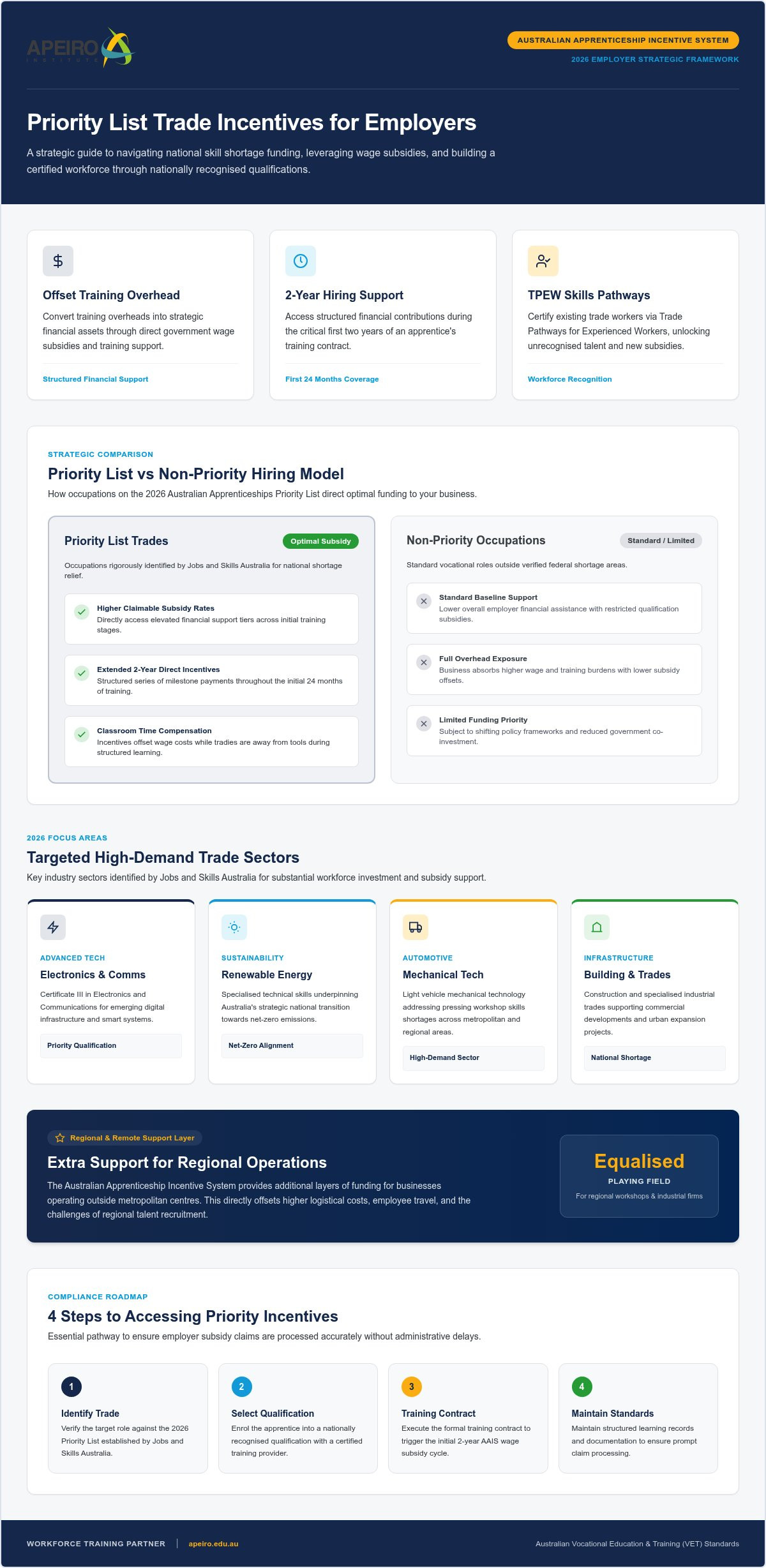
Strategic Workforce Planning: Partnering with Apeiro Institute
Managing the administrative side of apprenticeships can be a full-time job. Apeiro Institute acts as your expert guide, simplifying the entire training and incentive path so you can focus on running your business. We help you navigate the requirements of the 2026 Priority List, ensuring you're positioned to claim every available subsidy. By aligning your workforce development with our industry-focused programs, you turn the complex task of compliance into a strategic advantage. It's about making the system work for you, rather than you working for the system.
One of our core strengths is customising training delivery to suit your specific operational needs. We know that every hour an employee is away from the job site affects your productivity. Our flexible approach ensures that training is practical and relevant, minimising workplace disruption while still meeting all national standards. This balance is essential for businesses looking to grow without sacrificing their current output. We work with you to ensure that the learning process supports, rather than hinders, your daily operations.
Formalising Skills with Trade Pathways
Many Australian businesses have loyal, long-term employees who possess incredible skills but lack formal certification. This is where trade pathways experienced workers Australia can save your business thousands in recruitment and training costs. By leveraging Recognition of Prior Learning (RPL), we can fast-track the certification process by acknowledging the expertise your team already has. This means your staff spend less time in the classroom and more time applying their recognised skills on the job.
Turning these employees into qualified tradespeople doesn't just boost morale; it also unlocks Priority List trade incentives for employers. When an experienced staff member completes a qualification like the Certificate III in Light Vehicle Mechanical Technology through a formal pathway, your business becomes eligible for completion incentives that would otherwise be out of reach. It's a cost-effective way to certify your existing team while securing the financial backing your business deserves. Certifying your current team often provides a much faster return on investment than starting from scratch with a completely green apprentice.
Partnering for Success
At Apeiro Institute, our commitment to industry-aligned training is backed by a national presence. This ensures that whether you have one workshop or multiple sites, your training standards remain consistent and high. We act as more than just a training provider; we're a partner in your long-term success, helping you build a sustainable pipeline of skilled workers. Our expert trainers understand the specific demands of the electronics, automotive, and construction sectors, ensuring the skills taught are exactly what the modern industry requires.
If you're unsure where to start, we can help audit your current workforce to identify hidden incentive opportunities. Mapping your team's current skills against the latest Priority List trade incentives for employers helps you build a more qualified staff that supports your business goals for 2026 and beyond. Taking this proactive step ensures you aren't leaving money on the table. Explore our Trade Pathways for Experienced Workers (TPEW) today to see how we can help you formalise your team's expertise and grow your business.
Secure Your Business Future Through Strategic Training
The shift towards advanced electronics and sustainable infrastructure means the demand for qualified tradespeople has never been higher. By aligning your hiring and training with the 2026 Priority List, you aren't just filling roles; you're building a more resilient, cost-effective workforce. Accessing Priority List trade incentives for employers allows you to offset rising labour costs while ensuring your team holds nationally recognised qualifications. It's about turning your training overheads into a strategic investment for long-term growth.
Whether you're bringing on new apprentices or certifying long-term staff through Trade Pathways for Experienced Workers, the right partnership makes the process seamless. Apeiro Institute (RTO 45394) provides the expert guidance needed to navigate government-funded training and secure your financial subsidies. We're here to help you audit your team's skills and find the most efficient path to certification.
Upskill your team and claim your incentives with Apeiro Institute
Let's build a stronger future for your business together. Our team is ready to support your growth every step of the way.
Frequently Asked Questions
What is the Australian Apprenticeships Priority List for 2026?
The 2026 Priority List is a strategic document that identifies occupations currently facing a significant national skills shortage. It's designed to direct government funding towards trades that are essential for Australia's economic growth and future workforce resilience. By hiring for an occupation on this list, your business becomes eligible for higher subsidy tiers through the Australian Apprenticeship Incentive System (AAIS), helping you manage the costs of training and development more effectively.
How much can an employer claim for a trade on the Priority List?
The exact amount your business can claim depends on several factors, including the specific trade, the length of the training contract, and whether the apprentice is a new or existing worker. Priority trades generally attract higher subsidy rates compared to non-priority roles. Payments are typically released at key milestones, such as at six and twelve months of the apprenticeship, provided all compliance and training requirements are met by the employer and the student.
Can I get incentives for an existing worker who doesn’t have a qualification?
Yes, you can often access Priority List trade incentives for employers when upskilling existing staff through formal pathways. Programs like Trade Pathways for Experienced Workers (TPEW) are specifically designed to help long-term employees formalise their skills. By using Recognition of Prior Learning (RPL) to fast-track their certification, your business can qualify for completion incentives. This is a cost-effective way to certify your team while meeting the national standards required for government-funded projects.
What is the difference between a wage subsidy and a Priority List incentive?
A wage subsidy is a broad form of support that helps businesses cover a portion of an apprentice's pay during their training. In contrast, a Priority List incentive is a specific financial boost targeted at high-demand trades facing critical shortages. While both types of support aim to reduce your training costs, Priority List roles often unlock additional milestone payments that aren't available for occupations with a surplus of qualified workers in the current market.
How often is the trade Priority List updated by the government?
The Australian government typically reviews and updates the Priority List on an annual basis to reflect changing labour market conditions. This ensures that training subsidies are always directed towards the industries that need them most, such as electronics or civil construction. It's important to check the current list before signing a new training contract, as an occupation's status can change based on the data provided by Jobs and Skills Australia each year.
Does my business need to be a certain size to claim trade incentives?
No, trade incentives are available to Australian businesses of all sizes, from small family-run workshops to large national corporations. The eligibility criteria focus more on the validity of the training contract, the safety of the workplace, and the specific trade qualification being undertaken. As long as you meet the standard employer requirements and your apprentice is enrolled in a nationally recognised course, you can apply for the relevant financial support through the official ADMS portal.
What happens to the incentives if an apprentice leaves before finishing?
If an apprentice leaves your business before completing their qualification, any future milestone payments will stop immediately. Generally, you aren't required to pay back incentives that were already received for milestones successfully completed while the apprentice was still employed. However, it's vital to notify your AASN provider and update the Apprenticeships Data Management System (ADMS) as soon as the training contract is cancelled to ensure your business remains compliant with all government regulations.
How do I know if the Certificate III in Electronics is on the 2026 Priority List?
You can verify the status of the UEE30920 Certificate III in Electronics and Communications by checking the official 2026 Priority List published by the Department of Employment and Workplace Relations. This qualification is consistently featured due to the national shortage of technicians. Alternatively, you can contact Apeiro Institute for expert guidance. We can help you understand how Priority List trade incentives for employers apply to this specific trade and assist you with the enrolment process.

Disclaimer
The information provided on this blog is for general informational and educational purposes only. While every effort is made to ensure the accuracy and reliability of the content, the author makes no representations or warranties of any kind, express or implied, about the completeness, accuracy, suitability, or availability of the information contained on this blog.
The views and opinions expressed in blog posts are those of the individual author and do not necessarily reflect the official policy or position of any organization, company, or employer.
This blog may contain links to external websites or third-party content. These links are provided for convenience only, and the author has no control over and assumes no responsibility for the content, privacy policies, or practices of any third-party sites.
Nothing on this blog constitutes professional advice (legal, financial, medical, or otherwise). Readers are encouraged to seek appropriate professional guidance before making any decisions based on the information provided here.
By using this blog, you acknowledge that any reliance on the information is at your own risk.


